


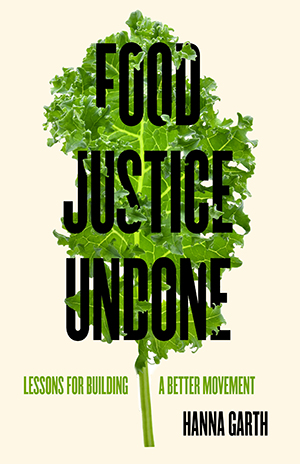
Food Justice Undone: Lessons for Building a Better Movement
Hanna Garth
295 pages, University of California Press, 2026
In the early 2000s, the “food desert” was an issue of rising concern. Areas with limited access to affordable nutritious foods (due to a relative lack of full-service supermarkets) were seen by policy makers and the USDA as a problem to document and resolve. Around the same time, driven by a wave of academic and popular media on the problems with our food system, the food justice movement fomented as a set of activists who came together to try to correct the injustices of our food system. These activists designed projects, programs, and interventions that focused on both increasing access to healthy food in low-income urban areas and teaching residents how to cook and eat healthier meals.
The food justice movement was meant to be an improvement upon food charity, which had been disparaged as both stigmatizing and creating dependency rather than self-sufficiency. The idea behind the food justice movement was to correct the structures and systems of injustice that had created food access inequality in the first place.
As an anthropologist who studies food systems, I spent 12 years researching the food justice movement in South Central Los Angeles. While I initially set out to document a radical movement to reshape our food system, I ended up observing something very different. In Food Justice Undone: Lessons for Building a Better Movement, I show how the power dynamics between well-meaning outsiders and residents of South Central negatively impacted the movement. These power dynamics often resulted in the outsiders’ building programs and interventions based on their own assumptions rather than listening to residents. I observed as food justice activists leaned on quicker techno-solutions that they saw as more feasible, rather than digging into the difficult work of tackling the structures of injustice that the movement set out to address in the first place. In the following excerpt I show how attempts by community members to communicate with activists were thwarted as these activists forged ahead with their own ideas of how to run the food justice movement.—Hanna Garth
* * *
Nine years after first meeting Julian, in March 2017, I attended a gathering of more than two hundred people working in food justice across Los Angeles. They had come together to unpack and examine the state of healthy food access in LA’s so-called food desert communities and to consider ways the food movement could play a role in addressing socio-economic and racial disparities in health and food access. The event took place at a venue off of Central Avenue, just blocks away from Nickerson Gardens, known as the largest public housing project west of the Mississippi. Many food justice activists I had been formally studying or informally observing were there, including Julian, who by 2017 had been doing garden education in area schools for several years. In the crowd I saw Sarah Cunningham and Chase Bledsoe, both working for Produce Power at the time, and Josh Anderson and Matt Smith, who had been involved in several interventions with different organizations, seated together in the back of the room.
I arrived at the gathering just as the opening remarks started, waving from across the room and mouthing “hello” to many people I knew. After the initial welcome, Andrés was introduced as a community member and invited to speak about his role in a local nonprofit doing work that he called “adjacent to food justice” and his history working within the community. To me, Andrés had positioned himself and the organization he worked for as doing food justice work, but not in the same way as many of the people in the room that he critiqued. He articulated his food justice work as part of a bigger and longer tradition of struggle for liberation, which was tied to histories and ideologies different from the food justice movement that had cropped up in the 2000s. Andrés knew he was a part of that new group too, but he wanted to ensure people understood that he was doing something different. He paused and added what seemed to be an off-script point to his remarks:
Today, we’re talking about the food desert and the areas of progress we made…At least from our vantage point—from the vantage of our residents, is that the food desert [label] always seemed kind of confusing and even contested, certainly contested over the last decade. Kind of felt like some white liberal came up with that term while they were making some vegan, organic food and making sure that there were none of our foods present because, for us, it didn’t feel like a desert because a desert is a naturally occurring state and certain animals can actually live and do well in the desert.
As Andrés mentioned the white liberal, vegan, organic food angle, I could not help but look for Sarah Cunningham in the crowd. Having first met her in 2008, I knew she would admit that as a raw vegan, yoga-loving, infusion-drinking, astrology-obsessed white lady, she fit this stereotype. She and I were part of several overlapping social circles, some linked to the area universities we were affiliated with and other social circles that had grown organically. We were both part of a radical queer house party circuit with a multiracial group of queer and gender-nonconforming folks working to disrupt the norms of dominant hetero-patriarchal society in ways big and small. For a few years we regularly met up for morning walks at the Silver Lake Reservoir and chatted about life and her food justice work. I knew from our conversations that Sarah understood herself as ideologically aligned with Andrés’s visions of liberation. She winced and shifted uncomfortably in her seat, but she held her gaze, intently listening to what Andrés had to say. I imagined that it hurt a little to hear this stereotype, but that this was a critical moment for Sarah to work on herself. Andrés continued:
But for us, it was never really about a desert. We use the term “food apartheid” because we felt that the allocation of food, and healthy food, was a system by design that creates unequal access for communities that are flooded with death-selling businesses—alcohol outlets and fast food restaurants—while grocery stores and farmers markets and healthy restaurants are abandoned in other parts of the city. We know that West LA has three times as many Ralphs [grocery stores] as South LA, even though West LA has fewer people.
Andrés underscored the importance of understanding food apartheid in context, mentioning some of the work his organization has focused on. Given that “our residents live next to underresourced schools, oil drilling sites, liquor stores, fast food restaurants, there’s no surprise that we have the lowest life expectancy in the city,” he said, emphasizing that “this is a result of historic and deliberate neglect, abuse and outright oppressive conditions in African American and Latino communities. So that’s why we call it apartheid.”
While the food desert concept was the most common way to understand the problem at the outset of my research, over the course of twelve years the term “food apartheid” became a counternarrative to characterize food retail inequality in settings across the United States. Describing an essentially separate and unequal system of food distribution, with similar logic to Andrés, New York State–based activists Karen Washington and Leah Penniman, founders of Black Urban Growers (BUGs) and Soulfire Farm, respectively, have argued that “food apartheid” more accurately describes the intentional and systematic forms of racism and economic discrimination that have created the inequitable food system. If a “food desert” is a landscape feature based on a moralized misunderstanding of ecology, “food apartheid” is a politically maintained state of affairs involving a politics of active neglect.
There was quiet laughter in the room when Andrés mentioned white liberals and vegan organic food. He was tapping into the genuine California wellness and health culture that moralized particular ways of eating and specific body types. He was poking fun at it, but this was also a real problem for the food justice movement, because it pulled focus toward these trends and away from the needs of the community.
A few people applauded when Andrés mentioned food apartheid. Many people in the audience seemed to nod their heads in agreement. Others just stared blankly forward. His comments were impactful to me, in part because since I started doing this work in 2008, I had not heard many people explicitly lay out the connections between historical and ongoing racial oppression and the food access inequality in South LA.
During a break I found Julian in the crowd. After catching up about his nonprofit organization’s work in local schools, I asked what he thought of the comments. “It’s interesting,” he said, “something I hadn’t really thought about. It’ll be good to keep in mind.” And he turned toward a table of snacks. I was puzzled by Julian’s response. I had always seen him as a food justice activist who really wanted to know what the community thought and needed, but he did not seem to digest what I understood Andrés to be saying, brushing off his remarks. While there could have been many reasons for Julian’s flippant response, at that moment I realized that many activists I had been studying had similarly disinterested responses to the links between racism and food access inequality. They seemed to rarely ask questions about the community, what residents needed or wanted, nor did they dwell on the many other problems that residents were dealing with, as Andrés had laid out.
While I pondered this disinterest in residents’ perspectives, two women introduced themselves to me and initiated a conversation. Raimi and Hazel had recently completed master’s degrees in architecture and urban planning, respectively, and both worked for local design firms interested in “breaking into” food justicee work. Both women aspired to get advanced degrees after working for a while. Hazel, who presented as white and had a British accent, introduced herself first, asking me if I was from South LA. After I replied with a simple “no,” Raimi, who presented as Black, stepped in, adding that she was from the East Coast and had gone to Ivy League schools for her undergraduate and graduate degrees. She told me that she and Hazel were working on a new food justice app. When I asked Raimi what it would do, she said, “We want to have an app that will help people find grocery stores or other places that sell food in South LA.”
An older woman with graying hair who appeared to be Black overheard Raimi and asked the three of us, “Who would that be for? Everyone who lives here knows where we can get food.” Raimi and Hazel did not respond. Filling the silence, Julian joined the conversation, offering an excited response, asking if Raimi and Hazel would be interested in collaborating as tech experts or designers for his school-to-community garden program. I viewed Julian as trying to interrupt an awkward moment and help the two young women save face. As I listened to their three-way conversation, I drifted off, my thoughts fixated on the casual comment of the older woman. She had indicated that she was a resident and would not find their intervention useful. I was really puzzled by the way Raimi, Hazel, and Julian did not seem to register the significance of her interjection, quickly pivoting out of an uncomfortable critique by praising one another and deepening their focus on quick-fix, technological interventions.
As I drove home, taking Central Ave. to the freeway, I thought about how people like Raimi, Hazel, and Julian had been able to design and implement so many interventions in South LA. At the same time, residents and community leaders like Andrés and the older woman from the community were cast aside by Raimi, Hazel, and Julian. I questioned why the movement highlighted and supported particular kinds of food justice projects in South LA while others were overlooked. I had heard from residents and food justice activists alike that early on residents had complained that there were not enough grocery stores for the population in the area and that the stores in the area were considerably older than those in other parts of the city. They questioned the quality of fresh meat and produce in the older stores, which tended to have older refrigeration units and slower turnover of meat, dairy, and produce. Given these specific and very real complaints, I wondered how we got to gardens planted by outsiders, cooking demonstrations in K–12 classrooms, and introducing fresh fruit and vegetables at local corner and liquor stores as the primary models for increasing access to fresh food in South LA.
I wanted to understand how particular narratives around food and justice shaped different types of actors and organizations, how they shaped the food justice movement as well as those whom they wanted to intervene upon in specific ways. Throughout this book I analyze systems of meaning, shifting and contested spheres of knowledge, claims of expertise, and ultimately who can intervene and to what ends. On one level this book is about food and food justice; it is also about the broader stakes of social justice and the possibility of multiracial coalitions that work toward better futures. I spent a lot of time with organizations and activists like Julian, who believe that it is essential to “give back” to the community and strive toward improving the systems and structures that are in place. These activists see the benefits of our society in their own lives and believe that others too can share in those benefits. They work toward this either through individual action or collective organizing. I also worked with individuals like Andrés, who believe that our status quo systems and institutions are the root problem. In an ideal world they would abolish those systems and build new ones that serve the communities they care about. However, many in this group see the impossibility of metaphorically burning it all down. Instead, they work to reform the status quo while still holding a practice of envisioning radically different future possibilities.
My anthropological training cued me to the importance of using ethnographic methods to understand the role of organizations and institutions in shaping various elements of society. This project could respond to anthropologists James Ferguson and Akhil Gupta’s call for more “empirical work on what these organizations are really doing, and how they create both new dangers and new possibilities for political practice.” Once I tuned in to the research in that way, I started to see patterns across the different ways of thinking that create distinct groups of food justice actors. For instance, the first group tended toward organizations that had only been involved in food justice work since it exploded in popularity in the mid-2000s, often working on quick, tangible solutions to immediate problems. The other group tended to look toward a much longer, centuries-long timeline that works toward justice and liberation while simultaneously attending to the needs of the community.