


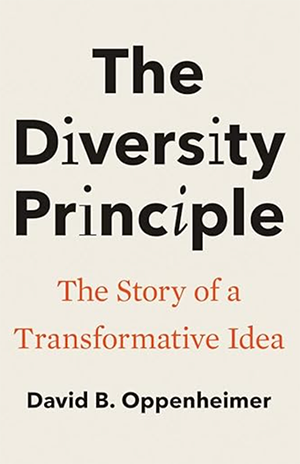
The Diversity Principle: The Story of a Transformative Idea
David B. Oppenheimer
416 pages, Yale University Press, 2026
On the last day of October 2022, as the Supreme Court heard challenges to the admissions policies at Harvard and the University of North Carolina, Justice Clarence Thomas said he was “flummoxed” by the very idea of diversity. “I don’t have a clue what it means,” he declared.
Thomas was not making an empirical claim so much as a philosophical one: in his view, diversity is an amorphous, intellectually hollow concept, little more than an aesthetic preference of elite institutions to have a few dark faces in the room with their white students. Those who insist that learning in diverse environments makes education richer are, in his telling, fooling themselves.
When the Court ruled the following June, banning race-conscious admissions in higher education, most commentary focused on the immediate fallout: who gets into elite universities now, and what it would mean for applicants of color. But the deeper implication went largely unexamined. The Court had not simply altered the mechanics of college admissions. It had rejected a centuries-old idea: that bringing together people with different backgrounds, experiences, and viewpoints improves learning, decision-making, science, business, and ultimately democracy itself.
That idea, the diversity principle, is often assumed to be an invention of the 1970s, born of affirmative action and campus activism. But the principle is much older, and far more profound. Its roots stretch across continents and centuries, linking Prussian educational reformers, Victorian philosophers, Harvard administrators, civil rights lawyers, anti-apartheid leaders, and modern psychologists. Far from a trend or a slogan, the diversity principle is one of the most durable ideas in the history of modern thought.
Its story begins in 19th-century Prussia with an unlikely figure: Wilhelm von Humboldt, linguist, diplomat, and architect of the modern university.
The Prussian Reform That Changed the World
Before Humboldt, European universities were lecture mills: professors talked; students memorized. Research and teaching were strictly separate. Humboldt imagined something radically different—a university where faculty and students learned together through inquiry, experimentation, and debate. Knowledge would be created collaboratively, not simply transmitted.
To make this possible, Humboldt insisted on bringing together people with different experiences and viewpoints. He called this a Mannigfaltigkeit der Situationen—“a variety of situations.” He opened the new University of Berlin not only to Protestants but to Catholics and Jews, outsiders in early-19th-century Prussia. The university flourished, and the Humboldtian model spread across Europe, to the United States, and eventually to much of the academic world.
Humboldt’s thinking was shaped in part by his wife, Caroline von Humboldt, a dazzling intellectual who hosted salons in Berlin, Paris, Rome, and Vienna. Revered in her time but now largely forgotten, she pressed her husband to see the value of outsider perspectives and lived out those convictions in a marriage that embraced personal openness and defied gender norms. Her influence, though often invisible in official histories, helped embed diversity into the DNA of the modern university.
How the Mills Reframed Liberty
Humboldt deeply influenced the British philosopher John Stuart Mill and his intellectual partner (and later wife) Harriet Taylor Mill, whose collaborations produced some of the most important works of the 19th century. On Liberty begins with Humboldt; the rest of the book can be read as an expansion of his argument.
For the Mills, diversity was not merely an educational preference. It was a precondition for freedom itself. A society could not be free unless it protected the right for its members to encounter a wide range of perspectives. They rejected the notion that professors could challenge students simply by simulating opposing views. Only exposure to people who actually believe in different ideas, they argued, could truly test one’s own thinking. And belief, they wrote, was the result of experience, which in turn was linked to diversity of religion and nationality.
Their activism reflected these convictions. Shut out of Oxford and Cambridge because they were Unitarians, and thus unwilling to conform to the Anglican oaths (and for Harriet because of her sex) they supported opening the universities to Catholics, Jews, and other nonconformists. They championed women’s rights, the abolition of slavery, universal suffrage, and minority political representation. In their minds, diversity was a prerequisite to liberty, and liberty a prerequisite to democracy.
Charles Eliot and the Americanization of the Idea
The diversity principle crossed the Atlantic through Charles Eliot, a young chemistry professor who became Harvard’s president in 1869. Inspired by German universities, he argued that American higher education needed a similar transformation.
At Harvard, Eliot put the principle into practice. He opened the university to women (through the creation of Radcliffe), to Catholics and Jews, to immigrants, and to Black students. He imagined a student body and a faculty whose differences would fuel scholarly exchange through the “clash of ideas.” By the early 20th century, when Eliot stepped down after forty years at the helm, Harvard was known for its intellectual heterogeneity. One contemporary contrasted it with Princeton: “The aim of Princeton is homogeneity. Harvard’s ideal is diversity.”
As he was stepping down from his presidency, Eliot wrote, “Can you imagine a greater diversity of human capacity, disposition, taste, and personal ambition than exists in Harvard College? I cannot. The diversity is wide; and it is not superficial, but deep. Think of the variety of races brought together in Harvard College; of the variety of religions represented here; and of the variety of households, every kind of household from the poorest to the most luxurious, with every sort between.”
Holmes, Frankfurter, and the Marketplace of Ideas
Eliot’s reforms created unexpected consequences. The elderly Justice Oliver Wendell Holmes Jr. befriended two young Jewish instructors at Harvard Law, Felix Frankfurter and Harold Laski. Their exchanges—across differences of age, class, religion, and politics—helped shape Holmes’s landmark First Amendment jurisprudence, the beginning of the “marketplace of ideas” doctrine that still defines free speech law today.
A generation later, Frankfurter, now himself a Supreme Court Justice, expanded those principles to include academic freedom, arguing that universities must be allowed to select diverse student bodies if they were to fulfill their educational mission. His thinking would shape the legal battles to come.
Diversity in the Civil Rights Era
As the Civil Rights Movement gained momentum, diversity began to surface in legal arguments against segregation. Thurgood Marshall, Pauli Murray, and Erwin Griswold claimed that segregation harmed Black students not only by giving them inferior resources but by denying them the chance to learn alongside white students.
Murray—a queer Black lawyer who battled exclusion at the University of North Carolina, Howard, Harvard, and the National Organization of Women, which she co-founded before resigning because of its exclusion of poor women and women of color, had a singular understanding of how identity shapes viewpoint. Her work helped lay the intellectual groundwork first for the Supreme Court’s desegregation decisions and then for its gender-equality cases.
Meanwhile, in apartheid South Africa, Chief Justice Albert van der Sandt Centlivres and the University of Cape Town argued that universities must be free to pursue racial diversity as part of their academic freedom. Frankfurter quoted Centlivres in a key First Amendment case, helping solidify the link between diversity and academic freedom in American law, quoting the South African’s argument that it is “the business of a university to provide that atmosphere which is most conducive to speculation, experiment and creation. It is an atmosphere in which there prevail 'the four essential freedoms' of a university—to determine for itself on academic grounds who may teach, what may be taught, how it shall be taught, and who may be admitted to study’.”
Archibald Cox and the Birth of Modern Affirmative Action Theory
The modern legal argument for diversity as a justification for affirmative action came before the Supreme Court from Frankfurter protégé Archibald Cox, the Watergate special prosecutor famously ordered fired by Richard Nixon. In 1973, when Cox returned to Harvard following the “Saturday Night Massacre,” President Derek Bok asked him to write an amicus brief defending race-conscious admissions at the University of Washington.
Drawing on Humboldt, the Mills, Eliot, Marshall, Murray, and Griswold, and citing Centlivres and Frankfurter, Cox argued that under the First Amendment universities are entitled to assemble diverse student bodies because diversity enhances learning. He offered a vivid example: a farm boy from Idaho brings something a Bostonian cannot; a Black student brings something a white student cannot. The Supreme Court dismissed that case on procedural grounds. But Justice Lewis Powell took notice.
When the Court considered affirmative action again four years later in Regents of the University of California v. Bakke (1978), Powell adopted Cox’s reasoning almost wholesale, even appending a thousand-word excerpt describing Harvard’s admissions plan that had been cut and pasted from Cox’s 1974 brief. Colleges could not use quotas, he ruled, but they could consider race as one factor among many to achieve the educational benefits of diversity. Powell considered Bakke the most important opinion of his career. It would shape American higher education for the next four decades.
Science Catches Up
In the 1980s, scientists began empirically testing the claims embedded in the diversity principle. The results largely confirmed what Humboldt, the Mills, Eliot, Marshall, and Cox had argued: diverse groups generate more knowledge; diverse teams are more creative; diverse companies are more successful. The emerging field of “diversity science,” advanced by scholars like Victoria Plaut and the late Katherine Phillips, supplied evidence that diversity, in Phillips’ words, “makes us smarter.”
At the same time, corporations embraced what became known as “the business case for diversity.” By 2000, major US companies began describing diversity not as social responsibility but as strategy—a competitive advantage in an interconnected world. In 2003, when the Supreme Court upheld the University of Michigan Law School’s diversity-based admissions policy, Justice Sandra Day O’Connor cited briefs from corporations and retired military leaders insisting that diversity was essential to their success.
Why Diversity’s Critics Are Wrong About What Diversity Is
The modern attack on diversity rests on a misunderstanding: that diversity means treating people as interchangeable representatives of their racial or gender group. Critics ask, reasonably, don’t individuals within racial groups hold a wide range of views? Isn’t assuming otherwise offensive?
The answer is that diversity has never meant assuming uniformity within groups. It means recognizing that people’s experiences shape their perspectives—and that when institutions exclude certain identities, they exclude certain perspectives. Humboldt understood this when he opened the University of Berlin to religious minorities. The Mills understood it when they argued that an Oxbridge education could not be complete without including Catholics, Jews, and women. Marshall and Murray understood it when they argued that Black students could not receive an equal education in segregated schools.
The Backlash Arrives
All of which makes the Court’s 2023 rejection of diversity in admissions feel like the undoing of a much larger intellectual tradition. The new conservative majority cast diversity as vague and suspect, and any race-conscious policy as racist in itself. And the ruling has emboldened opponents of diversity far beyond higher education.
Even before President Trump’s second term, corporate DEI programs came under attack. Efforts to diversify boards and leadership were portrayed as reckless. Public universities in several states banned discussion of racism. Now, with the president’s Executive Orders attempting to ban all DEI efforts and make the word “diversity” a synonym for “racism,” our country is undergoing a dramatic reversal.
Diversity advocates will pay a price, as they have before. Humboldt was driven from public life because of his strong opposition to antisemitism. Mill was turned out of office because of his opposition to racism. Centlivres lost his judicial position for opposing apartheid. Murray was excluded from myriad white and/or male institutions.
Why the History Matters Now
The diversity principle is not an empty slogan. It is an intellectual tradition that has shaped the modern research university and modern liberal democracy itself. We ignore that history at our peril.
It is easy to lose sight of what is being dismantled: not just policies, but an idea forged across two centuries on three continents—an idea that fueled educational reform, expanded civil rights, enriched science, supported democratic discourse, and helped universities and businesses thrive.
Without diversity, we lose the very conditions that make discovery, innovation, and democratic deliberation possible. We lose the “differently colored glasses” that, as John Stuart Mill wrote, help us see the world more clearly. We lose ideas we never hear, contributions we never receive, truths we never discover.
The diversity principle has survived wars, revolutions, dictatorships, apartheid, and political backlash. It has thrived because of its fundamental truth. Before we abandon it, we should remember where it came from—and how much we stand to lose without it.
This article has been adapted from The Diversity Principle: The Story of a Transformative Idea by David B. Oppenheimer, new from Yale University Press. Copyright © 2026 by David B. Oppenheimer. Reprinted by permission. All rights reserved.