


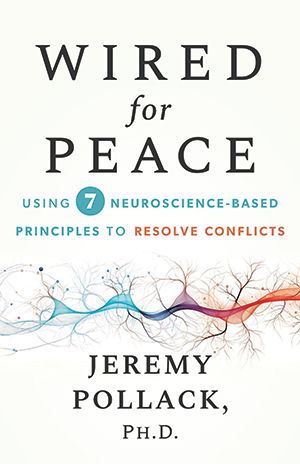
Wired for Peace: Using 7 Neuroscience-Based Principles to Resolve Conflicts
Jeremy Pollack
256 pages, Wiley, 2026
For practitioners working at the intersection of social change, governance, philanthropy, and organizational leadership, one of the most persistent challenges is not a lack of shared purpose, but the breakdown of collaboration under pressure. Even in mission-driven environments—where values alignment is often assumed—teams, boards, funders, and partners regularly find themselves pulled into cycles of misunderstanding, defensive communication, and stalled decision-making. These breakdowns are often treated as interpersonal failures or strategic misalignments. But a deeper question sits underneath them: What does it actually mean to be built for collaboration, and why do we so often struggle to access it when it matters most?
This question is especially urgent in a period marked by increasing polarization, rapid institutional change, and growing demands for cross-sector coordination. The success of contemporary social innovation rarely depends on isolated expertise. Instead, it depends on the ability of diverse actors—often with different incentives, time horizons, and constraints—to remain engaged in shared problem-solving even when tensions arise. In this context, conflict is not an exception to collaboration; it is one of its most frequent tests.
This excerpt draws on insights from evolutionary biology, neuroscience, and conflict resolution practice to examine a foundational claim: Humans are ultrasocial beings whose default operating system is cooperation and collaboration. While conflict can feel dominant in moments of stress, it is not the primary mode through which human systems function. Rather, it is a triggered state that often obscures underlying shared goals and interdependence.
Understanding this distinction has practical implications. It reframes conflict not as a breakdown of alignment, but as a temporary disruption in systems designed for coordination. It also suggests that effective collaboration is not simply a matter of better communication techniques, but of restoring conditions—such as trust, agency, humility, and shared goals—that allow people to return to their natural capacity for cooperative problem-solving.
For leaders and practitioners in the social sector, this framing offers both a diagnostic lens and a set of design principles for building more resilient forms of collaboration under pressure.—Dr. Jeremy Pollack
* * *
Human beings are what anthropologists and evolutionary biologists call ultrasocial. This term describes species that go beyond basic group living to exhibit complex, large-scale cooperation, often involving divisions of labor, collective defense, shared child-rearing, and sometimes even self-sacrifice for the group. Only a handful of other species can claim such a status, and they are all insects. Bees, ants, wasps, and termites are also considered ultrasocial.
In any case, we humans are unlike any other ultrasocial species; since we don’t all consider ourselves to be part of the same “family” or superorganism, we are not born with innate, unchangeable social roles; and we, of course, are self-aware. Therefore, we can deliberately choose to behave in a variety of ways rather than simply behaving or reacting instinctually as do the other ultrasocial species.
How do we choose to behave most of the time? Cooperatively. Sociopaths and psychopaths aside, the vast majority of human beings on the planet desire and attempt to live peaceful lives. When we find ourselves in escalated conflict, we’re behaving via unconscious autonomic processes that are designed for protection and survival. Indeed, the majority of our interactions are spent in cooperation and collaboration, not in conflict.
We’re so cooperative, in fact, that we’re actually quite weird among the animal kingdom. No other vertebrate can pass by or stand next to strangers and simply ignore them. That would typically lead to hasty avoidance or violent conflict among animals. But most of us humans do this peacefully, and every time we do, that’s all of us cooperating. Of course, this ability is supported not just by our biology but also by cultural norms, institutions, and systems of enforcement that make such peaceful coexistence possible. But our natural state is cooperative.
Cooperation is a natural part of our evolved human brains, and just like every other animate species, social or nonsocial, we have conflicts. The fact that we expose ourselves to so many social interactions every day, and only few of them result in escalated or emotionally heated conflict, supports the notion that we are more prone to cooperation and collaboration than we are to conflict.
The terms cooperation and collaboration are often used interchangeably, but they are not quite the same. Cooperation is when people work alongside one another toward a shared objective, typically dividing tasks and minimizing conflict. Collaboration, however, is deeper and more integrative: it involves merging ideas and cocreating something new that none of the individuals could have produced alone. While cooperation allows us to coexist, collaboration enables us to build and transform. In the context of conflict resolution, the goal is rarely just cooperation. It’s genuine collaboration, where renewed relationships are created and innovative, win-win solutions can emerge.
Melanie was the visionary CEO of a small but growing software company, which she founded with her husband, Mark, the chief operating officer. They also had a major investor, Daniel, who was positioned as chairman of the board. Melanie’s style was soft and meticulous; she took her time to think things through and was not always adept at making clear, efficient decisions. Daniel was the opposite. He was fast-talking, decisive, and gave and expected answers quickly.
When I was brought in to mediate an increasingly tense situation, Daniel and Melanie were no longer directly communicating. They each triggered one another’s stress responses too intensely. When Melanie was slow to respond or not give clear, direct answers to his questions, Daniel felt she was ignoring and disrespecting him. And when Daniel spoke loudly or quickly, demanding answers and decisions before she was ready to make them, Melanie felt he was trying to intimidate and manipulate her.
Now, since they were no longer able to directly communicate, they made Mark the go-between. This was incredibly frustrating and exhausting for Mark; and it put additional stress on Mark and Melanie’s marriage, which was already under the pressure of running a business together. Mark was ready to quit. Daniel was about ready to leave the board and withdraw his funding. And Melanie was ready to start something new without either of them. Bringing me in was a last-ditch effort at holding the ship together.
The good news was that each of them highly valued one another. Melanie and Mark greatly respected Daniel for his business acumen and felt it would be incredibly difficult to grow the business without his guidance. Daniel and Melanie felt they needed Mark to keep the company steady and operationally on track. And everyone knew that Melanie was the visionary; without her, there was no company.
Here’s the thing: when people get lost in the stress of ongoing conflict, they lose sight of what they’re trying to build together. Work relationships and marriages are all about creating something mutually beneficial and doing so interdependently. The most fulfilling business and personal partnerships keep their eye on the North Star—the vision, goal, life, culture, family, community, and/or value they are building together. Heightened sympathetic nervous systems, hypervigilant thoughts, and defensive behaviors only muddle the vision.
So, I saw it as my job to help Melanie, Mark, and Daniel clear away the mud and refocus on their North Star.
Meeting privately with each, I asked a series of simple questions:
“What are you trying to build together?”
“What do you each get from achieving this goal?”
“How do you see the others contributing to the vision?”
“If you’re being honest, how are you currently making it more difficult for the others to do their part?”
“What could you do to make it easier?”
This inquiry took almost an hour with each person, but we came to some important conclusions. First, I wanted to make sure they were all aligned on the North Star. Did they all share the same mutually beneficial goals? Were they all clear on the vision? Once we established that, we could clarify what each of them needed from one another to successfully build the company together.
Some important events happened when we finally got Daniel and Melanie together for a meeting. First, we took time to establish mutual care and appreciation. Then, they made space to listen to one another, without Daniel rushing or speaking loudly and without Melanie disengaging or withdrawing. They made room for mutual input on their goals and needs, which is crucial in collaborative solution building. Finally, they recognized and re-energized their focus on the shared goal—the North Star.
The three of us met several more times. During our meetings, Melanie and Daniel practiced self-regulation around one another, reestablished a foundation of mutual care and trust, refocused on how they needed each other to build the company and reach their common goals, and collaborated on devising actionable steps each of them could take toward those goals.
After several meetings, it became clear to all that it was time to stop making all of this so hard. They just wanted their relationships and their co-endeavors to be easier. Cooperation, co-regulation, and collaboration are much easier on the body, mind, and relationships. And of course, they are better for the culture and the work product.
So, we had to continuously ask these questions: What are we trying to build together? How are we making it harder to do so? How can we make it easier? What’s more important: proving the other person wrong or creating something meaningful together?
Conflict often feels natural because it captures our attention so intensely. But from both neurobiological and psychological perspectives, our brains and nervous systems appear to have evolved precisely for cooperation as an operating system that has enabled us to survive and thrive over evolutionary history.
Our nervous systems are inherently prosocial, meaning we are attracted to and attempt to foster cooperation and collaboration far more than conflict. Research on the social brain suggests the human neocortex grew disproportionately large in order to manage the complex relationships of group living. Successful collaboration requires us to understand what others are thinking and feeling, anticipate their reactions, and coordinate our behavior accordingly.
Inside that big brain, we also find circuitry designed for connection. Mirror neurons enable us to simulate the actions and emotions of others. This system helps us resonate with teammates and group members. We can essentially feel their frustration, excitement, or determination, which keeps us in sync.
Our neurochemistry also indicates that brains reward collaboration, not conflict. Positive social interactions can lower threat responses and activate reward centers associated with trust, bonding, and motivation. Collaboration reduces stress while boosting pleasure, trust, and social connection, creating a sense of safety that strengthens relationships and teamwork.
Understanding that our nervous systems are built for collaboration also helps explain why conflict feels so disruptive. When cooperation breaks down, our brains interpret it as a survival threat. Disagreements, exclusion, rejection, or betrayal can activate the same circuitry involved in physical danger, pulling us into defensive states of fight, flight, or shutdown.
In other words, we are already wired for peace. Peace feels calming, rewarding, and stimulating. We are only wired for conflict in that we have neural mechanisms available for defending against threats. When threats are perceived to be absent, our natural state is cooperative and our thriving state is collaborative.
Some people appear to thrive on or seek out conflict. But conflict-prone personalities are not natural; they are learned through conditioning. No nervous system comes into the world seeking tension and stress. On the contrary, our nervous systems are naturally seeking regulation and homeostasis.
If conflict served important needs during someone’s youth or young adulthood, such as leading to successful outcomes, then such behavior may become reinforced as a way to self-protect and satisfy basic needs. Others become conditioned to be hypervigilant, perceiving threats everywhere and regularly, leading to habitual self-preservation behavior and communication.
Whether a conflict-prone person seems to enjoy conflict or not, if that individual were interested in living a more harmonious life with a calmer nervous system and more stable relationships, they would have to recondition their system and return to a more natural, collaborative state.
If you’re reading this material, ideally you are motivated to live a more peaceful, collaborative life. Implementing collaboration during conflict resolution doesn’t just help resolve the problem; it regulates the nervous system and establishes a new interpersonal connection. Acts of listening, validating, and cocreating calm defensive circuits, release bonding chemicals, and rebuild trust networks. In this way, conflict resolution is less about winning arguments and more about returning people to their natural state: connected and collaborative.
The critical, primary element of collaboration during conflict resolution is to give each participant a seat at the table and a voice in the process. So often during conflict, people do not feel listened to or understood. Each person involved in building solutions should be able to play a role and contribute to both the ultimate goal and the proposed actions to reach it.
Creating buy-in also requires agency. When people feel they have a hand in building solutions, or at least a chance to voice concerns and get them addressed, they are far more likely to believe in and adhere to the solutions agreed to.
Humility is another powerful component of collaboration. Humility counteracts defensiveness and the desire to be right, and opens us to learning from and building on the ideas of others, even when we don’t totally agree. Research indicates that intellectual humility is highly correlated with open-mindedness and willingness to collaborate. In fact, it’s hard to imagine a successful collaboration without some level of humility at play.
Another critical element of collaboration during conflict resolution is a focus on shared goals. Before parties in conflict negotiate potential solutions, it’s important they clarify what each person’s goals are and find a way to align them.
Sometimes it’s obvious that all parties share the same goals but have different methods of reaching them or communication-style tensions along the way. In those cases, helping people refocus on their North Stars can help cut away the noise of conflict. Beneath the stories about who did what wrong, shared goals can reunite people toward a common vision.
In other cases, common goals are not as clear. When this is the case, the parties have to dig beneath surface-level positions to find alignment on underlying needs, goals, and values. If one party says “Fewer guns” and another says “More guns,” the deeper inquiry becomes: “What do fewer guns or more guns get you?” Under the surface, we often arrive at the same need—in this case, safety. The parties simply hold opposing views on how to achieve it.
In any conflict, the most important goal is solving the conflict itself. The problem is not a person but rather a third thing to solve together. If we can agree on viewing the problem as something separate from the parties involved, then we can tackle it together as a team.
The focus on a shared goal motivates the collaborative endeavor: to work together to create new, innovative ways of solving collective problems and satisfying everyone’s underlying needs. Your problems become my problems; your goals become my goals; your needs are the same as my needs. We’re in this together. This is the spirit of collaboration.
We can strengthen the power of shared goals by recognizing our interdependence relative to those goals. In order to realize the vision we’re building, we each have a role, and we won’t get there without everyone doing their part. Clearly identifying shared goals and determining how those goals require all of us to contribute should motivate each party to make it easier for the others to do their part.
Want to find effective solutions to a conflict? Give everyone a voice, remain humble throughout, establish shared goals, and focus on how we need each other to achieve those goals. While communicating care and establishing trust set the foundation for successful peace processes, sustainable and transformative solutions are built by humans collaborating in spirit, in thought, and in action.
Everything humans do and have ever done that is worthy of awe has been a result of collaboration. In fact, we are collaborating all the time without even realizing it. The accumulation of human knowledge is essentially a collaboration—humans learning from and building on the ideas of each other both contemporarily and across generations.
We were, indeed, built for this.