


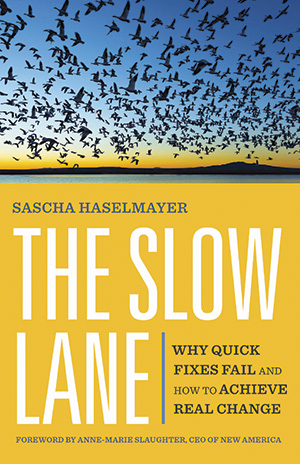
The Slow Lane: Why Quick Fixes Fail and How to Achieve Real Change
Sascha Haselmayer
240 pages, Berrett-Koehler Publishers, 2023
Societal challenges, from deadly viruses to homelessness to raging wildfires, have reached a new urgency worldwide. Time is of the essence, and it is therefore easy, human, and natural to think, We need to act, fast!
Well, not so fast, suggests social entrepreneur and Ashoka fellow Sascha Haselmayer in his new book, The Slow Lane: Why Quick Fixes Fail and How to Achieve Real Change. His decades of experience in bringing about transformative, lasting change to city governance in more than 150 cities worldwide led him to a critical realization: Social change takes a long time.
In The Slow Lane, Haselmayer guides the reader on a meditation about what it takes to achieve and sustain social change and address systemic issues like racism and climate change. The popular approach to problem-solving, he explains, has been dominated by a mentality of “dealing with change by finding shortcuts.” Haselmayer calls this approach “the fast lane,” which is epitomized by the “move fast and break things” mantra of Silicon Valley that has since been adopted across industries. In the start-up world, Haselmayer observes, the playbook is unambiguous: Investors celebrate short-term, “one size fits all” solutions that are easily scalable for profit.
Instead, Haselmayer proposes the slow-lane approach of listening, extending trust, developing relationships, and shifting power dynamics to solve systemic problems. Slowing down, he acknowledges, runs counter to “a world that celebrates only quick fixes [that] often end up doing a lot more harm than good.” Unlike the quick-fix mindset of people in the fast lane, people in the slow lane, Haselmayer says, “create solutions that don’t simply patch over a problem but take aim at the injustices and broken systems that keep producing failure in the first place.”
In the past couple of decades, we have witnessed slowness informing a variety of movements such as slow food, slow fashion, and slow living—all of which aim to reconnect people with cultures, traditions, and more local modes of exchange. Based on his research of more than 100 slow-lane movements, Haselmayer identifies five principles of the slow-lane approach: hold the urgency, or have patience for the time necessary to solve for complex issues; listen broadly, or listen deeply, with intention, and without preconception or judgment; share the agency, by empowering and giving space to marginalized people to contribute their ideas; nurture curiosity to unlearn dominant patterns of thinking so that new and creative ideas have the space to emerge; and embrace technology as an enabler of growth-mindset values and behaviors rather than as a tool to dominate and silence others. According to Haselmayer, these principles can be practiced universally; there is space for everyone in the slow lane.
Haselmayer illustrates these principles with vibrant examples of slow-lane successes, from a citizen assembly that changed the abortion law in Ireland to a notoriously violent prison in London that became peaceful once the prison management enabled the prisoners to participate in problem-solving. The book’s most powerful example of slow change is the four-decade transformation of Catuche—the formally declared “illegal” slum in Caracas, Venezuela—into a community of peace and prosperity. Fifty years ago, a few families started the informal settlement that became Catuche. However, the government never recognized its existence or the citizenship of its residents. “Eleven thousand people with all their lives and shelter were simply invisible to the bureaucrats,” Haselmayer explains. “The government had for generations systematically not issued birth certificates to poor people in informal settlements. Without citizenship, they were deprived of voting rights, rights to health care, education, and basic municipal services.”
In the 1990s, Yuraima Martín Rodríguez, a young professor of architecture, partnered with several academics, her father (an architect), and other activists to assist the development of the slum in a more dignified way. Her team determined that the residents of Catuche were the most knowledgeable about their needs and that they should be involved in the effort to solve the problems—from unsanitary water to gang violence—that plagued the slum. From mothers to gang members, all were given the opportunity to share their vision of a better and more just life. Rodríguez and her team also made it a point to talk with residents in places where they felt safe; they held conversations at residents’ doorsteps rather than forcing them to attend formal meetings in remote offices. “Catuche was not a community advised by expert consultants but a community that was actively winning its right to self-determination,” Haselmayer reflects.
The example of Catuche illustrates four slow-lane principles: Rodríguez and other changemakers held the urgency by not jumping to the most obvious, easiest, or cheapest solution. They listened deeply to citizens who had been ignored and discriminated against for decades by the government and valued their input; they shared decision-making power with them; and they remained curious and humble throughout the process. These collective efforts translated into breaking the longstanding cycle of poverty and violence and, perhaps the most challenging of all, reinstating civic hope where it was all but lost. Through Catuche, Haselmayer demonstrates that sustained holistic solutions require inclusion and participation of those concerned in thinking creatively, reframing the issue, ensuring connection to the actual needs, and experimenting with new solutions.
While The Slow Lane takes inspiration from existing approaches to social change, such as systems change and empathy-driven design, its most defining feature is its emphasis on the undeniable and consequential role that people’s humanity plays. Haselmayer argues that we must invest in our human relationships—only by becoming vulnerable and open to human connection will we be able to pause, listen, and share the power to act and effect meaningful change.
Haselmayer contends that undertaking such arduous work demands a commitment to joy—not profit. A commitment to profit, which materializes in quick, short-term fixes that can be iterated upon to further increase profit, fails to prioritize the interests of those who need help the most. He advises readers to “use joy as your north star,” because joy propels us “through the inevitable setbacks until we reach the other side.” Social transformation takes time, and joy fuels the patience and perseverance required to realize lasting change. Haselmayer’s argument for joy resonates with those of Eastern and specifically Buddhist philosophies that claim joy is the force that can unify diverse peoples and religions. As Nobel Peace Prize laureates Archbishop Desmond Tutu and the Dalai Lama write in their 2016 work The Book of Joy, the secret to finding happiness and spreading peace in a fast-paced and challenging world is joy.
Haselmayer adds humility and honesty as essential elements to successful social-change initiatives. Embracing humility and honesty enables changemakers to refrain from making assumptions about a community’s needs and instead to recognize that true leadership consists of sharing power, especially with people whose lived experiences are affected by the problems that are trying to solve for. “True social progress,” Haselmayer asserts, requires “care, respect, inclusion, justice, curiosity, humanity.” Creating change with the people and not just for the people we care about is what matters for the change to last.
After explaining the five principles across five chapters, Haselmayer telescopes outward, in the penultimate chapter, to suggest that the slow lane has the potential to strengthen forms of democratic governance. To illustrate the approach’s political potential, Haselmayer recounts the story of Denisa Livingston, a community-health and Indigenous rights activist in the Navajo Nation who also serves as the slow food movement’s Indigenous counselor for the Global North. Livingston began working with the Navajo community to fight the diabetes epidemic more than a generation ago. Her community organizing and education efforts, Haselmayer clarifies, “were not just improving health outcomes but also decolonizing a community and healing democracy.” Through her work on food systems, she helped to reinstate “a long tribal tradition of involving women in decision-making,” by restoring women’s power and older, matrilineal Navajo traditions. Empowering women through inclusion, sharing agency, and valuing women’s ideas has reshaped the gender balance of the Navajo Nation Council: In 2021, only 2 of the 24 council members were women; today, there are 9. Haselmayer emphasizes the importance of permanence in democratic society: “[Livingston] is leading her movement not by telling them what to do, or where to go, but by providing permanence,” he writes. Permanence, which is defined by time, is crucial for relationship building, trust, and stability, Haselmayer explains. It marks deep and honest investment in substantive, rather than superficial, social change.
Haselmayer concludes by returning to a statement that begins his book: Every single one of us—no matter our profession or circumstance—plays a role in social change. He presents a list of questions to prompt the reader to reflect on how deeply the fast-lane mindset dominates our thinking and actions and to consider how to adopt the slow-lane approach into our daily lives: “Where are the fast lane mindsets and behaviors in your life? How can we start to incentivize slow-lane mindsets and practices in our organizations? How can we reframe our goals, so that they both tackle the ‘always’ problems and lead us to solve with rather than for people? … How can we nurture our curiosity to promote a more flexible approach to change?”
Overall, The Slow Lane offers much wisdom. Haselmayer’s well-supported argument and guide to action has convinced me that we—that is, not only social-change actors but the citizenry writ large—can figure out a path amid the daunting challenges that lie ahead of us. Nevertheless, how to maintain solutions that are permanent, ownership by those who need them, and engaged participation from multiple actors are some of the questions that deserve more analysis and thinking than offered within the scope of Haselmayer’s book.
But for now—and for a long moment—I welcome Haselmayer’s invitation to slow down, pause, trust, and listen.