


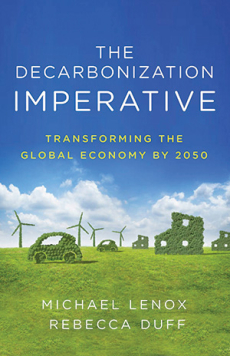
The Decarbonization Imperative: Transforming the Global Economy by 2050
Michael Lenox and Rebecca Duff
288 pages, Stanford University Press, 2021
There’s no better way to simultaneously tap your inner child and understand the global climate crisis than to visit a cement manufacturing plant. Giant in scale, oppressively hot, and Seussian in complexity, cement plants are the apotheosis of the industrial age—having enabled all the monumental works of modern civilization, from skyscrapers in Dubai to suspension bridges in China.
Cement manufacturing is also one of the primary drivers of climate change, accounting for 7 percent of global CO2 emissions. If the cement industry were a nation, only China and the United States would emit more. To solve this problem, University of Virginia Darden School of Business professors Michael Lenox and Rebecca Duff assert that we need to find a way to make “green cement.” This is just one solution to the dozens of technical challenges examined in their constructive new book, The Decarbonization Imperative: Transforming the Global Economy by 2050, which presents a sector-based approach to “provide a broad view of technological disruption … needed to decarbonize the global economy by 2050”—the widely accepted date at which society will have to achieve zero emissions to avoid catastrophe.
An odd fact that readers will learn from The Decarbonization Imperative is that the bulk of emissions from cement come not from the massive heating capacity required to produce the material but from a chemical reaction in the manufacturing process that releases carbon dioxide. I was already aware of the problems with cement when I had the opportunity to visit a plant outside of Pueblo, Colorado, as part of a state board working to address carbon pollution. I wanted to understand all the complexities of the manufacturing process in order to make better policy to address it. After an introductory slideshow, I asked, “You’re telling me that the way you make cement is that you put limestone, clay, and sand into a bucket and cook it?” The short answer: “Yes.”
The plant I visited was basically a giant oven purpose-built adjacent to a limestone quarry. Does it get any more analog? That’s the climate problem in a nutshell: We’re still running society by burning and cooking things we have either cut down or dug up.
Trying to square that circle—figuring out how the world can rapidly modify 200 years of locked-in carbon economy—is the work that Lenox and Duff set out to accomplish. They do so diligently, leaving no stone unturned. The book is effectively a technical manual that assesses the five major sectors (energy, transportation, industrials [capital goods such as aerospace, defense, and engineering], buildings, and agriculture) that need to decarbonize, offering multiple solutions for each industry.
For example, in the authors’ examination of cow burps—one of the most puzzling climate challenges arising from the dairy and beef industries—they propose an ingenious solution that uses technological advancements in production. “In 2009, the domestic cattle genome was sequenced, providing scientists and farmers the opportunity to identify the most productive beef and dairy cattle in the herd, and to breed on the basis of desired traits,” they observe. “One of those traits might be lower methane production.” Genetic modifications that produce low-methane cattle is just one potential answer of many for the dairy and beef industries.
The authors avoid falling into the trap that snares many climate solutionists, which is to mistakenly identify and hype climate fixes because they are driven by hope, not fact. Their section on soil carbon covers all the conventional approaches that have garnered much attention in the last decade—many of which, it turns out, have been based on shaky science. The authors conclude fairly that “agriculture decarbonization is unlikely by 2050.”
They are similarly pragmatic about the reality of electric vehicles. “It appears that the sustainable disruption of transportation is imminent,” they observe. “The important question though may not be if, but how long this disruption will take place. Time is of the essence. Even if all new vehicle sales in the world were electric, it still would take a decade, at very least, for the turnover in existing vehicle fleets to fully decarbonize transportation.” I have experienced this discrepancy in time—between the urgency of necessary action and how long it takes to implement change—in my own work as a climate policy maker in Colorado. We fought through lawsuits, torturous public meetings, and massive bureaucratic delays to pass an electric vehicle policy that would require only 6 percent of sales be electric—hardly the stuff of revolution.
Exactly when a technology starts to reduce emissions may be one of the most important questions in climate policymaking. Helping to find an answer has been the role played by climate modelers like those at the nonprofit Climate Interactive. Their simulations show that small modular nuclear reactors, favored by Bill Gates and briefly mentioned as a promising technology in this book, won’t start dropping emissions until 2053. This indicates that next-generation nukes are far less important (and possibly irrelevant) when compared with technologies that will stop fossil fuel combustion today.
Our carbon economy was intentionally built over decades of government capture by the fossil fuel industry, science obfuscation, and legacy subsidies.
The author’s respective scholarship on entrepreneurship and innovation influences their analyses in The Decarbonization Imperative. They note early in the book that “the failure to adopt clean technology … typically reflects a market reality that the clean technology is not as desirable as alternative technologies on existing dimensions of merit.” While the authors are not remotely suggesting that innovation will save us (they firmly articulate the need for policy solutions), this observation misses the fact that our carbon economy was intentionally built over decades of government capture by the fossil fuel industry, science obfuscation, and legacy subsidies. In such an environment, better technology may not actually be adopted. There’s a reason that today’s Ford Ranger truck gets about the same mileage as it did 25 years ago—and it’s not because a more efficient version wasn’t as desirable.
The truth about the climate crisis is that, with few exceptions, we’ve always known how to solve the problem technically. We also generally understand the suite of policies needed to implement those technologies. This book is a masterful overview of those fixes and part of a growing and necessary recent literature that includes publications by the nonprofit Project Drawdown, Bill Gates’ How to Avoid a Climate Disaster (in which he entirely misses politics as an essential solution), and, perhaps closest in scope and ambition, Saul Griffith’s Electrify. But the problem facing society is not what technological fixes or policies to implement so much as how to get them in place.
The promising strategies that Lenox and Duff recommend can’t and won’t arrive unless there’s a much stronger citizen movement in support of aggressive climate action. The truth is, no aspect of American society cares enough about climate to make it a national priority. Take the press, which influences how the public thinks. Business channel CNBC recently created a climate desk, but, as the energy writer David Roberts tweeted in August, if you want to see “what it looks like when the US media genuinely cares about something[,] it looks like Afghanistan coverage.” No such intensive media coverage has ever existed about climate.
The lack of care about this issue by policy makers, the public, and the media is why I think that even technical manuals like Lenox and Duff’s need to delve into the question of exactly how their technological solutions and policy proposals gain enough political traction to ever happen. That topic—the groundwork of nonprofits like Extinction Rebellion, 350.org, POW, and the Sunrise Movement—will likely be the subject of the next trove of climate books, such as Paul Hawken’s Regeneration: Ending the Climate Crisis in One Generation, which attempts to combine justice, climate, biodiversity, and human dignity into a plan to cut emissions almost 50 percent by 2030.
The authors’ ideas on how we make progress, for example, include improving global climate agreements that from the 1992 Rio de Janeiro Earth Summit onward have focused “largely on individual national emissions targets that few countries have been able to successfully meet,” they explain. “A technology innovation perspective suggests another approach. Rather than focus on emissions targets, focus on technology shifts.” They then suggest a range of approaches, the most exciting being the idea of creating a coalition of nations and airplane makers (the duopoly of Boeing and Airbus produce 91 percent of new planes) focused on decarbonization. This idea is both refreshing and realistic—because it’s soul-crushing to leave every global climate summit with a box full of targets that are both nonbinding and impossible to meet.
Another way to grow the movement is to make sure that books on the subject are page-turners. While The Decarbonization Imperative is an amazing educational resource, and much of it was fascinating for a wonk like myself, it might not be as riveting for readers outside the field. Yet, academic writing need not be staid. Sparkling prose can afford opportunities to galvanize and inspire readers—and climate solvers, a universally beaten-down, bedraggled, and depressive group, need all the positivity they can get.
The academic anchoring of the book affects not only the writing style but also the authors’ willingness to have some fun. In their chapter on energy, for example, Lenox and Duff mention “floating wind turbines” in passing and then quickly move on to another point, like disaffected parents. But, floating wind turbines? This is an opportunity to bring some joy to a dismal battle and illustrate the awesome creativity and technological virtuosity at the heart of many climate solutions.
But these criticisms are quibbles. The Decarbonization Imperative is a vital guide for the most important transition in human history. It should sit on every desk as a resource for scholars, policy makers, and citizens alike to both inspire and help realize dreams for a healthier planet.