


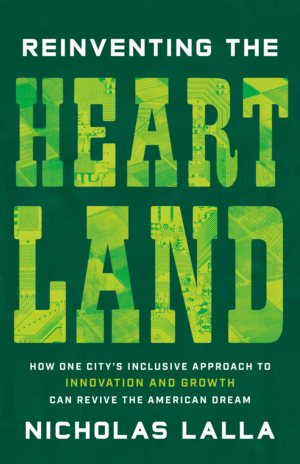
Reinventing the Heartland: How One City’s Inclusive Approach to Innovation and Growth Can Revive the American Dream
Nicholas Lalla
352 pages, HarperCollins Leadership, 2025
An incredible number of leaders across the nonprofit, philanthropic, and even government sectors believe that true innovation requires wholly new technology, high dollar budgets, and specialized training or certification. As a nonprofit technologist, I’ve witnessed this tendency firsthand over the past 20 years. Buying into this thinking has led teams that I’ve worked with to internalize the idea that they cannot be innovative simply because they lack funding. I’ve seen nonprofit CEOs who believe they aren’t qualified to sit at the table with tech companies and city leaders, as well as tech developers who feel like they must live in coastal cities to advance their career.
But we do not have to perpetuate this thinking. In Reinventing the Heartland: How One City’s Inclusive Approach to Innovation and Growth Can Revive the American Dream, urbanist Nicholas Lalla reimagines what technology and innovation can mean for organizations by presenting a pragmatic yet passionate approach to inclusive growth in the 21st century. The book chronicles his work to accelerate an “innovation economy” in Tulsa, Oklahoma, as managing director of Tulsa Innovation Labs (TIL), the LLC he formed under the George Kaiser Family Foundation (GKFF) to advance economic development projects. Lalla’s experience at TIL, as well as his previous stint leading a public-private cyber initiative for New York Mayor Bill de Blasio, provides the foundation for his 10-point action plan “for [economic] reinvention over an initial five-year time frame that other Heartland cities can adapt and adopt” to become tech hubs.
Lalla admits that creating a tech hub in Tulsa wasn’t easy. Yet he is adamant that “inclusive growth in tech must start with the reinvention of Heartland cities.” His vision demands that cities pursue two changes that occur in parallel: “transitioning … legacy economies to tech-based ones [and] shifting from a growth mindset to an inclusive-growth mindset” that results in broad economic gains across demographics. Lalla details the challenges, opportunities, lessons, and even limiting assumptions he experienced from his work in Tulsa, and his account offers insights and lessons for leaders across sectors in other geographies who wish to advance their local economies through tech. He advises readers to take these lessons and recommendations as inspiration and not direction, leaving space to honor and build on the uniqueness of each community.
Reinventing the Heartland’s 10 action points are grouped into three sections. The first, “Establishing a Tech Identity,” outlines Lalla’s data-powered approach to evaluating areas ripe for opportunity in a city and the elements to activate it. By developing this “industry cluster strategy,” a city can identify its “tech niche,” which “serves as the organizing principle for [a city’s] entire economic development project.” A tech niche builds upon a city’s legacy industries, represents high-growth tech clusters, offers jobs across a spectrum of education levels, and provides the opportunity for the city to lead.
Different cities will likely identify different combinations of investment areas. For Tulsa, the industry cluster strategy that built on both existing strengths and adjacent opportunities included virtual health, energy tech, and advanced air mobility. For other cities, clusters depend on the areas that give them the opportunity to lead and not just play a supporting role—what Lalla calls a city’s “right to win” industries. For many cities this may be a helpful approach not only for focusing on technical industries but also for generating a new lens on how to assess a city’s current and future needs, strengths, and prospects.
After they establish an industry cluster strategy, Lalla advises cities to select leaders who can implement the strategy and coordinate across industries “to align on a shared vision and make collective impact.” Lalla refers to these catalysts for collaboration as “good troublemakers”: leaders who can be disruptive or risk-taking but who are also “thoughtful, team focused, and sensitive to others.” He contends that a city’s government and legacy institutions must allow good troublemakers “wide latitude to do their job” without being micromanaged. “You need to stretch your disrupters,” Lalla advises, “so fully utilize them—throw them your thorniest problems. That will require organizations to be comfortable being uncomfortable.”
Such advice may be an increasingly tall order as a new presidential administration under Donald Trump takes aim at nonprofits and organizations doing equity work. Can these good troublemakers “create conflict,” as Lalla claims that they should, when institutions and organizations are scaling back on such good troublemaking for fear of government retribution? Lalla is cognizant of how the political leanings of the federal government affect the work of systems change. Acknowledging President Joe Biden’s administration’s “game-changing federal funds” to cities like Tulsa, he insists that “the federal government must continue to play a role in providing midsized cities and rural communities with the resources they need to invest in innovation.”
In part two, Lalla offers five areas of activity for leaders to “transform [their] city into an innovation engine”: establish a remote-worker incentive to attract outside tech talent; upskill incumbent talent to grow a city’s tech cluster; create diversity, equity, and inclusion (DEI) initiatives to support the underserved; reorient universities toward technological innovation and talent production; and connect start-ups with existing corporations to foster a culture of innovation.
Inclusive growth practices should encompass the full spectrum of a city’s strategies outside of overly simplistic binary thinking that would result, for instance, in choosing to either invest in upskilling the existing workforce or build the future one. Cities are complex places, after all, and sustained economic development requires time and intergenerational planning.
Community can be the purpose for what an inclusive economic development plan is ultimately responsible to.
Yet TIL’s strategy employed such either-or thinking. For example, Lalla reveals that TIL’s workforce strategy was to “forget the kids,” meaning that they “prioritized immediate needs” by investing in the existing workforce population and those available to work today, rather than in future generations. Similarly, TIL’s strategy supported workers who are already online and using tech instead of including those who lack broadband access and/or digital literacy. Despite noting that “governments and network operators should work together to invest in stronger broadband,” Lalla did not integrate this consideration into TIL’s innovation economy plan.
Other Heartland cities, including Kansas City, Missouri, and Chattanooga, Tennessee, have made addressing these digital divides a major focus of their economic development strategies. Whether a city follows Lalla’s tech hub plan or uses his ideas to go in other directions, digital equity should be an intentional part of the comprehensive approach. Folks can’t build their technology skills, work from home, pursue continued education or upskilling in a digital world, or start new businesses if they do not have internet access. Unfortunately, many millions of people across the United States are still not connected to the internet and all these opportunities. TIL’s strategies could have been more inclusive had they made space for those ready to work and those still learning, those already online and those still experiencing digital barriers.
That US coastal tech hubs have achieved unprecedented wealth for the few while contributing to the greatest wealth divide in modern times casts a doubtful shadow on Lalla’s faith in tech hubs to realize more equitable economies in midsized cities. The book’s final section, “Fueling the Future,” presents a strategy for investment by partnering with philanthropy and forging urban-rural alliances to compete for federal funding. Yet readers are left to imagine how such investment might generate equitable gains for workers. Unique to TIL’s—and Tulsa’s—success was the personal investment of philanthropist George Kaiser, whom Lalla variously praises throughout his book. “That GKFF is a valuable anchor partner for Tulsa is an understatement; its $5 billion endowment is a critical regional asset,” Lalla explains. What do other Heartland cities do without a Kaiser figure? Lalla advises that they seek out private philanthropy or community foundations that have a geographic focus to be part of a funding mix for their area. The inclusive economic growth Lalla discusses reminds us that regardless of how a city navigates those funding layers, success lies in remaining committed to inclusive benefits of that economy, ensuring that the communities most historically and systemically marginalized are supported in the economic development goals. Otherwise, cities will continue to serve the same wealthy interests as today.
Lalla’s lessons can help cities evaluate and implement economic development plans for technology industries. But what do inclusive growth and economic prosperity mean for people who do not work in tech? Communities rely on much more than tech workers—they need teachers, chefs, librarians, and countless other support and service workers to function. As Lalla’s many stories—interactions with longtime locals, advice from partner organizations, and insights from collaborators across the city—exemplify, residents feel deep pride in and love for Tulsa as a place and as a community. What they do not express is a pride in or love of technology.
That distinction is crucial. Tools will come and go, industries will evolve and be replaced. But community can be the purpose for building and—I think Lalla would agree—what an inclusive economic development plan is ultimately responsible to. With community accountability as the standard, the question confronting Tulsa and other Heartland cities—and all of us—is a matter of building futures that work for everyone.