


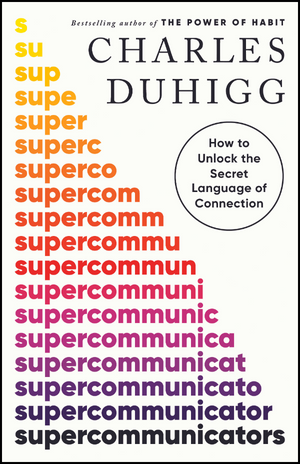
Supercommunicators: How to Unlock the Secret Language of Connection
Charles Duhigg
320 pages, Random House, 2024
In Supercommunicators: How to Unlock the Secret Language of Connection, Pulitzer Prize-winning journalist Charles Duhigg offers readers simple communication strategies to more effectively connect with friends, family, coworkers, and our communities. By harnessing commonly known conversation tools, Duhigg argues, everyone has the potential to become a “supercommunicator”: someone who “seem[s] to synchronize effortlessly with just about anyone” by making others feel at ease, sharing experiences without monopolizing the spotlight, and navigating thorny subjects with sensitivity.
Duhigg is the author of the 2012 New York Times bestseller The Power of Habit, about how we can change our habits by understanding the science of habit formation, and 2016’s Smarter Faster Better, which unpacks the science of productivity to offer tools to enhance self-optimization. In his latest work, Duhigg employs a similar methodology of combining research with feel-good case studies to devise a part self-help, part how-to guide to better communication.
Supercommunicators was inspired by Duhigg’s own budding awareness of his failure to connect authentically with his employees, friends, and family. Recognizing his shortcomings, he sets out to deepen his understanding of how people communicate with one another so that we can “learn how the people around us see the world and help them understand our perspectives in turn,” he writes. Perhaps this is why his prescription for connection is rather obvious: listen deeply, ask penetrating questions to reveal your interlocutor’s values, and be vulnerable and authentic in your engagement. “We need to genuinely understand what someone is feeling, what they want, and who they are,” he asserts. “And then, to match them, we need to know how to share ourselves in return.”
Duhigg’s framework for improved communication is most constructive at an interpersonal level and as a starting point for organizations committed to fostering open dialogue. It is arguably less successful when the framework is applied as a solution to our society’s worsening political polarization.
Supercommunicators, he observes, are not the most charismatic individuals, nor are they likely to be self-designated leaders in a group. They are, in fact, the ones who blend in, who ask significantly more questions than others, and who do not hesitate to admit when they don’t have all the answers. In his analysis of how supercommunicators operate, Duhigg leans on neuroscience research showing that different types of discussion ignite distinct parts of the brain: Practical matters engage the frontal lobe; discussions about the self (identity and relationships) activate the brain’s default mode network of the cortex and paralimbic regions; and discussions that elicit emotion engage the amygdala, the nucleus accumbens, and the hippocampus. He categorizes these three types of conversation as mindsets: the decision-making mindset (“What is this conversation about?”), the social mindset (“Who are we in this conversation?”), and the emotional mindset (“How do we feel in this conversation?”).
Duhigg proves that transformative communication is possible when interlocutors seek common ground.
While different, these mindsets do not function independently of each other. Rather, Duhigg says, they can shift “as a conversation unfolds.” For example, he proffers, “a discussion might begin when a friend asks for help thinking through a work problem (What’s This Really About?) and then proceeds to admit he’s feeling stressed (How Do We Feel?) before finally focusing on how other people will react when they learn about this issue (Who Are We?).” In this case, he advises matching, or mirroring, emotions to create an empathic connection with your interlocutor: “If someone seems emotional, allow yourself to become emotional as well. If someone is intent on decision-making, match that focus. If they are preoccupied by social implications, reflect their fixation back to them.” A supercommunicator, therefore, can skillfully assess their interlocutor’s mindset and then match it by steering the conversation in a way that reflects both of their needs. “Within every conversation there is a quiet negotiation, where the prize is not winning, but rather determining what everyone wants,” Duhigg contends. However, in several of his case studies, Duhigg’s benchmark for successful communication shifts from mutual understanding to persuasion—the latter implied as the real motivation for wanting to become a supercommunicator. “How do we nudge someone, through a conversation, to take a risk, embrace an adventure, accept a job, or go on a date?”
For example, Duhigg examines how doctors have persuaded their anti-vaccination patients to get the COVID-19 vaccine. He discusses a physician named Rima Chamie, who convinced her deeply religious patient, who had rejected all vaccines because he believed that God would protect him, to get vaccinated by establishing trust through bonding over a shared identity. Instead of imposing her medical expertise on her patient, Chamie disclosed to him that she, too, valued faith and family. Using his language, she reflected that she also cared deeply about the health of her children and grandchildren. She then expressed her gratitude that God gave humans the ability to make vaccines through a gentle (and rhetorical) question, “Maybe [God] gave us vaccines to keep us safe?” The question put the answer—and the decision-making power about getting the vaccine—in her patient’s hands as a sign of trust. By establishing common ground in their values, and particularly in their desire to protect their families, Chamie made room for the patient to shift his mindset. He decided to get vaccinated.
Duhigg’s stories predominantly showcase outcomes favoring the public good, such as the doctor persuading her patient to get vaccinated against a communicable virus that created a deadly, global pandemic. Yet he ignores alternative scenarios, in which social harm results from a supercommunicator’s powers of persuasion. Sidestepping such cases allows Duhigg to avoid having to delve into ethical discussions about a supercommunicator’s accountability to their interlocutors. But at a time when populism is on the rise globally, the failure to interrogate the ethics of this practice is a notable oversight. Emotion is, after all, the fuel for authoritarian populist leaders’ divisive identity politics.
Consequently, the book’s argument seems siloed from the political reality of our lives. If simply listening, connecting, and reframing conversations could sufficiently bridge divisions, then wouldn’t controversial matters like gun control and abortion have been resolved by now? Here, instead of diving in, Duhigg reverts to his earlier goal of supercommunication: “not winning but understanding,” which is the critical first step in humanizing all parties in a conflict. Despite admitting that agreement is not always possible, he does offer insight about how the book’s tools can bring people together when perspectives diverge too much.
For example, the media company Advance Local organized a workshop in 2018 that brought together gun-control activists and gun-rights advocates to “get everyone to start sharing personal stories about guns and gun control, the emotions and values underlying their beliefs, [and] then see if that might change the tenor of the debate.” The attendees listened to each other’s stories, understood divergent perspectives, and found some common ground—and the organizers deemed the event a success. However, when the conversation moved online and included people who had not attended the training, the conversation rapidly deteriorated. “Not everyone rose above their animosities,” Duhigg reports. “Some people were ejected by moderators, others opted out.”
His only advice for navigating online discourse—be extra polite, refrain from criticism, and frequently express gratitude—is overly simplistic and overlooks the harsh reality of online harassment and particularly its impact on marginalized communities. Misogyny and racism are exacerbated by a mob mentality prevalent in online spaces, and the absence of face-to-face interactions shields perpetrators from accountability. Training in communication techniques yields results in controlled environments but encounters limitations when applied to large-scale settings that lack accountability structures, especially those with anonymous interlocutors.
While Duhigg’s guide is less successful in the realm of political discourse, it does capture how sustained interventions in organizations can achieve long-term solutions. He points to Netflix as a case in point. After its communications chief officer said “the n-word” in a 2018 meeting, Netflix implemented protocols to address that incident and the systemic racism that the incident revealed. It hired a diversity manager to lead company-wide discussions and training sessions, Duhigg explains, “to foster dialogues, confront biases, and make Netflix a shining example of inclusivity.” By 2021, most employees had received diversity training, and Netflix was prepared for another transgression, if and when it arose. Employees were able to voice concerns directly to each other and company executives in structured, empathetic ways that made everyone feel heard. Duhigg concedes that “real change requires shifts in not only how Netflix hires, promotes, and supports employees, but society at large.” But the company has, he adds, “outpaced nearly every other big firm in Silicon Valley, as well as Hollywood, in hiring from underrepresented groups.” Organizations cannot foster growth and inclusivity in meaningful ways unless they are willing to confront their blind spots and engage in difficult conversations.
In Supercommunicators, Duhigg proves that transformative communication is possible when interlocutors seek common ground and “acknowledg[e] social differences, rather than preten[d] they don’t exist.” While commonly known, the communication tools he offers can help navigate interpersonal interactions with greater understanding and benefit. We can’t always get what we want from a conversation, but we can be more intentional in the way we connect with others—and that, in itself, is a worthy pursuit.