


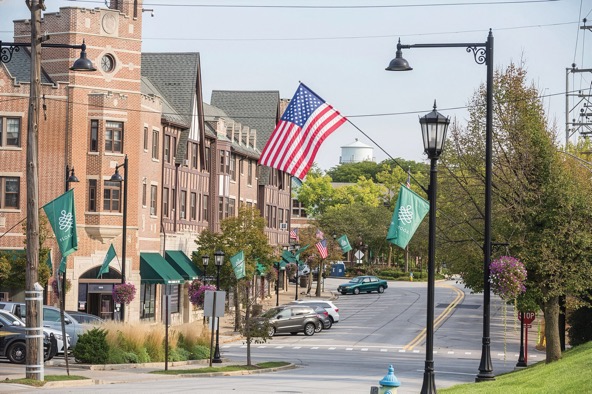
 The village of Flossmoor is an affluent, majority-minority suburb. (Photo courtesy of the Southland Development Authority)
Illinois’ Southland region has long drawn urban dwellers attracted by prospects of plentiful jobs, good housing, affordability, and wide-open spaces. With towns like Worth in its north, Mokena in the west, Beecher and Peotone in the south, and those bordering the Indiana state line to the east, the area encompasses 400-plus square miles and more than 60 towns across Chicago’s south suburbs.
Home to both working-class and white-collar professionals, and to the town where Pope Leo XIV grew up, the Southland is also a place where industry and natural habitats coexist, and where small-town America sits adjacent to the hustle and bustle of the country’s third-largest city. Since the late 19th century, the Southland’s various towns have been home to diverse racial, ethnic, and religious groups. During slavery, the region was an important stop on the Underground Railroad, and it went on to host both the nation’s first incorporated, self-governed Black town in the North and its first Black-owned airport (both in Robbins).
Like the nearby South Side of Chicago, where racially restrictive housing covenants were a postwar norm, the Southland has not always been immune to tensions involving race. But the region became a model for mid-20th-century integration in 1959 after a Black family moved into the middle-class suburb of Park Forest. “The principal reason we’ve been successful is that the people of Park Forest are intelligent, responsible Americans who realize a person’s rights under law,” Robert Dinerstein, the then-village president of Park Forest told Time magazine shortly after the family’s move, which garnered notoriety seven years before Martin Luther King confronted hostile mobs while marching in support of integrated neighborhoods on the South Side.
While Chicago’s Black population has decreased by one-quarter since 2000, according to the US Census Bureau, the Southland this century has attracted a significant number of upper-middle-class and wealthy Black households. Despite this influx, pockets of the Southland over the years have, like Chicago, dealt with economic disinvestment, joblessness, and an uptick in crime. The whole region is part of the Rust Belt, where America’s deindustrialization has left blighted streets and impoverished communities in its wake. Life for Southlanders can vary greatly from town to town, with less well-off communities laboring to keep pace with neighboring stable suburbs.
In South Holland, a longtime dry suburb that in 2023 became the last Illinois town to issue restaurant liquor licenses, Tiffani McHaskell says she does not worry too much about safety. “The crime is still relatively low, especially compared to the Chicago area,” says McHaskell, a financial broker who previously lived in the Windy City. “I do still have the peace of being able to walk outside with my husband at midnight.”
Nevertheless, the couple are eyeing a move from the town of nearly 21,000 where she’s lived for about 20 years. “There is not the development that should be there,” she says, noting that they have looked at leaving the Southland altogether. “I still have to go outside of where I actually reside just for the grocery store.”
The next suburb to the east is Calumet City, which could be thought of as South Holland’s antipode: It was an Al Capone-controlled vice town during Prohibition (when it was known as West Hammond). Calumet City is where educator Carolyn Strong, McHaskell’s high school friend from the 1990s, has resided, likewise for around 20 years. The town of around 35,000, which borders Indiana, has in recent years contended with a rash of business closures and ongoing struggles with commercial properties.
“When I got here, it was totally different than what I’m looking at now,” she says. For Strong, who also lived in Chicago before moving to the Southland, a lack of adequate retail options in Calumet City is why she does much of her shopping across the state line, which she says is so close to her house that she can literally walk her dog there. “When I got here, there were stores like Old Navy and Michaels,” she notes. “Now I’ve got to go to Indiana.”
If the region turns around its prospects to retain the McHaskells and Strongs, it may have the Southland Development Authority (SDA) to thank. Created in 2019, the nonprofit organization focuses on the revitalization of the region through opportunities created for newer and existing business owners, real estate development, and municipal consulting. Leading the SDA’s efforts as CEO is Bo Kemp, who came to the job with a unique combination of experience in finance, government, and entrepreneurship that he freely mixes in his cross-sectoral work to rejuvenate the region.
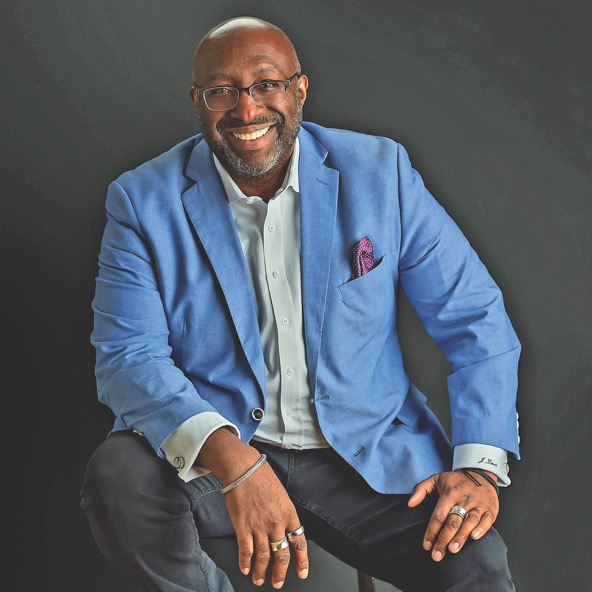 SDA CEO Bo Kemp brings a mixture of business savvy and cross-sector experience. (Photo courtesy of the SDA)
“It’s a very unique space that reflects a lot of the complexity and the diversity of the United States,” Kemp says of the Southland. “You go very quickly from where there are literally corn and soybean farms to urban and suburban areas within a 15-minute drive.”
The SDA’s quest to revive the Southland has become more urgent as governmental funding, long a reliable source of support for nonprofits nationwide, has dried up. If the SDA succeeds, it will have written a new chapter for a region that for much of the 20th century was one of the country’s major drivers of economic growth. In the process, its unique combination of community-mindedness, business savvy, and collaborative creativity could be a model for the Rust Belt and other communities across the country that are floundering from industrial decline and underinvestment.
A Petri Dish of Sorts
The Southland has long been a symbol of aspiration for many in the Chicago area. By virtue of proximity, it has been an especially tangible symbol of mobility for residents of the South Side.
“The south suburbs used to be the place where you were moving on up,” Kemp says. “It was an indication about your economic advancement.”
Quiet, tree-lined streets, which in the region’s easternmost areas are frequently fringed with bungalows and ranch homes, still conjure feelings of idyllic, postwar suburbia that were a staple of 1950s sitcoms like Leave It to Beaver and Ozzie and Harriet. Going farther west, one might make their way past country clubs in places such as Homewood and Flossmoor, in addition to Olympia Fields, whose namesake private club since the 1920s has hosted major tournaments of the men’s and women’s Professional Golfers’ Association.
For Southlanders and South Siders of a certain age—primarily later Baby Boomers, Generation Xers, and early Millennials—memories abound of preteen weekends spent at the Aladdin’s Castle arcade in Matteson’s Lincoln Mall or the Wright’s Barnyard family amusement center in Lansing. Teenagers of those times can also recall the Southland being a great place to shop for trendy clothes and athletic wear at Lincoln Mall, as well as for first dates at the movie theater attached to Calumet City’s River Oaks Center, followed by dinners close by at Olive Garden or the Red Lobster next door in Dolton.
“A lot of people not only lived in the communities, but they actually worked there,” says Ronny Anderson, who came of age in the 1990s as a teenager in Park Forest. “The Southland was never the richest area, but it was typical suburban America.”
The SDA has received funding from local philanthropic foundations and additionally generates revenue from redevelopment services it provides to municipalities. In turn, the SDA uses its funds to invest in the community in ways that reflect Kemp’s business savvy and cross-sector experience.
The post-deindustrialization hardships experienced by some Southland suburbs reflect those of other towns attached to the nation’s legacy cities of Chicago, Detroit, Cleveland, and so on, which incubated the major manufacturing hubs of the early-to-mid-20th century, helping to propel the country’s emergence as the world’s economic leader. “They built homes to attract the workers, and then they fell on hard times as manufacturing started to move away from the United States,” says Kemp, a Detroit native keenly aware of the struggles faced by legacy metropolitan areas in the years since.
Kemp is adept at navigating the different worlds of the working-class Rust Belt, corporate America, and the ivory tower. A gregarious policy wonk who also hosts a podcast about entrepreneurship called The First Million Is Always the Hardest, he is happy to take as much time as needed with laypersons to explain the most plodding details of economic development, no matter how many times it needs repeating. A graduate of Yale University and Harvard Business School, Kemp has enjoyed a varied career that includes time as a mergers and acquisitions specialist with Morgan Stanley, a private-equity associate, and an owner of a New Orleans-based education-services company that ceased operations in 2005 after Hurricane Katrina. From there, he entered the political world, working for Cory Booker in 2006 when the future US senator was running for mayor of Newark, New Jersey. Following Booker’s victory, Kemp was tapped to be Newark’s business administrator.
“That was my first foray into doing anything that was related to government or development,” says Kemp, who oversaw municipal service business operations for New Jersey’s largest city. “Because I came from this background that was both entrepreneurial and financial, I approached a lot of the problems that we had in a different way. I found there are areas where government does work, and there are areas where it does not.”
Kemp returned to the private sector a couple of years later but remained involved in municipal finance as a consultant, which included several years as a senior director for the international law firm Faegre Drinker. “I kept getting calls from those in the public sector asking me to share some of the experiences I had,” he recalls, having gone on to amass a portfolio of work consulting to more than a dozen municipalities. His professional path subsequently led him back to his Rust Belt roots and to the Chicago area, where in 2018 he became a member of the Cook County Council of Economic Advisors, which was attempting to boost development in the south suburbs. Those pursuits laid the building blocks for the SDA, which was established a year later.
Kemp was persuaded to join the SDA by its cofounder and CEO, Bob Weissbourd, whom he was introduced to through a mutual professional acquaintance. With an endorsement by Weissbourd, who had always intended to be the organization’s CEO on a temporary basis, Kemp in 2021 was chosen to be his successor.
In the beginning, the SDA sought to attract new companies to the area. When the pandemic hit, the organization reoriented its mission. “We spent our first two years really focusing on keeping the businesses that were already in the Southland alive,” he says. “By having the focus first on the inside-out, as opposed to the outside-in, it gave us insights about the needs of businesses that already were engaged in the Southland. We adjusted our strategy to focus equally on the businesses that were already here.”
To hear Kemp describe it, the Southland is a petri dish for testing new ideas for growth and development. He feels such ideas are more difficult to implement in a city like Chicago, where the civic pressure may be more intense. “So much more attention is paid there,” Kemp says. “We get to try some things that might otherwise inhibit our innovations.”
Promoting Entrepreneurship
With a staff of more than a dozen employees, the SDA is one of more than 11,000 organizations nationwide occupying the $53 billion economic-development sphere, according to data platform Cause IQ. The SDA has received funding from local philanthropic foundations; governmental grants; national philanthropic entities such as the MacArthur, Ford, and Kellogg foundations; and corporations like AT&T and Bank of America. The organization additionally generates revenue from redevelopment services it provides to municipalities. In turn, the SDA uses its funds to invest in the community in ways that reflect Kemp’s business savvy and cross-sector experience.
Large-scale economic-development projects require the cooperation of various stakeholders over what is often a long-term process. In the Southland, those stakeholders include residents like McHaskell and Strong, wanting reenergized neighborhoods. On the business side, it is entrepreneurs looking to grow their commercial footprint. At the political level, civic officials—some of whose towns have housing values two to four times lower than those of their well-off Southland counterparts—must buy in. Working to coordinate the Southland’s disparate stakeholders is the SDA, which serves roughly 700,000 residents throughout 45 identified municipalities, two counties, and significant portions of two US Congressional districts.
Joblessness distresses many Southland suburbs, especially in majority-minority municipalities like the ones where McHaskell and Strong reside. One of the SDA’s critical strategies seeks to reverse those fortunes through business development, with a focus on small and mid-sized enterprises owned by individuals from disadvantaged groups.
The SDA’s Business Growth Services (BGS) helps entrepreneurs scale up their companies. Interested entrepreneurs with differing levels of business experience can schedule a free, 30-minute consultation with the organization to see if BGS can help them. Once enrolled, participants can receive assistance via online training modules and programs designed to help companies streamline operations, as well as workshops that guide entrepreneurs through the process of accessing capital investments. The services are mostly free of charge, with some options requiring a low-cost fee.
Approximately 35,000 small and mid-sized businesses (SMBs) operate in the Southland, according to the SDA, with 400-500 annually participating in BGS. The program also acts as a third-party consultant that connects entrepreneurs looking to scale with established business partners through a matchmaking process. By the SDA’s estimates, the organization provides more than 2,400 hours of service per year to SMBs.
The SDA also directly invests each year in about three dozen enterprises that the organization identifies as having high-growth potential. “By servicing this middle role, we facilitate a lot of small and medium-sized businesses in getting access to services that they probably wouldn’t have, putting them on a path to grow,” Kemp says.
One businessperson helped by the SDA is Fershawnda Green, the founder of Poppin Plates Culinary Incubator, which operates kitchen spaces in the suburbs of Park Forest and Lynwood for chefs, food-truck vendors, and entrepreneurs to test culinary concepts. With experience as a caterer, Green launched her business in 2018 to help others navigate some of the same challenges accessing shared kitchen space as she encountered coming up in the food industry.
Seeking to raise Poppin Plates’ profile, Green discovered the SDA through associates of hers. To help get the word out about the business, the SDA covered the cost of a five-week social media marketing campaign that Green estimates was worth between $3,000 and $5,000. The organization also connected Green to several vendors, who helped her clients with onboarding processes, IT services to build websites, and payments for business and sanitation licenses. “The relationship that we have made has been great,” she says about the SDA.
Helena Simms is another Southland businessperson who has benefited from the BGS program. She is the owner of a traveling phlebotomy services provider and a phlebotomy training center, both of which operate as Lab Girls. Simms started her business as a single company in 2020 and was faced with running an enterprise during the pandemic. “During COVID, it was challenging, because my business was in person,” she recalls about having to cut the size of her classes from 10 students to 5. Simms admits she also needed to be educated overall about the rigors of being an entrepreneur, as she was running her provider and training services under one limited liability company (LLC), potentially raising her liability risks.
By 2023, Simms’ difficulties were compounded when, without explanation or much notice, her landlord notified her that she would have to vacate the facility she had been using for Lab Girls. Reaching out to the SDA for guidance after attending a sponsored event, she got help restructuring her LLC into two separate businesses and finding a new location for both of her businesses, which currently operate in the suburb of Lansing.
“Now when I’m getting looked at for a loan or grant, all my codes are matching up,” she says. “In a sense of my goals and mission, everything is all together now.”
New Life for Old Industries
Boosting manufacturers in the modernization, scaling, and growth of their operations makes up a second critical strategy of the SDA’s work. Here the SDA is trying to revitalize a sector with deep roots in the region.
The larger Calumet area, one of the US’ industrial hotbeds for much of the 20th century, includes swaths of the Southland, Chicago’s Southeast Side, and Northwest Indiana. With its location on Lake Michigan and access to nearby rails, small rivers, and other tributaries, the Calumet area became a major recipient of iron ore pellets transported from mines around the upper Great Lakes region, which were used to manufacture steel in the region’s plants. At its postwar peak, the Calumet area was among the world’s leading steel producers.
But as with other Rust Belt communities, deindustrialization in the latter part of the century ushered in Calumet’s economic downturn. “The Southland is fascinating because it was a rich industrial area full of good, well-paying, middle-class jobs,” says Jean Pogge, a Chicago-based management consultant who previously served as the SDA’s interim chief of staff. “When deindustrialization hit the United States, that hit the Southland hard. It never recaptured the economic power that it had before.”
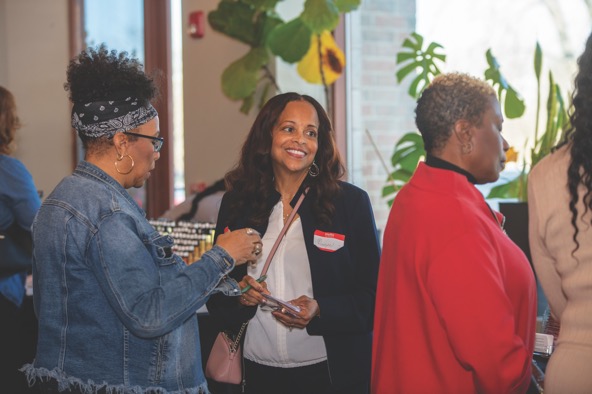 Attendees gather at SDA’s SheInspire event, hosted in March 2026 to celebrate women entrepreneurs in honor of Women's History Month. (Photo by Kanysha Milton)
When decent-paying jobs left some of the Southland’s blue-collar communities (which tended to be more racially segregated), so too did many white residents who had the means to relocate elsewhere. “The decline of manufacturing led to a loss of job and pay opportunities, which in turn fed a wave of white flight as longtime residents left and were replaced by African-American city dwellers lured by better, yet not too expensive, housing,” wrote Casey Toner in a 2018 story jointly produced by the Chicago-based Better Government Association and Chicago NPR affiliate WBEZ. Although specifically documenting the Southland suburb of Dolton, where Pope Leo was raised by his educator parents, Toner’s narrative could well apply across the traditionally blue-collar Southland communities whose tax bases suffered in the aftermath of population declines and business disinvestment.
Even though traditional industries have long left the region, the Southland still has resources like water and energy in place to kick-start activity among new manufacturers and industries, particularly those powered by tech. As a result, Kemp is bullish on manufacturing’s potential to accelerate the Southland’s growth. “We clearly have a strategic advantage,” he says. “We’re developing a lot of access to power. Those are the infrastructure ingredients necessary to support any and all future industries.”
The SDA’s targeted companies are concentrated in metals, machinery, and equipment (MM&E), and are serviced by way of the Metals HUB, an initiative launched in 2022 by the SDA and Cook County, Illinois, which is the nation’s third-largest county for private-sector manufacturing jobs, according to an analysis of data from the US Bureau of Labor Statistics by the nonprofit organization SSTI.
For entry into the Metals HUB, the SDA recruits both small manufacturers (those with fewer than 20 workers) and larger companies that may be relying on outdated workflow operations. MM&E manufacturers that are part of the initiative receive tailored business and marketing plans, access to a pipeline of prospective employees by way of the SDA’s workforce internship and mentoring program, connections to different manufacturers for the purpose of pursuing joint ventures, and networking opportunities with manufacturing experts and insiders. The Metals HUB has a network of more than a dozen statewide partners—including governmental bodies, higher-education institutions, and workforce nonprofits—that work with Southland companies included in the initiative. Currently, 40 companies receive assistance via the hub.
“We’re in a manufacturing renaissance,” says Weissbourd, who is now the president of Chicago-based urban and regional development firm RW Ventures. “Everything is digitizing and automating. Even other industries, they all need manufactured products.” The Southland, Weissbourd notes, is a center for metal plating and bending, tool and die processing, and chemical and plastic fabrication—the manufacturing of all being dependent on critical, high-end technology like robotics and electrical grids, which the Southland has ready access to. “The next generation of industries, a lot of those are in the Southland,” he says.
The SDA is simultaneously committed to developing clean-energy infrastructure for the region through the Monarch Fund, an investment arm for which it aims to raise $100 million to deploy for development projects. “We’re trying to make sure that every time we touch a physical building and a neighborhood, we’re also making the investment in climate energy capacity,” Kemp says.
There may be no better example of a manufacturer that represents the Southland’s past and future than Ability Engineering Technology (AET). Founded in the late 1940s, South Holland-based AET began as a tool and machining company, and today specializes in building equipment used in cryogenic processing. AET counts the US Department of Energy (DOE) and NASA as customers, with other governmental entities, academic institutions, and industrial companies rounding out their client base. But as vital of a role as AET fulfills in supporting the nation’s critical infrastructure, it still has to deal with typical small-business concerns regarding overhead and slim margins.
“Although there are opportunities for small businesses, most of us are not able to take advantage of them because we are spread very thin,” says Eugene Botsoe, AET’s owner and CEO. “You’ve got to worry about profitability and cash flow. And with small businesses, you tend to have people who do multiple roles.”
Botsoe maintains that the Southland can be a mecca for advanced manufacturing—particularly quantum manufacturing, which employs cooling substances like cryogens to fabricate components that are used for everything from computers to rockets. Botsoe learned about the SDA after attending a local presentation where Kemp spoke and found that Kemp’s vision for the Southland dovetailed with his own goals of growing AET amid a regional economic renaissance and a nationwide resurgence of onshoring.
Since AET joined the Metals HUB, Botsoe credits the SDA for developing a financial plan to assist the company in purchasing a new facility, as well as renovating its existing building. He also cites their help in seeking sources of grant assistance, which would help defray costs of its expansion plans. According to SDA figures, its work has helped AET save $100,000 annually through low-cost financing.
“My number one priority is to grow my business, to have a viable business that employs people, and that’s on the cutting edge of technology so that we always remain attractive,” Botsoe says.
Livable for All
As the SDA works to help scale small and mid-sized Southland businesses, real estate development has become a third critical strategy of the organization’s objectives. Targeting around three-quarters of the Southland’s towns and villages (a population roughly that of Washington, DC, the nation’s 22nd-largest city), the SDA is on a mission to build affordable homes for residents it seeks to attract with new jobs, along with keeping residents in suburbs such as those where McHaskell and Strong live. In the short term, the SDA has a goal of developing 50-100 homes a year, with hopes of having 1,000 homes finished in the next five to seven years.
One of the iconic police car-chase scenes from the 1980 movie The Blues Brothers was shot inside of Dixie Square Mall. But by the time of the film’s release, the mall had been closed for almost two years, a victim of Harvey’s economic downturn and population decline.
To realize its housing aspirations, the SDA has partnered with the South Suburban Land Bank—Illinois’ first established land bank—to purchase abandoned and vacant properties for development. “The Land Bank allows us to go after blighted and abandoned property, redevelop that property, and put it back on the tax roll,” Kemp says. “By combining our long-term efforts for development and the Land Bank’s capacity, we can be really thoughtful about where we can redevelop neighborhoods in a strategic way over time.”
Kemp believes the Southland is primed for population growth over the next decade due to new jobs arising from the emergence of new tech fields, which would access the area’s natural resources for development. Prospective employees might prefer to reside closer to their workplaces, and Kemp states that the bulk of these employees will not be in upper-management roles, thus unlikely to be living in areas where the costs of living are rapidly increasing relative to their earning power. “If you want to continue to recruit the next Googles of the world and all the key industries for growth, you can’t do that with a population only of people who are making $100,000, $200,000, or $300,000,” he says.
One challenge is the sticker shock that homeowners in majority-minority Southland suburbs have experienced in recent years, paying some of the county’s highest property taxes. The tax issue has become a hot-button topic in the Chicago-area political landscape, but Kemp believes the tax burden of residents could decrease as more people flock to the Southland for decent jobs and affordable homes. New Southland homes for non-high-wage individuals could also prove essential, given that a number of residents might commute to Chicago for work, either by six US Interstate highways or the Chicago area’s Metra Electric rail line. For these workers, residing in the city—or the Chicago area’s north and west suburbs—might not be as attractive due to cost-of-living concerns, including housing.
“The south suburbs are uniquely positioned to address this issue,” Kemp says. “It’s the only place where you can build housing for less than $250,000 in the region. In order to maintain a diverse workforce in the Chicago region, the south suburbs have to build those homes.”
One of the SDA’s more ambitious housing developments is slated for Harvey, a suburb whose homeownership rate is 8 percent lower than the national average. Once celebrated as the “Gateway to the South Suburbs,” Harvey today has one of Cook County’s highest property-tax rates and its third-lowest rate for property-tax collection—not to mention having the most tax-delinquent homes of any suburb in the county.
In the Southland’s heyday, Harvey was widely heralded as being the region’s ideal blue-collar town—a place where manufacturing jobs abounded and commercial activity, for a time, was supported by the Dixie Square Mall, which opened in 1966. One of the iconic police car-chase scenes from the 1980 movie The Blues Brothers was shot inside of Dixie Square. But by the time of the film’s release, the mall had been closed for almost two years, a victim of Harvey’s economic downturn and population decline. (Universal Pictures rehabbed the mall’s shuttered interiors to film the scene.)
Dixie Square may be long gone, but economic hardships—not to mention concerns about public safety—remain in Harvey, which was over $100 million in debt as of early 2026. There the SDA is backing a $2.1 million project to rehabilitate vacant properties targeted toward first-time homebuyers, who are required to attend classes that cover the basics of owning and managing a home. The SDA has partnered with local private capital and philanthropic foundations to subsidize costs for the project, which has also carved out opportunities for women- and minority-owned contractors to participate amid a national decline in diversity, equity, and inclusion initiatives. The project is part of the organization’s goal of building 1,000 housing units, which would be conveniently located near public transit.
“We’ve started with housing in Harvey as a template,” Kemp says. “We’ve started to build an ecosystem of developers, contractors, and subcontractors that will execute this work, and that’s part and parcel of the effort to build 1,000 homes.”
The SDA’s real estate endeavors also extend to the development and rehabilitation of commercial properties, an undertaking designed to spur the creation of business opportunities for contractors. Some of its planned commercial real estate projects include the development of a 144-acre solar-powered cold-storage facility for use by food-service businesses; a 250-acre mixed-use industrial and community space; and the construction of a grocery store to be owned by the SDA and managed by a for-profit company.
“There’s a connection between housing development and general economic development,” says Lyneir Richardson, a onetime board member of the SDA and current CEO of Chicago TREND, a nonprofit commercial real estate developer. “Where there are jobs, there is economic vitality, and that leads to other outcomes like better retail services and amenities, as well as investments in parks, police, and schools.”
Municipal Revitalization
Additionally, the SDA is working with the village of Hazel Crest to establish an arts district, accompanied by the construction of 40 multifamily units. An arts center will anchor the village’s efforts to redevelop a vacant retail plaza in what was its downtown area. Projects like Hazel Crest define the fourth critical strategy of the SDA’s work: municipal consulting.
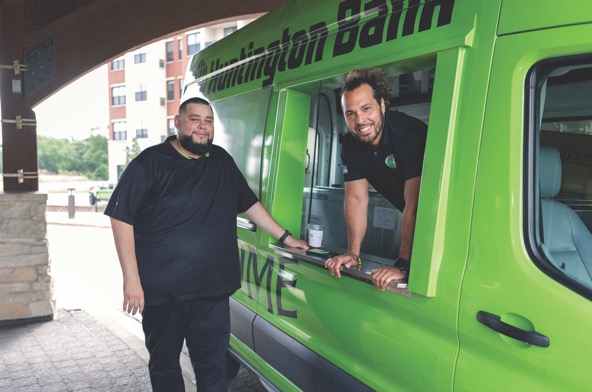 Alberto Perez (left) and Michael Barrera of Huntington Bank attend the SDA’s June 2026 Coffee Connections Event at Krema Coffee House in Tinley Park. (Photo courtesy of the SDA)
“We are helping them think strategically about the development of a block, a neighborhood, and a corridor,” Kemp says about the SDA’s consulting services, which also involve assisting suburbs with the acquisition of property for development and gaining access to governmental grants for infrastructure improvements.
For help developing commuter-friendly infrastructure around the district, the SDA has worked with the village to obtain a transit-oriented development (TOD) grant from the Northern Illinois Transit Authority (formerly the Regional Transportation Authority), which oversees Metra, the Chicago Transit Authority, and the Pace Suburban Bus system, all serving the Chicago area. The SDA has identified TOD as being critical to the Southland’s revitalization, and the data may bear it out. A 2019 joint study by the National Association of Realtors and the American Public Transportation Association estimated that by being located within a half mile of transit, homes can benefit from a 4 to 24 percent increase in property values compared with homes farther away. The Federal Transit Administration puts the numbers higher, stating that various studies have shown that transit projects can raise nearby property values by 30 to 40 percent, and possibly as much as 150 percent under ideal conditions.
“The south suburbs are blessed with a lot of good transit options, as you have the Metra Electric going through a lot of the 45 Southland towns,” says Nicholas Greifer, the SDA’s director of economic development. “That’s an important part of what we do.”
Even as the SDA concentrates on making the Southland a vibrant place to live, work, and play, Kemp stresses that the region should not be seen as a zero-sum alternative to Chicago. Rather, he envisions a Southland renaissance as a rising tide that could lift the boats of other Windy City communities near the region. But Kemp makes no bones about supporting the home team.
“Our hope would be that the development of the south suburbs also facilitates the development of the South Side of Chicago,” he says. “But if you had to make a business decision, the Southland today probably presents as a faster opportunity to execute that.”
Measuring Impact
The business of revitalizing once-thriving regions can be laborious, as the fruits of economic development take time to grow. And like many who have come from the private sector to municipal government and the politically intensive world of economic development, Kemp has had to exercise patience working toward a bigger picture.
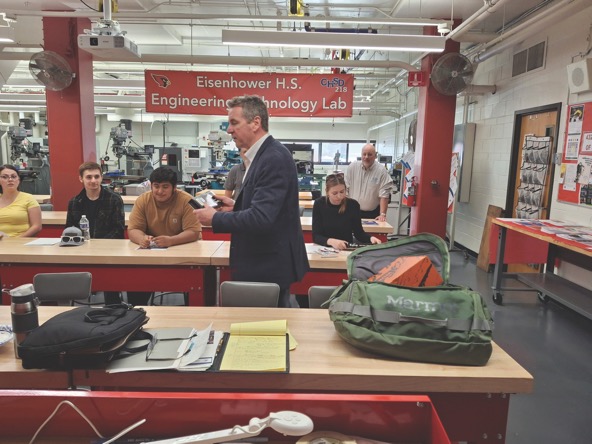 Southland high school students meet with former SDA Metals HUB Director Harry Holtz to launch the SDA Metals HUB Engineering Technology Internship Program. (Photo courtesy of the SDA)
“Part of the reason that government can run slower is that they have to account for every single one of their choices, good or bad, in a way that a private entity never does,” he says. “Most people, once you move them from one space to the next, they struggle in that transition, because it’s very different.”
To assess the value of its work, the SDA created a composite multiplier model from an industry-standard economic-software program, the calculations of which are publicly available through print materials, its website, and a 12-plus-minute presentation on the organization’s YouTube page. The model consists of inputs that measure direct effects like spending on services and programs, and indirect effects such as growth to employment and the tax base, as well as induced effects, which is income spent in the region by workers.
For 2024 (the most recent year available), the SDA estimates that the total economic impact of its work with businesses exceeded $25 million, or $7.30 for every dollar invested by the organization. According to the SDA, 75 to 80 percent of Southland enterprises it assists are owned by people of color, and around 65 percent are women-owned. Combining business development with initiatives such as the South Suburban Land Bank, housing development in Harvey, and its municipal consulting services, the SDA estimates that its work has generated a regional economic impact of more than $211 million from 2020 to 2024. “When we invest in the Southland, we are trying to create ecosystems of people and organizations that can execute even if we were no longer in the market,” Kemp says.
The SDA’s ultimate ambition is to make the entire Southland desirable to residents and businesses, be they new, existing, or prospective. To achieve that, Kemp and his colleagues believe that the organization must concentrate its focus on less affluent places like Calumet City, Harvey, and Hazel Crest—which are at least one-sixth below Illinois’ median household-income level—while keeping residents from leaving places like South Holland, where economic security is being threatened by rising business disinvestment. The organization’s hope is that those suburbs can gradually become more like Mokena, Orland Hills, Tinley Park, and the predominately African American Olympia Fields—four Southland suburbs with high homeownership rates and median household incomes surpassing $100,000.
“We try to identify those populations where we think there’s the biggest upside, because they’ve had underinvestment for a long period of time,” Kemp says. “We make sure that a lot of our resources are directed to those that have not had that target in the past.”
The SDA and its partners have occasionally hit bumps in the road. Some are financial: The Harvey housing project hit unforeseen rehabilitation issues that raised construction costs and ate into a bank loan. Those issues were compounded as interest rates, at the time, were elevated nationwide. Other difficulties are bureaucratic, such as when the permit and inspection process on projects like Harvey slowed down contractors. Then there is the task of getting people in the Chicago area to take the Southland seriously as a place to do business and live.
The SDA has been able to acquire new loans from philanthropic organizations for the Harvey project, which it estimates as having generated more than $4 in economic impact for every dollar spent on the purchase and development of properties. Like other organizations with big ideas for achieving economic-development goals, it has had to soldier on in the face of factors beyond its control, such as higher interest rates, municipal red tape, or convincing people to believe in the Southland’s future. The SDA does not shy away from addressing those challenges explicitly, which it documents in case-study-like blog posts on its website.
“What the SDA is doing is building trust with residents, business, and municipalities,” Pogge says. “Are there those who want to go faster than others? Of course. But I think the SDA welcomes that, because they also want to move fast.”
No Margin, No Mission
The SDA, like many nonprofits around the country, is facing headwinds from declining government financial support and economic instability.
The SDA early on received federal support from the pandemic-era American Rescue Plan Act and has more recently received funding from such agencies as the DOE, the Department of Labor, and the Small Business Administration. But from its inception, the organization was working toward the day when it could produce the majority of revenues from its own activity.
Kemp says the SDA currently generates up to 45 percent of its own funding through property sales tied to the South Suburban Land Bank and its municipal consulting work. Along with leveraging the capital raised through its Monarch Fund, the organization aims to generate two-thirds of its own revenues by the end of 2027.
Many nonprofits had already been swimming against the tide prior to funding cutbacks, as 30 percent do not survive past 10 years in business due to numerous difficulties, according to the National Center for Charitable Statistics. Like the SDA, Kemp feels that nonprofits will need to be nimbler in the future, writing in the Winter 2026 issue of this magazine that “they must innovate to grow, creating new and robust revenue streams on which they can offset funding losses.”
Prior to the formation of the SDA, Kemp met with officials of the Philadelphia Industrial Development Corporation (PIDC). Sam Rhoads, PIDC’s former executive vice president, sees parallels between the SDA’s operations model and that of the PIDC, which generates revenue through loans and real estate assistance to growing businesses (among a variety of services it provides throughout Philadelphia), and receives government support at the federal, state, and municipal levels.
Like Kemp, Rhoads believes that nonprofits will have to become more adaptable with their business operations, anticipating that government funding might occasionally dry up due to a variety of factors. “The pressure is always on economic-development organizations to be creative and to think about how you can fulfill your mission,” says Rhoads, who retired from the PIDC in May 2026. “The famous phrase for nonprofits is, ‘No margin, no mission.’ If you don’t at least break even, then you can’t fulfill your mission.”
Now more than a half decade into its existence, the SDA is nearing its original goal of being a self-sufficient vehicle that produces its own revenues—or at least the lion’s share. “We are disrupting not-for-profits and economic development,” Kemp says. “We attack problems differently, and we’re financed differently than most other not-for-profits.”
The SDA continues to raise its profile with its existing work, along with solidifying its community influence through sponsored events and webinars that are also opened to small and midsized businesses it hopes to attract. The organization has backed a new, half-day networking event for local content creators, some of whom might be on the ground floor of documenting the Southland’s socioeconomic rebirth. Perhaps its biggest public event to date is the ACHIEVE Summit, a three-day networking affair for Southland entrepreneurs and white-collar professionals that celebrated its second year in June 2026, and which has featured keynote speakers from outside the region like Daymond John, founder of hip-hop clothing line FUBU and a star investor on the ABC reality show Shark Tank.
The SDA has come a long way since its founding, but it faces a longer journey in translating its regional ambitions into evidence-based results beyond the economic impacts it likes to calculate and tout. So far, the SDA has avoided the pitfalls other nonprofits have encountered in trying to scale up their ambitious undertakings. And as the story of the Southland’s renaissance continues to be drafted, the SDA may end up being one of its heroes.
Read more stories by Kyle Coward.