


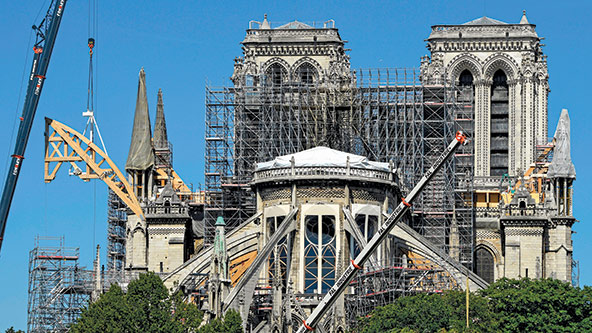
 The reconstruction of Notre-Dame de Paris cathedral after its catastrophic fire on April 15, 2019, has sparked debate in France about philanthropic giving and inequality. (Photo by Bertrand Guay/AFP via Getty Images)
On the evening of April 15, 2019, a fire broke out in the Notre-Dame de Paris cathedral and nearly destroyed the historic structure. In the days that followed, rich individuals and corporations poured in donations to restore it. Their contributions added up to almost €1 billion ($1.12 billion). Such largesse sparked controversy. The yellow vest movement was roiling France, triggering massive and at times violent protests against cuts to social benefits and increased taxes in a context of rising inequalities.
Many French commentators drew a parallel between the cathedral’s near collapse and the threatened disintegration of the French social fabric. They criticized rich donors for being oblivious to social realities while favoring strategic causes to improve their brand image and benefit from tax cuts. In response, several donors stated that they would give up the tax advantage related to their donation. Bernard Arnault, CEO of LVMH and France’s richest individual, who pledged €200 million ($224 million) from his companies and family fortune, complained that in other countries, donors would be congratulated instead.
For Frédéric Théret, the fundraising director of the Fondation de France (FDF), this situation and the challenge that came with it were unprecedented in France, where such massive gifts were almost unheard of. “Not a single cause in France has raised so much money with so few donations,” he says. “The 10 biggest private donations for Notre-Dame made 90 percent of the billion raised. Only €30 million [$33.6 million] came from smaller donors. This is a cruel reminder of inequalities and of the concentration of wealth.”
In the evening of the disaster, most French households were willing to make a donation. Yet the mega gifts of Arnault and his peers made small donors feel that their contributions were meaningless. “This discrepancy confiscated their possibility to participate,” Théret says. The FDF, one of four French organizations that stepped in to collect money for Notre-Dame, raised a total of €9 million ($10 million) from small donors to support the cathedral’s restoration.
The freedom of donors to give to causes of their own choosing, independently from any democratic process and without necessarily prioritizing society’s needs, has been an object of recent controversy in the field of philanthropy. Stanford University political scientist Rob Reich has pointed out how tax breaks for donations arguably subsidize one individual’s pet cause at the expense of the public—an undemocratic outcome that needs justification. This raises the question of whether philanthropy can be democratic and, if so, under what circumstances.
FDF has sought to foster a democratic version of philanthropy since its 1969 creation, initiated by President Charles de Gaulle and André Malraux, then minister of culture. Its initial endowment was provided by France’s public banks, but it was set up to collect additional funds from myriad small donors to address needs as diverse as poverty, education, culture, health, and the environment, supporting nonprofit actors on the ground with grants and technical support. In addition, it quickly organized to provide more wealthy individuals with the opportunity to create their own donor-advised funds (DAFs), as a means to guide them through the complexity of making impactful gifts.
Over its five decades of existence, the FDF has developed three key practices to ensure that the funds it mobilizes and distributes serve the real needs of society. First, it collects from a variety of sources, thereby increasing its independence while ensuring more access to funding. Second, it has developed inclusive governance structures that empower a variety of policy makers, civil society actors, experts, and beneficiaries in the grantmaking process. Finally, it implements a bottom-up approach to designing its programs that ensures that individuals and communities who are the intended beneficiaries of the programs help shape them. In this way, the FDF provides a great test case of an attempt to do democratic philanthropy.
The Origins of Fondation de France
In postwar France, philanthropy was an underdeveloped phenomenon. Before the creation of the FDF, there were only 250 so-called foundations in the country, compared with 15,000 in the United States. Most of the few French foundations were operating health, social, or educational services for the poor or the disabled. Until 1987, foundations even lacked a specific legal status. The most ambitious ones could obtain from the state a special authorization to operate as a foundation, after a very tedious administrative process of approval by the government. Yet most existing organizations called foundations were in fact traditionally incorporated under “association loi 1901,” France’s most prevalent nonprofit form.
The renewal of interest in philanthropy in the 1960s was spurred by the increasing needs of France’s ambitious cultural policy. After the fall of the Fourth Republic due to governmental instability, the Fifth Republic emerged in 1958 around the figure of General de Gaulle, an icon of the French Resistance. De Gaulle saw culture as a powerful way to unite the French people. He therefore created a new Ministry for Cultural Affairs in 1959 with the goal of providing “most of the French people access to the major pieces of art of humankind, and foremost of France” and tasked Malraux, its first minister, to make culture accessible to all citizens.
Democratizing culture was an ambitious goal, which required funding. Private sponsorship appeared as an interesting lever to support these goals. This attempt at mobilizing private funds to support public goods reflected the rising interest for a third way in a world polarized between market liberalism and state interventionism. As civil society grew and social expenditures increased, many reformers saw the postwar welfare state as increasingly inadequate to handle the social changes and financial challenges ahead. They turned instead to the development of a third sector, made of associations and foundations.
The students’ protests in 1968 expressed this refusal of the preeminence of a bureaucratic state in civil society. “The recent unrest brings to the forefront the ideas of participation, autonomy, and comanagement,” Michel Pomey said at the time. “They encourage us to imagine the structures to answer these claims with discipline, freedom, and efficiency.” A senior official and member of the State Council, the highest administrative jurisdiction in France, Pomey would play an important role in FDF’s creation. François Bloch-Lainé, a senior advisor to Malraux who also participated in the creation of the FDF, said that “the idea was to bring out new mediators between citizens and the state, which cannot meet the needs of the community alone.”
In the search for new ideas and models, French policy makers turned to the United States to seek fresh ways to reconfigure the provision of the common good between public and private actors. In 1965, Pomey, who would soon be nicknamed “Mr. Foundation in France” by his American counterparts, visited the United States to understand the functioning of American foundations. Community foundations, which are designed to pool donations into a coordinated grantmaking facility dedicated to a given place, caught his attention. In contrast to private foundations created by a single donor to address a specific cause, community foundations were unique tools to mobilize a large pool of donors to tackle a broad range of issues. He returned with a clear and simple recommendation: Create in France a grantmaking foundation inspired by American community foundations that was dedicated to funding “the margins of social progress, for innovation, experimentation, and the exploration of possible futures.”
The FDF was thus created in 1969 as a private foundation designed to pool philanthropic resources from French citizens to support the development of cultural, social, and environmental innovations across the country. It was also meant as a tool to modernize and boost French private philanthropy, in a context where the existing foundations were mainly charities created in the late 19th and early 20th centuries for the provision of social services. The public roots of the foundation and its clear mandate to serve the common good led to the development of processes and practices to ensure that the resources mobilized were indeed used to best serve democratic ideals.
Diversified Funding
Recent critics of philanthropy point to the disproportionate influence of elite donors’ preferences on the decisions made by foundations. But the FDF has managed to mitigate this influence in several ways. First, it has diversified its revenue sources. From inception, the FDF has relied on a combination of revenues from an endowment built from diverse assets, small gifts from a large pool of donors, and a range of closely monitored DAFs. In this way, the FDF maintains a solid financial base without depending on a narrow set of donors.
The initial endowment to the FDF of Fr 16,250,000 (about €2.5 million, or $2.79 million) included donations from 15 French financial institutions, orchestrated by the Caisse des Dépôts et Consignations, France’s largest public bank and credit institution. This initial private endowment was insufficient to fund the FDF’s ambitious goals, so its leadership decided to raise additional gifts, whose number and amount have gradually increased over the years as the foundation built its reputation. Earmarked gifts were initially predominant, namely for social and medical research purposes, but in the mid 1980s, the trend reversed, and by 1992, 67 percent of the gifts were unrestricted, allowing the FDF to use them to develop its own programs.
The FDF immediately distinguished itself from other foundations, which were traditionally created by a single family, by its ability to attract large gifts, some of which were used to increase the FDF’s endowment. In 1983, Napoléon Bullukian, an art enthusiast who had made a fortune in construction, made a gift of Fr 20 million (about €3 million, or $3.34 million) in real estate in favor of artistic creation and medical research. He gave an additional Fr 60 million (about €9 million, or $10 million) to the FDF in his will. The same year, Martial Lapeyre, CEO of a carpentry business and passionate about history, made a bequest of Fr 200 million (about €30 million, or $33.4 million) to the FDF, earmarked to preserving the memory of the French emperor Napoléon Bonaparte.
French law progressively increased tax exemptions for philanthropic gifts, first in 1987 and then in 2003, making them all the more attractive for donors and for the foundation. In 1992, the FDF received in one year as much in bequests as during the whole decade of the 1970s. “Some donors’ requests were constraining, but the foundation was still a fledgling structure,” says Dominique Lemaistre, FDF’s current grantmaking director. “It had to survive. We accepted everything that was given to us.” In 2018, the FDF’s endowment reached €117 million ($130 million).
Early on, the foundation also started launching fundraising campaigns to increase its reach and build up its reputation around meaningful themes. The first campaigns with national scope—one for disabled children in 1970 and another to mitigate the loneliness of the elderly in 1975—were both successful. The FDF raised Fr 100 million (about €15 million, or $16.7 million) and Fr 40 million (about €6 million, or $6.7 million), respectively, for the causes. With the help of direct mailing, the FDF began launching yearly national fundraising campaigns targeted to individual donors and companies in the late 1970s. These campaigns, which raise large amounts of small (mostly unrestricted) gifts, allow the FDF to distribute grants to fund society’s evolving needs, including causes such as poverty, medical research, education, culture, environment, international development, and humanitarian emergencies.
In 2018, the FDF raised €26 million ($29 million) from 470,110 donors. The profile of the typical donor has remained rather constant throughout the history of the foundation: 50 years old or older, he or she is an executive, middle manager, or pensioner with an average or high income. As such, FDF donors are quite homogeneous and more affluent than the donors of other organizations, such as humanitarian NGOs, that usually appeal to more diverse profiles.
Between the revenues of the endowment and the funds raised, the FDF was able to distribute about €40 million ($44.6 million) to its various programs in 2018. And while some of the funds are earmarked—as was, for instance, the case when the FDF received in the 1980s legacies from AIDS patients earmarked for medical research—most of them are not. Such nonearmarked funds from a multitude of small donors give FDF the freedom to allocate them to best meet underserved social needs.
Finally, to encourage the growth of private philanthropy, the FDF also developed, from the beginning, a new type of service for larger donors: donor-advised funds (DAFs), which gave them access to the tax breaks granted to any philanthropic gift in France, without the hassles of creating a stand-alone foundation. These funds were designed after the American model that Pomey observed in the United States. Through the support, advice, and management offered by its staff, the FDF ensured that its philanthropic initiatives were as relevant as possible. To do that, the FDF used the expertise that it developed over time through its own programs. The foundation hosted only three DAFs in 1970 and 200 in 1990, and hosts 860 today. The DAFs amounted to an aggregated endowment of €1.7 billion ($1.89 billion) in 2018 and distributed €180 million ($199 million), including €40 million ($44.5 million) to FDF’s own programs and the rest to other nonprofit organizations.
DAFs are less democratic than other forms of philanthropy because donors have control over how their funds are spent. But the FDF has encouraged more democratic practices for DAFs. Since French law is quite flexible when it comes to their management, the FDF started to set formal rules for their governance in the late 1970s. This led to the definition of four possible models of governance for DAFs: through a steering committee, a family circle, the founder alone, or the FDF itself when the fund is a bequest given without specific individual governance requests. “Each fund has its own story and its own specificities, so it does not make sense to impose one-size-fits-all governance processes for these funds,” Lemaistre says.
The FDF nevertheless encourages all DAF funders to open their decision-making to collaboration, through using a diverse steering committee. “We always recommend that the founders surround themselves with councils, committees, and volunteers that contribute alternative voices to the decision-making process,” FDF Executive Director Axelle Davezac says. Of the 860 DAFs, 83 percent are managed with a steering committee. In addition, the FDF oversees each fund to monitor compliance and administrative assistance. Importantly, it also provides funders with informal advice or more formalized recommendations, according to demand, to help them design meaningful philanthropic projects.
“We strike a balance between respecting their motivations and convictions, while encouraging them to take into account the lessons that we have learnt from 50 years of philanthropic interventions,” Davezac says. “There is a tension between the funders’ personal aspirations, their desire to be personally involved, the required commitment to meet social needs, and the acceptance of the collegial decision-making process. We must prove that collegiality is not a constraint, but a necessary condition for the successful provision of social value and, ultimately, a real asset for their fund.”
Take, for example, the A&P Sommer Foundation. When Adrienne and Pierre Sommer decided to pursue philanthropy, they were childless but very fond of their dog and desired to support “animals in need.” When they reached out to the FDF to host their philanthropic initiative as a DAF in 1984, they discussed their idea with Guy Courtois, then FDF executive director, and the FDF’s board recommended that the DAF work on both animal and human well-being. Fifteen years later, thanks to a highly qualified committee of experts, the A&P Sommer Foundation has become France’s premier philanthropy for “animal mediation”—introducing animals in institutions (elderly homes, prisons, homeless shelters, homes for disabled children) for therapeutic benefit. While the first call for animal mediation projects received only 20 applications, the program now receives about 200 each year.
Inclusive Governance
In addition to diversifying its revenue sources, the FDF pursues a democratic form of philanthropy by using inclusive governance practices to incorporate a wide range of voices from French society into decision-making.
The FDF’s governance structure was specifically designed to foster pluralism. From the beginning, a volunteer board of trustees has governed the foundation. The board is composed of 20 to 30 members equally drawn from three groups: representatives of the founding financial institutions, members appointed by leading government ministers, and members representing civil society selected by the other members of the board through a majority vote by secret ballot. This tripartite composition is meant to attract a diversity of skills and backgrounds from all of French society. The selection process gives special attention to beneficiaries, including young people, women, and non-Parisians, as well as people from various professional backgrounds, including scientists, doctors, and trade unionists. Mobilizing greater diversity, however, remains challenging in a context where academics and professionals are traditionally viewed as the most knowledgeable and legitimate. The short duration of the terms (four years, renewable once) fosters turnover, which is meant to increase diversity and prevent bureaucratic rot.
The board of trustees sets the FDF’s strategic direction, approves the budget, and validates its main programs. Five additional volunteer committees help the board oversee the foundation’s strategy and operations: a financial committee (to monitor the investment of the endowment), an audit committee (to oversee budget and finance), a remuneration committee (to oversee staff compensation policies), a DAFs committee (to oversee the foundation’s donor-advised funds directly governed by the FDF), and a gifts committee (to oversee the compliance of large gifts and bequests).
The board delegates grantmaking recommendations to volunteer committees, one per program, facilitated by the executive team. This practice of relying on experts’ and beneficiaries’ advice to decide how to allocate funds originates from the FDF’s first fundraising campaign. As it started to explore how to best run and manage La Croisade des Coeurs, its campaign to support disabled children, the foundation team realized that the field was very scattered, made of a diverse range of nonprofits, including family associations, medical institutions, and educational facilities. To coordinate its work with such a diverse crowd, the FDF built a coalition of diverse voices in this field, including researchers, experts, and families with disabled members. This step enabled the foundation to draw direct insights from the field, learn about the limitations of existing service providers, and identify innovations worth supporting. The coalition was initially enlarged to address other causes funded by the foundation, but as the range of programs grew, this first committee evolved and split into specialized ones.
“Foundations are, in essence, very undemocratic, as decisions are traditionally concentrated in the hands of a few donors,” Lemaistre says. “Since the foundation’s early days, we have worked to avoid this trap. At the level of each of our 32 programs, all grantmaking recommendations are made in a completely collegiate manner.”
The 32 committees associated with each program are composed of 10 to 18 members each, for a total of more than 300 voluntary experts selected for their program-related expertise or experience by the FDF staff or other committee members. They are appointed by the president of the FDF board for a three-year term, renewable once. The foundation pays close attention to the diversity in expertise and profiles of the members.
“There is really this concern, when building committees, to make them representative and to include beneficiaries’ voices,” FDF Executive Director Davezac says. “One person, whether a donor or a professional, cannot alone decide what is in the best interest of the public. Collegial governance processes, which are slated in our bylaws, are key to ensure that we stay true to our democratic ideals by practicing democracy internally.”
Adaptive Program Design
Serving the needs of a large, diverse society requires flexibility as well. The FDF has learned over the years to adapt its interventions to local contexts and to take into account how public needs can evolve over time. This has led the foundation to stay open to a variety of tools and strategies. It has also required finding ways to listen to local social needs and then design the type of support that may be needed at a given point in time.
Consider how the FDF decided on its first national campaign, La Croisade des Coeurs. François Bloch-Lainé, one of the FDF’s cofounders, and Lino Ventura, a renowned actor in French cinema who had created a nonprofit to support disabled children because he had a mentally disabled daughter, brought the cause to the FDF’s attention. The Ministry for Social Action and Rehabilitation, to whom the FDF had reached out to better understand the issue, encouraged the foundation to raise funds and get involved in coordinating their use. The FDF saw its role as supporting social innovations that would complement the state’s intervention.
The program committees have also helped the FDF remain nimble. In the 1970s, the FDF pioneered funding for edge causes such as coastal protection and mental illness. In the 1980s, it launched new initiatives around AIDS research, international development, and support for the elderly. In the 1990s, the FDF mobilized support for major international emergencies (such as Romania, Bangladesh, Somalia, Iran, Bosnia, and Kosovo) but also developed programs to support culture and the arts as well as teenagers’ health programs. In the aughts, the FDF launched new programs to fund initiatives to prevent school violence, provide parenting support, foster social and professional integration, and support environmental causes.
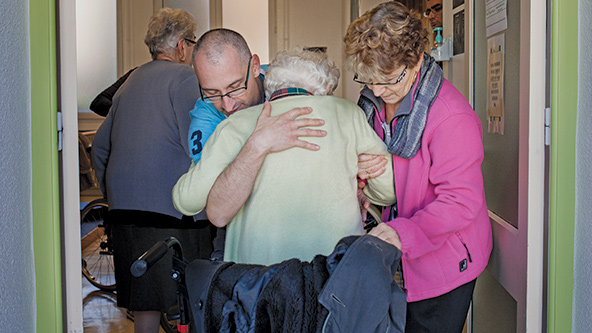 The Fondation de France’s commitment to palliative care has transformed the way French health care approaches end-of-life treatment. (Photo by Theophile Trossat courtesy of Fondation de France)
Over time, the FDF not only adapted the focus of its programs but also developed a wide range of grantmaking approaches to best achieve impact in a given field. The FDF has supported individual grants to researchers if more research is needed on a specific topic. It has issued more open calls for proposals to foster innovation and identify ideas developed by people on the ground working on a specific problem. It has funded long-term capacity building to help a few leading organizations bring their innovation to scale. It has also supported events or conferences that bring together civil society and policy makers. “What is key is not to come with preconceived ideas of what support is needed,” Davezac says. “We constantly try to imagine, work, and build with all the people who are involved in the subject.”
The foundation is also flexible about its time commitments. When required, it is able to support long-term (20 to 25 years) programs, a time horizon required to address complex social issues. But it is also open to work on shorter-term initiatives, to explore new issues or validate the FDF’s ability to create positive impact in a given field.
Palliative Care
The FDF’s program for palliative care provides a compelling illustration of the foundation’s readiness to adapt to society’s needs over time, carving out for itself a unique position between civil society and policy makers. The FDF started to support palliative care initiatives in 1988 when a doctor on the health program committee pointed to the total absence, in French hospitals, of any measures intended to enhance the quality of life of terminal patients. The foundation started with a few experimental grants to hospitals and care facilities and slowly scaled up from there to become the financial backbone of the growing palliative care movement. Eventually, as the state took over this role, the FDF decreased its activity and moved on to other pioneer programs.
“We take a very long-term perspective, with the idea that at the end of the program, a solution to the problem is institutionalized, that doesn’t rely on our intervention anymore,” Lemaistre says.
In a first step, during the 1990s, the foundation focused on identifying the very few players who were inventing the practice of palliative care under the radar in large medical institutions. At the time, most doctors were focusing on medical treatments only, and the idea that resources should be devoted to enhance patients’ psychological and physical well-being as they approached death was considered extravagant.
After this first exploratory phase, the FDF started to support the building of a movement by encouraging exchanges and collaboration among these scattered groups. They funded the creation of an academic society, the French Society of Support and Palliative Care, and helped set up the first university degrees in that field. The foundation went on to support the creation of specific living rooms geared for the use of patients’ families in care facilities, helped create discussion groups for both staff and families, and funded the production of documentaries to help raise awareness of the suffering of nursing staff in the face of the pain and death of their patients.
The FDF’s commitment to palliative care strove to transform the way death was seen in the medical field, and it generated tremendous controversy. Isabelle Marin has been working as a doctor in palliative care in various hospitals since the emergence of the practice in the 1980s. “It has become more institutional now, but it is still met with great resistance,” Marin says. “In the same way that death is considered as a sign of failure for medical science, palliative care is seen as an alien extra-medical activity.”
Her first encounter with the FDF goes back to 2001, when she inaugurated a family lounge funded by the foundation in her hospital: “We were pushing to make room for nonmedical interventions and to open the hospital to other worlds. The family lounge is a space which does not look like a medical space. We tried to make it look like a real living room, with normal furniture, to create this enclave in the hospital. The hospital was initially reluctant, and when they ended up accepting the idea, they still did not want to pay for it.” The FDF paid for the lounge furniture. “Having this funding was an argument for our hospitals, so that they would also give us the premises,” Marin says. “The hospitals needed a bit of pressure. This is what Fondation de France was for. It helped us to put pressure on the hospitals.”
In 1999, the French government adopted a new law officially recognizing palliative care as a legitimate practice and providing public funds to develop palliative care centers in main hospitals. In 2005, a second law was passed to strengthen the rights of persons at the end of their life. Progressively, the state took over what the FDF had initiated, leading the foundation to reorient its action. “The FDF played an important role in pointing out the gaps in the system and pushing public authorities to step in,” says Régis Aubry, a doctor and director of palliative care at Besançon’s hospital. “For palliative care, the foundation acted like a whistleblower in the face of a collective denial.”
As palliative care was progressively introduced in public hospitals, the needs evolved and the FDF reoriented its activities to take up new challenges in a second phase. “Obviously, we had to adapt. We couldn’t keep supporting what was now supported by others,” Lemaistre says. To adapt its positioning, the foundation turned to its health committee, composed of medical experts with very diverse backgrounds. “The feedback from professionals was essential for us to understand what was happening on the ground,” adds Lemaistre.
The FDF decided to turn its focus toward caregivers, through practice analysis groups, training sessions, and regional and national thematic meetings. It also focused on two areas in which the palliative approach was still in its infancy: geriatrics and pediatrics. In pediatrics especially, death was taboo. The FDF brought the topic to the public’s attention by supporting the production of a movie, professional conferences, seminars, and various publications. In 2002, it helped set up a working group on the limitation or cessation of pediatric intensive care treatments. In 2010, the creation of a pediatric palliative care team with public funding consecrated the recognition of the field and marked the success of the adaptive strategy of the foundation.
The foundation eventually decided largely to stop its palliative care program in 2010, because most of the work institutionalizing the practice had been achieved. This decision spurred debate among members of the health committee, some of whom felt that the work was not yet over. “The field of palliative care now exists and is legitimated, but there is still much to be done,” Marin says. “People on the committee wished the program had kept going: Public hospitals are going through a crisis, so it’s a nightmare to get funding.”
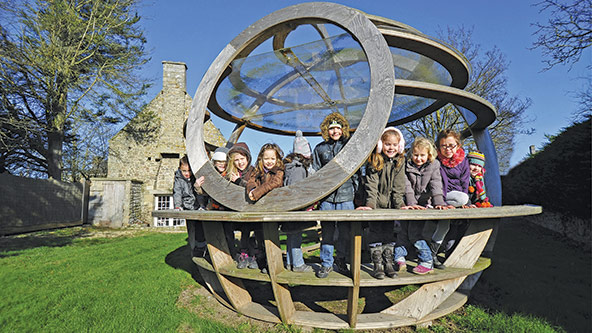 Children gather on the outdoor playground structure they helped design at Le blé en herbe school in Trébédan, Brittany, France. (Photo by Alain Pinoges courtesy of Fondation de France)
But the FDF wanted to reallocate its means to new programs: “With limited resources, we were not able to run many major programs in parallel, and we knew at the time that the field of palliative care was strong enough so that it would keep going without our support,” Lemaistre says. “We had been waiting to focus on new issues for a long time, namely the living conditions in prisons and the reintegration of ex-convicts.” The foundation thus has to walk a fine line between being attentive to the needs on the ground while keeping a broader perspective on what its role in society should be. “Our goal is to provide evidence that some solutions can work,” Davezac says. “But we cannot substitute ourselves for the state.”
Citizens in Command
The FDF also believes it should not substitute itself for the communities it seeks to serve. Its program Les Nouveaux Commanditaires (New Patrons) illustrates how it has tried to avoid the elitist drift of philanthropy. The program was developed in the 1990s to provide financial help and artistic guidance to groups of citizens willing to use art as a means to satisfy local needs. In doing so, it aims to fully reverse the top-down dynamics in the art sector by drawing artists and society closer. “It is not just about asking citizens what they think about a specific artistic project,” Lemaistre says. “It is about giving them the power to be themselves in command of the project.” The program also aims to reconnect contemporary art with the general public and its needs.
“Today, society doesn’t ask anything from its artists anymore,” notes Lemaistre with regret.
The FDF program sought to bridge this gap by anchoring art in circumstances that citizens could directly understand. François Hers, the artist entrusted with the program, advocated for a more democratic conception of art grounded in civic life. “Exhibitions in a museum are not enough,” he says. “Isn’t the goal of art to help us live, to make us discover new ways to relate to the world?”
The program seeks to empower the wider public and give people the necessary tools to become art commissioners. A cultural mediator provides citizens with expertise on contemporary art and brings together public and private resources to finance projects. “As an expert of contemporary art, the mediator can facilitate the encounter between the artists and the commissioners,” says Catia Riccaboni, the FDF’s head of cultural programs. The mediator helps citizens to formulate their needs and then suggests an artist who can help the commissioners refine their expectations. The artist is given the necessary freedom to develop his or her artistic response to these needs. These collaborations can take unexpected turns, as was the case with the project Le blé en herbe (“Wheat grass”) in the small village of Trébédan.
Located in Brittany, a region in northwest France bordering on the English Channel, Trébédan is a typical victim of what could be called the “cultural desert of the hinterlands.” The inland town is largely populated by factory workers and low- to middle-income families. The town’s school, called Le blé en herbe, serves as a kindergarten and primary school for 80 students. When the school director contacted the FDF to help carry out an artistic project for the village in 2007, the decrepit school reflected the challenges faced by the town: poor insulation, presence of asbestos, a Portakabin used as a kindergarten classroom for three decades.
The school director and her colleague had tried to give a new impetus to the community through several school projects with parents, elected officials, and senior citizens. But they were eager to go even a step further and reached out to the FDF to participate in this Nouveaux Commanditaires program with the hope of carrying out an art installation around the water springs of the village, as a follow-up to a longtime school project. This proposal was deemed unconvincing by Anastassia Makridou-Bretonneau, the cultural mediator assigned to the project. “The village was dying, and they wanted to use art as a Band-Aid. I thought they could have higher goals,” she says.
With her help, the commissioners, including the school’s teachers and headmaster, the mayor of the village, a few students’ parents, and other residents, were soon able to come up with a more meaningful proposal: transform the school to make it the center of the community life. “They had probably ruled out this possibility in the first place out of modesty and realism,” explains Eric Foucault, the technical mediator of the project. “No one was daring to voice the idea that the school itself was the subject of the proposal. I was the one who opened this door,” Makridou-Bretonneau adds. Matali Crasset, a world-renowned industrial designer, was commissioned to design this new ambitious initiative.
The new Blé en herbe reopened in 2015 after a long maturation process and repeated iterations negotiated between the artist and the commissioners. Crasset created a set of structures meant to boost and enrich the active and open pedagogy favored by the school’s teachers. She designed two monumental entrances into the lunchroom and the library: one turned toward the school, the other toward the village, to invite their use by the community outside of school time. The intricate connection between the school and the village is reiterated by four building extensions, in which residents and students can play, read, or meet.
“The commissioners wanted to show that the school could serve as the heart of the village, an intergenerational and open place,” Foucault says. Crasset further designed permeable buildings, shared spaces, and classrooms open to the outside with large windows. She also created a set of modular furniture that children can move on their own. She imagined the school as “a tool for active teaching where creativity is ubiquitous,” she says. “Educational policy, economics of education, environment, solidarity, culture—all these subjects are addressed in this project; art connects them.”
Did the program achieve its ambitious objective of putting citizens in command of art? Estelle Zhong Mengual, a sociologist who conducted the impact assessment of Les Nouveaux Commanditaires in 2017, more than 20 years after it began, recognizes the challenges associated with the mobilization of citizens on a topic as culturally biased as the arts. “Participation is based on self-initiative and volunteerism; this is partly socially discriminating,” she says. “Disenfranchised citizens or employees working in socially disqualified jobs rarely step in to make a command.” Yet, thanks to the work of the mediators and the collective dimension of the arts commissioning, the FDF took a real step in making the arts more accessible to citizens traditionally excluded from arts patronage.
Challenges Ahead
The FDF has pursued many different strategies, with varying success, to avoid some of the pitfalls of elite philanthropy. Democratizing philanthropy is an idea that is far from an easy task in practice, and the FDF is well aware of current and coming challenges.
Implementing collegiality in governance processes is, for example, a constant struggle. While diverse committees of beneficiaries and practitioners from various backgrounds are strongly desired, their active participation is not necessarily easy to secure and goes beyond their mere presence at meetings. It requires creating a safe space where they can voice their concerns, and feel respected and listened to. “Making these committees work is thus a never-ending process,” Lemaistre says.
When it comes to designing programs, transforming social innovations into lasting and scalable social impact is another major challenge. Whether addressing palliative care, prisons, or the solitude of the elderly, the FDF’s work remains constrained by the degree of its ability to mobilize long-term supporters for the innovations that it helps launch. If effective innovations are to scale and become sustainable, alternative support needs to be mobilized—not an easy task. As in the case of palliative care, the state can sometimes step in. In other cases, local governments, local philanthropists, or volunteers must take the lead. When it becomes unclear who can take over, the FDF faces the difficult question of how and when to stop a program—a question that is all the more acute when the programs on the chopping block have the enthusiastic support of civil society actors.
As it celebrates its 50th anniversary, the FDF can look ahead with the satisfaction of having built an alternative model to some of the most prominent private foundations that counterbalances the influence of major donors by distributing power among smaller donors, civil society representatives, and beneficiaries. In doing so, it nevertheless recognizes that it relies heavily on professionals and experts, whose voices often carry more weight than those of the smaller donors and beneficiaries that the foundation is meant to serve. The FDF is thus constantly walking a tightrope, running the risk of alienating its donors and becoming disconnected from its core beneficiaries. As it moves forward, the FDF’s leadership thus must find creative ways to cultivate this fragile equilibrium between the interests of donors, the specialized knowledge of staff and experts, and the needs of society and its diverse citizens.
Read more stories by Anne-Claire Pache, Éléonore Delanoë & Megan Tompkins-Stange.