


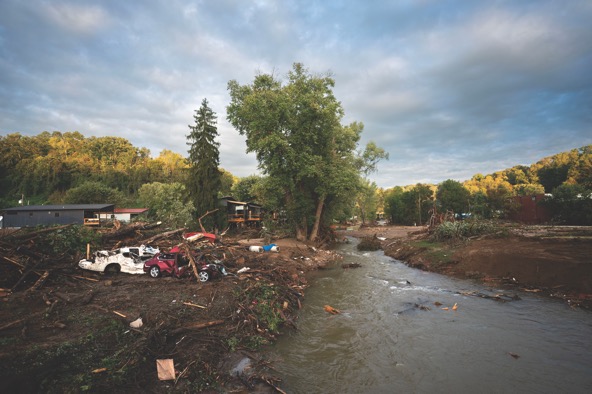
 Hurricane Helene caused flooding and landslides across eastern Tennessee and southwest Virginia and into West Virginia. (Photo by Sean Rayford/Getty Images)
Two years ago, the deadliest storm to hit the US mainland since Hurricane Katrina caused nearly $60 billion in damage in North Carolina alone and redrew the climate-risk map for the entire central Appalachian corridor. After dumping more than 30 inches of rain in parts of the southern mountains, Hurricane Helene triggered catastrophic flooding and hundreds of landslides across eastern Tennessee and southwest Virginia and into West Virginia. Entire towns were affected, and more than 250 people died.
Help did not come quickly. One year after landfall, federal funds covered only 9 percent of North Carolina’s total estimated damage. The Federal Emergency Management Agency (FEMA) took 191 days to issue its first buyout approvals (for only 75 homes, roughly 0.1 percent of the total affected households), leaving many homeowners still paying mortgages on uninhabitable “ghost properties.” Today, families, communities, and landscapes are still carrying the scars of the storm: collapsed bridges that school buses can’t cross, businesses closed or floundering, empty seats at dining room tables, and families struggling everywhere.
This is a familiar story in a place where help rarely comes quickly. But after generations of underinvestment and institutional neglect—on top of a legacy of ecological and economic extraction—our communities have become accustomed to building our own civic and financial infrastructure. And so, after Helene, Appalachians did what we always do in response to disaster: organize.
Our response flowed through waterways built from local connections and community self-knowledge. In Appalachia, trust is often quietly accrued through years of presence, rather than by position or title, something accumulated through enduring relationships, repeated interactions, and shared experience. Communities learn whom to trust by who shows up; who follows through; who exercises sound judgment under pressure; and, most important, who can be counted on when formal systems are delayed, incomplete, or absent. However informal, this accumulated body of evidence serves as a dense record of character, competence, reciprocity, and reliability, enabling fast and adaptive decisions that even well-intentioned bureaucratic systems aren’t designed to make at the speed catastrophe requires.
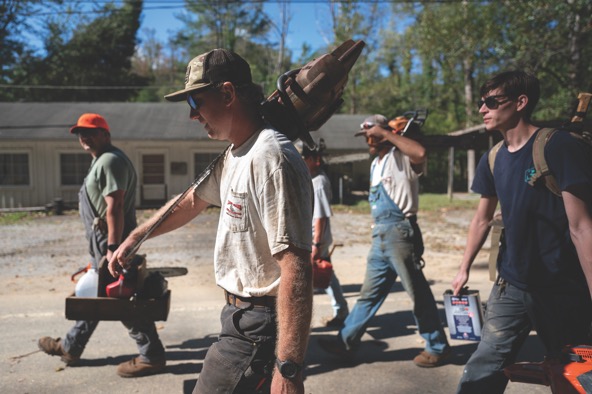 Rebuilding from Helene will take years, if not decades, of work. (Photo by Sean Rayford/Getty Images)
After Helene overwhelmed our formal systems—and while even mandated and budgeted FEMA funds were locked away in (ongoing) litigation—people and organizations who had spent decades building trust were able to coordinate rapidly; make the most of flexible capital tools; and move initial funds within days, millions within weeks, and tens of millions and counting in the months following. While trust is often viewed as a “soft” asset, it is operational infrastructure in marginalized economies, even a form of civic power. Any region that wants to survive compounding crises amid disinvestment needs to start investing in it now, before a disaster forces the question.
While not a permanent substitute for formal systems of support or strong public institutions, those trusted local networks sustained communities through the long wait for more official responses (a wait that, in much of the region, continues even now). While formal systems remained offline—including basic physical infrastructure like cellular towers—community-based organizations stepped in as vital capital pipelines, operating across the region’s full geography. FEMA was delayed, and traditional philanthropy moved much too slowly for the need, but community networks mobilized across 31 counties at a scale that would soon top $100 million. This speed was crucial: Desperately needed financial resources moved quickly into hard-hit communities, where many faced a total loss of income without power or water, where trees and debris were still blocking homes and roadways, and where collapsed bridges and roads prevented people from reaching shelter. Critical relief allowed businesses to stay open and families to stay in their homes (or find new ones), as well as providing immediate disaster relief to communities that could not afford to wait for help to come.
It is important to clarify that this is not a success story. The capacities and resources that were mobilized for acute crisis are not long-term substitutes for recovery systems functioning at scale. What we think of as Appalachia’s “resilience architecture” was born of institutional neglect and generational underinvestment—corporate, federal, and philanthropic—and it has had to carry far more weight than it could ever have been designed to bear. It is often invisible, labor intensive, and compensatory, coming at a high cost to individuals and communities, and doesn’t necessarily build real resilience. But the Appalachian response to Helene offers lessons about building community-driven resilience, alongside much more difficult questions about what has not yet been done. Those questions have yet to be answered: How do we fund the systems required to close the gap between what institutions promise and what communities actually need to receive? What would it take for capital to flow into the region at the scale at which it has historically flowed out? Preparedness is less expensive than recovery, but how do we get philanthropic strategy to fund it that way?
Ours is a uniquely Appalachian story, but it won’t be for long. Appalachia is far from the only postextraction economy facing increasingly acute climate vulnerability, as the Earth gets hotter and the weather gets wilder. Across the globe, the geological conditions that produce valuable minerals and other natural exports are often tied to climate-sensitive landscapes, from the coalfields of Scotland and the mineral economies of Sierra Leone to the tin and tungsten communities of Bolivia (or any region ravaged by extractive practices). And the absence of reinvestment that so often accompanies prolonged extraction tends to leave the same pattern of underdeveloped infrastructure exposed to overheated weather.
We believe the solutions we’ve developed here may be transferable to wherever else that pattern repeats. Of course, we are still a long way from the kind of sustained investment in local institutions, infrastructure, and civic capacity needed to anchor durable, locally governed resilience. But the architecture of Appalachian recovery offers lessons for any region where postextraction economies meet climate vulnerability. We learned that outside help, when it comes, arrives late, arrives with conditions, and often leaves with something. Rather, it is the neighbors who come first. The networks that responded to Helene were the ones that were generations deep before the storm began.
When Historic Extraction Meets Climate Volatility
As a 2025 Washington Post investigation observed, the mountainous central Appalachian region has become one of the country’s most dangerous zones for heavy rainfall and flash flooding. According to some analyses, Appalachia remains generally well positioned for habitability in a climate-change-defined 21st century. But Helene showed that there is no such thing as a climate haven, and the question is when, not if, climate change impacts us. Moreover, vulnerability to the climate is about a lot more than weather. Appalachia’s climate vulnerability began 150 years ago, when the world-changing wealth extracted from Appalachia flowed outward, and ecological and social fragility became embedded here, in a risk-prone landscape with aging infrastructure and an impoverished population.
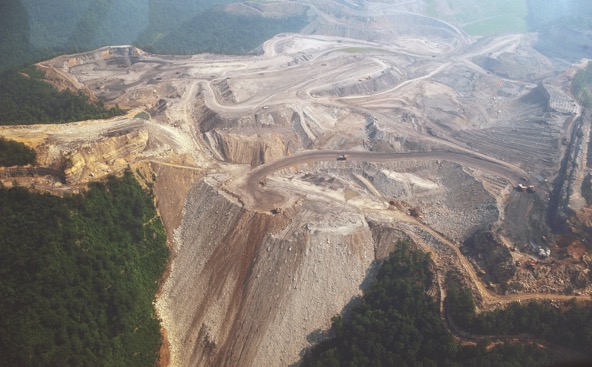 The aftermath of mountaintop removal strip mining leaves entire watersheds and communities vulnerable to climate catastrophes. Hurricane Helene also produced catastrophic fires after the flooding. (Photo by Mandel Ngan/AFP via Getty Images)
Appalachian coal and timber may have powered the industrial revolution and built our cities, but wealth extraction from central Appalachia was always designed to prevent local ownership and accumulation. One of the best and most famous illustrations is the broad form deed, which separated surface rights from mineral rights and left individual landowners with no claim to the value beneath their feet. Another is the infamous way in which workers in company towns were paid for their 7-day, 12-hours-per-day workweek in “scrip,” redeemable only at the company store (while all housing, schools, and even churches remained company owned). As a result, while homeownership was the primary engine of intergenerational wealth elsewhere, many Appalachians were left without. When extraction booms turned to busts, families were left with nothing to sell or borrow against and nothing to pass down after generations of hard, dangerous work.
Federal policy facilitated coal and timber extraction, but long-term reinvestment in municipalities, healthcare, workforce development, and water systems never came close to the scale of resource removal and ecological damage (or the impoverishment left behind when the extraction was complete). While our natural resources produced world-changing wealth elsewhere, ecological and societal fragility was left here, inequities compounding in every hospital closure, shuttered newsroom, or new water advisory, and in every generation that couldn’t see a future for itself in the region. Today, landownership rates remain low, especially because of absentee corporate ownership; with limited buildable land outside the floodplain, the communities most exposed to flooding and landslides are often those with the least control over whether and where they can relocate.
Helene’s record rainfall also fell onto degraded landscapes, which flood faster and harder than healthy forests and watersheds, which act as natural storm-resistant infrastructure. A century of logging, strip mining, and mountaintop removal systematically dismantled that capacity in our region. Instead of capturing and holding water on mountaintops and steep slopes, exposed rock and compacted fill now channel rushing water into hollows and valleys. Even land restored to the government’s satisfaction continues to function differently from an intact forest. Mountaintop removal increases peak stormwater runoff and is the primary contributor to flood volumes in affected watersheds. Communities that bore the cost of extraction without corresponding reinvestment are now paying a disproportionate share of the cost of resilience.
Institutions Failing the Test
Postextraction communities don’t fall behind all at once; they’re held there, incrementally, until a disaster reveals how little ground was left beneath them. Hurricane Helene was, in this sense, a defining stress test for the future.
In central Appalachia, 30 counties remain without a single local grantmaking foundation, while 66 counties have less than $1 per person in philanthropic assets.
Our government, philanthropy, and formal institutional response all failed. Within weeks of the September 2024 storm, national attention had already shifted to the presidential election and California wildfires; the philanthropic response that typically follows a major disaster was much reduced, and Congress didn’t take meaningful action for months or deliver federal dollars at scale. Indeed, after FEMA’s cancellation of more than $200 million in preallocated disaster-prevention projects, North Carolina’s private road-and-bridge-repair program covered only 10 percent of applicants. (In rural regions, “private” infrastructure frequently serves entire communities and provides critical access for school buses and first responders, as well as thousands of residents.)
In the vacuum FEMA left behind, the steady current of long-term recovery work has been pushed downstream to state and local actors. Political polarization deserves some of the blame for this failure, as FEMA’s workforce is significantly diminished. But the structural weakness of these systems long predates our current political moment. Part of Appalachia’s structural fragility is its exposure to the political winds, which is why our recovery remains buffeted by partisan negotiation, rather than grounded in predictable public obligation.
Disaster-recovery agencies work best where they can leverage preexisting economic strengths: high property values, a strong tax base, and an insured and safely housed population. In these regards, central Appalachia might more closely resemble a low- and middle-income country than one of the wealthiest nations on Earth. The Appalachian Regional Commission designates nearly 40 percent of Appalachian counties as “distressed” or “at risk,” ranking them in the bottom decile nationally in the areas of poverty, income, and employment. Even before Hurricane Helene, Asheville, North Carolina—one of the better-resourced cities in the region—was losing roughly 30 percent of its treated water to leaks and inefficiencies, nearly double the national average. After Helene, some Asheville neighborhoods went more than 50 days without potable water. Central Appalachia’s public systems have remained undercapitalized across administrations—a pattern, not a gap.
Traditional philanthropy has never functioned as a meaningful counterweight in Appalachia. For one thing, philanthropic dollars are in short supply locally: 30 counties in central Appalachia lack an active foundation, while 66 hold less than one dollar per capita in philanthropic assets. But even the limited dollars that reach rural Appalachia rarely arrive as flexible, long-term capital. Local organizations navigate fragmented funding streams, with civic engagement in one silo, economic development in another, and disaster recovery in a third (even though their work is inherently integrated). The responsibility for stitching those systems together falls on those with the least administrative capacity to do it.
This architecture grew out of relational infrastructure already in place. The storm’s aftermath has simply revealed what was already long in the making.
Traditional philanthropic systems also tend to assume a baseline of institutional readiness that many organizations in the region have never had the funding to build. Capital flows most reliably toward entities that already look “ready,” often bypassing those with deep local trust and influence. By prioritizing scale, replicability, and visibility—criteria more easily satisfied in major metropolitan areas—philanthropists can bypass rural regions, which rarely meet those thresholds, even when the need is acute. This problem is certainly common across rural America, where roughly one-fifth of the national population lives but which received just 3.5 percent of foundation-grant dollars. Appalachia stands out as even more underserved, receiving less than 10 percent of per capita grantmaking. Appalachia is exemplary in that its communities most in need of flexible, trust-based capital are least likely to receive it.
Building Regional Philanthropy from Trust
As the region’s coal industry declines, new civil-society networks have begun working to imagine and build a postextraction future. Between 2010 and 2015, the Central Appalachian Network (for community economic development), the Appalachia Funders Network (for funders), and Appalachian Community Capital (for small-business lending) were all formed, focusing on scaling the region’s investment system to absorb and deploy capital. Borrowing from the Center for Community Investment’s conceptual framework of “capital absorption,” this collectively built ecosystem and pipeline for community-driven priorities has emerged to allow large-scale investment to reach the ground. Together, they form a system of bioregional finance, where trust, shared purpose, and blended-capital investment supplant the scale-driven logic of traditional philanthropic institutions.
Helene did not create this architecture. It grew out of relational infrastructure already in place: mutual-aid traditions rooted in familial and faith ties, community-development financial institutions (CDFIs) with decades of place-based lending experience, and funder networks building across institutional and political lines. But the storm’s aftermath has helped to reveal what was already long in the making, as well as demonstrating how it works: a feedback loop built on relationships and mutual obligation, paired with flexible capital tools, that could move resources faster and more equitably than the federal systems ostensibly designed for the task.
Within days of the storm, for example, the Appalachia Funders Network launched the Appalachian Helene Response Fund, a pooled grant fund for impacted communities, operating on trust-based principles: low-burden reporting to sustain staff capacity, grant structures that support frontline workers’ well-being, and recognition that many recipients are simultaneously serving their communities while living through the disaster themselves.
Trust, in a broader sense, was how the Appalachia Funders Network could step into this regional convening role: In communities where formal credit histories are thin and financial collateral is scarce, relationships serve as an alternative form of risk assessment. Particularly in postdisaster contexts, nuanced community knowledge serves as a kind of “informal insurance” that can catalyze recovery efforts. Lower perceived risk accelerates deployment, and when a trusted local lender vouches for a project, investors participate in deals they might otherwise decline. Relational infrastructure has already done work that institutional processes can only replicate at greater cost and slower speed.
While the money raised by the Appalachia Funders Network was modest relative to the scale of need, the fund’s role was catalytic: International, national, regional, and local donors were willing to contribute immediately, because they trusted the network’s relationships and proximity to impacted communities. By aggregating resources, coordinating distribution, and driving dollars directly to organizations, the network reduced uncertainty for donors about where funds would be most effective and whether they would reach communities in need. Creating a single, trusted entry point for donations both eliminated the need for funders to vet multiple organizations and reduced the reporting burden on local groups managing storm response in real time. Capital could move more quickly into the hands of locally trusted organizations, which could expand operations and stabilize services.
Because of the historic disinvestment context—and the fact that community development in central Appalachia rarely relies on a single funding source—financial tools must deliberately reframe risk. Community projects here are virtually always funded through a multiple-source capital stack, layering grants, investments, and flexible financing to match the needs, timelines, and revenue potential of a given project. A typical blended stack in our region might include a senior loan from a CDFI, a subordinate or flexible loan from an investment organization like Invest Appalachia, a recoverable grant providing working capital or bridging a reimbursable grant, and a loan guarantee mitigating collateral gaps. It might also leverage federal or private grant funding for predevelopment and technical assistance.
In underinvested markets, this kind of creative structure is essential for capital to reach places it doesn’t otherwise go easily. Too many underinvested markets get written off as too risky, when the problem is how to structure for risk. For this reason, in addition to providing flexible loan financing, Invest Appalachia’s Catalytic Capital is designed to complement other financing and fill gaps between traditional grantmaking and lending. As the most flexible layer of repayable funding, it can be deployed in multiple forms, unlocking four to six times its value in additional investment by derisking deals that conventional lenders would otherwise decline.
Trust Moves Fast
Disaster recovery is a long-term process, but so much depends on what happens in the immediate aftermath. Forty percent of businesses that close after a large-scale disaster never reopen, while another 25 percent fail within two years. Preventing mass closures in Asheville required a robust recovery plan with immediate access to capital, so the WNC Strong coalition came together within two weeks of Helene’s landfall, creating a website and communications plan for fundraising and deploying $8 million in short order to more than 1,000 entrepreneurs, preventing the loss of an estimated 10,000 jobs in the process.
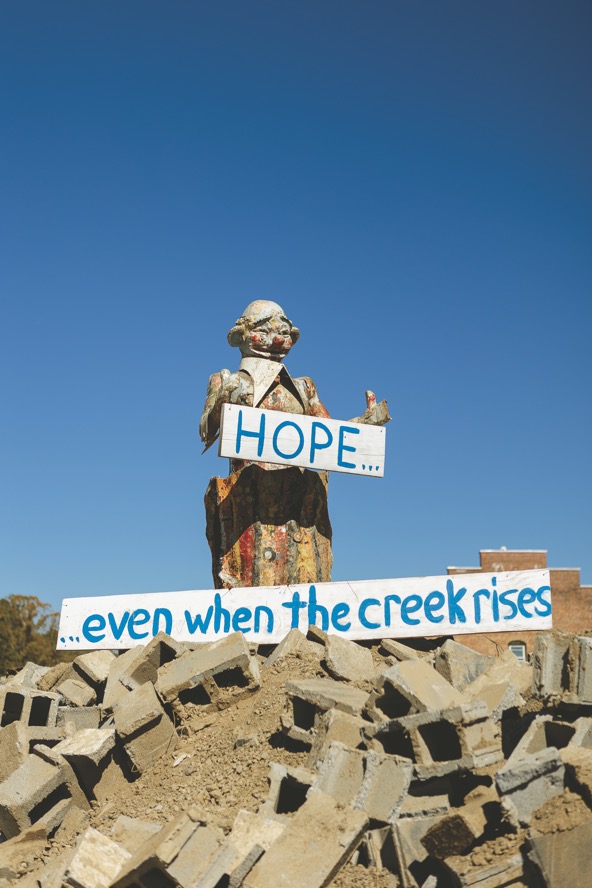 “God willing and the creek don't rise” is a familiar phrase across Appalachia, here more hopefully repurposed. (Photo courtesy of Bren Dandy)
In strained markets, solutions like these rarely emerge from a single organization or funding source. They are stitched together, quilt-like, through coordinated, locally rooted efforts that reflect both necessity and long-standing understanding that recovery does not occur in isolation. WNC Strong served as a clearinghouse for grants, emergency loans, and other rapid-response funding, bringing together more than 20 partners and more than three dozen funders, including local governments, community foundations, CDFIs, and philanthropy. Partnership and funding flowed through Appalachia Funders Network’s Helene Response Fund and several of the network’s members.
As of December 2025, the WNC Strong Together coalition had deployed more than $110 million to small businesses and community projects. Through the Mountain BizWorks-managed Helene Business Recovery Fund, more than $59.6 million in emergency loans was issued to 852 businesses, while the WNC Small Business Initiative—led by Dogwood Health Trust and managed and implemented by Appalachian Community Capital—distributed $55 million in direct grants to more than 2,100 small businesses.
It is crucial that trust predate the disaster. In the weeks after Helene, the East Tennessee Foundation (ETF) deployed what its leadership called “leap of faith” grants, funded not through conventional due diligence but through relational knowledge built over decades. The board raised its approval threshold so grants over $100,000 could move without individual review, eased diligence for newer organizations, and cut administrative fees. Where structural constraints prevented direct grants to individuals, ETF routed funds through houses of worship and community nonprofits already known to be serving as resource hubs. ETF also invested early in long-term recovery groups with little initial capacity, betting that proximity to need plus flexible capital would perform better than waiting for institutional readiness.
The lesson for community foundations elsewhere is clear: The umbrella fund, board relationships, and regional partnerships must be built before a crisis demands them.
Building New Flows and Waterways Into a New Watershed
Sometimes what begins as an emergency response becomes a reliable (and replicable) infrastructure. For example, Appalachia Funders Network’s First Fridays meeting was initially formed out of necessity, as a recurring call for funders and community leaders working across Helene-impacted geographies. But as calls quickly became a node in the region’s recovery architecture, the meeting became a space where needs could be surfaced, strategies aligned across sectors, and funding decisions shaped by those closest to the work. Giving organizations visibility into what others are doing reduces duplicative effort and amplifies network-level learning. With the help of the Center for Disaster Philanthropy, the Appalachian Funders Network added a dedicated data-and-research position to formalize what had previously been diffuse knowledge, tracking where disaster-recovery dollars were going, identifying funding gaps and deserts across sectors, and telling on-the-ground stories through qualitative and quantitative means. The Appalachian Helene Impact Explorer emerged from this work as a way of visualizing recovery in real time, offering funders and public agencies alike a clearer understanding of where needs persisted and where capital could be most effective.
Helene has been a live case study in how distributed energy resilience can be built from the community level up, and how early, flexible capital can catalyze a compounding investment that goes far beyond repairing damage. Once pooled funds, research-informed insights, and locally grounded decision-making were in place, capital began moving into projects designed to increase resilience, not just recover what was lost. Coinvestments in organizations like the Footprint Project supported permanent microgrids at community anchor institutions, ensuring energy resilience as a foundation for future disasters. The Helene Response Fund awarded the Footprint Project its first Helene-related grant, catalyzing additional funding rounds and enabling the organization to establish a permanent regional presence. Invest Appalachia partnered with the Footprint Project and Appalachian Voices to develop a network of resilience hubs: permanent solar microgrids at volunteer fire departments, community centers, and churches that keep power, communications, and critical services running when the grid goes down. North Carolina has since committed $5 million to install up to 24 microgrids across six Helene-affected counties, and Invest Appalachia is providing low-to-no-interest bridge loans to nonprofits for up-front installation support.
What Worked, What Doesn’t
What made this system work—what made it a system—were preexisting relationships, community knowledge, and social infrastructure, as well as the trust emerging from them, which, in turn, initiated a regenerative feedback loop. As capital was deployed to expand community asset control, the building of local ownership increased resilience, better positioning businesses and organizations to weather future downturns. That endurance, in turn, further reinforced trust, creating more trust-based investment and community ownership. Practitioners sometimes call these relational channels “waterways,” in deliberate contrast with the linear, extractive logic of the “pipeline.” In a region where watersheds have always mattered more than political boundaries, capital that moves like water is not a metaphor so much as a simple description.
Without reinvestment, the costs of resilience can shift to communities themselves—a kind of tax that penalizes the most vulnerable for their own survival.
No single transaction demonstrates how waterways become a watershed, and traditional transactional grantmaking can’t reproduce it. It’s a cumulative product of network-level relationships, capital structures, and governance decisions accumulating over time. But the result was a system that could move capital with a degree of speed and flexibility rarely seen in formal recovery systems. Decision-making authority was distributed, rather than centralized, relying on cross-sector alignment to reduce friction, bringing philanthropy, mission lenders, community organizations, and eventually public actors into alignment on priorities. Perhaps most important, the system demonstrated a willingness to invest in communities and projects that conventional lenders often deemed too risky, challenging long-held assumptions about where viable opportunities exist and showing that locally driven recovery efforts are not only possible but capable of generating durable value.
For all its effectiveness, this system remains constrained by the conditions that necessitated its existence. Far from a fully resourced model operating at scale, it is a form of infrastructure built in response to the absence of a consistent federal partnership, of long-term institutional investment, and of capital that matches the scope of need. It works where it works only because it has been forced to work. And while Appalachia’s resilience architecture has proven capable of coordinating, deploying, and stretching limited resources under unprecedented pressure, no survival system can compensate indefinitely for the absence of resources scaled to need. And the scale of need continues to exceed the investment coming in.
What would it take to build for a truly resilient future? After Katrina, national philanthropy showed up not only for immediate relief but also to build long-term civic infrastructure that still exists today. It created a durable bridge between philanthropy and community-defined recovery, as well as reinforcing advocacy, organizing, and local leadership that ultimately helped unlock billions of dollars in public and private investment. That response was possible in part because substantial financial and institutional infrastructure already existed to receive and coordinate outside investment.
No comparable philanthropic movement has yet emerged for communities in Appalachia. If regional efforts like Appalachian Funders Network’s pooled Helene Response Fund demonstrate the strength of the collaborative system, they also underscore what local and regional actors can’t accomplish alone. The absence of large-scale national philanthropic investment still reflects a structural gap, the historical absence of the infrastructure that enables communities elsewhere to attract and direct recovery capital after disasters. Substantial portions of central Appalachia are banking deserts or at risk of becoming them, and without proximity to financial power, even the relationship-based networks required for recovery investment can’t take hold. Uneven local capacity remains a primary barrier, often funneling immense responsibility to a small number of committed individuals, a dynamic that is known colloquially as the STP (“same two people”) problem and creates systemic bottlenecks and high burnout.
In Appalachia, as with other global contexts where informal networks serve as a structural last resort, real risk exists in overrelying on these systems without providing the formal scaffolding they require to endure. Our region has long depended on mutual aid and networks of care to fill institutional gaps, but, despite the fact that informal, multiparty relationships can move work quickly, their durability is limited without formal structures and sustained funding. And because this relational infrastructure is largely illegible to traditional investment frameworks, its real value is rarely counted. It moves capital, absorbs painful delays, and keeps systems functional, but it doesn’t appear on federal balance sheets or philanthropic dashboards. That invisibility has a cost: When relational infrastructure operates without reinvestment, the costs shift to communities themselves—to their time, their networks, their capacity—in a kind of resilience tax. The less a system invests in a community, the more likely we are to penalize the most vulnerable by making them responsible for their own survival.
Local ingenuity cannot replace predictable, large-scale, and sustained public investment. Federal presence and philanthropic partnership matter not episodically and not symbolically, but as stable partners in prevention, infrastructure, and recovery.
Investing in a Lasting Recovery
Communities like ours have been forced to value trust as a functional component of a long-term recovery from postextraction economics, but we’ve learned a lot about what works—and how to make it work.
We’ve learned that blended capital is the best tool for building resilience in fragile markets, and that in the absence of trust or community-led governance, capital is easily misdirected, especially without financial tools creative enough to match the complexity of the local context. Standard tools fail in nonstandard markets, and where conventional financing doesn’t reach, no single source of capital will close a deal. Moreover, grants can create a cycle of dependency and hinder long-term planning, while loans exclude the borrowers who need them most.
What works is layering tools alongside one another: grants, recoverable grants, credit enhancements, and loans, each piece absorbing a different kind of risk so that the full stack can reach communities and projects that any one source would reject. Funders and investors need to let go of siloed thinking and accept that in underinvested markets, creative structure is the cost of doing business. While we’re trained to think that flexibility is a concession, it’s a prerequisite for impact.
We’ve also learned that community governance is a necessary condition for durable recovery. Localized, democratically governed capital tools, where communities retain decision-making authority, produce more durable outcomes because accountability is built in. If communities aren’t empowered to govern their capital and control their own assets, the capital and assets will eventually serve someone else’s priorities. A century of exporting wealth and inheriting the costs produced something extractors didn’t intend: a population that knows how to organize around what’s coming next.
Moreover, while 36 percent of GDP from 2000 to the present is tied to disaster spending, we risk an endless cycle of rebuilding what was there before, including the vulnerabilities. But when so much is invested in picking up the pieces, the system is rewarding response over prevention. The people in affected communities are best positioned to build something better than endless cycles of disaster and recovery. And in many rural communities, what urban designers and research labs imagine as the future of resilience is already built. The mutual-aid networks, the resilience hub infrastructure, and the future of postdisaster connection—all of it is on display across parts of central Appalachia.
Building Beyond Solutions
We need to build much, much more. We’ve braided mission lending, philanthropic dollars, and community capital into working infrastructure and have recycled scarce dollars and stretched institutional capacity beyond reasonable expectations. This adaptive architecture helped communities survive an acute crisis, but it is not a substitute for what we are missing.
It is also not a solution, in the sense of substituting for other investments. If it represents a viable layer of infrastructure on which long-term resources can be built, this is true only if we fund it and have the capacity to sustain it. Every dollar invested in climate mitigation and disaster preparedness saves an estimated $13 in recovery expenses. But the very concept of climate “solution,” as a firm and final endpoint, might be misaligned with a future of climate volatility: These are compounding challenges, and, amid our current climate outlook, there may be no postdisaster steady state to solve for. If a solution does exist, it is a shift from episodic and reactionary mode to firm and ongoing commitments, from paying for recovery, disaster by disaster, toward capitalizing the standing capacity that responds. And what we have built is the design foundation of any real solution that will survive here or in other postextraction contexts.
For regions facing similar histories and geographies of risk, understanding how to braid mission-driven capital may be the difference between recovery and collapse. The capacity to blend and stack capital around community-led priorities is a muscle that strengthens with use and is built during blue skies, so that when disaster strikes, communities and their capital partners can move together quickly. By formalizing these networks, similar communities can move from a resilience of necessity to resilience that is resourced and chosen.
Need will continue to outpace support in our region and beyond. Climate volatility, infrastructure fragility, and institutional erosion are converging. Philanthropists and funders who are tired of one-off interventions that provide short-lived solutions have an opportunity to partner with regions like ours to build long-term capacity, readiness, and resilience in ways that allow capital to go further, dollars to recirculate locally, and innovation to be born from constraint. But that opportunity requires engaging communities like those in central Appalachia not as charity cases but as design partners in building systems the rest of the country will eventually need as well.
Appalachia is already today’s proving ground for resilience. Tomorrow’s will be anywhere.
Read more stories by Lauren Sowers, Kalista Pepper, Ryan M. Eller & Andrew Crosson.