


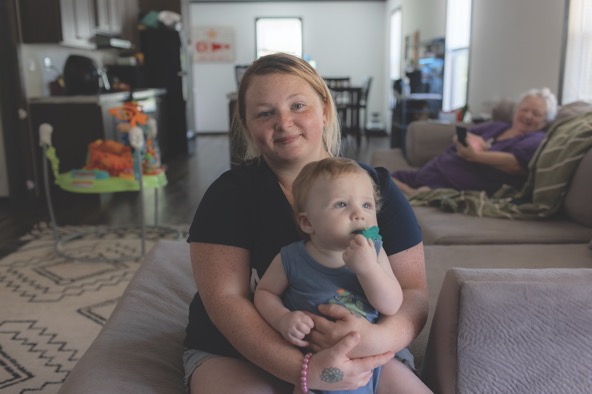
 After her Central Texas home flooded in July 2025, Airbnb.org guest Skylyn and her son stayed in a listing. (Photo by Marshall Tidrick)
This article is from SSIR’s forthcoming Fall 2026 print issue. Subscribe today for full access online and to receive your own print copy.
* * *
Sarah Sherr woke to the smell of smoke at 3:30 a.m. on January 8, 2025. Pregnant, she was two weeks from her due date. She shook her husband awake, packed up their malamute and border collie, and drove away from their West Altadena home before he even had time to put on a shirt. By 7 a.m., the palm trees lining their street were ablaze. Their house was ashes two hours later.
Like tens of thousands of people in Los Angeles displaced by wildfires that week, Sherr needed somewhere to go. Scrolling on Instagram, she found a post about free Airbnb housing credits for wildfire victims. The offer came from Airbnb.org, a nonprofit that provides free emergency housing through the same platform that powers one of the world’s largest homestay companies. She filled out an application that night, and by morning she had credits in her Airbnb account. She and her husband stayed with their animals for four nights in a mountain cabin in North San Diego, then moved to a property with a pool and a garden, where they spent the first month of their newborn’s life.
“We had very limited options with our animals, and it was such a relief that we could go somewhere of our choosing,” she says. “It was such a weird time of peace and fun and stress all at once.”
Founded by Airbnb in 2020, Airbnb.org was built on a premise that the company’s platform, with its nine million listings in nearly every corner of the world, could do more than serve leisure travelers. Established as a separate 501(c)(3), the organization mobilizes that technology and infrastructure to provide free temporary housing when disaster strikes. Airbnb.org activates hosts near distressed locations, waives fees, and works through a network of local nonprofit partners to identify and refer displaced and unhoused families.
“On the surface, we’re addressing housing,” says Christoph Gorder, executive director of Airbnb.org. “Underneath it, we’re addressing a delivery mechanism. How do we get you assistance very quickly, and how do we give survivors agency.”
Repurposing the Platform
An Airbnb home provides displaced families something that makeshift shelters in school gyms and stadiums cannot. It gives them a sanctuary to grieve, to regroup, and to cook a meal. It keeps them together, and, critically, it keeps them close to the schools, jobs, and communities they depend on to rebuild their lives.
The model works through partnerships. Airbnb.org identifies trusted local nonprofits, negotiates agreements, and when a crisis hits, moves quickly. The nonprofit partner vets and refers families. Airbnb.org deposits credits directly into referred people’s Airbnb accounts. People who don’t already have an Airbnb account can create one for free, and a dedicated customer-support team helps Airbnb.org guests with the booking process. Local partners often provide help such as power and connectivity to those who have lost internet access. Families choose their own accommodations to fit their needs, and Airbnb waives all service fees.
Because Airbnb acts as Airbnb.org’s largest donor, covering all operating costs and providing additional funding for disaster responses, 100 percent of public donations go directly to housing. Airbnb.org raises the majority of its funds from the public through individual donors and Airbnb hosts. Hosts are paid as they would be for any ordinary Airbnb stay, though many choose to offer a discount for Airbnb.org guests. Any Airbnb host can participate and does not need to donate to Airbnb.org to host emergency stays, though many do choose to support the organization by donating a percentage of their earnings. Recurring host donors alone contribute roughly $2 million to the organization every year.
For nonprofit partners like All Hands and Hearts, a volunteer-run disaster-relief organization that identifies and refers displaced families to Airbnb.org, the host community is central to what makes the model work. “It’s a very meaningful way for people to feel that they can chip in beyond the obvious donation or volunteering,” says Nicolette Koeman, chief engagement officer of All Hands and Hearts.
Responding First
On the night of January 7, as fires spread rapidly across Los Angeles County, phones began ringing at 211 LA, the hub for community members and organizations looking for health, human, and social services. Many of the callers looking for help had already lost access to housing, transportation, and basic utilities.
Disaster response is Airbnb.org’s core mission, but the organization is expanding its vision.
Representatives from Airbnb.org called 211 LA Executive Director Maribel Marin, and within hours, the two organizations had signed an agreement. “We are scrappy problem-solvers,” Marin says. “We didn’t have to worry about red tape. We said, ‘Let’s do this.’”
In the first three weeks after the disaster, 211 LA handled 41,669 wildfire-related contacts. Housing emerged as the most urgent need almost immediately. Ultimately, more than 63,000 nights were donated through the partnership. In the immediate aftermath, Airbnb.org supported short-term evacuation stays for 10,452 households and coordinated longer-term 30-day placements for 321 households, totaling 8,129 nights of safe, temporary housing.
A similar response unfolded when devastating floods struck Kerr County, Texas, in the state’s Hill Country region in July 2025. There, Airbnb.org partnered with All Hands and Hearts, which identified the residents most in need and referred them to Airbnb.org. Free housing credits went to displaced residents, family members needing to stay close to search-and-rescue operations, and first-responder crews conducting relief efforts on the ground. While some just wanted a home with a backyard for the kids to run around in, others needed a pet-friendly home or accessibility features.
“Dignity and ownership are the keywords in a disaster-recovery journey,” Koeman says. “The technology and platform of Airbnb really allows us to have a very targeted, personalized, modern way of supporting people.”
Austin Dickson, CEO of the Community Foundation of the Texas Hill Country, saw the value of the model firsthand. The foundation granted Airbnb.org $1.6 million to support the Kerr County response.
“A family cannot focus on insurance claims, rebuilding plans, school enrollment, or returning to work if they don’t know where they’re sleeping next week,” Dickson says. One pregnant flood survivor, who had a toddler and a full-time job, chose the Airbnb.org option specifically because she couldn’t absorb the added burden of finding and furnishing a rental on top of everything else. “That’s survivor-centered design working as intended,” Dickson says.
The efficiency of the model also appealed to Dickson. “Their platform is already built to deliver housing at scale during crises, without requiring us to build that infrastructure ourselves.”
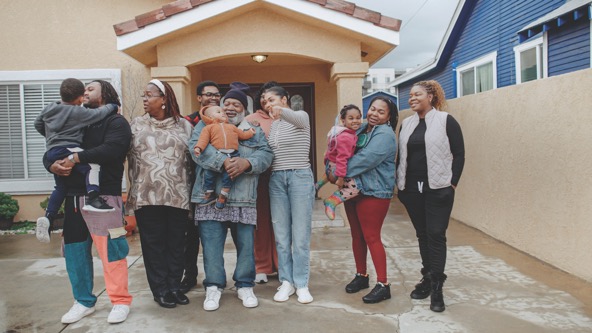 Airbnb.org helped the multigenerational Benn family stay together in one home after they were displaced by the Los Angeles wildfires in January 2025. (Photo by Thalía Gochez)
Expanding Beyond Disaster
Disaster response is Airbnb.org’s core mission, but the organization is expanding its vision. Its Medical Stays program provides free housing to families who must travel long distances to access specialized medical care. Gorder describes it as a Ronald McDonald House model, without the waiting list. Since spring 2026, the program has expanded to Italy, Spain, and Thailand.
In Mexico City, two nonprofit partners, Fundación Vuela and Casa de la Amistad, are already enrolling families. In May 2026, Airbnb CEO and cofounder Brian Chesky announced a commitment of more than $1 million to expand Medical Stays in Mexico over the next three years.
Childhood cancer is the leading cause of death from disease among children ages 5 to 14 in Mexico, and Mexico City receives more than 25 percent of the country’s childhood cancer patients. Families travel from every region, often with no plan for where they will sleep.
“The first thing in their minds is how to get the sick kid to the hospital,” says Diego Herrera, cofounder and CEO of Fundación Vuela. Many times they don’t even think about where they’re going to stay.”
Public hospitals offer little help. Herrera describes streets outside pediatric wards filled with parents waiting overnight for visiting hours, sleeping on sidewalks, unable to bathe or rest. Existing shelters typically allow only one parent and one patient, leaving single parents with the hard decision to leave their other children behind. The consequences can be deadly. In Mexico, Herrera says, treatment for an estimated 20 percent of childhood cancer patients is abandoned when the logistical and financial burden of staying in the city becomes too great.
In the first six months of operating Medical Stays in Mexico City, Airbnb.org and its partners provided nearly 300 nights of free housing to more than 50 families. For many, the experience required learning new technology. Guided by Vuela staff, some families were using a smartphone app for the first time, navigating an email account and digital transactions entirely foreign to them.
Leo was among the first patients in the program. When the shuttle taking him and his mother got stuck in traffic, their Airbnb host, Erick, drove his own car to pick them up, showed them the neighborhood, and pointed out restaurants. Days later, Leo told Herrera that even though his mother wasn’t allowed to stay overnight at the hospital, he could sleep peacefully knowing she was safe and resting nearby.
Another patient, Romina, suffered from nausea after chemotherapy and struggled to eat the hospital food. Back at her Airbnb, her mother cooked a meal and was able to encourage her daughter to eat.
“Cancer is hard enough,” Herrera says. “Nothing should make it worse.”
Becoming Proactive
In its six years of existence, Airbnb.org has only found ever-greater need for its services. In 2023, Airbnb.org responded to eight disasters. In 2024, that number grew to 18. In 2025, it jumped to 78, including the LA wildfires, Hurricane Melissa in the Caribbean, and the Central Texas floods. Responses in 2026 already include Winter Storm Fern in Nashville, Tropical Storm Nils in France, and the earthquakes in Venezuela. The Medical Stays program is growing across multiple continents.
Airbnb.org can deploy housing credits wherever its platform reaches. But it is limited by its ability to partner with trusted local nonprofits already embedded in communities, preferably before disaster strikes. First-time responses with first-time partners can be slower and messier. Take the complexity faced by 211 LA managing 51,000 contacts in the first days of the fires. Organizers grappled with data duplication, scattered families, and the challenge of reaching people who feared a callback from an unknown number was a scam.
“We wouldn’t have struggled as much if we had some of these partnerships in place before the fire started,” Marin says.
Even when agreements are in place, the sheer volume of need can overwhelm operations on all sides. In Los Angeles, Gorder admits that as demand exploded in the first days of the fires, Airbnb.org’s own phone banks were crushed. Processing tens of thousands of families simultaneously, verifying eligibility, depositing credits, and troubleshooting placements tested the organization’s infrastructure.
Dickson echoes the lesson from Texas. “Relationships built after a disaster are always going to be slower and less effective than relationships built before one. When the disaster happened, we weren’t introducing ourselves. We were activating relationships that already existed.”
Airbnb.org has begun building more associations in advance. It has formalized disaster-preparedness partnerships with government agencies and community organizations in Los Angeles, Japan, and Mexico City, alongside standing agreements with Catholic Charities across its 168 US chapters and with 211 networks nationwide. Most recently, Airbnb.org signed an agreement with the Secretariat for Integrated Risk Management and Civil Protection, Mexico City’s disaster response agency, to provide free stays for first responders and volunteer groups who deploy to communities impacted by disasters throughout the country.
“The need continues to rise, and we see it happening with climate change all around us,” Koeman says. “There is no way that authorities can cope with this level of need on such a big scale. So it is going to require all of us, civil society and private entities, to come together to really support the need that exists.”
As Airbnb.org has expanded, Gorder says, the organization has shifted from reactive to proactive. His team has developed country-level plans and pre-signed agreements designed to speed up the time between crisis and housing.
“The question is not whether we will have more disasters,” he says. “The question is, how quickly can we help, and how much agency can we give people in the worst moments of their lives?”
Read more stories by Corey Binns.