


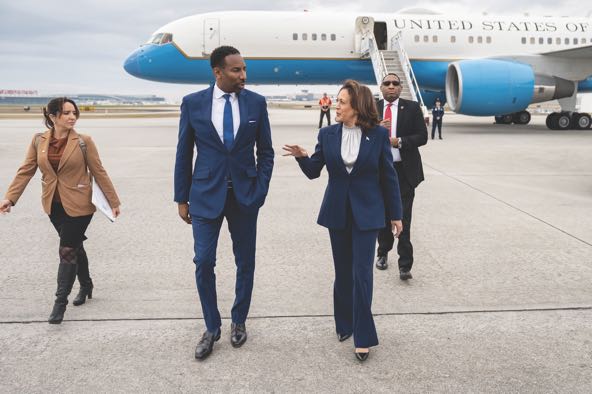
 Mayor Andre Dickens welcomes Vice President Kamala Harris to Atlanta on February 8, 2023. (Photo by Lawrence Jackson for the White House)
US government agencies and philanthropies have spent enormous sums to help individual Americans thrive. They funnel their resources vertically, silo by silo, to address different issues, from housing and education to employment and food, to alleviate individual material needs.
These expenditures haven’t bolstered America’s struggling neighborhoods. In fact, such funneling often weakens horizontal social bonds and widens horizontal spatial divides, making it harder to improve such struggling locales. When government services help a child get a leg up—by, for example, getting into a university or finding a decent job—without improving his or her neighborhood, they encourage that person to move elsewhere, making it that much harder to fix what has been left behind.
Atlanta Mayor Andre Dickens came into office in 2022 with a commitment to adopt a radically different, neighborhoods-centric vision for governing the city. Dickens contends that promoting strong neighborhoods is a crucial function of city government, essential both to uplift those who are struggling and to enhance urban fiscal health. It also can help attract and retain the talent necessary to boost the city in the years ahead.
“Neighborhoods are our single best organizing framework for being responsive to resident needs and working across sectors,” the incoming mayor’s transition report contended. “A better Atlanta is one where all neighborhoods are healthy, thriving, equitable, and accessible.”
The task is formidable. The city has a significant number of fragile neighborhoods despite its progress in some locales. According to the most recent “Neighborhood Change Report,” which was published by Atlanta’s Department of City Planning, and other related sources, 40 of the city’s 101 neighborhoods are in a state of “sustained distress,” defined as doing consistently poorly across several measures for multiple decades. They contain roughly one-third of the city’s population, or over 150,000 people, and a significant proportion of the city’s land mass, highlighting how much untapped potential they contain for the city.
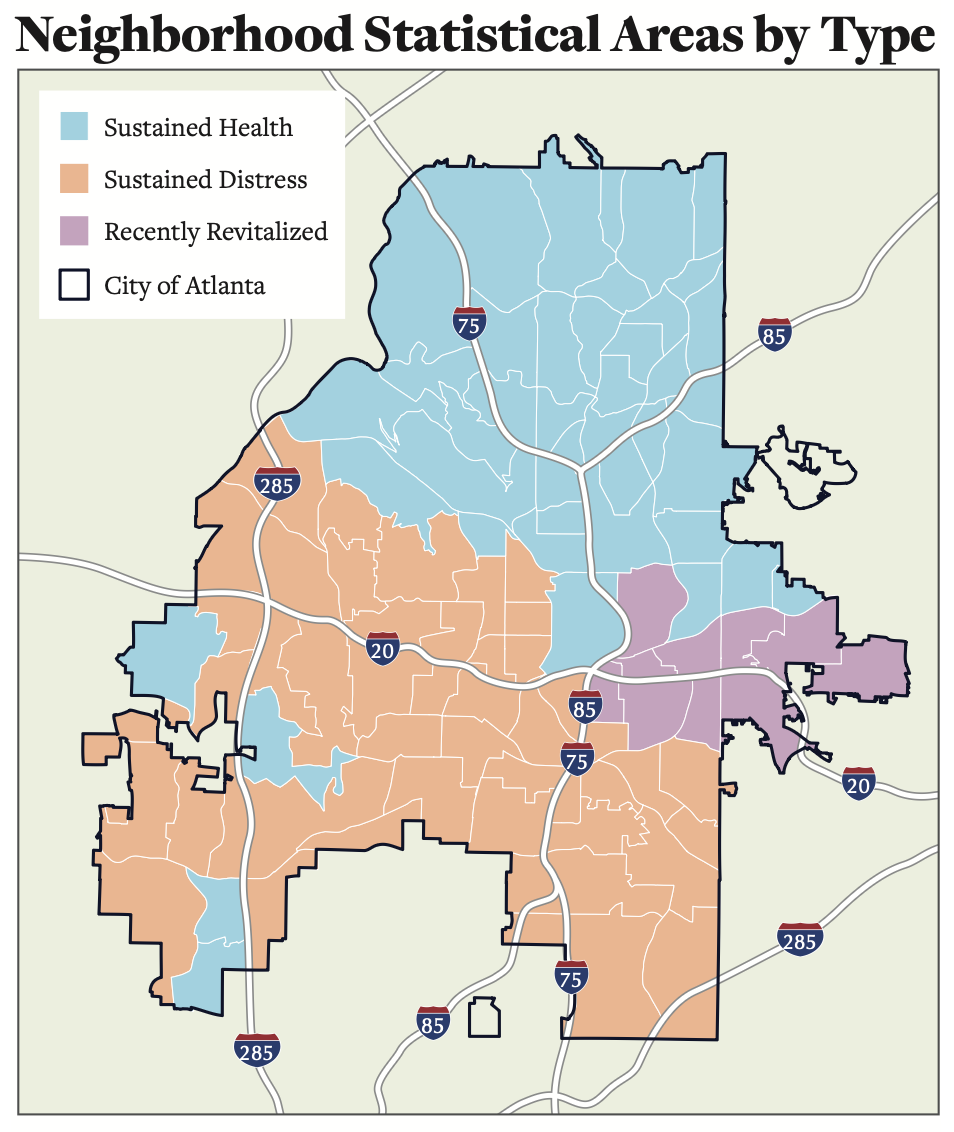
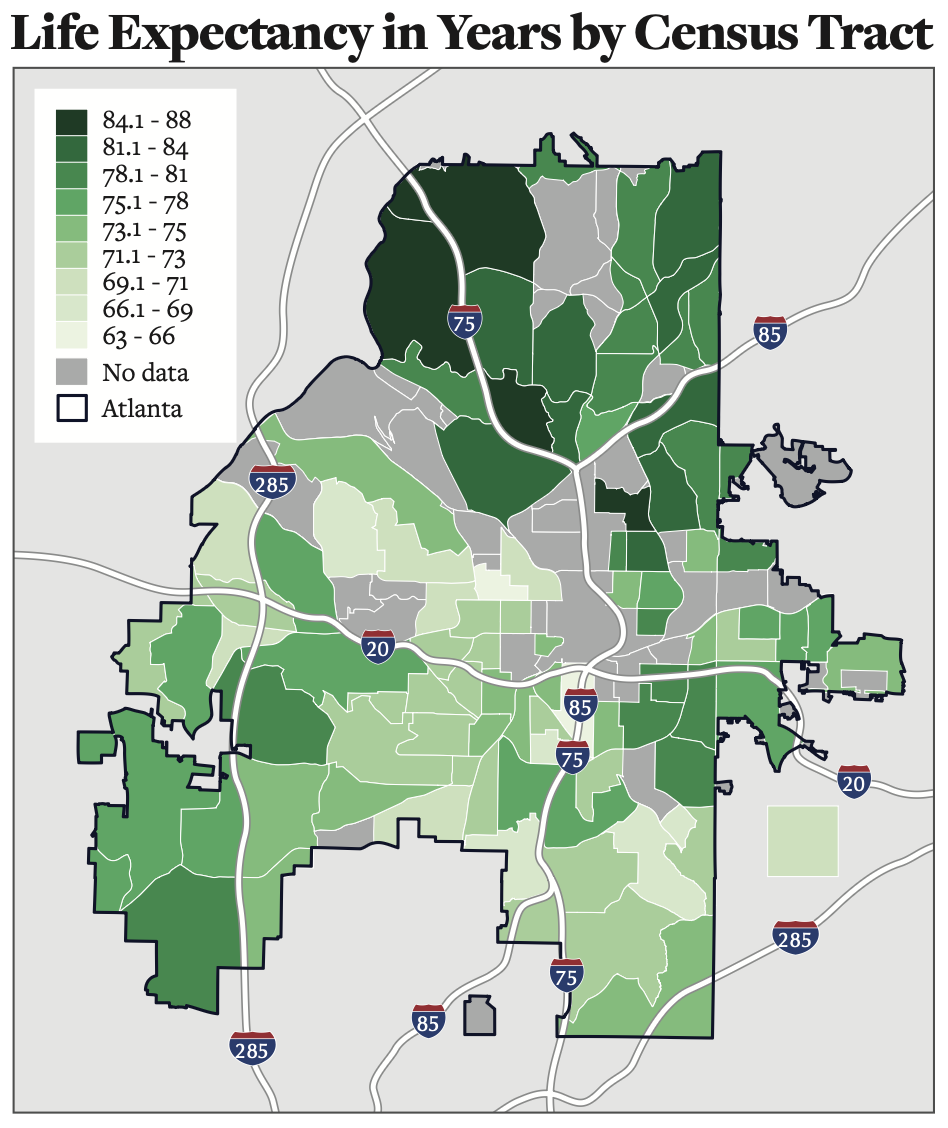
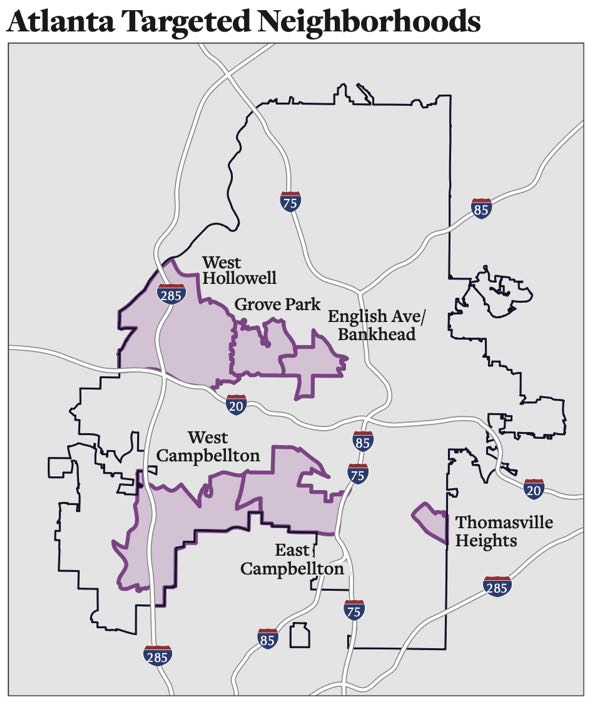
The mayor’s office has targeted six neighborhoods for strategic investment: West Hollowell, Grove Park, English Avenue/Bankhead, West Campbellton, East Campbellton, and Thomasville Heights. (See “Atlanta Targeted Neighborhoods” below.) They were selected for several reasons: They have the best mix of assets—including public land, planned public or private investments, and good access to transit—that could be leveraged; are adjacent to or near places that are on the upswing; have preexisting revitalization plans that could be quickly activated; and have or could quickly build up the neighborhood institutions necessary to shepherd the effort. The public land gives the government capacity to get projects done quickly. The various investments act as scaffolds on which a larger effort can be developed at a lower cost. Each of the neighborhoods is also doing quite poorly, with some of the lowest-performing schools, highest levels of crime, and highest vacancy rates (almost 25 percent). The six are distributed geographically across the city in such a way that they can catalyze revitalization in adjacent areas through the spillover they will produce if successful.
Atlanta’s experiment shows how the assumptions undergirding investments in welfare, public goods, and urban renewal can be reframed.
Four Essential Arenas for Change
Four arenas are essential to making neighborhoods attractive to potential residents: education, housing, commercial corridors, and the physical landscape (including green areas and streetscapes). Boosting these so they become strong assets for a neighborhood extends growth horizontally across a city.
Schools support childhood development—a key goal of the whole effort—and attract new residents necessary to make each neighborhood flourish. The mayor’s internal strategy upholds schools as the “most important engine for success” in a given neighborhood, according to David Edwards, chief policy officer in the mayor’s office. Parents will make considerable sacrifices if they have access to desirable schools, distinguishing them as a key bellwether of any neighborhood. Better schools draw middle-income families, who are essential to changing the social and economic dynamics. With good management, the right investments, and close ties to particular locales, schools can play a crucial role as long-term neighborhood anchors.
Because substantial improvements in the quality of local housing are essential to attracting new residents and bolstering quality of life in the neighborhoods, nearly 70 percent of the money allocated in Atlanta’s plans is for this purpose. The goal is to increase the housing stock in these six geographies by constructing 5,000 affordable units as well as 3,000 market-rate units that will attract middle-class residents and all the amenities that they bring. As part of this emphasis on mixed-income neighborhoods, the city will no longer support affordable-housing projects that concentrate poverty. Instead, it will focus on initiatives that increase the supply of quality housing available to people from diverse classes in the same neighborhood.
“It is essential that low-income residents live in concert with middle- and higher-income neighbors and share in the benefits of the amenities associated with mixed-income neighborhoods,” Edwards says. In addition, the city will aggressively seek to upgrade existing housing by both enforcing housing, health, and building codes more proactively and subsidizing investments of property owners willing to participate.
Such efforts can yield substantial neighborhood growth in a way that makes them more middle class without forcing out low-income populations. There are many underutilized properties—abandoned structures and empty lots—in these places. Dickens writes: “When a new family moves in to a long-abandoned community with vacant lots, and they move into that home and as long as they keep it in the general character of the existing community, that’s positive—the same when businesses move into abandoned buildings.”
These neighborhoods not only have received less investment than elsewhere; they also have been systematically disconnected from thriving areas by major highways and huge public-housing projects constructed in the postwar years that concentrated poverty. The city is also leveraging vacant or underutilized commercial property to attract grocery stores, financial services, and other amenities, as well as recruiting investment to these locales. Public transportation is worse in these locales than elsewhere in the city. By creating new rapid-transit lines, the city will boost connectivity across the neighborhoods as well as with other parts of the city.
Restructuring Governance
Dickens’ goal is not only to throw the full weight of the city government behind neighborhood transformation efforts in a way that was previously unimaginable, but to go where no large city has gone before and change how the government itself functions. While other cities either have no neighborhood office or place it several rungs down the hierarchy in the planning office, in Atlanta the current effort is being run directly out of the mayor’s office.
To advance this initiative, the mayor is seeking to restructure government around neighborhoods in Atlanta in two stages. As a start, after building support among key partners in and out of government, he established a strike force in 2022 comprising the heads of all the agencies needed to collaborate to quickly advance neighborhood-centric investments aimed at generating systemic change. The group includes the leaders of the Atlanta Public Schools, Atlanta Housing, Invest Atlanta, Metro Atlanta Land Bank, Metropolitan Atlanta Rapid Transit Authority (MARTA), and the Atlanta Beltline. Each will make neighborhood health a central strategic goal of their agency’s work in ways they did not previously.
The mayor also established a team of 20 professionals with expertise in neighborhood revitalization, housing, education, economic development, and public-private-philanthropic partnerships in his office. This team works with local leaders, institutions working directly in the six neighborhoods, and other key stakeholders as it coordinates and monitors efforts. The mayor’s office has strongly encouraged philanthropies, nonprofits, and other nongovernmental organizations to reorient their focus from services to neighborhoods as well as put into place a range of complementary investments and programming that only the private sector can undertake.
In stage two, the goal is more ambitious. By leveraging the city’s rich history of public-private partnerships to transform places, the mayor wants to rethink how government itself works. The model is that established by the city’s successful Beltline initiative, which transformed a 22-mile, largely abandoned rail corridor into a park with trails, green space, streetscapes, public art, and neighborhood-serving retail over two decades. Launched by the Atlanta Committee for Progress (ACP), which offers strategic advice and support on critical issues to City Hall from the city’s business, civic, philanthropic, and academic leaders, the Beltline is managed by a quasi-public agency, Atlanta Beltline, Inc. (ABI), and its nonprofit partner, Atlanta Beltline Partnership (ABP). ABI made the large investments, while ABP raised money from philanthropies to provide a wide range of programming.
With Mayor Dickens’ urging, the ACP has agreed to play a similar role in launching the neighborhoods effort and then advising on and fundraising for it. In a parallel fashion, two entities will be established to lead the neighborhoods effort. The first, the Atlanta Urban Development Corporation, an Atlanta Housing affiliate, was established in 2023. It will work as an implementing agency tasked with coordinating all large-scaled investments, and it has been given direct control of the public land in the neighborhoods through transfers from other parts of government.
The nonprofit partner, which is projected to launch in the coming months, will support the city’s leading neighborhood institutions and ensure that various nongovernmental partners and public- sector agencies collaborate to advance the goals for each neighborhood. It will be able to leverage lessons learned elsewhere, provide technical support, and invest in the professional development of local leaders.
Reorienting philanthropic and nonprofit funding and programs toward neighborhood revitalization will create resources to enhance civic infrastructure, improve quality of life, increase the ability of residents to remain in their neighborhoods once they start improving, and fill in gaps that the government cannot address well, such as early-learning centers, YMCAs, financial-literacy programs, and business incubators. It will also ensure that plans privilege resident input, avoid major displacement, and are implemented in ways that benefit residents.
Atlanta’s goal is to do what few cities have been able to—“achieve fairness of place in Atlanta,” as David Edwards, chief policy officer in the mayor’s office, puts it. While this effort will surely take time, Atlanta’s past success with place-based projects—private organizations have led efforts to revitalize neighborhoods such as East Lake, Historic South Atlanta, and Edgewood in recent decades—shows what is possible and why it’s worthwhile to chart this course.
Read more stories by Seth D. Kaplan.