


“My back door is open almost all the time,” says Jackie Lynn, a 59-year-old resident of Bridge Meadows. “There are kids coming in and out, adults coming in and out. When I talk to people who are thinking about moving here, I tell them, ‘You’re not renting a home. You’re not renting an apartment. You’re renting a community.’ ”
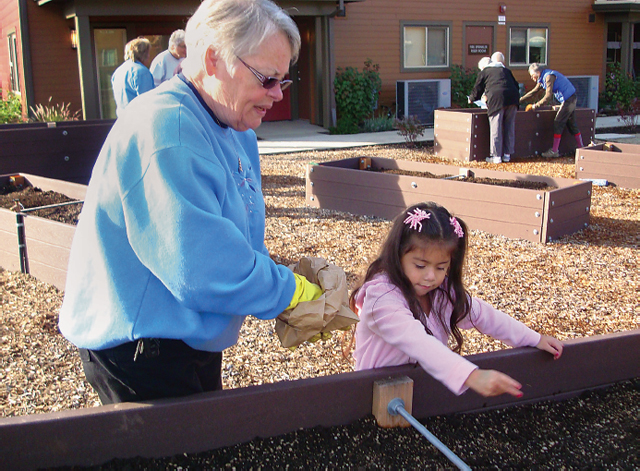 At Bridge Meadows, a community elder helps a young neighbor plant seeds in the facility's communal garden. (Photo courtesy of Bridge Meadows)
And not just any community. Bridge Meadows is what its creators call an “intentional intergenerational community.” Built on a two-acre site in a residential section of North Portland, Ore., Bridge Meadows combines housing for the adoptive families of foster children with housing for adults aged 55 or older. The “intention” behind this intentional community is to maximize social connectedness and to create an environment that will enhance childhood development. It follows a model that was pioneered by Brenda Eheart, executive director of a nonprofit group called Generations of Hope Development Corporation (GHDC). “Ordinary people can make a really significant difference in the way we address social problems,” Eheart argues.
For Jackie Lynn, community—intentional, intergenerational, or otherwise—was not a significant part of her life until just a few years ago. Previously, she lived alone with her dogs on a five-acre spread at the base of Mt. Rainier, in Washington state. Then she learned that a family in Oregon that she is related to was going through a crisis. The parents in the family were heroin addicts, and their children were under the supervision of a social services agency. Lynn applied for a job transfer, moved to Oregon, and adopted the children (two young boys and a girl). “I had no support,” says Lynn. “I was working full time as a single parent. It was a really stressful time.”
To residents like Lynn and her family, Bridge Meadows offers a variety of benefits. Its built environment consists of 9 houses for families, 27 apartment units for community “elders,” and an array of shared resources that includes a community center. In return for reduced rents, each elder spends 100 hours per quarter performing volunteer activities that range from supervising children at play to leading story sessions in the site’s library. Bridge Meadows also employs four on-site staff members who assist in day-to-day operations, coordinate activities, and otherwise help residents strengthen ties with one another. Every week, the facility hosts support group meetings, classes, and presentations by outside visitors.
“In the summer, there’s always a Slip ’N Slide on the lawn,” says Derenda Schubert, executive director. “We have a community garden, where the kids get to help grow things like Swiss chard, blueberries, strawberries, zucchini. Every Wednesday at 4 o’clock, we have Happiness Hour, where all three generations of the community come together and build new relationships.”
The result, in effect, is an innovative form of peer-based social services. An intergenerational community like Bridge Meadows applies an untapped resource (older adults who seek purpose in their lives) to an unmet need (support for foster children and their families). But it doesn’t just substitute volunteers for paid professionals. It erases the distinction between who is a “service provider” and who is a “client.” An elder doesn’t just mentor children in the community, but also receives help with daily tasks. A child doesn’t just use support services, but also becomes an active community member who can assist others. Professionalized service thus gives way to neighborhood care.
A Place for Families
The vision that informs Bridge Meadows originated in the early 1990s. Brenda Eheart, then a sociology professor at the University of Illinois, was exploring ways that the state could better support families who adopted children out of its foster care system. A permanent housing facility devoted to such families, she theorized, would add stability to their lives. Concentrating a number of families in the same place would also make it easier to deliver services to them. Most important, locating families with similar challenges in close proximity to one another would allow them to share resources—and to share experiences.
Initially, Eheart envisioned a facility that would accommodate a dozen or so families. But the Pentagon forced her to think bigger. The US Department of Defense owned a decommissioned Air Force base in the rural town of Rantoul, Ill., and Pentagon officials told Eheart that she could pursue her vision at that site—but only if she agreed to take 84 houses. It was more than Eheart had bargained for. A site that gathered 84 families with foster children in one place would aggregate too many shared challenges.
Around that time, Eheart attended a presentation by Maggie Kuhn, founder of the Gray Panthers, who was promoting the concept of enabling seniors to share their homes with young people in exchange for light caregiving services. Eheart recognized that an inversion of Kuhn’s model would solve her dilemma: She could rent some of the houses in the Air Force development to older adults at reduced rates, and in return these seniors would provide support to foster families. “It creates a new kind of organizational capacity,” Eheart says of the model that she developed.
Hope Meadows, as the community in Rantoul is known, welcomed its first residents in 1994. In 2006, Eheart left her operational role there and formed GHDC, a vehicle for promoting and replicating the Hope Meadows model. “Creating these communities from scratch—finding the money for the bricks, the mortar, and the land—it stumps most of these nonprofits, because they’ve never done it,” Eheart says.
Eheart and her team help nonprofit organizations develop fundraising strategies, connect them with architects and builders, and assist them in recruiting administrators to oversee newly created communities. Several groups are working to implement the GHDC concept, and two GHDC-sponsored communities are now in operation. The first, Treehouse at Easthampton Meadow in Easthampton, Mass., opened in 2006. The other is Bridge Meadows, which opened in 2011.
Unlike the original GHDC community in Illinois, Bridge Meadows is in an urban setting. And instead of relying on existing infrastructure, it was built from the ground up to be a place that would support an intergenerational community. Early in the design process, for example, there was talk of creating a clear distinction between areas where families would live and areas where older adults would live. “But while we agreed there were times when our seniors needed to be able to retreat and have some privacy, we didn’t want to make that too easy,” says Brian Carleton, the architect who designed Bridge Meadows. So he and other site planners abandoned that idea. In the final design, they interspersed triplexes that house seniors with family-oriented duplexes.
Despite its urban location, Bridge Meadows incorporates elements that evoke the feel of a suburb or even a small town. “Every family home has a garage,” Carleton says. “We also splurged on square footage a bit and made a room that was uniquely the master bedroom, so that there’s a strong sense that there are parents here. Because these kids have been bounced around all their lives, it was very important to give them that sense of a traditional family home.”
A Leap—and a Hope
The social connectedness that Bridge Meadows helps to promote has already had a big impact on the children who live there. “After only two years, they’re getting awards at school for their citizenship,” says Schubert. “They were all behind academically when they came to us, and now they’re all at [grade] level or beyond.”
Jackie Lynn echoes that assessment. “Three years ago, when everything happened, it was hardest on my daughter. She was already 12 years old then. Now she’s thriving. [The Bridge Meadows staff] helped me get her into a private high school. She talks about going to college, and everyone encourages it,” Lynn says. “Two of the families here have women who are her [biological] mother’s age, so she’s really bonded with them. She’s making phenomenal leaps and bounds, and it’s because of the support structure.”
Can the intergenerational approach that Eheart has pioneered expand by “leaps and bounds” as well? Can it evolve from a limited set of pilot projects into a widespread model for social service delivery? Eheart believes there are no limits on the kinds of vulnerable populations that these communities can serve. She envisions developments in which older residents live side by side with wounded veterans, mothers who have left incarceration, and homeless LGBT youths, among other groups. And the model has already proved to be flexible enough to work in different settings.
Ultimately, however, Eheart and her colleagues are trying to create organic communities, and organic communities aren’t something that planners can easily deploy on a grand scale or in a fixed amount of time. Recent experience shows that it takes a while to get a place like Bridge Meadows up and running. (Its creators began their development efforts in 2004.) Intentional communities are also, by their very nature, limited in size. “For a community to really function, you can have between 100 and 150 residents, at most,” Eheart says.
Eheart recognizes the challenges inherent in developing the Generations of Hope model on a large scale, and she emphasizes the need to break conceptual ground as well as physical ground. That starts, she believes, with changing how people think about the role and shape of programmatic social services. “These aren’t things that can be done quickly,” she says, referring to communities like the one at Bridge Meadows. “If we can get four or five places where we are demonstrating the philosophical principles behind this—the good results that happen when you develop a culture of care—then I think the concept will be out there. It will spread by itself.”
Read more stories by Greg Beato.