


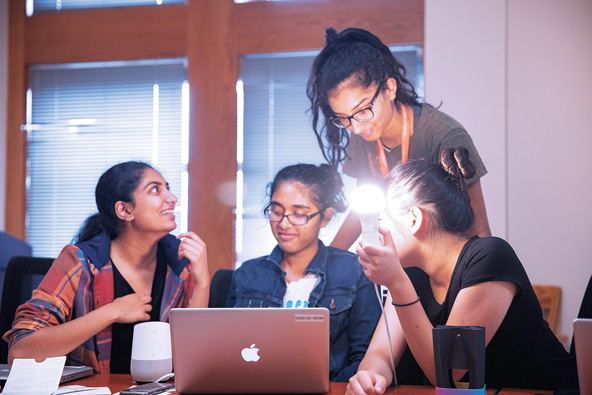
 Students at the Princeton University branch of AI4ALL receive both technical
training in computer programming and learn about tech policy and ethics. (Photo courtesy of Princeton University Office of Communications)
Students at the Princeton University branch of AI4ALL receive both technical
training in computer programming and learn about tech policy and ethics. (Photo courtesy of Princeton University Office of Communications)
On a hot August day in New Jersey, a group of teenagers sat in a classroom and watched a video from the artificial intelligence company DeepMind. Animated figures danced around the screen, “learning” to navigate an obstacle course. The students laughed, as any typical 16-year-olds would, before asking, “Can we see the code?”
The group of 32 high school students were at Princeton University for a three-week summer program organized by AI4ALL, a nonprofit dedicated to increasing diversity in the burgeoning field of artificial intelligence, or AI.
While sectors as diverse as health care and education are adopting AI technology, the field remains largely white and male. Only 10 percent of those working on “machine intelligence” at Google and 15 percent of Facebook’s AI research group are women. Numbers for African-Americans and Latinos are also low at both companies. This presents a real danger that tools such as algorithms will be biased, especially when the teams designing them are unrepresentative of broader society, says Sarah Myers West, a postdoctoral researcher at AI Now—a New York University research center. People working on AI “create the ideas about what these technologies can do and the purposes they can serve,” she says.
Recent examples of such bias include search engines displaying ads for arrest records more often in searches for distinctively black names and surfacing listings for higher-paying jobs less often for women than for men.
“When we build an AI system, we decide what problem we’re going to work on and how are we going to approach designing a solution,” says Olga Russakovsky, an assistant computer science professor at Princeton University. “When we have a team that’s not diverse, it’s not going to think as critically about all the parts of this.”
AI4ALL began in 2015 when Russakovsky—then a Stanford University PhD student in computer science—pitched the idea of an AI summer camp for girls to her advisor Fei-Fei Li. Li, a professor of computer science at Stanford and chief scientist of artificial intelligence at Google Cloud, loved the idea, and together they established the first program. In 2016, the program expanded to the University of California, Berkeley, and then to Princeton, Boston University, Carnegie Mellon University, and Canada’s Simon Fraser University in 2018.
Some AI4ALL branches are open only to girls, while others admit both boys and girls with a focus on racial inclusion. Several programs are free, while others charge tuition (more than half of the students receive financial aid). All programs include computer programing training and cover tech policy and ethics. Participants meet professors and graduate students, and visit organizations like Google and the National League of Cities.
Over lunch, Princeton AI4ALL students discuss the challenges posed by lack of diversity in AI and in leadership positions generally. “It’s tough when you’ve come to expect CEOs to be white men,” says Inaaya Coleman. Her tablemates agree: When they don’t see others who look like them in a particular field, they’re less likely to pursue such positions.
Youth initiatives like AI4ALL are important for increasing inclusiveness, says AI Now’s Myers West, but recruitment, promotion, and compensation are also critical.
After the program ends, AI4ALL connects alumni with industry mentors and offers grants for AI-related research or community projects. “We tap into their existing talent and passion,” says AI4ALL CEO Tess Posner. “They’re going on to do more creative things than we ever could have come up with.” Recent alumni developed a natural-language-processing algorithm to improve emergency dispatch response times, and conducted research on a computer vision system that monitors surgeons’ tool movements to analyze surgical skill.
AI4ALL plans to branch out to additional universities and is building an online platform to expand access to its curriculum to teenagers around the world.
“High school students are way more advanced, motivated, smart, and capable than people give them credit for,” Russakovsky says. “They build things that have impact in the world.”
Read more stories by Stephanie Wykstra.