


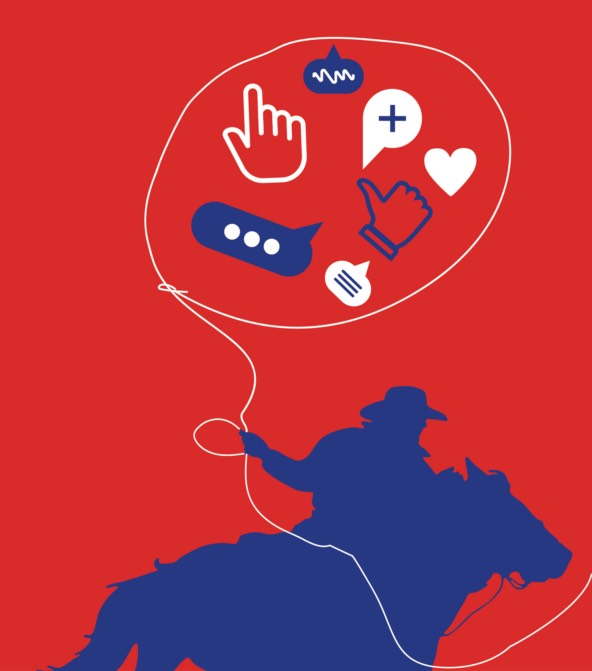
 (Illustration by Anastasia Vasilakis)
In June 2025, the Stanford Center on Philanthropy and Civil Society, the academic home of SSIR, hosted its Junior Scholars Forum in partnership with the Doctoral Seminar in Social Entrepreneurship and Philanthropy (SEPHI) at ESSEC Business School in Paris. The articles in this issue’s Research section report on papers by scholars who participated in the forum.
* * *
Alex Dildine used to run the digital organizing program for the nonpartisan group Organizing for Action (OFA), an offshoot of Barack Obama’s presidential campaign. During her tenure at OFA, Dildine managed the former president’s digital assets, using email lists and social media to organize communities that had become civically engaged by joining the campaign. In her work helping create leaders remotely, Dildine encountered an array of problems: decades of declining social capital, volunteers in far-flung locations struggling to find meaning online, and low response rates on digital platforms.
Dildine is now a doctoral candidate in political science at Johns Hopkins University, and her dissertation research asks how organizers can build a sense of community in ways that sustain long-term engagement.
“When Trump was elected in 2016, I watched as volunteer participation rates skyrocketed,” Dildine says. “But I knew that without the organizational infrastructure and an intentional effort to create a sense of community, virtual or otherwise, people were not going to know how to continue their engagement.”
What tools, Dildine wondered, could help practitioners turn online enthusiasm into offline action? Was there a way to assess the depth and quality of engagement online, and whether people found meaning, community, and purpose in organizing?
To answer these questions, Dildine’s dissertation delves into historical cases; draws on interviews with organizational strategists; and mines organizational databases, training materials, and annual reports to chart the patterns of volunteers over time, spanning an earlier era of optimism about the internet to the more pessimistic present, thanks to years of accelerated data gathering and online surveillance. Microtargeting campaigns have offered one easy way to find supporters to back a particular cause, for example. But moving those individuals targeted by campaigns to fight or even take risks for a political cause remains an unsolved challenge. Most organizations lack proven online strategies and must compete with a barrage of emails and notifications to capture people’s attention.
“She is answering questions that we weren’t even in a position to ask a decade ago,” says David Karpf, an associate professor of media and public affairs at the George Washington University. “Her research takes seriously that political voice and action has increasingly moved online and then teases out the complex consequences and implications for mobilization, organizing, and power-building.”
Most practitioners have been taught to gauge impact by measuring clickthrough rates, petitions, or doors knocked. This is in part because obtaining detailed data about what volunteers do is notoriously difficult. Dildine’s longitudinal approach traces strategic organizing alongside the evolution of digital tools to highlight principles or assumptions that guide leaders about what moves volunteers.
“My inflection point is potentially looking at before and after the pandemic,” Dildine says. “Before March 2020, people used some digital tools but weren’t necessarily all in on digital organizing. Maybe they did livestreams on Facebook to broadcast their efforts, but they hadn’t done the organizing piece, which is the key.”
Political organizing and power-building have entered a new paradigm, Dildine’s research shows. Digital tools have eased the challenges of recruitment, of building membership lists, and the costs of identifying potential volunteers. Rather than measuring clickthrough rates, however, fostering long-term engagement will require different types of measurements, Dildine’s findings suggest.
How organizations structure staff and activities becomes even more challenging when organizations make strategic choices with the knowledge that people do not exist in separate online or offline communities but always have a foot in both worlds. A great deal of research seeks to understand what the digital landscape means for individuals, but much less about group life, collective power, and civil society.
“How are we flourishing if our lives are online?” Dildine asks. “If that’s where we’re going to do our collective life, then how do we make sure that we’re finding meaning and community and purpose? That’s much bigger than just politics.”
Research paper: “The Promises and Perils of Digital Organizing: Building Community Power in the Age of Surveillance Capitalism,” PhD dissertation by Alexandra Dildine.
Read more stories by Daniela Blei.