


 (Illustration by John Hersey)
Countries and communities around the world are increasingly facing existential threats from climate change. The United States has sustained 403 climate events since 1980 that have each exceeded $1 billion in damage—in total more than $2.9 trillion—according to the National Oceanic and Atmospheric Administration (NOAA). The 27 events in 2024 resulted in $182.7 billion in losses and were exceeded by the record 28 disasters the previous year. Worldwide, a 2024 Nature Medicine study projected that over four million lives have been lost due to the effects of climate change since 2000, and the World Economic Forum projects 14.5 million additional deaths and over $12.5 trillion in economic losses by 2050.
The climate emergency is a wicked problem—a complex challenge that requires exceedingly innovative, collaborative, and widely scalable solutions. Addressing this crisis requires new ways of organizing that represent bold innovations in structure, leadership, and governance.
Bob Perkowitz understood this need when he began formulating the idea of a new nonprofit climate organization in 2005. He had been a successful entrepreneur building and selling companies in the direct-to-consumer apparel and home-furnishings markets. He also served on the boards of two of the nation’s largest environmental organizations—the Environmental Defense Fund and the Sierra Club—which gave him a grounded understanding of climate change and the environmental movement. The combination of his business acumen, nonprofit experience, and growing environmental concern inspired him to explore ways to address climate advocacy with a rational, nonpartisan, and positive approach that could engage everyday Americans who might otherwise be turned off by traditional environmental activism.
Perkowitz founded ecoAmerica to build institutional leadership, public support, and political resolve for climate action in the United States with the clear intention of “engaging and supporting existing networks rather than creating new networks.” He recognized that impact would be driven by scale, and he wanted to get there as quickly as possible.
“What we’re doing is not just a better way of organizing large-scale change,” says Perkowitz, who remains president of the organization. “I think it’s the only way of doing it right—getting the leverage, the scale, and the credibility needed to drive change.”
Specifically, ecoAmerica is an adaptive metanetwork. Metanetworks are broadly defined as networks of networks. Adaptive metanetworks intentionally integrate practices anchored in polycentric governance and complex adaptive systems. Such systems are robust, interconnected, nonlinear, and unpredictable. Change within such systems is often unplanned and emerges naturally from the ebb and flow of the interconnections and communications within the system. Polycentric governance applies in complex, fragmented, but interdependent systems with nested domains, where each domain governs itself and interacts with other domains, but no one domain dominates the others. In metanetworks, governance, decision-making, and action are distributed throughout a system rather than concentrated or centralized. This structure makes them, despite their large scale and reach over many different organizations and groups, highly malleable and responsive to smaller-scale, local dynamics as well as experimentation and shared learning.
Adaptive metanetworks are particularly suitable for working toward climate mitigation and resilience. Climate problems stretch from local to global levels and require systemic strategy, coordination, and cooperation at a massive scale among heterogeneous institutions across different sectors, diverse populations, and numerous different local contexts. Adaptive metanetworks can adjust more nimbly and systematically to the complexity, chaos, and unpredictability of on-the-ground conditions.
“Americans are living through a period of systems failure,” says Gus Speth, environmental lawyer and founder of the World Resources Institute. “It turns out to be a system that is very much in control, but not always knowingly, because there are many parts of that system, and those parts don’t really comprehend the other parts. If we could ever join forces to combine energies to oppose that system, we might get some deep change adopted.”
Speth suggests that a “movement of movements” is necessary to align climate policy change with political systems change. He believes this organizational approach is critical to achieving the large-scale systemic transformation needed to address climate change. EcoAmerica’s organizational design innovation provides an opportunity to align disparate climate networks around common goals. Together as an adaptive metanetwork, they are capable of collaboration, cooperation, experimentation, and adaptive learning that connects policymaking, research, organizational tools, and grassroots engagement to achieve the fundamental systemwide overhaul needed to fight climate change.
Genesis of a Climate Metanetwork
While serving on the Sierra Club’s board in the early 2000s, Perkowitz recognized the opportunity of engaging American youth in the climate movement. “I saw all these young people that were concerned about climate change, and no one was asking them how they could help,” he says. “We had initiated the Sierra Student Coalition on a few dozen campuses among more than 4,000 college campuses across the country, and I suggested we go out and reach these campuses by working through the major national college associations.”
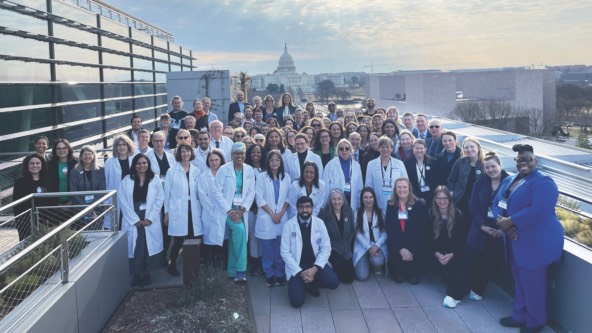 In March, ecoAmerica cohosted the Our Planet, Our Health: 2025 Climate Action Convention in Washington, DC. (Photo courtesy of ecoAmerica)
At the time, the Sierra Club’s leadership lacked the resources to pursue his suggestion. “So, I went off, found some people, put together resources, and founded ecoAmerica,” he says.
In 2005, with help from SRI International, Perkowitz honed the initial design of what he calls “version 1.0” of ecoAmerica, focusing efforts on the US higher-education sector. He believed reaching the millions of students matriculating through colleges and universities would provide the early influence needed to create a solid foundation for the organization. Launching in 2006, ecoAmerica helped create the American College and University Presidents Climate Commitment program, which by 2010 resulted in 697 US universities pledging carbon neutrality. In addition, ecoAmerica led the development of a curriculum and courses for green workforce development programs with the American Association of Community Colleges, engaging the Environmental Protection Agency and the Department of Education to support the creation and promotion of the program. These early successes cemented ecoAmerica’s commitment to investing in psychographic research on consumer attitudes and climate communications to explore new opportunities to influence American society at scale.
EcoAmerica then began to expand to other large US institutions to increase its outreach to everyday Americans. In 2010, the organization sponsored its first national climate summit in Washington, DC, bringing together 64 of America’s leading social scientists and practitioners from the academic, NGO, philanthropic, and corporate spheres to collaborate on strategies to move the United States forward on climate solutions. Their inaugural conference report called for a national climate public policy, stronger coalitions, and improved communications to build public support for climate action. EcoAmerica’s second national climate summit in 2011 grew to 80 participants and resulted in a call for more cross-sector collaboration, deeper engagement with youth, and more efforts to connect with Americans on climate change in personally relevant ways. By 2012, the climate summit had expanded to more than 100 participants and included America’s leading CEOs, academics, celebrities, climate and sustainability leaders, innovative social leaders, and climate communication experts. The 2012 conference report called for collective action to change the American energy infrastructure to reduce carbon emissions.
A Pivotal Collaboration
By 2012, ecoAmerica had helped to integrate college students across America into climate advocacy, partnering with universities on climate research and education, and drawing attention to the climate crisis by convening policy makers, business leaders, philanthropists, and celebrities. That year, the John D. and Catherine T. MacArthur Foundation approached Perkowitz and requested a white paper describing ecoAmerica’s business model. At the time, the foundation was seeking to better understand the climate change movement and was looking for ways to support American climate action in a more sustained manner.
“Six months after the initial white paper, MacArthur asked us for another report on actions that the foundation could take on climate change, and that resulted in a grant for ecoAmerica to help the foundation focus their climate initiatives,” Perkowitz says. “In 2012, we wrote an extensive report and plan for them that helped create the second phase of ecoAmerica’s work.”
The work with the MacArthur Foundation led to two additional grants totaling $6 million to support a new ecoAmerica initiative called MomentUs, which aimed to work behind the scenes with large institutions, associations, and organizations in major societal sectors such as business, health, faith, and education to empower and support climate work with research and resources. The MomentUs strategy encouraged leadership and collaboration through a robust multisector institutional network meant to increase public support for climate solutions through their constituents in local communities across the United States. EcoAmerica developed a new national campaign through its network to reach out to local newspapers, social media, and policy makers to engage Americans in the climate conversation in hopeful, positive, and nonconfrontational terms. They intended, through their research investments, communications resources, and institutional collaborations, to align climate solutions with everyday American values of community and freedom. The MomentUs campaign emphasized that climate change affected every American every day, and every American could make a difference.
EcoAmerica’s original MomentUs focus was on five sectors: education, business, health, faith, and communities. It soon found the need to pare the effort down. “We’d been working in higher education for 8 or 10 years, and by then nearly every university in America had curriculum and practices to address climate change,” Perkowitz says. “We knew we had reached a point of diminishing returns.” The business sector presented its own challenges. “It was difficult to get leverage with so many trade associations, so many subsectors, so many organizations,” Perkowitz says. “It was just not something we could wrap our arms around.” By 2013, ecoAmerica had narrowed its focus to the health and faith sectors, along with engaging local communities through civic organizations, associations, and local government offices.
MomentUs became a blueprint for ecoAmerica “version 2.0,” Perkowitz says. By 2016, ecoAmerica’s strategic focus was squarely on collaborating with key decision makers in large US institutions to secure commitment and permission to engage with their networks. EcoAmerica continued to publish extensive research on climate attitudes and communications, climate metrics, green energy policy, climate and mental health, and climate priorities.
In 2019, they introduced the annual American Climate Leadership Awards to encourage and amplify climate leadership, providing more than $150,000 in awards to the winner, runners-up, finalists, and semifinalists. The Awards connect ecoAmerica with grassroots climate leaders across the country and promote them to the public at large. Winners have included California university students who secured a University of California systemwide commitment to 100 percent renewable electricity by 2025 (since pushed to 2045); Schools for Climate Action, a grassroots youth-adult campaign to empower school boards, PTAs, teachers unions, and student councils to advocate for climate policy change; and Cooperation Jackson, a Mississippi group focused on sustainable community development and worker-owned, democratically self-managed enterprises. The 2025 winner was Change is Simple, an organization that brings STEM-based sustainability and experiential climate education to New England schoolchildren.
Growing the Grassroots
Once ecoAmerica had its research, policy, promotion, and leadership arms in place, it was time to turn to grassroots organizing as its next big step. In 2022, ecoAmerica launched an innovative online climate training program that has educated more than 7,500 people in climate communication and local advocacy skills in less than three years. Upon completing the training, participants are offered an opportunity to join the Climate Ambassador network, a community that now includes more than 3,000 members. These ambassadors gain access to ecoAmerica’s online Forj platform, which connects users and enables them to engage in real time with ecoAmerica and other ambassadors. Forj also provides additional training, presentations, talking points, research, templates, other resources, and regular opportunities for action and advocacy.
“To accomplish our mission, we needed to go downstream,” Perkowitz says. “We set up the climate training program to help leverage that.” EcoAmerica calls this effort “Going Local,” combining the top-down focus from institutional partners with a bottom-up focus on grassroots engagement. Perkowitz labels this “version 3.0 of ecoAmerica.”
Today ecoAmerica has a grassroots reach of well over 60 million Americans through its nearly 200 institutional and denominational members in its three sectors of faith, health, and local community organizations. Ashley Lane, director of network activation at ecoAmerica, says that the addition of the Climate Ambassador network to its existing three sector networks provides “the climate leadership infrastructure and base building that America needs—one that is rooted in trust and powered by people, and built to impact the center of American society. That is what we are trying to do.”
Through its research and outreach programs, ecoAmerica encourages climate engagement at all levels of American society. The Climate Leadership Awards are a significant contributor toward ecoAmerica’s sustainable grassroots climate action. EcoAmerica’s $3.4 million operating budget in 2024 was funded primarily by family foundations and individual high net worth donors who are committed to change.
“We all want to make a positive difference,” Perkowitz says. “We can still certainly solve the climate challenge and look our children in the eyes and say we left them prospects for a better world. At the very least, we can give them a reasonable chance at a reasonable future.”
Sustaining and Scaling a Mission-Driven Entity
Leaders such as Perkowitz who seek meaningful impact at scale in the social sector wrestle with several big questions, such as: How do you structure organizational design in contexts where member entities operate in polarized, autonomous, and diverse environments? How do you build and strengthen collective leadership capacity? And how do you address the challenges of scale as they arise? Over its two decades, ecoAmerica’s genesis and growth offer important insights in response to these questions. We can organize these insights into five pillars that together capture its novel impact as an adaptive metanetwork: 1) responsible leadership-at-scale; 2) open system learning architecture; 3) responsive resource deployment; 4) cross-level constituent capacity enhancement; and 5) catalytic innovation amplification. Let us examine them in turn.
Responsible Leadership-at-Scale | In an adaptive metanetwork engaged in momentous social change, attention to scale and system dynamics is crucial. EcoAmerica promotes and practices a leadership model that emphasizes adaptive, ethical, and deeply relational behavior that focuses on network alignment and engagement. The model emphasizes embracing complexity and enabling conduct that furthers collective efforts.
Jacqui Patterson, founder of The Chisholm Legacy Project and former director of the NAACP Environmental and Climate Justice Program, believes that systemic change requires tackling our extractive economic system at scale. “If we truly want to get to where we need to go as a world, to truly mitigate the climate change impacts, that’s the level of change that we need to be talking about,” she says. That is not easy in a large, diverse, and politically polarized country. But groups like ecoAmerica, Patterson says, cultivate spaces of varying size and scale where people can set aside differences and focus on mutual aid that, taken as a whole, can generate large-scale change.
Leadership is a necessary but insufficient solution to an existential challenge such as climate change. The late Nobel laureate Elinor Ostrom emphasized that in a polycentric climate governance system with nested but independent domains, addressing the challenge of climate change requires both the bottom-up efforts of grassroots leaders and the top-down efforts of national and international policy makers. Since 2016, ecoAmerica has focused on top-down engagement through its institutional members, and now, with its Going Local initiative and its Climate Ambassador program, is paying increasing attention to bottom-up grassroots engagement. This approach rests on inspiring and empowering climate leaders at every level of the metanetwork.
“The idea of top-down and bottom-up leadership is synergistic and mutually reinforcing,” says Ed Maibach, director of George Mason University’s Center for Climate Change Communication. “You need bottom-up pressure to give leaders at the top the cover to be bold. Without bottom-up support, we’re leaving them vulnerable to criticism from the opposition.”
This effort to encourage and amplify grassroots leadership permeates the metanetwork, from community gardens addressing food deserts and healthy-food scarcity, to misting stations addressing extreme heat and urban heat sinks, to inner-city green spaces addressing urban asthma. Many of these grassroots engagements are cross-sector, and frequently the approach is lifted from one location, modified, and scaled in other locations.
Take, for example, Community Lighthouse in New Orleans: “The Community Lighthouse project employs a cross-sector interfaith and health network to provide access to power after a disaster, like during Hurricane Katrina 20 years ago,” says Ben Fulgencio-Turner, director of ecoAmerica’s Climate for Health program (CfH). “When the power goes out, people die from lack of relief from heat, or because they can’t get their oxygen running, or because they get carbon monoxide poisoning from generators. Having resilience hubs built around solar microgrids, with backup generators, all within walking distance of everyone in New Orleans, was their goal. The idea of solar microgrids came from relief workers in Puerto Rico, after Hurricane Maria.”
Open System Learning Architecture | In our hyperconnected world, an enormous amount of information is being generated, including knowledge that informs continuous learning and action—especially in disbursed and networked organizations. Processing such a flood of information and making it actionable are challenging. “Sharing information is crucial, but we live in an age of such information overload that it’s complicated,” says Bill McKibben, climate activist and Schumann Distinguished Scholar in Environmental Studies at Middlebury College.
“Research is fundamental to ecoAmerica,” says Meighen Speiser, executive director of ecoAmerica. “It’s how we started, and it informs everything that we do.” But the generation of research is just the first step. EcoAmerica’s extensive capabilities to source and disseminate research, and to gather and act on feedback and additional information and insights from its broad metanetwork, including donors and external stakeholders, is fundamental to its mission and effectiveness. The organization’s collective practices seek out feedback, share knowledge, and encourage collaboration, experimentation, mutual learning, and deep engagement across the metanetwork. Its internal processes include constant streams of communication to allow ecoAmerica to collect, evaluate, and act upon feedback and research to enhance institutional learning, sensemaking and sensegiving, and group cohesion.
This attention to mutual learning is built into ecoAmerica’s practices. Before sharing research outcomes with the metanetwork, all research is reviewed and evaluated by the ecoAmerica senior leadership team. This experiential review process deeply familiarizes and engages the ecoAmerica leaders with the research, which in turn facilitates the network sensegiving that follows. Each piece of research is then presented to key institutional members to prioritize climate action based on current psychographic data. Much of the research is shared with the Climate Ambassador network through its online Forj portal, and ultimately the research output is publicly shared on ecoAmerica’s websites. They not only act on the research but apply it in their messaging and outreach.
“We let our partners know that our mission is to help them to lead on climate,” Speiser says. EcoAmerica backs this expectation of climate leadership with peer-to-peer guidance and support, helping to align climate action to the partner’s existing priorities.
Feedback is a core cultural practice at ecoAmerica. Members constantly seek feedback from myriad sources—face-to-face meetings, online requests, surveys, and many other avenues. This process enables double-loop feedback in which members delve more deeply to question underlying assumptions. Such two-way learning hones members’ mental frameworks, feeds adaptive behaviors, and results in continuous experimentation and innovation that is amplified across the metanetwork.
The metanetwork is also adapted to broad dissemination. Brett Matulis, ecoAmerica’s communities program director, conducted climate training for more than 320 public school educators in Prince George’s County, Maryland, just outside of Washington, DC, in 2024. The idea originated from a local Climate Ambassador who organized and coled the trainings. “Prince George’s County is one of the biggest school districts in the country,” Matulis says. “It includes 9,000 teachers and over 130,000 students. If each of them reaches 120 people, it can have a massive impact.” The program is being replicated in Bellevue, Washington, and the Denver, Colorado, public school system is planning a similar training.
The adaptive impact is further amplified through ecoAmerica’s ideation practices. For example, from these school systems trainings, the team began discussing a “train the trainer” model and quickly recognized that their limited resources could not support the idea. After further ideation, the sector directors and Ashley Lane’s network activation team developed the Group Climate Ambassador Training, which provides educators with facilitation guides, printed literature, and online videos to train both students and other educators.
Research and dissemination of information is only part of the shared learning architecture. Storytelling capacity is also important at all levels of the metanetwork. EcoAmerica encourages climate leaders, through its programs and trainings, to tell their own stories and to communicate with their audiences in constructive and personally relevant ways.
“Stats and figures and headlines of storm impacts don’t stay with you,” Matulis says. “What stays with you is how you felt, and if someone tells a story that makes you feel something, that has lasting impact.” These efforts to encourage personally relevant storytelling are supported by ecoAmerica’s significant investment in psychographic and communications research to understand how Americans think and feel about climate change. Such storytelling is a critical part of the climate training program and Climate Ambassador leadership development.
Responsive Resource Deployment | Climate leadership is expected from every member of the ecoAmerica metanetwork, from their own leaders to the top executives of the organization’s large institutional partners, continuing through to the practitioner and grassroots levels. These partners include the American Psychological Association, the American Academy of Pediatrics, Kaiser Permanente, the Presbyterian Church (USA), the African American Mayors Association, the Islamic Society of North America, other climate networks, and many other groups. “As audacious as we are in our goals, we let our partners know that our mission is to help them to lead on climate,” Speiser says. EcoAmerica backs this expectation of climate leadership with peer-to-peer guidance and support, helping to align climate action to the partner’s existing priorities.
 (Illustration by John Hersey)
This alignment takes significant effort. EcoAmerica’s program directors stay close to their partners, providing regular communication, sharing access to extensive research and resources, and building deep trust. Their grassroots outreach, their programs and climate trainings, and their online capabilities drive that engagement. The resources provided by ecoAmerica are extensive and include research reports, climate opinion surveys, climate action and communications guides, mental health resources, webinars, and webcasts. EcoAmerica is now encouraging the integration of climate work and the arts, with online kits available to make climate communications an immersive, interactive, and fun activity.
EcoAmerica’s ability to capture feedback and learning from one sector and quickly ideate and pivot is an important benefit to both institutional members and grassroots leaders. Whether customizing Climate Ambassador training for educators or medical school students, or creating new programs within their three core sectors, this ability to quickly learn, adapt, and amplify is essential to the metanetwork. Keeping their eyes on the grassroots level is imperative to ecoAmerica’s success.
“The goal with all my denominational partners is to reach and support the people in their faith community, the congregations and the congregants,” says Rev. Carol Devine, director of ecoAmerica’s Blessed Tomorrow (BT) program, which engages faith communities in addressing climate change as a moral challenge. “I keep that lens as I try to support them with resources, events, and training.” Such grassroots engagement is supported by targeted campaigns. In late 2023, for example, ecoAmerica launched One Home One Future, a multifaith initiative that brings together faith organizations and denominations across the country to support congregations with tool kits and resources to pursue numerous different priorities, from disaster preparedness and climate justice to environmental stewardship.
Cross-Level Constituent Capacity Enhancement | Building adaptive capacity at the grassroots level is crucial to the metanetwork’s, a multifaith initiative that brings together faith organizations and denominations across the country to support congregations with tool kits and resources to pursue numerous different priorities, from disaster preparedness and climate justice to environmental stewardship.
This practice starts at the top: Perkowitz calls ecoAmerica “an open-source” organization. “We share all our resources and materials openly under a Creative Commons 4.0 license. You can take anything you want,” he says. “Our job is to develop climate leaders and then support them as they step into that leadership role.”
EcoAmerica undoubtedly faces a challenging political context. As much as it has grown in such a short time, it must continue to draw on the vast social capital it has built to navigate emerging challenges and galvanize its members and the public at large.
The annual Climate Leadership Awards, local recognition, grants, ongoing training, and continuing resource allocation to grassroots leaders are all “powerful capacity builders,” Speiser says. Grants were initially available only to large, institutional partners “for things like setting up a full-time or part-time employee to manage their climate program,” according to Speiser. EcoAmerica has recently begun to offer micro-grants as institutional members became more established and the need was identified to build capacity at the grassroots level.
“In our faith sector, we’ve announced small grants of $500 to $1,000 for individual congregations to engage other faith congregations in their community, to do something collective and collaborative, to raise awareness and engagement on climate,” Speiser says.
BT’s Devine finds the new program impactful. “In 2025, we had well over 2,000 participants in our hybrid National Faith and Climate Forum, and over 1,000 were gathered in person with other faith communities,” she says. “One local leader had nine different faiths represented at their gathering.” EcoAmerica’s micro-grants encourage metanetwork growth and increased commitment to collaboration and collective action at the grassroots level.
Providing sanctuary for grassroots leaders who take on the difficult work of climate action is crucial for scaling member capacity. EcoAmerica has built an inclusive, welcoming, and embracing community that encourages engagement and commitment, utilizing Forj to enhance connection and cross-sector collaboration among grassroots leaders themselves and with ecoAmerica’s team leaders.
EcoAmerica is keenly attentive to issues of justice, equity, diversity, and inclusion (JEDI). “By design, our strategy is meant to be more inclusive,” Speiser says. “The whole reason for our being, as an organization, is to bring more people along on climate—to invite a broader diversity of people into the movement. The people who are hurt first and worst generally have the least. Climate change is an injustice multiplier.” Most metanetwork members prioritize JEDI efforts, and many are living amid oppression, poverty, racism, classism, and bigotry. In local trainings, ecoAmerica promotes climate justice by emphasizing that climate solutions equitably serve and benefit communities that have faced systemic exclusion. The Climate Leadership Awards program spotlights the work of effective climate solutions from diverse groups.
Pursuing such goals is difficult under the current Trump administration, which has prioritized rolling back and cracking down on organizations’ diversity, equity, and inclusion programs.But ecoAmerica is committed to its JEDI efforts. It recognizes that climate resiliency and climate justice require preparation, and the organization is committed to climate justice work that engages the communities most affected and works to provide them with resources that can help to effect change before the next crisis arrives. “It’s hard to separate climate justice from human justice,” BT’s Devine says.
Catalytic Innovation Amplification | Amplification is critical to catalyzing the emergence of large-scale change. Nearly every published ecoAmerica communication dating back to 2014 expresses the goal of amplifying climate leadership and climate solutions. Climate leaders across the metanetwork are trained and encouraged to experiment, to innovate, and to share innovations across and outside the network.
“The innovation of finding ways across different levels of the network to bring them together to amplify their power, again in a completely unique way, is the innovation that I’m most enthusiastic about, and is the innovation that I believe can have the greatest impact,” Fulgencio-Turner of CfH says.
Climate leadership is amplified throughout the metanetwork, but also to donors, and to external stakeholders through ecoAmerica-sponsored climate conferences, summits, trainings, and forums; through numerous online and in-person meetings that are built into their practices; and through its annual Climate Leadership Awards. “Eighty percent of our Climate Awards nominees come from outside our network,” Speiser says.
In the last five years, ecoAmerica has produced more than 100 webcasts, dozens of webinars, and nearly 50 how-to guides, all to encourage and enable grassroots climate leaders to engage locally in positive, nonconfrontational, and personally relevant ways. This approach then encourages others to engage.
Ultimately, ecoAmerica is striving to amplify climate leadership, and the generative emergence it desires is collective climate leadership at scale. This collective leadership, both top down and bottom up, will encourage and sustain the shifts in American society that can reverse the climate crisis. The goal is ambitious, but it is matched by the means that ecoAmerica has developed: networks upon networks of organizations mobilizing and coordinating millions of people to address the most daunting and complex challenge of our era.
Path Ahead
In one of his first acts as president after taking office again on January 20, 2025, President Trump withdrew the United States from the Paris Agreement, the international accord negotiated in 2015 for participating countries to limit greenhouse gas emissions and prevent global surface temperatures from growing beyond 2º C above preindustrial norms. So far in his second term, the Trump administration has expressed support for oil, gas, and coal as essential to the country’s energy profile and ridiculed green energy as a “scam” and climate change as a “con job.” Meanwhile, climate scientists warn that global warming is accelerating more than earlier projections suggested and that we are running out of time to prevent runaway climate change.
EcoAmerica undoubtedly faces a challenging political context. As much as it has grown in such a short time, it must continue to draw on the vast social capital it has built to navigate emerging challenges and galvanize its members and the public at large. Lane, ecoAmerica’s network activation director, thinks the organization is up to the task. “We see federal progress stalling, and public trust is fractured,” she says. “Our greatest opportunity lies in equipping local trusted messengers, and that is exactly what our program is doing.”
Speth believes that the current administration actions may encourage the social engagement needed to drive systems change. “It’s not exactly right to say that Trump is providing us with silver linings, but people must recognize now that we are in an existential crisis, and we must think about how we magnify our strength,” he says.
However, Ed Maibach of George Mason thinks that the country and actors in the climate action space have much more work to do to match the forces fighting climate change mitigation. “The first challenge is getting people to care,” he says. “We haven’t succeeded there, or not nearly as much as the opposition has succeeded, but winning hearts and minds is only half of the challenge. The other half of the challenge is, once you do win hearts and minds, you still need to make it easier for people, for organizations, and for governments to do what is necessary to make a difference.”
Maibach sees growth potential in aligning climate networks for action. Each climate network is itself a node in a greater network of climate action. “The nodes are often very, very poorly connected. I feel like we’re in the opening stages of this opera.” He adds, “Frankly, I see highly functioning networks of networks from those who are opposed to climate change. They seem better connected and more amenable to cooperation, and much more disciplined in their respective potential for influence. And they are much better funded.”
“Collective action requires relationships, and relationships are built on trust,” says Marshall Ganz, grassroots organizer and senior lecturer at the Harvard Kennedy School. “That trust grows out of shared risk and shared commitment. It doesn’t precede it.” Metanetworks can grow only as fast as trust-building allows. EcoAmerica’s collective leadership-at-scale requires careful and deliberate cultivation of trusting and transformational relationships, which will take time—a preciously scarce commodity with the acceleration of climate change.
Since its inception, ecoAmerica has made important and unique contributions around climate awareness and actions on the US national scale. Its unique organizational structure as an adaptive metanetwork offers important possibilities to other social sector entities considering business models with low transaction costs and potentially high impact through their reach at scale.
“Hopefully people will read this and say, ‘Hey, you know, I can do that. I should participate in that training. I can collaborate to push for change,’ and maybe they’ll do it with us, or maybe they’ll do it on their own,” Perkowitz says. “We want the planet and the people on this planet to live.”
Read more stories by S. Aqeel Tirmizi & Timothy G. Staub.