


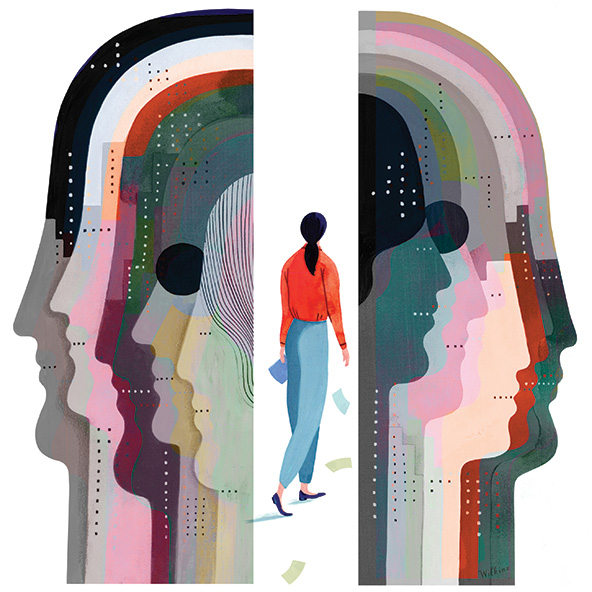
 (Illustration by Sarah Wilkins)
Mental illness affects large portions of the world’s working population. In the United Kingdom, for example, one in six employees has a diagnosed condition.
Companies have to learn how best to support their employees experiencing mental illness. A new study suggests that part of the solution may be to afford workers greater autonomy over how they balance work responsibilities and flaring symptoms. Many workers use strategies of disengagement from some aspects of their jobs and engagement in other aspects when they are going through an episode of illness, and those strategies prove effective.
“Our findings suggest that temporary (dis)engagement can provide unique benefits for employees with mental illness and the organizations in which they work,” write researchers Emily H. Rosado-Solomon, an assistant professor of management at Babson College; Sherry M.B. Thatcher, a professor in the Department of Management and Entrepreneurship at the University of Tennessee, Knoxville’s Haslam College of Business; and Sam D. Strizver, a PhD student at the University of South Carolina’s Darla Moore School of Business.
Their study, based on five years of data collection, involved 59 interviews with employees who had diagnoses of anxiety or mood disorders. The subjects worked in a range of occupations, including bus driver, chemical engineer, graphic designer, and touring musician.
Employees first have to decide whether to talk about their mental health with coworkers, their boss, or the human resources department. Some participants said they found it easier to discuss their condition with colleagues when they were between episodes or not experiencing symptoms. Managers who learned of their employees’ mental health issues often tried to give psychiatric guidance, according to interviewees—something the managers were unqualified to do. However, participants did appreciate bosses who were empathetic and encouraged them to use flexible workplace benefits.
The research focused on how employees managed symptoms at work. The authors found that workers given small measures of autonomy—the ability to work the drive-through line in a restaurant on days when interacting with a steady stream of customers would provide a welcome distraction, for example—were able to deal with their symptoms better.
Since beginning graduate school, Rosado-Solomon, the child of two mental health professionals, had been wondering what researchers knew about the work experiences of people with chronic mental illness. The literature had little on the topic that considered the issue from the point of view of the employees themselves.
Watching a friend live through a bout of clinical depression while working at a company made Rosado-Solomon think that “maybe now was the time for more sustained, focused research on this,” she says. Then the COVID-19 pandemic hit, leaving companies around the world grasping for ways to manage employees with anxiety and depression.
Companies understand that they have obligations to employees dealing with serious physical illness like cancer or diabetes. The difficulty with mental illness, Rosado-Solomon says, is that employers often feel that it is a different category of illness that affects job performance. The researchers found that because workers have discovered their own sophisticated strategies to keep up their performance levels while experiencing symptoms, “we see people thriving at all levels of the organization,” she says.
The paper builds on the research literature on emotional regulation, which has found disengagement to be a crucial method, by explaining how choosing to disengage from certain work tasks and situations can be useful for employees having mental health issues, says Hooria Jazaieri, an assistant professor of management at Santa Clara University’s Leavey School of Business.
“Rather than viewing disengagement as a maladaptive strategy, the authors demonstrate that disengagement is indeed a strategy that can help employees meet their work goals,” says Jazaieri, who is also a licensed psychotherapist treating patients with anxiety, mood, and personality disorders.
Most workplaces don’t manage employee mental health well, in part because they aren’t able to tailor responses on a corporate or manager level to an individual worker’s own issues.
“Instead of a one-size-fits-all approach, this paper reinforces the notion that employees are self-aware,” she says. “When trusted and given agency, they can choose when it is appropriate to temporarily disengage in order to manage symptomatology, which is ultimately in the best interest of the organization.”
Find the full study: “Navigating Mental Illness at Work Using Disengagement and Engagement Pathways” by Emily H. Rosado-Solomon, Sherry M.B. Thatcher, and Sam D. Strizver, Academy of Management Journal, forthcoming.
Read more stories by Chana R. Schoenberger.