


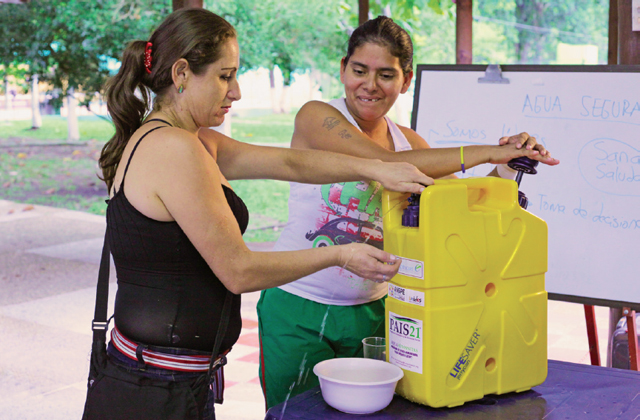
 Women in the Colombian municipality of Ibagué use a LifeSaver System jerrycan to access clean water. (Photo courtesy of the País21 Foundation)
In June 2012, Juan Manuel Santos, the president of Colombia, appeared at the inauguration of the Center for Social Innovation (CSI), the first government-supported center of its kind in Latin America. At the event, he said, “Social innovation can help us be more effective, efficient, and sustainable in our goal of reducing poverty. Social innovation has to do with the rethinking of our policies and programs, with the help of private companies and citizens.”
When Santos took office in 2010, he named the alleviation of poverty as an important goal for his government. Over the past decade, Colombia has gone through a series of positive transformations. Domestic security has improved notably as the government has taken steps to bring the country’s long-running civil conflict under control. Over the past four years, the Colombian economy has grown at an average annual rate of 4 percent. Between 2002 and 2013, the country’s poverty level decreased from 54 percent to 33 percent, and extreme poverty dropped from 20 percent to 10 percent. Yet Colombia still ranks as one of the most unequal countries in the world. “We don’t have a trickle-down effect. We know that economic growth is necessary, but it’s not enough,” says Samuel Azout, cofounder of CSI and former director of the National Agency for the Alleviation of Extreme Poverty (ANSPE).
To pursue different approaches to reducing poverty and inequality, the government in 2010 created the Department for Social Prosperity. ANSPE is part of that department, and it was through ANSPE that the government started to move social innovation onto the public agenda. In 2011, ANSPE gathered 46 organizations from multiple parts of society for a series of workshops that aimed to explore opportunities and challenges related to the pursuit of social innovation. “We wanted to construct a center that addressed the necessities of the ecosystem. It wasn’t an automatic process. It took a lot of time,” says Carolina Puerta, former director of social innovation at CSI.
Following that process, the Colombian government launched CSI. The mandate of the new center is to foster innovative, scalable, and sustainable solutions to the problem of extreme poverty. Its core activities include funding and developing projects, coordinating the efforts of various participants, and increasing the capacity for social innovation at a regional level.
The CSI provides insight into the role that the public sector can play in promoting social innovation. At the same time, it illustrates some of the gaps in credibility, collaboration, and scalability that continue to mark this field, particularly in a country such as Colombia. People who have taken part in CSI activities have discovered that it’s not enough to have a good idea for driving systematic social change. In addition, social innovators must have the ability to combine talents, resources, and capacities in a way that transforms ideas into action.
Areas of Exploration
In its first two years of operation, CSI has initiated a diverse array of projects that target specific problems related to poverty.
Access to water | Providing financial incentives to fund projects can be a powerful tool to stimulate social innovation. In 2012, ANSPE, Colciencias (the national Department of Science, Technology, and Innovation), and the Inter-American Development Bank created Ideas for Change, a challenge-based competition. The first challenge focused on water as a vital element of social development. In Colombia, 53 percent of the rural population do not have a reliable source of potable water. As a result, many children in poor rural areas are at high risk of contracting cholera and other diseases.
Organizers of the water challenge received 61 proposals and awarded a cash prize to 10 of them. Among the prize-winning solutions was a proposal by the País21 Foundation, a Colombian nonprofit, to implement the LifeSaver system in the country’s Putumayo region. The Lifesaver system uses a jerrycan equipped with a nanofilter; each container provides up to 18.5 liters of potable water per fill. “In our project, we did workshops that involved all the actors from the community,” says Alvaro Martínez, director of País 21. “We wanted to give knowledge to the community and create appropriate uses of the technology.”
The water challenge initiative used an online platform to foster a dialogue between institutions that have developed solutions to the water problem and communities that are affected by the problem. “The idea was not to take a project to a community, but rather to find solutions with and for the community,” says Ricardo Triana, a consultant from Colciencias.
The Ideas for Change approach shows how government can develop new instruments to identify social needs and innovative solutions. But as an initiative that focuses on pilot projects, it has clear limitations. “Implementing a solution is not enough. We need to find ways to scale up the solutions to a bigger dimension,” Triana argues. Martínez shares that concern: “If we already have a proven model, we need to move fast to scale it to a national level. We need to create a fund so that people can access validated social innovations.”
More and better housing | Another effort begun by CSI is the Pioneers Alliance, a partnership that brings together Compartamos con Colombia, a nonprofit organization, and eight private companies to identify novel solutions to social problems. “ Pioneers Alliance involves the coordination of different actors—not only actors that provide funding, but potential partners that can provide knowledge, networking, and contacts,” says Francisco Noguera, a project manager for the alliance who works for Compartamos. The alliance has created challenge prizes that focus on four areas: housing, income generation, mobile applications, and nutrition.
Colombia has an estimated housing deficit of 4 million homes, and there are gaps in the public sector effort to close that deficit. To fill those gaps, the alliance created a challenge prize called Proyecta Colombia. In response to that challenge, the Kayrós Foundation submitted a winning proposal for a project called Alliance for a Worthy House. The Kayrós project reaches people in vulnerable communities and offers them access to credit, along with other forms of assistance. So far, the organization and its partners have completed several hundred housing improvements. “We want to reach people with an integral housing solution that is secure, sustainable, and earthquake-resistant,” says Haidy Duque, cofounder of Kayrós.
The key to efforts like Proyecta Colombia, Duque argues, is building trust among various stakeholders. “I’m convinced that governments can accelerate change, but we must create alliances that generate credibility,” she says. “This is when the real magic happens—when all the actors unite to create social change.”
Food solutions | Latin American countries generate about 100 million tons of food waste per year. In Colombia, meanwhile, about 40 percent of the population suffer from food insecurity. Buen Provecho (“good appetite”), a Pioneers Alliance challenge initiative, aims to help solve both of those problems. Partners in the effort include Minka-Dev, a social enterprise that promotes sustainable development, and FUBAM, a large food bank network. In the challenge phase of the initiative, Buen Provecho invited private sector organizations to propose ideas for transforming already-ripe fruits and vegetables into nutritional, nonperishable products. The goal was to find proven solutions, says Juliana Mutis, cofounder of Minka-Dev: “We want to create an ecosystem of alliances to make the model more viable.”
The winning proposal came from ALSEC, a large food products company, which has developed a process that takes decomposing fruit—fruit supplied by food banks, for example—and turns it into a nutritional powder for children. ALSEC also made a commitment to outfitting production plants that will sort, disinfect, and process the fruit provided by its Buen Provecho partners. “We are going to pilot the idea and transfer the knowledge to the other food banks in the country,” says Luis Guillermo Bonilla, director of FUBAM.
Gaps in the Field
The projects that have emerged from Ideas for Change and the Pioneers Alliance targeted public policy gaps using social innovation. Along the way, though, these early initiatives have also revealed some limitations that an organization like CSI will face. One limitation is that these initiatives tend to bring forth promising ideas but not established models. “Projects are not investment-ready. There are good ideas, but they haven’t passed the formalization stages,” says Ana Aristizabal, investment manager of Bamboo Finance, a private equity firm that has invested in social innovation efforts in Colombia.
Another limitation that has marked early CSI initiatives relates to the difficulty of scaling up effective projects. “Our view is that these projects can grow, not only through mechanisms of public policy, but also by taking these projects to a level where they can attract private capital,” Noguera says. He notes, however, that attracting private capital has been difficult because many companies don’t see a link between their business goals and the goal of reducing extreme poverty.
Despite limitations, CSI has shown that government has a role in promoting social innovation in Colombia. By mobilizing ideas and piloting projects, CSI has fostered collaboration among multiple actors. One of its achievements has been “to make [social innovation] a public policy,” Puerta says. “It was very difficult [at first] because many institutions didn’t believe in this.”
Ana María Rojas, who served as director of CSI until September 2014, suggests that the center has found a place for itself. “In two and a half years of existence, we already have a portfolio of 35 piloted projects. The next step is scaling up. We have a base of projects that we can sell to other entities in the government,” she says. “A center for social innovation can’t do everything alone. Social innovation has to do with networks and communities. With coordination, social innovation can help us create solutions for social challenges.”
Read more stories by Juan Manuel Restrepo.