


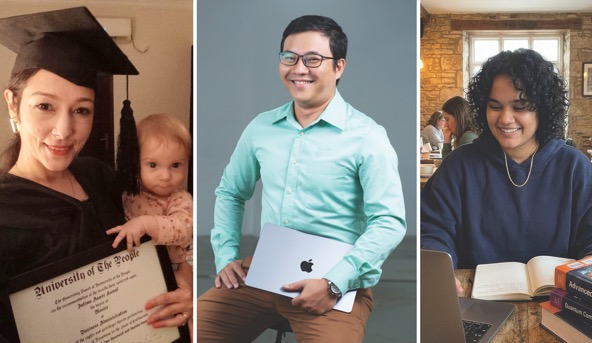
 Students from all over the world attend University of the People. From left to right: Fatima K., an MBA graduate from Pakistan; Duy L., an MBA graduate from Vietnam; and Heshani K, a computer science student from Sri Lanka. (Photos courtesy of University of the People)
When asked why so many professors continue to volunteer for University of the People, entrepreneur Shai Reshef describes what many of them experience. “What could be better than waking up in the morning, making your cup of tea or coffee, opening your laptop, and here studying with you is a woman hiding at home in Afghanistan, someone selling food on the street in Africa, and a woman in a shelter in Ukraine,” he says.
But while individual student stories provide compelling examples of the impact of UoPeople, the tuition-free university Reshef launched in January 2009, the scale it has achieved is equally striking. Now operating in more than 200 countries and territories, UoPeople has more than 200,000 students, of which more than 17,000 are refugees and more than 17,500 are internally displaced persons.
“The global reach of this school is incredible,” says Ann Wagner, who teaches education at UoPeople. “If I have 17 students, they’re from at least 10 different countries.”
The idea for a tuition-free online university first occurred to Reshef, who has more than 25 years’ experience in education, as he watched the emergence in 2007 and 2008 of online platforms that enabled professors to help students answer questions about their assignments. “I said, ‘Wait a second,’” he recalls. “We have open-source technology, open educational resources, and free professors. That’s a university—all I have to do is to put it together.”
At the time, online instruction, which had emerged in the mid-1980s, was becoming an increasingly popular way of delivering higher education. And Reshef had seen the power of technology in education as chairman of Kidum Group, an Israel-based for-profit educational services company whose e-learning subsidiary partnered with the University of Liverpool in the early 2000s to create an online university.
But while online degrees have proliferated in the decades since then, they come with cost barriers, even though they are cheaper than degrees that require in-person attendance. The average US online college student pays about $1,000 per credit, for example. In the academic year 2024-25, the average cost of an online degree in the United States was $40,536 for a bachelor’s degree at a state university and $63,185 for an online degree at a private college or university.
When launching UoPeople, Reshef believed that expanding access to high-quality, accredited higher-education programs meant offering them tuition-free. “There are tens of millions of students around the world who deserve a higher education and can’t get it either because it’s too expensive or they live in countries where there aren’t enough universities,” says Reshef, who used $1 million of his own money to launch the university. “This is a lost generation.”
While UNESCO (the United Nations Educational, Scientific and Cultural Organization) estimates that the world’s higher-education enrollment rates have more than doubled over the past two decades, reaching 269 million in 2024, significant enrollment-rate gaps remain. In sub-Saharan Africa, for instance, just 9 percent of young people (typically 18 to 24 years old) are enrolled in higher education. Moreover, UNESCO’s 2022 figures showed a gap of up to 60 percentage points between the richest and the poorest nations.
To increase access to higher education globally, Reshef knew he needed to keep costs as low as possible. First, this meant registering UoPeople as a nonprofit institution of higher education. While students are charged modest application and end-of-course exam processing fees, instruction is free, as are books, online materials, and annual enrollment.
“We are tuition-free—but we are not free,” Reshef explains. “If they can, students are expected to pay $180 per course, so a full year of a BA program costs $1,800. However, over 75 percent of the students pay zero. So, if you have the money, we ask you to pay, and if you don’t, we don’t.”
Access and Flexibility
Assisted by grants and scholarships, the institution can include students from developing countries in higher education. And the model is equally compelling for students in the United States, where the high cost of a university degree can leave students with debt burdens of up to $43,333, and the outstanding federal student-loan debt is some $1.693 trillion.
For Annabella Penna, who in 2022 moved from Venezuela to the United States with her family when she was 17, UoPeople provided an educational lifeline. “I had so much uncertainty as to what to do,” says Penna, who is pursuing an associate degree in computer science. “I didn’t know if I was going to be able to pay a university in the United States, because everything is so expensive over here.”
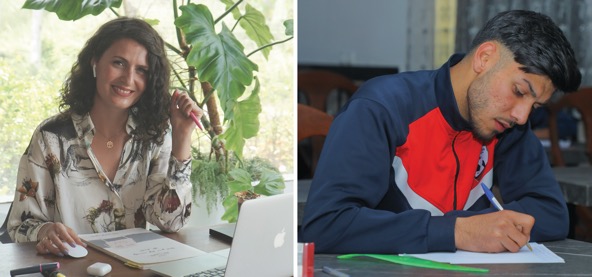 Nelli B. from Russia, left, completed a master’s degree in education. Nizamuddin A., right, from Afghanistan is studying business. (Photos courtesy of University of the People)
Because the UoPeople model enables students like Penna to study for a degree that would otherwise be unaffordable, the institution attracts funding from a range of donors, including foundations (such as the Gates, Hewlett, and Ford foundations), corporations, and individual philanthropists.
“It’s all about access,” says Frank Brown, retired partner of private-equity firm General Atlantic and consultancy PwC, who supports UoPeople through his family office. “When you think about the prohibitive cost of a residential model of top education,” he says, “the concept of porting the instruction—the same quality or even somewhat higher and more consistent—to a female Afghan refugee on a cellphone is incredibly compelling.”
Yet affordability is not the only reason students come to UoPeople. Since many also face the insecurity of living everywhere from war zones to homeless shelters, prisons, and refugee camps, many such students seek UoPeople for its flexibility. “Because of the kind of students we have, we allow them up to 10 years to complete the degree,” Reshef explains.
The daily challenges facing students are also why UoPeople offers flexibility, particularly as many students lack reliable internet access. “I even had one student trying to file on time by hooking up his internet to a car battery,” Wagner says. “So you have to be really flexible and understanding.”
The reason instructors want to volunteer for UoPeople varies, Reshef says. Retired professors may simply want to continue teaching. Those still in employment see it as a way of giving back. “And young faculty want the experience and the stamp of the University of the People on their résumé,” he says.
Given professors’ appetite to volunteer as well as the demand from students who face challenges in accessing higher education, Reshef might have been tempted to lower UoPeople’s barriers to entry. However, he believes that for the degree to be valuable, it needs to be credible, which means requiring certain standards of both prospective students and volunteer teachers.
Undergraduate students must be aged 16 or older, must be able to study in English (students can also study in Arabic), and must have completed high school or home school equivalent or have at least 24 college credits.
Faculty must have a master’s or equivalent degree and online-teaching experience. They must be available to teach two nine-week courses at least twice a year and devote 15 hours a week to tasks such as assessing student progress and responding to student and administrative emails. Once accepted, they go through a training program, and while teaching, senior professors supervise and monitor their performance. “If you don’t meet our standards, you can’t stay with us,” Reshef says.
Fully Accredited
Reshef also worked to secure official recognition for UoPeople’s standards of quality, integrity, and academic rigor by seeking accreditation, which was granted in February 2025 by the Western Association of Schools and Colleges (WASC) Accrediting Commission for Schools.
In the United States, regional accreditation agencies such as WASC are more widely recognized than national agencies, Reshef says. “So we have the same accreditation as Stanford and Berkeley—and you can’t get any better than that,” he says. “That opens the gates wider for our students.”
Meanwhile, all UoPeople’s courses undergo regular peer review by panels of practitioners and professors from major institutions. For Reshef, this focus on quality is critical. “Creating a university and giving people a chance is great,” he says. “But if you don’t give them a good product, you haven’t done them a favor.”
The success of UoPeople raises a question, however: Why have no other institutions used the online model to lower the cost to students and increase access to their courses?
Globally, efforts are being made to widen access to higher education, with 84 percent of countries setting access as an objective in their national plans. Yet, as UNICEF concludes in its 2026 report: “While data remain limited, available evidence suggests that equity efforts tend to decline after initial access, leaving many students unsupported once inside the system.”
“I thought I’d be out of business in a year,” Reshef recalls about the launch. Having often heard expressions of disbelief in his model, he wonders whether the barrier is simply skepticism that a tuition-free university is feasible.
Brown, who from 2006 to 2011 was dean of INSEAD, a global business school based in France, is also surprised that the UoPeople model has not been replicated. But his guess as to the reason differs from that of Reshef. “People are reluctant to change, to break a business model that’s been in place for hundreds of years,” he says. “And for those that can afford it, you can’t beat the classic residential model. But it’s not accessible to everyone.”
For now, UoPeople stands alone in taking this path. And until others follow, the global higher-education gap is likely to persist. However, the donors, instructors, and others in its community recognize the institution’s impact.
“I run a school with 100 students—but every time I
have 15 to 20 students in a University of the People course, I’m affecting not
only them but also the lives they touch around the world,” says Wagner, who
taught in China, Ethiopia, and Cambodia before returning to the United States.
“I do feel like the work I do changes the world. That seems like a big
statement—but I think it’s true.”
Read more stories by Sarah Murray.