


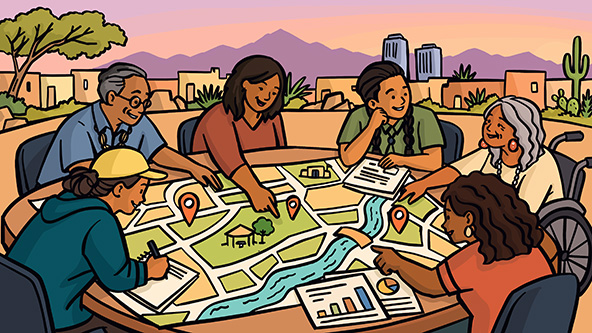
 (Illustration by Jasmin Pamukcu)
For years, nearly every piece of data the Tucson Indian Center (TIC) collected was designed to answer someone else’s questions. Since 1963, TIC has served the urban Native community in Tucson, Arizona, offering primary care and behavioral health services, diabetes prevention and wellness programs, employment and job training, and emergency housing assistance. Intake forms for those programs, satisfaction surveys, and reporting metrics were all developed to collect data that met federal grant requirements but told us almost nothing about what our community wanted to know about itself.
Eventually, those of us leading and working at TIC said, “Enough.” We began building a different kind of data system—one organized around our community’s priorities. But to understand why this work is both difficult and transformative requires understanding the origins of contemporary data systems that are used to quantify Native people in the United States.
For much of the 19th and 20th centuries, information about Native peoples was collected and controlled primarily by federal agencies, academic institutions, and other outside entities. Rooted in settler colonialism and white supremacy, that control was part of broader efforts to dominate Native land, identity, and governance, and it has left many Native nations dependent on data rarely collected by or for them. Data, including census records and blood-quantum classifications, were used to define Native identity, determine eligibility for land and government benefits, and advance assimilation policies, often with limited Tribal authority over how information was collected, interpreted, shared, or used. In this way, quantification became a tool of administration and control. Research also frequently took a deficit-based approach, emphasizing poverty, health disparities, unemployment, and other challenges while overlooking community strengths, cultural knowledge, Tribal priorities, and the social and historical conditions shaping those outcomes. In doing so, it reinforced stereotypes and informed policy without adequately reflecting Indigenous perspectives. Many of today’s data failures, such as the chronic failure to collect mortality data for Indigenous populations, continue that history through seemingly mundane administrative policy and practice.
Among the many intergenerational harms that continue to be perpetuated by these systems of oppression are broken promises, unenforced legal agreements, and denials of access to the health and public health surveillance data tribes need to protect their citizens. Under federal law, Tribal epidemiology centers are public health authorities. The 2010 reauthorization of the Indian Health Care Improvement Act required the Department of Health and Human Services to provide Tribal epidemiology centers the same health data routinely shared with state and local agencies. More than 15 years later, this law has gone largely unenforced, and many centers are still denied access to the data.
During the COVID-19 pandemic, the staff of the Great Plains Tribal Epidemiology Center was forced to record cases by hand across 311 counties in North Dakota, South Dakota, Nebraska, and Iowa because digital surveillance systems available to neighboring health departments were inaccessible. The US Government Accountability Office and a 2025 audit of all 50 states documented the same pattern, with still no effort to ensure Tribal centers had data access.
The same systems of oppression that unfairly restrict data access also perpetuate Native erasure by overwriting our identities. Sarah Shewbrooks, lead epidemiologist at the Great Plains Center, recalls a funeral director who unabashedly admitted that he classified Native people solely based on his opinion of their appearance and never asked family members how they should be identified. Native people are routinely misclassified, often wrongly listed as white or Hispanic on death certificates.
Reporting practices deepen the erasure. Agencies often suppress what they deem to be “small counts” of Native people’s information, as they consider it to be too minuscule to be worthy of consideration or publication. If the data is published, they fold American Indian and Alaska Native responses into a catch-all “other” category. The effect is that the smallest communities drop out of view and out of the published record. Abigail Echo-Hawk (Pawnee), who directs the Urban Indian Health Institute (UIHI), describes the result as merely an asterisk where an entire community of people should be. Together, these practices produce the systematic erasure of an expansive and diverse group of people whose lived realities continue to be unknown and whose needs continue to go unaddressed.
Echo-Hawk and her colleagues Sofia Locklear, Sarah McNally, Lannesse Baker, and Sacena Gurule describe this as data genocide: the elimination of Indigenous people from data, and with it the failure to fulfill the federal government’s treaty and trust responsibilities. They argue that practices of data genocide are rooted in colonialism and structural racism and are continually reproduced by data professionals and institutions through harmful and dehumanizing reporting standards that have become normalized and are rarely, if ever, challenged.
The consequences are most visible in the Missing and Murdered Indigenous Relatives crisis. Native women and girls are killed and disappear at disproportionately high rates across the country. Arizona has the third-highest rate of Missing and Murdered Indigenous Women (MMIW) in the United States, and Tucson has the fourth-highest rate in the nation. Many of these cases never appear in official records. UIHI identified 506 cases across 71 cities by painstakingly piecing together records requests, news reports, and family accounts because many victims never appeared in law enforcement databases at all.
Data that does get collected tends to focus only on deficits: suicide rates, substance use, poverty, and violence. Echo-Hawk puts it plainly: Data that describes Native people only as a problem to be solved is bad data because it upholds the stereotypes that justify the conditions it claims to measure. Institutions then build programs, write policy, and move money based on a portrait the community never sat for. Good data, by contrast, is data that a community recognizes as an accurate description of itself, complete with its strengths and its struggles.
This is our inheritance at TIC—and it’s the inheritance of any organization working with Indigenous peoples and Indigenous data. It’s this history and context that informs our community-centered approach to data governance that finally puts Native communities first.
Sovereignty, Governance, and the Urban Distinction
To understand what makes our work at the Tucson Indian Center distinctive, it’s necessary to distinguish between two concepts that are often and mistakenly treated as interchangeable: data sovereignty and data governance.
To add context, Tribal sovereignty is the inherent authority of Tribal nations to govern themselves. Tribal governments long predate the US Constitution—and may in fact have served as the model for it. Tribal nations derive sovereign power from their people and their relationship to ancestral lands, a status that the federal government can recognize but cannot confer. In practice, Tribal sovereignty includes the authority to form a government, make and enforce laws, determine citizenship, and regulate activity within Tribal jurisdiction. The Native Nations Institute (NNI) and the US Indigenous Data Sovereignty Network define Indigenous data sovereignty as the right of a Native nation to govern the collection, ownership, and application of its own data. The concept is derived from the inherent right of Tribal nations to govern their peoples, lands, and resources. It’s ultimately an expression of legal authority.
Tribal Research Review Boards (TRRB) are examples of that authority in practice. One TRRB, the Navajo Nation Human Research Review Board, has overseen all research conducted within the Nation’s boundaries since 1996. Researchers must show community benefit and submit results before publication. Dozens of TRRBs now operate, some independently and others in partnership with the Indian Health Service. They help ensure that a researcher cannot simply approach a Tribal Nation with a research grant and a survey instrument in hand, and with no benefits or protections for Tribal members. Tribal nations can refuse, and sovereignty is what makes that refusal legally meaningful.
Data governance addresses a different issue. Governance is a term that encompasses the rules, practices, processes, and people that direct and control something—in this case, data: what is and is not collected, who holds it, who may access it and for what purpose, how these rules are enforced, and how decision makers are held accountable. The two concepts are distinct but linked: Governance is the process through which sovereignty is exercised. A sovereign nation governs its data by right. An organization that lacks the legal authority of sovereignty has to govern by other means; they have to rely on community governance structures, accountability systems, and a commitment to stewardship. In that sense, governance expresses institutional autonomy and community self-determination without legal jurisdiction.
Urban Indian Organizations (UIOs) illustrate why the distinction between data sovereignty and data governance matters. Roughly 71 percent of American Indian and Alaska Native people now live in urban areas, and UIOs are where many receive healthcare, social services, and community support. They are also where much of the administrative data about Native communities is generated before it flows into county, state, and federal systems. However, Tribal citizenship does not depend on where a citizen lives, and nations retain their relationship with citizens who move away from their lands. But a nation’s practical ability to govern data generated hundreds of miles from its territory, by an organization it does not control, is another matter.
This is the governance challenge that UIOs like TIC must solve. TIC is not a Tribal nation and can’t exercise sovereign authority over the data it holds. Yet the information TIC collects concerns citizens of hundreds of sovereign nations, and someone still has to decide how that data is collected, protected, interpreted, shared, and used. UIOs are being asked to build data governance approaches for the citizens of many nations, none of whom they have the authority to govern. No existing governance framework fully answers how to govern data in this kind of circumstance or setting.
This is why Indigenous data governance requires a collaborative, community-centered approach. It allows UIOs to directly engage in decision-making about data with community residents in ways that center self-determination. Community members get to ultimately decide what information we ask them to provide, how those data are stored, who may access them, how requests from outside researchers are evaluated, and what purposes the data should ultimately serve.
A growing body of scholarship has begun to articulate what responsible Indigenous data governance should look like. The CARE Principles for Indigenous Data Governance, developed by Stephanie Russo Carroll and colleagues through the Global Indigenous Data Alliance, organize Indigenous data stewardship around four commitments: collective benefit, authority to control, responsibility, and ethics.
Several organizations have expanded this work: the Native Nations Institute at the University of Arizona and the Māori Data Sovereignty Network. Together, these frameworks establish principles for Indigenous data governance that organizations like TIC can adapt to the realities of urban Indian communities.
Trust Is at the Heart of Data Governance
Without sovereign authority to govern data by law, data governance for organizations like TIC depends on trusting relationships with community members and with organizational partners.
But the work of building trust unfolds on a far longer timeline than a federal contract or a philanthropic grant. The funding infrastructure is in active tension with the governance infrastructure because governance depends on relationships that cannot be accelerated to fit a reporting deadline. And organizations that serve Indigenous communities absorb the deeply relational work of building trust as unpaid labor that must be done continuously, well beyond a three-to-five-year grant cycle. There is no budget line for the years it takes to build enough trust with a community so that it will be willing to share its knowledge.
TIC’s partnership with Pima County shows what a trust-based relationship at the organizational level can produce. What began as a partnership in which the county supplied technical expertise has evolved into one in which TIC’s leadership is in the foreground. TIC has begun training county staff in Indigenous data governance while building its own analytical and institutional capacity. Our shared goal is to build and sustain a community-governed data ecosystem, an interconnected set of people, information, and processes that will generate data that reflects the needs and priorities of urban American Indian communities in Tucson and Pima County. The data ecosystem we envision is rooted in values, governed by our community members, and built to advance goals that have equity and justice at their core. And like a natural ecosystem, our community-governed data ecosystem is interdependent, requiring institutional partnerships and ongoing collaboration with community members to thrive.
This kind of partnership is significant because it breaks with a familiar historical pattern. Native communities have long experienced extraction—not only of land but also of knowledge and data. Knowingly or unknowingly, dominant institutions like governments, hospitals, for-profit companies, and academic institutions have operated from a settler colonial position: They have benefitted and profited from their collection and use of Indigenous information while exploiting the same communities, who received nothing at best or were actively harmed at worst in return. Because of this history, trust can’t be assumed. It must be earned by showing over time that data will be used primarily for the community’s benefit. And the only way to guarantee that is by having the community govern it.
What Community-Governed Data Looks Like in Practice
Community governance only matters if it changes how an organization makes decisions. At TIC, that means creating structures that don’t depend on a single executive director’s instincts or staff members’ goodwill. That’s why we created an advisory council for Promoting Indigenous Models of Assessment (PIMA). The name PIMA comes from an Indigenous word meaning “I don’t know,” which reflects the initiative’s purpose: learning what our community wants to know about itself. The council provides a consistent community voice that helps ensure TIC’s data practices reflect Native community priorities, values, and perspectives. Council members represent different Tribes, generations, ages, genders, lived experiences, and roles, bringing together clients, board members, staff, and community members.
The council governs inquiry by shaping questions, methodologies, and decisions about what information should and should not be collected. We continually return the conversation to a single guiding question: What knowledge will produce collective benefit for the community?
This guiding question has already shaped decisions about who the right partners for TIC should be. In one case, the council declined to partner with a county representative after members found the representative’s presentation of Native data disrespectful. It emphasized negative outcomes, reduced Native people to an asterisk when sample sizes were deemed too small, and failed to reflect community strengths and perspectives. The decision made clear that technical expertise is not always enough: TIC’s partners must also represent Native communities accurately, respectfully, and in ways the community recognizes as meaningful.
Our council’s long-term vision is that the data of Tribal citizens can ultimately return, whenever possible, to their Tribal nations. This vision is informed by the fact that we understand ourselves as data stewards rather than owners. However, making that vision a reality will require infrastructure that does not yet exist: shared technical standards, agreements with hundreds of Tribal nations, and pathways for data exchange that no UIO has been funded to create. This is the challenge facing urban Indigenous data governance.
The Change We Hope to See
Three changes would help TIC and other UIOs advance the work of Indigenous data governance:
1. Funders and federal agencies should fund governance itself. Grant structures reward compliance via predetermined metrics, and evaluation criteria are written before communities enter the conversation. Paying for relationship-building before data collection begins, writing communities into the scope of work beyond consultation, and accepting community-defined outcomes as evidence would change what gets built. Between 2002 and 2016, foundations directed just 0.4 percent of annual giving to Native communities, so there are opportunities for improvement and increased giving.
2. Researchers and practitioners should share authority before collecting, not after. If you gather information about Indigenous people through an intake form, an evaluation, or a study, you are working with Indigenous data, and decisions about how data is collected and used are not yours alone. Consult the CARE Principles and any Tribal data protocols before you start. Agree to follow them in writing, with accountability mechanisms that explain how you will uphold your agreements. Practice co-powered consent, an expanded form of consent described by Jamila M. Porter and Aysha Dominguez Pamukcu in their book, Advancing Equity and Justice, in which community members influence the design and implementation of a research study or evaluation, decide if they will participate, and, if so, determine how their participation will be structured. Researchers and practitioners should collaborate directly with communities on every step of the process, from conceptualization to data collection and analysis. They should return findings to the community first—well before the funder sees them—and ensure that the community agrees with how findings are framed before they are published.
3. Government agencies should make Indigenous data governance a budget priority and standard administrative practice. Government agencies should stop collapsing Native respondents into nondescript categories. Instead, they should utilize Native-informed data practices that can minimize the harms of data genocide. Governments should invest in Tribal epidemiology centers and UIOs that already have existing and trusting relationships with Native communities. Government agencies can adopt Indigenous data sovereignty policies—like the policy adopted by the Arizona Department of Health Services. These policies formalize sovereign-to-sovereign relationships between government agencies and Tribal nations, recognize the rights of Tribes, and describe the responsibilities and expectations of those who interact with Tribal health data.
The future of Indigenous data governance will depend not only on Tribal sovereignty but also on whether UIOs have the resources, authority, and partnerships to govern data alongside the communities they serve. Achieving that future will require coordinated action from funders, researchers, government agencies, and community partners, coupled with the leadership of UIOs and the wisdom of Native communities.
Read more stories by Dylan Baysa, Melodie A. Lopez & Lana Fred.