


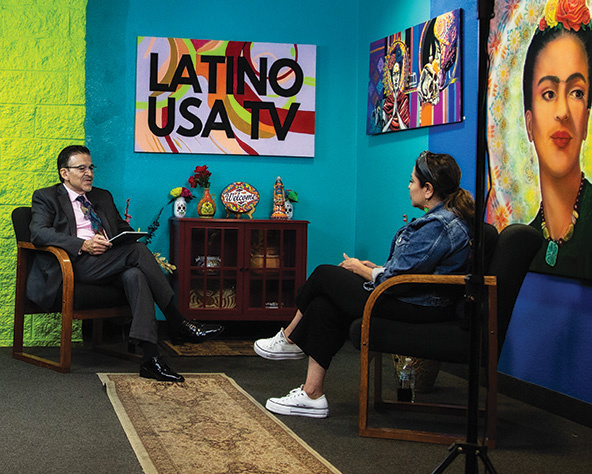
 Sehila Mota Casper discusses Latinx heritage during an interview with Dr. Jose Leyba in May 2025 for Arizona Barrio Stories, part of Latino USA TV. (Photo courtesy of Latinos in Heritage Conservation)
Government-led heritage conservation efforts in the United States have historically left communities of color vulnerable to disinvestment and their historical contributions forgotten. Of the more than 96,000 properties on the National Register of Historic Places, fewer than 10 percent “reflect the diversity of the country’s population,” according to the National Park Service, which administers the list. Fewer than 1 percent of listed sites are associated with Latinx histories.
Recognizing the need for a national nongovernmental organization dedicated to preserving Latinx places, stories, and cultural heritage, a group of heritage practitioners, advocates, and scholars working in Latinx communities launched Latinos in Heritage Conservation (LHC) as a volunteer-led network in 2014. That network has since grown into the nation’s foremost Latinx historic preservation nonprofit, whose mission is to build a movement that affirms Latinx heritage through education, conservation, and leadership development.
“We’d been doing [historic preservation] long enough to realize that we were trying to shoehorn our history and our places into programs that were never designed with our unique history and culture in mind,” says LHC cofounder and board member Laura Dominguez. Now a Mellon Humanities postdoctoral fellow at the University of Southern California, Dominguez has worked in academia and with local historic preservation nonprofits, including San Francisco Heritage and the Los Angeles Conservancy. Throughout her career, she says, she has witnessed the gaps in existing programs that often result in Latinx professionals being sidelined.
Federal agencies, which set standards for the field, have made efforts to address those gaps in recent years. The National Park Service published a comprehensive survey of Latinx heritage sites and accompanying resources, called the American Latino Heritage Theme Study, in 2013 to bolster the representation of Latinx histories at national park sites. The Advisory Council on Historic Preservation also created an Equity Action Plan in 2022 that recognized disparities in national preservation and committed to developing a more inclusive preservation program.
The executive branch has countermanded these efforts since President Donald Trump’s inauguration in January 2025. The Trump administration has targeted diversity, equity, and inclusion efforts across the federal government and issued executive orders to change historical interpretation at national parks and museums to whitewash the nation’s past. The administration’s changes are “undoing critical progress and reducing visibility,” said Sehila Mota Casper, LHC’s executive director, in a press release.
Dominguez says that the voices of people of color were marginalized in historic preservation efforts even before the Trump administration’s latest orders. When developing LHC, she says, the cofounders considered, “What would it be like if we, from the ground up, reimagine [historic preservation] with Latino history, culture, and values at the center?”
After first organizing in 2014, LHC held annual summits in 2015 in Tucson, Arizona, 2016 in Houston, Texas, and 2018 in Providence, Rhode Island, to bring together preservation professionals committed to diversifying the field to exchange best practices, introduce its work to new audiences, and network with potential funders and representatives from the National Park Service and the Advisory Council on Historic Preservation. LHC also engaged in advocacy efforts for Latino heritage sites, including consulting on and sending letters supporting National Historic Landmark (NHL) nominations. The group was central to the success of NHL designations for Chicano Park, the heart of the oldest Mexican-American neighborhood in San Diego, California, and McDonnell Hall in San Jose, California, the home parish of labor leader Cesar Chavez. Both won national landmark status in 2016.
In a series of strategic-planning meetings held between 2014 and 2019, Dominguez says LHC leaders surveyed other historic preservation organizations to “understand the landscape from an NGO side” and determined that their aims would be best served with access to grant funding. Consequently, LHC incorporated as a 501(c)(3) and established a board of directors in January 2020. After incorporating, LHC received a $750,000 grant from the Mellon Foundation.
“We saw from their board and their leadership [that] there was a lot of depth and substance, and they had already done work in a wide variety of geographies,” says Justin Garrett Moore, program director of Humanities in Place at the Mellon Foundation, about awarding such a significant grant to the young organization. Moore says LHC’s work also appealed to the Mellon Foundation because it recognizes the US-Mexico border region, where LHC is rooted, as underfunded. The grant enabled LHC to hire Casper, one of the group’s cofounders, as its inaugural executive director and develop one of its anchor programs, The Abuelas Project.
The People’s Register
The idea for a storytelling-centered project to serve as a repository for Latinx historic sites nationwide emerged at LHC’s first convening in 2015. There, attendees tasked with reimagining historic preservation from a Latinx perspective discussed “the intimacy and the legacy of the kitchen table, where women gather around with their coffee, or while they’re working or cooking, and share stories,” Dominguez says. The web-based Abuelas Project recognizes the importance of storytelling to Latinx communities and the role of women as keepers of Latinx heritage. (Abuelas means “grandmothers” in Spanish.)
Funding from the Mellon Foundation allowed LHC to develop a strategic plan for the Abuelas Project and a pilot, which focused on Texas and launched in January 2024. The now-nationwide Abuelas Project weaves maps, geospatial information systems (GIS) data, archival research, and oral histories into interactive content using Esri’s ArcGIS Online platform and its StoryMaps application. The project’s first StoryMaps featured vulnerable Mexican cemeteries across Texas and the experiences of migrant farmworkers who came to the United States as part of the government-sponsored Bracero Program from 1941 to 1964.
We’re trying to build on that tradition of historic preservation as a pathway into amplifying your voice in your community for positive change.
Dominguez says the need for a web-based format was concretized when many educational and cultural programs and workplaces were forced to shift online during the early months of the COVID-19 pandemic, when LHC was just starting as a nonprofit. The format also allows LHC to mark sites lost or significantly altered due to demolition or gentrification, issues that have impeded the inclusion of Latinx historic sites on the National Register, which has strict evaluation criteria concerning the integrity of historic properties.
Sites listed on the Abuelas Project website come from the organization’s researchers and crowd-sourced tips submitted via an online questionnaire. Behind the scenes, this data is compiled to create a list of never-before-catalogued historic sites, which can be used for further research into America’s Latinx histories and to help target historic preservation advocacy efforts. According to Casper, the Abuelas Project serves as a “people’s register,” offering a grassroots and Latinx-centered alternative to the white-dominated National Register.
While building the Abuelas Project, LHC transformed its earlier summits into a biennial national convening called Congreso. These events have been held in Denver in 2022 and in San Diego in 2024, offering multiday national forums to amplify regional preservation efforts, address challenges, and continue shaping LHC’s national vision.
The organization’s early successes helped it garner additional support, including from the National Trust for Historic Preservation and the National Endowment for the Humanities. In 2024, LHC received a second grant from the Mellon Foundation—this time $4 million to continue supporting the organization’s operations, grow the Abuelas Project, and establish a regranting program to steward Latinx heritage sites.
Building Community Capacity
The grant program facilitated by LHC’s second Mellon Foundation grant is the nation’s first program dedicated to funding Latinx heritage projects. Its first round of applications closed in February 2025. It will provide grants of $5,000 to $100,000 from an initial pool of $600,000 to empower grassroots nonprofit organizations and community groups working to protect and uplift Latinx histories in their communities.
LHC also has other initiatives to democratize historic preservation and empower Latinx communities. One example is its downloadable Latinx Preservation Toolkit, which provides step-by-step guidance on historic designation processes from the local to the federal levels to equip Latinx communities with the knowledge and guidance they need to lead preservation efforts in their communities.
The organization is also leading a Latinx preservation equity study, a national audit to track the effects of the National Park Service-led American Latino Heritage Initiative, which produced the American Latino Heritage Theme Study in 2013. “Our goal is then to analyze all of that and provide recommendations for future federal policies and funding practices for Latinx heritage,” Casper says.
To carry out its work and train the next generation of Latinx heritage professionals, LHC also hosts a fellowship program for graduate students. Since the program’s inception, graduate student fellows have contributed to the development of the Abuelas Project and the Latinx Preservation Toolkit.
Casper says these programs are vital to diversifying the field of historic preservation and furthering LHC’s mission to protect Latinx cultural heritage. “Everything we are doing is so we can empower communities to tell their own histories, save their own sites, and also have the know-how to work alongside practitioners in the field that are in the decision-making seats,” she says. The work has begun to feel even more urgent in light of the Trump administration’s rollbacks. “It’s about defending historical accuracy, honoring our ancestors’ contributions, and ensuring future generations inherit the complete, diverse story of America,” Casper says.
For both Casper and Dominguez, LHC’s efforts are part of building vibrant and more diverse communities. “Historically, we can see examples of how advocates who come together around trying to save a place often become powerful civic voices,” Dominguez says. “We’re trying to build on that tradition of historic preservation as a pathway into using your voice [and] amplifying your voice in your community for positive change, for social justice, and for more equitable communities."
Read more stories by Marianne Dhenin.