


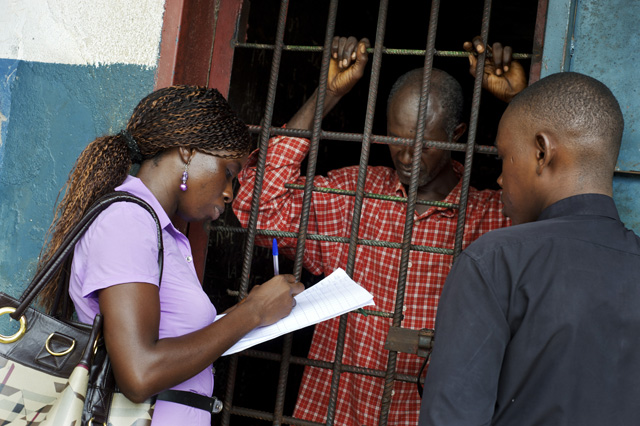
 A Timap paralegal visits a man who has been detained without
charge in Bo, Sierra Leone. (Photo by Aubrey Wade)
A Timap paralegal visits a man who has been detained without
charge in Bo, Sierra Leone. (Photo by Aubrey Wade)
Farmers in the Bo District of southern Sierra Leone had a pest problem. Cows owned by a senior official of the police force were grazing on their farms and uprooting their crops. The farmers filed complaints, but the police did nothing. Eventually, one farmer set poison out for the unwelcome animals on his farm and killed one of the cows. In response, the police arrested and detained every man and woman in the village. Paralegals from the nonprofit organization Timap for Justice arrived at the police station and demanded the unconditional and immediate release of the detainees.
In Sierra Leone, paralegals aren’t just paper-pushers. They often exert a considerable degree of influence. “In this particular instance, we not only challenged the detention but also challenged the powerful man to control his cows, build a fence around them, and provide compensation to farmers whose crops had been destroyed by these cows,” says Simeon Koroma, cofounder and director of Timap. (The word Timap means “stand up” in Krio, the language of Sierra Leone.)
Fully credentialed lawyers are scarce in this part of the world. Today, there are just 350 lawyers in all of Sierra Leone—a country of six million people. What’s more, 95 percent of those lawyers practice in the capital city of Freetown.
To fill this void in the national justice system, Timap equips ordinary citizens to act as paralegals. In that role, they provide free legal services to impoverished and marginalized communities. They deal with issues that range from domestic violence to government corruption. They win paternity payments, persuade authorities to build water wells, and protect children from abuse. Timap has 70 paralegals in its network, and most of them have no more than a secondary-school education. And yet they have proven to be highly adept at resolving legal disputes. In 2012, their efforts enabled Timap to settle more than 70 percent of the cases that it handled that year. “To be able to resolve [that many] cases is a huge achievement in any justice system,” Koroma notes.
In recent years, Timap has expanded its reach at a remarkable pace. In 2010, Timap handled about 8,000 cases. By 2012, it had doubled that figure. Other groups, both inside and outside Sierra Leone, have taken note of what Timap has accomplished. The Carter Center, for example, has sponsored a project to replicate the paralegal-based model in Liberia, and the United Nations Commission on Legal Empowerment has recognized Timap as a model for how to deliver justice services in a weak state.
Grassroots Justice
Koroma and his colleague Vivek Maru co-founded Timap in 2003, in the aftermath of a decade-long civil war in Sierra Leone that cost the lives of 50,000 people. The country’s Truth and Reconciliation Commission identified injustice at all levels as one factor that helped cause that conflict. “We had to grapple with how to provide people facing injustice with basic services, especially in very rural communities,” says Koroma.
In creating Timap, Koroma and Maru drew inspiration from community-based paralegals who had offered justice services in South Africa during the anti-apartheid struggle. Yet in Sierra Leone, multiple factors—from police corruption to inadequate transportation—make the pursuit of justice especially difficult. Once people are under arrest, for instance, they often remain in jail for excessive lengths of time or without access to bail. Detainees awaiting trial account for 57 percent of the prison population in Sierra Leone, according to a study conducted by Prison Watch Sierra Leone and Timap. Before trial, detainees spend an average of a year and seven months in custody; the average bail amount is 25 times as high as their weekly salary.
To confront a challenge of that scale, Timap has developed a model that’s designed to leverage limited resources. Paralegals receive four weeks of classroom training before they start working with clients, but most of their training happens in the field—and under supervision by professional lawyers. Timap employs two full-time lawyers (Koroma is one of them) and also relies on a cadre of private lawyers who offer assistance at reduced fees. The backup support that lawyers provide is a crucial element in Timap’s long-term success, Maru explains: “Otherwise, there’s a risk that paralegals become like quack doctors. If you just give them a certificate and they’re on their own, that’s inadequate.” Each month, supervising lawyers and senior paralegals meet with junior paralegals in various regions to analyze cases and to offer advice on strategy. “That ongoing training and support makes for high-quality staff,” says Maru, who left Timap in 2007. (He continues to serve on the group’s board of directors.)
The Timap approach makes no allowance for specialization. After all, in many communities that Timap paralegals serve, people have no alternative way to access legal services. “It’s important to be able to provide some information and some advice on most legal questions that people have,” says ZaZa Namoradze, director of the Open Society for Justice Initiative. (The parent of that group, the Open Society Foundations, has been a prominent supporter of Timap. From 2009 through 2014, the foundation provided $500,000 annually to the organization—an amount that covers most of its annual operating budget.)
Timap’s operations extend beyond helping people case by case. Paralegals record details about their cases, and Timap aggregates that information to measure the size of their caseloads, the results that they achieve in each case, and the duration of each case. These records, in turn, allow Timap to build an evidentiary foundation for the advocacy efforts that form an important part of its overall mandate. Data gathered from paralegals on gender-based violence, for example, helped Timap to push for new anti-violence legislation that passed in 2007.
Koroma and his colleagues also work to widen access to paralegal services nationwide. Four other organizations in Sierra Leone now follow the Timap model, and recently Timap published a manual for community-based paralegals that those groups are using to ensure quality-control standards for training and data collection. Timap officials estimate that an investment of about $2 million, or 33 cents per capita, would enable Timap and these allied organizations to deliver paralegal assistance to the entire country.
Two Systems, One Solution
Another factor complicates Timap’s work: Sierra Leone has a plural legal system. A formal set of institutions, based on British law, operates primarily in the capital. Those institutions coexist with a customary legal framework in which regional chiefs hold sway. Sierra Leone has 149 chiefdoms, each ruled by a paramount chief, and the vast majority of citizens turn to these local leaders to resolve disputes. Lawyers have authorization to represent clients only in formal institutions; the rules of the customary framework specifically bar them from acting in that capacity. Paralegals, however, can operate in both settings.
The customary system has a problematic history. “Before the war, people in rural areas were at the mercy of the chiefs,” says Daniel Sesay, who served as Timap’s first lead paralegal. “Some chiefs were wicked and were bent on inflicting heavy fines and punishments on their people.” Even today, rulings by local chiefs often conflict with human rights. Customary law allows prepubescent girls to be married without their consent, and it prohibits women from inheriting family property, for example. In cases of that kind, lawyers and paralegals from Timap can invoke their knowledge of the formal law to check abuses in the customary framework. “This approach of working with both systems helps greatly in correcting some of the discriminatory customary laws and practices, especially those affecting women,” says Sesay.
To reduce the risk of tension with local authorities, Timap treads carefully when it sets up shop in a community. The organization hires paralegals to work in their home chiefdom, for example. In every chiefdom where Timap works, moreover, it assembles a community oversight board that consists of respected locals. The board has authority to ensure that each paralegal serves people well, and it can smooth things over if a paralegal runs into trouble. “The organization becomes accountable to the communities,” says Koroma.
Where possible, Timap leaders also take steps to win over local chiefs. Consider the case of a mining company formerly called the Sierra Leone Diamond Corporation (it’s now called African Minerals), which ravaged the land in six villages in southern Sierra Leone. The company left behind pits in the ground that were as large as an Olympic-size swimming pool and two stories deep. It destroyed the bridge that connected the villages to the local main road, and it flooded a nearby river. The paramount chief was at his wits’ end—until a legal team from Timap negotiated remediation and compensation for these communities. “He was hugely appreciative,” says Maru. “By providing assistance on larger-scale problems for which the customary leadership is grateful, you buy space to engage intra-community problems where the paramount chief might be skeptical of paralegals getting involved. You earn goodwill.”
In 2011, Maru founded an organization called Namati, which aims to build an international movement around the approach to injustice that he helped pioneer in Sierra Leone. Today, the Namati network includes 295 organizations from around the world. “Law is, for many people, a threat or an abstraction. We focus on bridging the gap between what’s in the books and what’s actually happening in real life,” says Maru. “Community paralegals can help bridge that gap. They can be close to the communities that they serve, but at the same time they are connected to lawyers and the formal system when necessary.”
Read more stories by Corey Binns.