

 (Illustration by Adam McCauley)
Two women stand in a conference room in a market research center in a suburban office park outside Milwaukee, Wisconsin. The room contains only two chairs and a small table. One woman, psychologist Mitzi Desselles, is walking the other woman through the “dangerous edge” exercise. It’s 2005.
Desselles positions the woman at one side of the room on a spot representing the status quo. Communications researchers and strategists watch from behind a two-way mirror.
“This is where you feel comfortable,” Desselles says. Then she points all the way across the room: “Over there is gay marriage.”
Desselles gently leads the woman a few steps forward, to a spot representing laws that protect LGBTQ people from job discrimination. The woman says she is comfortable there. They walk a few more steps and stop again. “This is civil unions,” Desselles says, which confer legal rights and responsibilities to couples without the social status of marriage. The woman is also comfortable there.
About three-quarters of the way across the room, they stop on the spot Desselles calls “gay marriage.” The woman looks down, as if peering over a dangerous cliff. Desselles asks why she feels anxious about the idea of same-sex marriage. “I want to be fair, but this is foreign,” the woman answers. “I was raised to think marriage is between a man and a woman.” Her conflicted response, echoed by dozens of other men and women who participate in the exercise, provided insight into the challenges same-sex marriage advocates faced. As one well-known political pollster put it to me around that time, “You’ll never see gay marriage in your lifetime.”
“Merely having a majority is not enough,” says Evan Wolfson, the founder of Freedom to Marry, about what is required to achieve large-scale, long-term attitudinal change on contentious issues. “You need a solid majority. You need a majority that can’t be eroded or peeled away.”
Wolfson’s organization led the fight to secure same-sex marriage rights in the United States. To some political strategists, building that kind of majority wasn’t just an uphill battle for the marriage equality movement—it seemed like an impossibility. When Gallup first polled on the issue in 1996—the year the Defense of Marriage Act, which defined the institution to be between a man and a woman, was signed into law—only 27 percent of the US public supported legal recognition of same-sex marriages. In the first decade of the 2000s, the marriage movement lost ballot referenda in 30 states.
Fast-forward to 2018. A Gallup survey on the topic reported that 67 percent of Americans supported marriage equality—which, thanks to the US Supreme Court’s landmark 2015 Obergefell v. Hodges ruling, is now the law of the land. Public support first reached 60 percent in Gallup’s 2015 survey, and has not fallen below that level. A cause that some strategists thought was hopeless has become the new normal.
In building a winning majority, the marriage equality movement achieved what some social scientists call “durable attitude change”—a shift in attitudes that persists over time and resists counterattack.1 This effort required millions of people to change their minds on a deeply personal issue, despite a long history of invisibility and vilification of LGBTQ people. It also required beating back a relentless campaign to maintain the status quo by powerful politicians, including former president George W. Bush, and deep-pocketed groups such as the National Organization for Marriage.
In this article, I assess that extraordinary feat through the lens of Aspirational Communication, an approach that seeks to motivate and mobilize people to support a cause by connecting it to the audience’s aspirations for their own lives. I specifically suggest a six-step framework based on the approach that can help social movements to drive durable attitude change. To broaden the discussion, I demonstrate how the framework also applies to another campaign, one that changed attitudes and behaviors on a very different but equally difficult issue: youth smoking.
Cultivating New Identities
In 2000, 23 percent of American teenagers reported smoking cigarettes. A highly successful and much-celebrated campaign by the Truth Initiative, a nonprofit public health organization, led the way in cutting teen cigarette smoking to 5 percent in 2019. Before it launched nationally in 2000, the initiative’s pilot campaigns in Florida and Massachusetts achieved a dramatic decline in cigarette use among young people.2
Truth’s communications strategy aimed to change young adults’ attitudes toward cigarette smoking by promoting an “aspirational identity” to at-risk adolescents. We’re highly motivated to take actions that help us live up to our image of the kind of people we truly want to be—our aspirational identity.3 Truth harnessed this tendency by branding a tobacco-free lifestyle through words, images, and stories that made it seem cool to be a nonsmoker. Brands can help people express their aspirational identities by serving as symbols of the kind of person they are or aspire to be.4
The Truth team faced a difficult task. The teens in their at-risk audience were subject to powerful countervailing influences, such as peer pressure, glamorized images of smoking on TV and in movies, and billions of marketing dollars spent by tobacco companies. To lower smoking rates, Truth’s aspirational brand strategy had to drive attitude change durable enough to resist tobacco industry marketing.
But by 2005, the Truth campaign had succeeded, according to a study published that year in the Journal for Health Communication. It found that the target audience’s new attitudes toward cigarette smoking persisted over time. “Truth brand equity, once established, is not affected by exposure to industry countermarketing campaigns,” the study’s authors wrote. “The brand has staying power and remains effective in spite of potentially countervailing messages.” 5
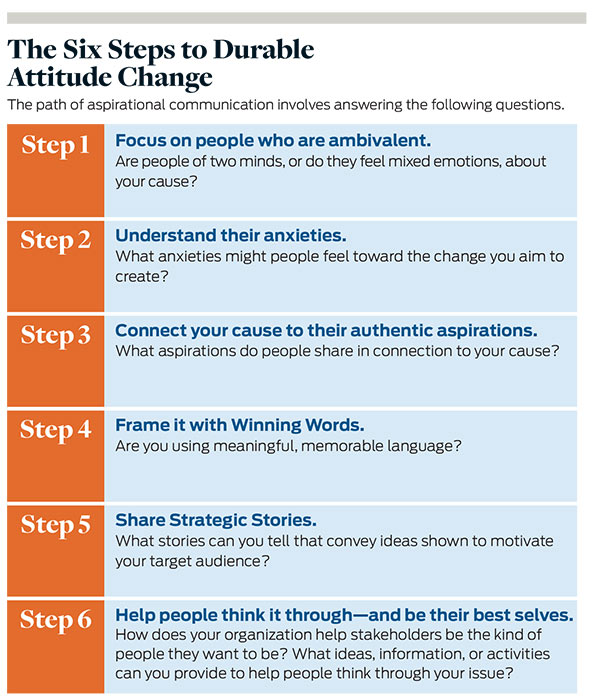
The Truth campaign, like Freedom to Marry, drove a mass shift in attitudes by appealing to its target audience’s aspirational identities. We can understand the effectiveness of the campaign in terms of the six-step framework of Aspirational Communication that I offer here.
Step 1: Focus on People Who Are Ambivalent
When you survey the vast middle ground of public opinion on a contentious topic, you’re likely to find a lot of people who are ambivalent. We often observe this state of mind among people who say they are “of two minds” or have “conflicting feelings.” Because these inner conflicts make us feel uneasy, we try to resolve them to achieve peace of mind. People who feel torn about a contentious social issue may ultimately change their worldview to achieve inner peace—by making peace with the changing world around them.6
Building a solid, durable majority for marriage equality required persuading not only people who were undecided, but also people who said they opposed it. Among those opposed, Freedom to Marry focused on a particular category: people who favored civil unions but did not support legal recognition of same-sex marriages. Nationally, they represented about 15 percent of the population, according to Pew Research Center polling and a Freedom to Marry analysis.
These conflicted voters “wanted to be fair and supportive of LGBT people—yet they were not convinced that same-sex couples ‘deserved’ marriage,” according to a Freedom to Marry report. Their positions suggested that these voters were perhaps ambivalent—and thus open to persuasion.
The Truth campaign also focused on ambivalent people. In the case of youth smoking, the target audience was young people “who had never smoked but who would not rule out trying a cigarette sometime in the next year or if a friend offered them one.” 7 As with “conflicted” voters for the marriage equality campaign, Truth’s target audience seemed to be of two minds when it came to smoking.
Step 2: Understand Their Anxieties
Anxiety often underlies the inner conflicts and public turmoil associated with contentious social issues. The American Psychiatric Association defines anxiety as an uncomfortable feeling in response to an anticipated threat—something that might happen in the future that makes you feel insecure.8 In the brain, anxiety can disrupt attention, concentration, and memory, prompting people to shut down, rather than open up to new ideas.9 When people feel anxious about a social change like marriage equality, you need to address their concerns up front.
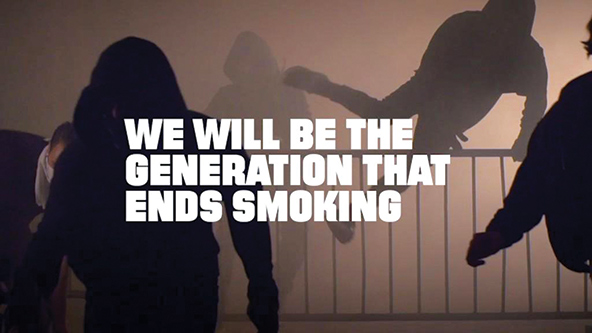 Ads for youth antismoking campaigns incorporated images that communicated the rebellious independence of teenagers.
Desselles unearthed a number of anxieties and doubts among people who felt ambivalent about marriage equality. For some, the issue caused alarm about the future of society, with same-sex marriage quickening a downward spiral into social chaos. President George W. Bush tapped into this anxiety in his 2004 announcement supporting a constitutional ban on gay marriage, calling it the only way to protect “the most fundamental institution of civilization.”
Desselles’ research showed that marriage equality triggered feelings of powerlessness, especially among men. Other participants questioned whether same-sex relationships were genuine and felt as if the movement was out to subvert the institution of marriage by “redefining” it. Some feared that government would force religious institutions to perform same-sex weddings, in violation of their beliefs.
Such feelings revealed a daunting emotional terrain. To navigate it and address these anxieties, the marriage equality movement needed to find ways to help conflicted people feel comfortable with recognizing the rights and relationships of same-sex couples.
For the teen smoking campaign, Truth explored the emotional terrain of adolescence—a time of high anxiety for teens, many of whom worry about how their peers perceive them.10 Social anxieties and peer pressure can feel more real and immediate to them than the abstract, future prospect of lung damage from smoking cigarettes.
“One consistent experience of adolescence is the constant feeling of being ‘on stage’ and that everyone and everything is centered on their appearance and actions,” reports a guide for healthy adolescent development by the Bloomberg School of Public Health at Johns Hopkins University.11 Teens anxious about fitting into a social group are susceptible to pressure from peers who see smoking as cool.
The Truth campaign understood teen anxiety about fitting in and being cool, and aimed to address the anxiety by making it cool not to smoke. The campaign team for Truth’s pilot program in Florida turned to teens to figure out the best way to do that.
“We really relied on the teens involved in the campaign to help us stay in line with what was cool to them, rather than assuming what we thought was cool was what they thought was cool,” says Carlea Bauman, who served as press secretary for the Florida campaign. “You could never say smoking isn’t cool, and the campaign never did. That was hard for some adults who really wanted to say that smoking wasn’t cool, but that wouldn’t have been authentic at all.”
Step 3: Connect Your Cause to Their Authentic Aspirations
Connecting an issue to people’s aspirations—tapping into ideas and emotions that define and motivate them—opens an efficient route to addressing their anxieties. Your aspirations are your ideas about the kind of person you want to be, the life you want to live, and the world you want to live in. Aspirations are important to our personal identities and play a powerful role in driving our attitudes and behaviors.12
What’s more, lifting up aspirations and values that people with different backgrounds and perspectives share can help them “see themselves” in a cause. We can relate to people who seem very different to us when we sense that they share hopes and values similar to our own. We recognize our common humanity.
Among all the popular fears and doubts surrounding the marriage issue, Desselles’ psychological research found a shared aspiration that would ultimately serve as a fulcrum for changing hearts and minds. Some ambivalent voters nonetheless expressed respect for same-sex couples, saying they must “truly love each other” to stick together despite discrimination and social pressure. These loyal couples represented an aspiration many people held for marriage: a lifelong commitment. The ideal articulated in the traditional wedding vow, to stay together “for better or for worse,” was shared both by voters the movement needed to persuade and by same-sex couples striving to marry.
This authentic, mutual aspiration around marriage would be critical to reducing anxiety and resolving inner conflicts in favor of equality. Cognitive studies show that we’re most likely to like and trust people who are similar to us in some way.13 Voters who understood that same-sex couples shared their own aspirations for marriage were less likely to feel threatened and more likely to understand that same-sex couples wanted to join the institution, rather than undermine it.
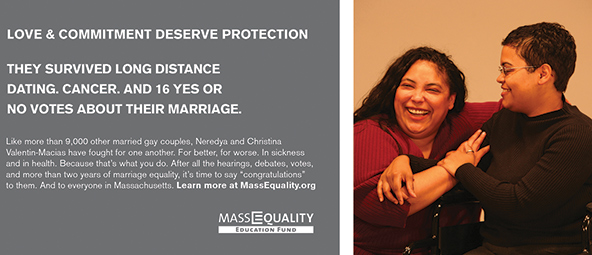 Ads for marriage equality communicated the love and
commitment of gay couples to connect with shared hopes and dreams.
Ads for marriage equality communicated the love and
commitment of gay couples to connect with shared hopes and dreams.
The Truth campaign tapped into the aspirations of adolescents through a brand strategy, much like a clothing company or other consumer brand might market its products. Psychological research suggests that young people will adopt aspirational identities that reflect their values and act in ways that reinforce that identity.14 The Truth campaign worked directly with young people to design a brand focused on adolescent aspirations: to be independent from adults, express their individuality, and take more control over their lives.15 In the words of one study of the campaign, Truth connected to this aspiration through a narrative focused on “socially irresponsible behavior of the tobacco industry and the ability of youth to rebel against the industry and take control of their lives, thereby establishing their independence.” 16
The campaign turned the notion of smoking as a symbol of youthful independence on its head. A survey of young people representing Truth’s target audience found that the number who agreed that “not smoking is a way to express your independence” increased 22.2 percent over the first 10 months of the national campaign.17 Connecting the cause to this aspiration was crucial to the campaign’s success.
Step 4: Frame It With Winning Words
Once you have a clear read on the emotions and aspirations of your target audience, it is time to craft your message. The first words people hear about an issue influence every perception and judgment that follows, so framing a topic strategically at the outset is critical.18 The words you use first (and most frequently) to talk about your topic should be what I call Winning Words—simple but meaningful words and phrases that define the issue in terms that win over the target audience.
The marriage equality movement built an initial base of support among roughly a quarter of the voting population by using messages about civil rights and equal protection under the law. Defining the debate in those terms won over people who were already inclined to support minority groups fighting to be treated equally under the law—but their numbers were insufficient for a solid majority. Most people didn’t see marriage through a legalistic lens. What’s more, talking about the legal “benefits” of marriage made people think same-sex couples were marrying to get tax breaks and other perks. To build a winning majority, the movement needed Winning Words.
The insight about people’s shared aspirations for marriage inspired the movement to reframe the cause as honoring “love and commitment.” Evan Wolfson had used these words in his 1983 law school thesis, which outlined his vision for marriage equality. “Part of the reason I wanted to do marriage in the first place was claiming this shared, aspirational, value-laden vocabulary of love, commitment, family,” he says.
Voters across the political spectrum could readily relate to “love and commitment.” Love, intimacy, and belonging are universal desires. Beginning with “love,” the message appeals to the heart. “Commitment” speaks to the responsibilities of marriage, and to the dedication, hard work, and loyalty involved in maintaining a long-term relationship. This simple message reflected personal values that many people recognize in themselves and aspire to live by.
“Love” and “commitment” aren’t fancy words. They’re familiar. The fact that people can easily understand, remember, and repeat them makes them more likely to be passed on by word of mouth—a highly persuasive form of communication. What’s more, messages that are easy to recall are more likely to influence our thinking and actions.
This short-and-sweet message also delivered a powerful counterpunch to the opposition’s message, which defined marriage exclusively as “a union between a man and a woman.” Marriage equality supporters could now say simply, “Marriage is about love and commitment between two people.” Two words helped take the moral high ground on the way to a winning majority. Who wants to stand in the way of love and commitment?
Similarly, the brand name of the teen tobacco initiative frames the cause with a simple but profound Winning Word that evokes the campaign’s core narrative: Truth. This single word sets the campaign at odds with a tobacco industry that deceives young people about the harms of smoking and robs them of their independence by getting them addicted to cigarettes.19 The campaign’s name positions young people as autonomous, independent truth-tellers taking on corporate power and deceit.
The campaign’s name was chosen by young people involved in the Florida pilot program. Carlea Bauman, press secretary for the Florida campaign, says the teens responsible “had a much more finely tuned radar about what would actually work.” The initial idea for the brand name was Rage, but the teens rejected it. “The kids picked the name Truth because the campaign was exposing the truth of the tobacco industry,” she says.
The language in the Truth campaign’s call to action—“be the generation that ends smoking for good”—speaks to the aspirational identity of today’s young people as changemakers. This choice of language is supported by extensive research that has found that being an agent of positive change in the world is a powerful aspirational identity for young Americans. The Millennial Impact Project, a study commissioned by the Case Foundation that surveyed more than 100,000 people born between 1980 and 2000, found that many aspire to remake society for the better. Millennials in particular see themselves and their peers as better catalysts for social change than government or other institutions. Two-thirds of the generation believed they could make a “moderate” or “big” impact on the world.20
“For millennials, taking consistent positive actions every day or week is a fundamental part of their identity,” writes Case Foundation CEO Jean Case. “In changing how change is made, members of this generation no longer see themselves as ‘activists’ like their parents, but rather as ‘everyday changemakers.’ ” 21
Step 5: Share Strategic Stories
Not only was the marriage equality movement’s “love and commitment” frame a short, simple, and powerful message, but it also established the foundation for a new storytelling strategy.
Storytelling is the most powerful form of communication.22 We learn our language, our values, and how the world works through stories. In order to comprehend a story, we must first believe what it tells us—a phenomenon the poet and philosopher Samuel Taylor Coleridge called the “willing suspension of disbelief.” Readers must put aside critical reasoning and judgments and accept the sometimes fantastical premises of fictional works in order to enjoy them. You do this when you’re reading a novel, viewing a film, or listening to a skilled storyteller in person. If you’re in a highly rational, critical, or judgmental frame of mind, you’re less likely to enjoy the experience.
Studies suggest that the suspension of disbelief may also occur when we hear nonfiction stories about real people, which cause us to let our guard down and believe the story in order to understand it. When we hear a story about two men or two women who love each other, our brain has the experience of believing that to be possible. To then disbelieve it takes additional mental effort. We have a bias to believe stories.23
But there’s more to the strategy. For storytelling to help you achieve your goals, the stories you tell need to communicate specific ideas and touch emotional chords that actually move people to support your position. Many organizations and movements miss the mark here. While a growing number have caught on to the emotional power of storytelling, many don’t have a clear understanding or articulation of the essential ideas their stories need to convey to persuade their audiences and achieve durable attitude change.
In the case of marriage equality, the big idea of “love and commitment” pointed to a clear and simple storytelling strategy: Share stories of couples in loving, committed relationships.
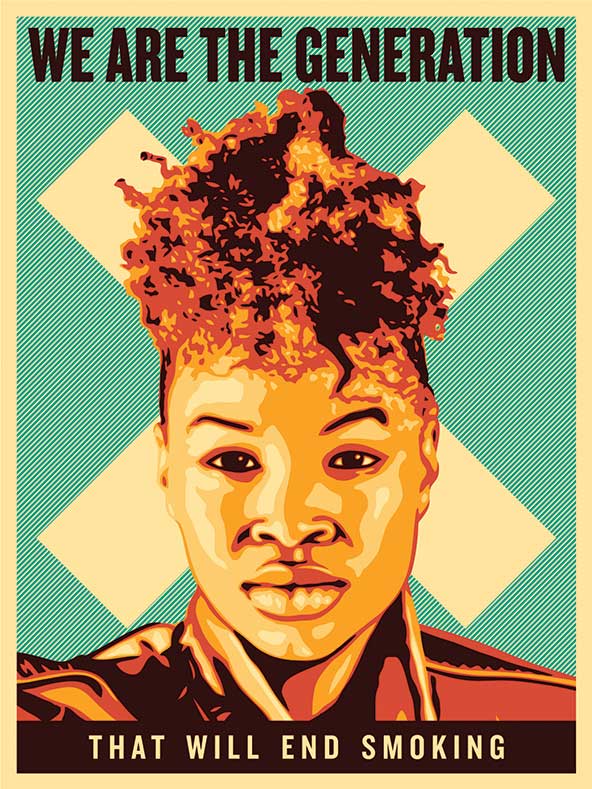 Teens in the Truth campaign's target audience could see aspirational versions of themselves in Truth’s imagery.
In Massachusetts, the first state to marry same-sex couples, advocates began the new storytelling strategy with a simple but effective ad. It features two women who stayed together “in sickness and in health,” as the vow goes, after one of them was diagnosed with cancer. Their story demonstrated the authenticity of their commitment; the words, image, and story all worked together to deliver the shared aspiration.
“Love and commitment” wasn’t just an advertising slogan—the phrase became the heart of the movement. Qualitative research with LGBTQ people in Massachusetts found that those most likely to take action for the cause were in committed relationships. This simple but profound storytelling approach not only persuaded conflicted voters but also mobilized a base of supporters. Couples shared their stories with neighbors and legislators, at public hearings and campaign rallies, and via news and social media. These deeply personal stories drove home the “love and commitment” idea thousands of times, reaching millions of people.
The Truth campaign also used strategic storytelling through paid advertising and social media. Truth’s content illustrated the deviousness of the tobacco industry in seeding false information and creating dependency, and highlighted the power of independent young people to make change.
“The basic idea was to use challenging, thought-provoking ad contexts and images of teens in control, rebelling against forces that would prevent them from expressing their independence (i.e., the tobacco industry),” write the authors of a 2002 study of the Truth campaign.24
The campaign’s first national ad, “Body Bags,” featured young people dumping body bags outside the Philip Morris headquarters to dramatize the 1,200 deaths that tobacco use causes every day.
This type of storytelling gave young people the sense of being part of a social movement, which added to the motivating power of the antismoking message. “Much like the early protesters against the Vietnam war, Truth teens would take up the mantle against the establishment (in this case, the tobacco industry) and create an environment that fostered camaraderie and a sense of mission,” write the 2002 study authors.
The Truth campaign’s impact depended largely on its strategic use of images to tell its story. Teens in its target audience could easily see themselves—and, just as important, aspirational versions of themselves—in Truth’s imagery. Truth’s storytelling shows tobacco-free teens who look cool, independent, and rebellious.25
From the beginning, Truth has used young people involved in local campaigns to tell its story in ads, not actors. Young people represent the program in news and social media, too; adults don’t deliver campaign messages to the target audience of independent-minded adolescents. This approach is both strategic and authentic, a necessary combination to augment the impact of storytelling.26
Step 6: Help People Think It Through—and Be Their Best Selves
Strategic storytelling about love and commitment created empathy for same-sex couples by opening people’s eyes to the realities of their relationships, but that didn’t secure marriage equality’s victory. The final step in achieving durable attitude change was to help the audience of ambivalent voters think through the issue on their own terms—and decide to live up to their own aspirations for the kind of people they wanted to be.
Many people perceive strategic communications about political issues the same way they see product marketing: pushing emotional buttons to prompt a purchase or other immediate action. Emotion is critical; messages must evoke emotional responses for people to notice them, remember them, and be moved to act.27 Manipulating people’s emotions—especially anger and fear—is a tried-and-true tactic in politics.
However, truly changing attitudes about a controversial topic fraught with cultural, political, and personal significance takes more than pushing emotional buttons. It takes what Richard Petty and John Cacioppo, two social scientists who have studied persuasive communication, call “elaboration.”
“Attitude change that is based on high levels of elaboration is more likely to influence thought and behavior and more likely to be persistent over time and resistant to counterattack,” they write in their groundbreaking 1983 study of persuasion.28
Petty and Cacioppo developed the Elaboration Likelihood Model, which suggests two different paths to persuasion. What they call the “central route” is what we think of as ordinary thinking—careful consideration of information and ideas by the recipients of a persuasive message. This is what the model labels elaboration. Those who take the time to think through the topic are more likely to change their minds in a meaningful way. Once that happens, the new attitude persists and they resist changing their minds again.
The other path is the “peripheral route,” which we tend to take when a topic doesn’t affect us personally. In this case, we use our intuition and “go with our gut.” Rather than considering the arguments for and against, we’ll base our judgment on who is delivering the information. The messenger matters more than the message.
To achieve durable attitude change, both the marriage equality movement and the Truth campaign needed their target audiences to take the thoughtful route. Freedom to Marry helped people elaborate through advertisements that modeled the mental “journey” taken by those who wrestled with inner conflicts and ultimately supported marriage equality. These ad campaigns featured friends and family members of lesbian and gay couples who changed their minds on the subject. A television ad for Freedom to Marry’s Why Marriage Matters campaign showed “Darrick” and “Kate,” a heterosexual couple, discussing their journey:
Darrick: Where I grew up, gay people were not in the forefront or in the community.
Kate: Over the years, I’ve met some gay and lesbian couples. Their commitment to each other is just like our commitment to each other.
Darrick: Built around love, like any other relationship. As a parent, as a neighbor, the Golden Rule is very important.
Kate: We teach our children to treat people the way we want to be treated. I would absolutely not want anyone to tell me I could not get married.
Darrick: And we certainly wouldn’t want to deny that for anyone else.
The couple describes a journey that unfolded over years, but the ad captures it in about 30 seconds. It doesn’t feel preachy or tell viewers what to think. It simply presents two people sharing their own thinking and reaching their own conclusions. In the end, the couple decides to live up to their own aspirations: adhering to the Golden Rule and being good parents and neighbors.
Encouraging and assisting people to think through their values and aspirations—through communications like Freedom to Marry’s videos, in-person conversations, and other approaches—can motivate them to reconsider their position. In fact, Freedom to Marry’s research found that the idea the Golden Rule expresses—treat others as you’d like to be treated—influenced many people who changed their minds. Communications that reminded their target audience of the kind of people they aspired to be prompted ambivalent voters to think matters through on their own terms.
Note that Derrick says he’s a “neighbor” and a “parent”—two roles central to his identity. Messages using nouns of identity like these are more likely to motivate people to take action than messages that don’t, because they communicate that a behavior reflects the kind of person one is. For example, in one study of this dynamic, children who were asked if they wanted to “be a helper” were much more likely to help an adult with several tasks than children asked if they wanted “to help.” 29
Seeing their own identities, aspirations, and values reflected in the movement motivated many people to take the time and energy to think through the issue. Seeing themselves in the message was essential. “Thoughtful message processing occurs when we think about how the message relates to our own beliefs and goals,” states Principles of Social Psychology, a user-friendly reference work explaining fundamental concepts in the field.30 Connecting your cause to people’s authentic aspirations is the key that can open the door to durable attitude change. It moves your audience beyond empathy to self-reflection.
“We really, in some sense, transformed the question from ‘How do you feel about gays?’ to ‘What kind of person are you?’ ” Evan Wolfson says. “Are you a fair person? Are you a person who believes in freedom and love and commitment and family? Do you believe that everybody ought to be treated with respect? That you ought to treat others as you would want to be treated?”
Like the marriage equality campaign’s “journey” ads, Truth equips its target audience for the kind of elaboration that leads to durable attitude change. Beyond its aspiration-oriented brand and strategic storytelling, Truth focuses on facts. The campaign shares information about the addictiveness of smoking, deaths and diseases attributed to tobacco use, marketing practices of the tobacco industry, and other areas of concern. This approach enables users to think things through, come to their own conclusions, and ultimately realize their own aspirations.31
“We’re not here to criticize people’s choices, or tell them not to smoke,” says Eric Asche, chief marketing and strategy officer for the Truth Initiative. “We’re here to arm everyone—smokers and nonsmokers—with the tools to make change.”
Truth worked with the Mayo Clinic to design a digital quit-smoking program, BecomeAnEX, which helps users translate attitude change into behavior change by creating a “quit plan.” The first step in the process encourages smokers to think of their aspirational self-image as part of developing a plan to quit: “Your vision of who you want to be will focus your quit plan on what really matters.”
From a Hopeless Cause to the New Normal
The famed psychologist Abraham Maslow authored an influential theory of motivation that suggests that helping people resolve their inner conflicts over the marriage issue allowed them to realize their aspirations for their own lives. His theory posited that we are motivated to take actions that make us feel safe, secure, and accepted, and to achieve esteem from others and self-respect. We also strive to fulfill ourselves through using our unique talents and abilities. In addition to these self-oriented motivations, Maslow said we also aim for “self-transcendence.” We seek a sense of purpose that’s defined not by satisfying ourselves, but by serving others and connecting to larger causes.32
Social movements that equip us to look beyond political and cultural divides and recognize our shared humanity help us achieve our full human potential. The key to truly changing hearts and minds is to enable people to see your cause as an opportunity to live up to their aspirations for themselves. Touch their hearts with well-told stories. Use words that remind them of their own hopes and values. Offer information and ideas that help them think it through on their own terms. When they reach their own conclusion, they have changed their own minds—and likely they have changed them for good.
This article appeared in the Winter 2020 issue of the magazine with the headline: "Aspirational Communication"
Read more stories by Doug Hattaway.