


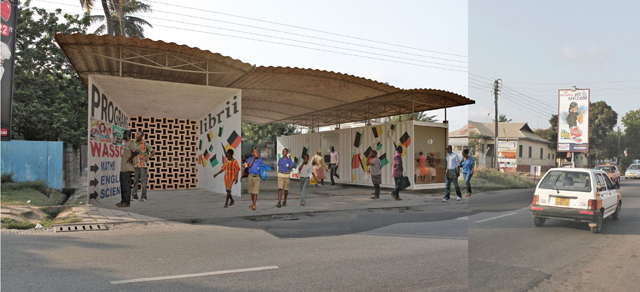
 The first Librii branch, set to open in 2014, will serve residents of Accra, Ghana. (Artist's rendering courtesy of Librii)
By the time Andrew Carnegie completed his signature philanthropic effort in the early 20th century, more than 2,500 libraries had been built in the distinctive Carnegie style—graceful architecture outside, open stacks (where patrons could easily browse book collections) inside.
A century later, a library designed for the digital age is about to open in Accra, Ghana. And Carnegie wouldn’t recognize it.
Called Librii, it challenges nearly every aspect of the traditional library. The first Librii branch, scheduled to be ready in early 2014, will use repurposed shipping containers in its construction. It won’t even have books on its shelves; indeed, it won’t have many shelves. Instead, users will generate content on their own using print-on- demand technology and multimedia tools.
Librii will charge for some services, such as Internet access and skills training, while providing other resources for free. Generating a revenue stream means that each Librii franchise will operate more like a social enterprise than like a traditional public library. Locally hired staff members will include both an entrepreneur to run the business and a professional librarian to curate content. (The umbrella organization for Librii has applied for nonprofit status.)
David Dewane, founder and CEO of Librii, came up with the idea as he was finishing graduate studies at the Rice University School of Architecture. “I asked myself: What would it mean to undertake another Carnegie-scale project? Where would those libraries go? Who would they benefit? What would they look like?” he recalls.
Dewane, an American who lives in Washington, DC, had the chance to think through those questions when he participated in an online game called Evoke. Developed by the World Bank Institute, the game immersed players from around the world in solving serious challenges from the not-so-distant future—a water shortage, say, or a pandemic. (See “Game Changers of the World, Unite,” in the summer 2010 issue of SSIR.)
The digital divide was exactly the kind of problem that Evoke was intended to tackle. In Africa, for instance, only 3 percent of the population has broadband Internet access. By the time Evoke ended its run in late 2010, Dewane and a team of colleagues were ready to move their napkin-sketch concept— a plan to build revenue-generating, Internet-enabled libraries across Africa—to the prototype stage. The World Bank Institute selected Librii as one of a handful of Evoke-inspired ideas that would receive seed funding and mentoring support. “This is a fantastic example of what we hoped would emerge from the game,” says Robert Hawkins, senior education specialist for the World Bank.
Supporters, including Librarians Without Borders and Architecture for Humanity, have rallied around the Librii concept. Gensler, the architectural firm where Dewane works, contributed schematic drawings for the shipping container prototype.
Equally important are the 650 backers who provided $52,000 in funding through a Kickstarter campaign. To send a message to Librii patrons, the design of each facility will feature a display of donors’ names. “It’s a way to say: This building is here because all these people around the world want you to participate in the global conversation. Now what are you going to do with it?” Dewane explains.
People in the development sector are watching for lessons to emerge from Librii. “When this concept hits the ground, it will adapt and change,” says Hawkins. “There’s a lot to learn here. Librii is going to be not just a source of information, but a space to gather people who will create new things together.”
The first Librii branch will serve residents of the Osu area in Accra. Once that facility is operational, the next step will be to open branches in other parts of that city. “We want these branches to function at the level of neighborhoods,” Dewane says. Each branch will likely have “different tools of production” that reflect local preferences, he says. One might have a music recording system, another a green screen for making videos, another a 3-D printer.
In that way, Librii branches will not only embody the public library ideal, but also go a step further. “They’re really laboratories,” Dewane says. “We want to provide the best tools and then just get out of the way and see what happens.”
Read more stories by Suzie Boss.