


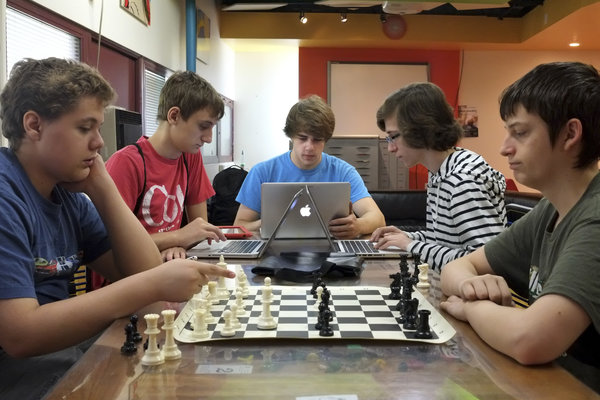
 At Elizabeth Forward High School, located near Pittsburgh, students gather in a classroom known as the Gaming Academy. (Photograph by Ben Filio, courtesy of the Sprout Fund)
On a typical school day in the Elizabeth Forward School District, which covers parts of Allegheny County, Pennsylvania, students engage in learning activities that are anything but typical for public education. Elementary students visit a mobile fabrication lab, where they use laser cutters and other tools to turn raw ideas into prototype objects. Middle school students learn math and language arts by using motion-capture technology and whole-body movement to control a giant computer screen that is projected onto their classroom floor. High school students create 3D animations and tackle college-level programming challenges in a special classroom that they have dubbed the Gaming Academy.
That these futuristic educational experiences are taking place in a small district that borders Pittsburgh—a city known for its “steel town” past—is especially surprising. But those experiences are “symbolic of how Pittsburgh has transformed as a region,” says Bart Rocco, superintendent of the district. “This is a Rust Belt community that needed to change or die.” Since 2008, his district has gone through a reinvention. Back then, it was losing enrollment to charter schools and online academies, and it had a high dropout rate. Today teachers and students at Elizabeth Forward schools regularly partner with cognitive scientists, game designers, and tech entrepreneurs to design state-of-the-art projects. Partly as a result, enrollment in the district has stabilized, and the dropout rate has plummeted.
Similar stories are unfolding across the greater Pittsburgh region as Remake Learning—a loosely organized innovation network—brings together disparate groups to reinvent education. By pursuing a new model for how, where, and when learning happens, participants in the network give formerly disengaged young people compelling reasons to connect with schools, museums, libraries, and other institutions. The network traces its origins to 2006, and today its membership includes more than 250 organizations and about 2,000 individuals.
Remake Learning efforts have helped bring national support and recognition to the Pittsburgh region and its schools. In 2013, the MacArthur Foundation awarded the city $500,000 to join Chicago and New York City in creating a “hive learning network” to support nontraditional youth programming. In 2014, Pittsburgh became the first US city to win the Tribeca Disruptive Innovation Award. The same year, the Digital Promise League of Innovative Schools honored three districts in the region. (Elizabeth Forward was one of the three.)
As the reputation of Remake Learning spreads, communities around the globe are looking to Western Pennsylvania for ideas and inspiration. “When we show up at White House meetings and other events, people always ask us, ‘What’s in the water in Pittsburgh?’” says Gregg Behr, executive director of the Grable Foundation, a Pittsburgh-based organization that helped drive the creation of Remake Learning. (At its inception, the initiative was called the Kids+Creativity Network.)
In part, the Remake Learning story is less about what’s in the water than about what’s on the air. Fred Rogers, the children’s television pioneer who created and hosted the PBS series Mister Rogers’ Neighborhood, produced that show in a Pittsburgh studio from 1966 to 2001, and he remains a local icon. “He’s part of the DNA here, a constant reminder to put kids first,” Behr says. “He was also kind of a geek. He saw that television—the [new] technology of his time—was attractive to kids and used it for purposes of learning.” Remake Learning continues that tradition by drawing on newer technologies and by serving a “neighborhood” that spans an entire region.
A Loose Network
When Behr arrived at the Grable Foundation in 2006, he took time to meet with teachers, museum staff members, library directors, and others who work with children and teens. In those conversations, he kept hearing variations on the same message. “In an unprompted way,” he recalls, “they all said something like, ‘I’m not connecting with kids the way I used to.’”
Behr then convened a series of informal meetings with stakeholders in the educational system of greater Pittsburgh. The premise of these gatherings, he says, was that “something seismic is going on [with learning].” Researchers shared insights from the field of learning science, which takes an interdisciplinary look at how people cultivate knowledge. Cultural anthropologists described how young people leverage digital tools and peer-to-peer collaboration to learn outside the classroom. Game designers and robotics experts discussed ways that technology could reengage disaffected students.
Those meetings led to the formation of an ad hoc group whose mission was to support an approach known as “21st-century learning.” Technology, Behr notes, is just one element of this approach. “It’s about how young people are pursuing knowledge differently,” he says. Students today are less apt to learn by reading a textbook than by (say) creating products in a “maker space” or by building relationships with peers and mentors via social media.
The group began to hone its strategy in 2009, when the Grable Foundation joined forces with the Sprout Fund, a Pittsburgh-based nonprofit. Previously, the Sprout Fund had focused its work on projects that would attract creative adults to the Pittsburgh region. But Cathy Lewis Long, cofounder and CEO of the fund, saw an opportunity to make a deeper impact on the city. “We realized that if our goal is to make [greater Pittsburgh] a better place to live, work, and play, we can’t overlook learning,” she says. Using that principle as its guide, the Sprout Fund took charge of managing a series of education grants that Grable funded.
In 2011, after overseeing $900,000 in seed grants, the Sprout Fund proposed a new role for itself—that of network steward. “Instead of just giving away money, we said, ‘Let’s codesign a set of resources that organizations need beyond a grant,’” Long says. The Sprout Fund’s contribution to Remake Learning now encompasses grantmaking to support innovative projects, field building and knowledge sharing across the network, and communicating the accomplishments of network members. In 2015, the fund published the “Remake Learning Playbook,” an online resource that documents best practices.
Even as Remake Learning has grown, it has resisted formal organizational structures. In 2014, the initiative created a leadership council that coordinates interaction among leaders at what Long calls “the treetops”—prominent institutions in business, government, higher education, public education, civil society, and philanthropy. But informal collaboration at the grass roots continues to drive the efforts of network participants, and Remake Learning has no formal application process for membership. “It’s still an open network,” Long says.
A Model For Learning
Remake Learning has become “our ecosystem to increase student engagement across the region,” says Megan Cicconi. She is director of instructional innovation for the Allegheny Intermediate Unit (AIU), an entity that provides professional development, assessment, and other services for 42 school districts. AIU has helped thousands of teachers explore classroom strategies that fit a 21st-century learning model.
In 2009, AIU established the Center for Creativity. Teachers from all over the region visit the center to learn about robotics, 3D printing, and other technology-based practices. The center recently held a maker workshop for teachers of consumer science (a discipline formerly known as “home ec”). The teachers learned to combine traditional low-tech activities, such as sewing, with more advanced technology, and now they can bring that learning into their classroom: Instead of making an assignment to sew pillows, for example, they might show students how to create bike-riding apparel that lights up at night for safety purposes. “This approach maps STEAM [science, technology, engineering, arts, and math] concepts across the curriculum,” Cicconi says.
AIU also partnered with the Institute of Play, a nonprofit organization based in New York City, to pilot a professional development program called TeacherQuest. Through immersive workshops, the program shows teachers how game mechanics can improve the learning process. “You don’t just sit and listen” during a TeacherQuest session, says Angela Lamers, a seventh-grade science teacher who attended a workshop in 2014. “You work and play with your peers.”
In 2015, AIU offered teachers more than 100 classes (all of them at no charge). “Classes might be taught by me, by classroom teachers, or even by students,” Cicconi says. “The roles of ‘teacher’ and ‘student’ are malleable. We’re all learners.” A Center for Creativity workshop on drone technology, for example, resulted in a collaborative effort by students, police officers, and hobbyists to design a speed trap for a street in front of a high school.
Thanks to Remake Learning, interest in Pittsburgh as a site for educational innovation is growing fast. Common Sense Media and PBS Learning Media, for example, are two national organizations that have established a presence in the city. “We’re a good petri dish,” says Long.
As Behr points out, though, his city doesn’t have a monopoly on the Remake Learning model: “There’s no reason every community in the country couldn’t do what we’ve done. You may not have 250 potential partners, but you probably have schools, libraries, businesses, a community college.” And “that’s enough,” he says, for local leaders to “think collectively about helping kids be future-ready.”
That kind of thinking, Behr suggests, leads to high aspirations. “We want to create a community where the whole region is a kid’s campus,” he says. “Whatever it takes to light up learning—robotics, maker [spaces], gaming, experiences that happen in or out of school—we want to create learning pathways for kids that help them navigate the economy, become great citizens, and thrive as lifelong learners.”
Read more stories by Suzie Boss.