


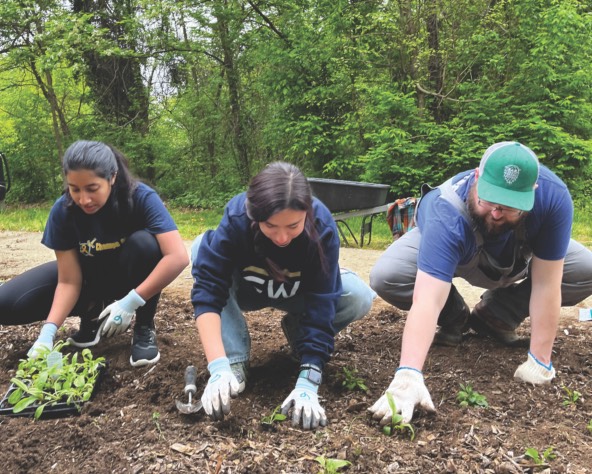
 Student members of SINAR participate in the club's planting day at Piscataway Park in April 2024. (Photo courtesy of Garden for Wildlife)
Julia Swanson, a senior at George Washington University (GWU) in Washington, DC, found herself elbow-deep in soil at Piscataway Park in spring 2024, planting a garden that she and her classmates had designed as part of the Wild Visions Habitat Creation Challenge. The onetime project welcomed students across the Washington metro area to design gardens and bring them to life using native seedlings.
“It was an invitation for students to imagine a much greener world and an ambitious community-oriented response to biodiversity collapse, and then to actually find a tiny piece of land and realize their wild vision,” says Rosalie Bull, former campus engagement lead at Garden for Wildlife, who spearheaded Wild Visions.
Garden for Wildlife is a for-profit e-commerce offshoot of the nonprofit National Wildlife Federation (NWF). Launched in 2021, the company sells curated native plant collections and provides planting guides, aligning the booming home gardening market with NWF’s conservation mission. The company also donates a plant to a community project for every plant it sells. Wild Visions expanded that donation program to colleges, reaching a new market segment and broadening NWF’s educational programming.
When developing the challenge, Bull took inspiration from solarpunk, a literary and art movement that offers radical, creative, and optimistic visions of the future, rooted in eco-socialist principles such as sustainability and living in harmony with nature. Drawing on this ethos, Wild Visions was created in 2023 to give students control of a piece of the world and encourage them to shape it according to their imaginations to ease their climate anxiety. About 70 percent of Gen Z respondents to a 2021 Pew Research Center survey said they felt anxious about the future, and the climate crisis has consistently been among young people’s top issues in recent elections.
“I think everyone our age experiences feelings of helplessness and dread because climate change is such a scary, overwhelming thing,” says Swanson, who participated in Wild Visions as a member of GWU’s Students for Indigenous and Native American Rights (SINAR). “Being able to do this one little thing felt like reclaiming a sense of agency, like we as individuals actually can make a difference.”
After more than a year of development, 14 student groups, including SINAR, planted their gardens across the Washington metro area in April 2024. Altogether, the gardens, now maintained by local partner organizations, provide 6,000 square feet of new wildlife habitat with 2,000 native seedlings and offer urbanites green spaces to cool down and connect with nature.
Wild Visions culminated in a garden party and awards ceremony hosted by Garden for Wildlife. SINAR won a landscape design award for its turtle-shaped garden with black-eyed Susans, foxgloves, and goldenrod. The garden was modeled after the flag of the native Piscataway people.
“We wanted to take the opportunity to honor whose tribal lands we are on today,” says Jacob Brittingham, a SINAR member and a citizen of the Choctaw Nation. SINAR named their garden Wawpaney, a word for “dawn” or “daybreak” in Nanticoke, a language spoken by the Piscataway people, “to symbolize a new beginning or a better tomorrow,” he explains.
Read more stories by Marianne Dhenin.