


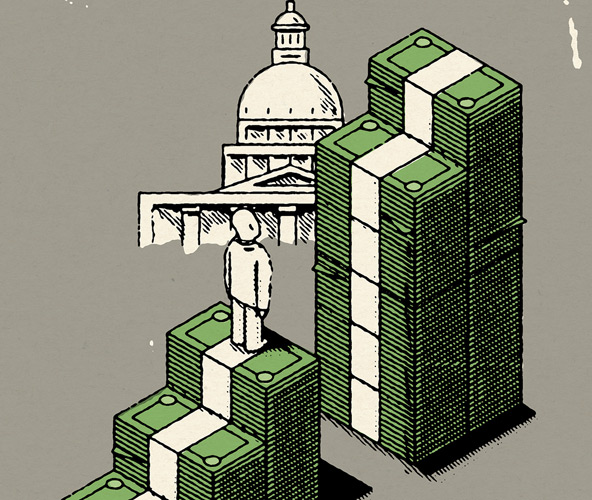
 (Illustration by Michael George Haddad)
The adoption of Pay for Success contracts (PFS), also known as social impact bonds, has spread across the world. PFS is a public- private partnership in which the government contracts with a service provider to furnish an intervention to address a societal issue, and private investors provide financing for a performance-based financial return. As of April 2019, $431 million have been raised for 139 projects launched, and by the end of 2018, more than 69 more projects were in development.
However, PFS represents only 0.001 percent of the $79.2 trillion in global assets under management. So long as PFS fails to attract more interest from traditional investors, its ability to scale will remain unfulfilled. And there is good reason to think that PFS will continue to face a funding gap from traditional investors.
Risks and Opportunity Costs
Since the social impact bond’s first launch in the United Kingdom in 2010, PFS has achieved global attention for its promise of addressing costly societal issues through private financing of governments’ outsourced service interventions. In PFS, an intermediary typically manages the multiple contracts between parties. The government contracts with private investors to finance an intervention for a societal issue, such as juvenile recidivism, offered by a contracted service provider. If the results from the intervention meet predetermined “success” metrics, typically evaluated by a contracted independent third party, the government pays the private investors their principal and an agreed-upon performance-based return. If the intervention fails, the government pays nothing. This arrangement shifts the performance risk associated with the service provider and the innovation risk associated with these new public-private partnerships and the service interventions from the government to private investors for the promise of monetary and social returns.
A government’s decision to outsource services, whether directly or through PFS, features a separation between ownership and control of the outcomes—between risk-bearing and decision-making. In traditional government contracting, the government provides the capital from its tax revenues, is the owner of the outcomes, and bears the risk of nonperformance, but the service provider controls the performance. In PFS, by contrast, the investors provide capital, demand a return for the use of their capital, and bear the risk of losing their return and investment if the intervention fails. They, like the government, do not have direct control over the implementation of the intervention, but bear the performance risk. Similarly, the service provider, who utilizes the capital, controls the intervention, but does not bear the risk of nonperformance.
The separation of risk bearing and decision making introduces two sources of performance risk. The first, adverse selection, occurs before parties sign any contract. Because the government or investors have less information about the quality of the services contracted than the provider, investors face performance risk, which they can either decide to bear or engage in costly due diligence to mitigate. Moral hazard, by contrast, occurs after the contract is signed, because investors lack information about how the provider is utilizing their financial resources. The provider can engage in suboptimal behavior and not suffer the consequences of the intervention’s failure.
In PFS, which employs performance- based payments, neither the government nor the provider bears the performance risk because the investors’ payments, not the provider’s, are performance- based. Instead, the government shifts the performance risk to the investors, who accept the transfer of risk by demanding a higher return for their investment. All contracts for services, not just PFS, create performance risk. Under traditional outsourcing of social services, the government bears the risk. PFS simply brings the cost of this risk to the surface, as investors demand compensation for assuming the risk, and we question whether the government will be willing to pay the price for the risk transfer.
Beyond performance risk, there is also the risk in funding innovation. Investments in innovation inherently face uncertainty, because the probability of success is difficult to assess. The uncertainty surrounding PFS leads risk-averse investors to demand more reward for their investment and risk-averse government officials to pay less for the desired outcomes. This shared uncertainty and risk aversion can impede their ability to find mutually agreeable terms, which may require philanthropic capital to bridge the funding gap. Proponents of PFS counter this worry by suggesting that a repeated track record of successful PFS contracts will reduce uncertainty, thereby increasing future government payouts, attracting more investors, and reducing reliance on philanthropic capital. But this suggestion ignores the political risk and desire for cost savings faced by governments and the opportunity costs faced by investors.
More certain outcomes could increase a government official’s willingness to invest, but critics deem this scenario unlikely due to political pressures that the government faces when negotiating subsequent PFS contracts. In addition, some cost savings generated by PFS arise only with the first intervention, which will also limit the government’s payouts in subsequent PFS contracts initiated to sustain the intervention.
For investors, PFS should become less risky over time as the model is refined and proven. With lower risk, investors should accept lower potential payouts. However, the opportunity cost for investors may also change, affecting the returns demanded for investment in PFS. For example, increases in interest rates on risk-free Treasury bonds will lead investors to demand higher returns from riskier investments such as PFS. In August 2012, when the first PFS contract launched in the United States, the risk-free rate on a five-year Treasury bond was less than 1 percent—one of three lowest months in 50 years. The rate has recently risen to 2.95 percent and has averaged 6.4 percent over the past 50 years. As the risk-free rate rises, investors with other opportunities for their capital will be less attracted to the risky PFS investment proposition without higher returns.
Capital to Scale
If PFS is going to scale using capital from private investors, the government must get a better handle on the risks and costs of such contracts. This is not an easy problem. Typically, the government employs a simple direct contracting model that uses tax revenues to pay a fixed fee for the services provided. Performance risk and innovation risk from new interventions still exist and are borne by the government, but their price is unknown.
One way the government can assess the price demanded by investors to bear the performance risk is by implementing performance-based payouts in its direct contracts with service providers and requiring the same method of evaluation demanded for PFS. Many proponents of PFS demand the costly gold standard of randomized controlled trials (RCT) to ensure that the investors, not the government, bear the risk of the provider’s underperformance. The investors then demand a higher return for assuming the performance risk. By not following the same performance-based payments and high standards for evaluation in its direct contracts, the government accepts the risk of nonperformance, which society bears. PFS simply places an explicit price on performance risk and forces the government to decide if it is willing to pay to mitigate the risk in its contract for services.
Thanks to philanthropic capital, which pays for due diligence, monitoring, and evaluation, and absorbs some of the investors’ financial loss by acting as a guarantor, the government currently pays a discounted price to transfer the risk to the investor. Repetition will create learning, data, and measurement infrastructure, reducing the costs of risk bearing. Unfortunately, this reduction is limited, because scale will likely be achieved by engaging new governments, introducing new interventions, and expanding to new providers—generating new performance and innovation risk. Thus, the government’s willingness to bear risk or pay the price to transfer it to investors will influence the need for philanthropic capital.
Despite such challenges, PFS will undoubtedly tap some of the almost $80 trillion of assets under management. The question is how much it can tap given investors’ other opportunities. Private equity investors, who take on more financial risk and have extensive due diligence, evaluation, and monitoring costs, expect financial returns of 20-25 percent. Investors in public securities demand market returns because they can diversify away security-specific risk. Given the investment opportunities available to these investors, future PFS contracts will likely support interventions with less risky social outcomes or continue to need significant capital from philanthropies and the growing impact investor community.
For our purposes, impact investors are willing to take lower financial returns or wait longer for their return because they also seek social impact. While some impact investors are committed to the success of PFS, many seek the greatest social impact irrespective of the funding vehicle. Because impact investors also seek financial returns, PFS must compete to deliver the financial and social returns that justify the risks vis-à-vis alternative social-investment vehicles. Even if PFS could compete on both fronts, impact investing assets are small compared with the trillions in global assets.
PFS has inspired a new era of service contracting that utilizes data and preventive initiatives to produce government savings, improve people’s lives, and recycle philanthropic capital. Yet proponents of PFS have subsidized much of this success, making scalability without impact investing and philanthropic capital highly questionable. Ultimately, PFS faces a daunting challenge: Will scaling reach the trillions held by traditional investors to fulfill the promise hoped for by supporters? We do not believe so, unless the participants better understand the risks that each party bears.
Read more stories by Stefano Rumi & Mary Margaret Frank.