


 (Illustration by Melinda Beck)
In recent decades, philanthropy has increased its investments in policy advocacy to realize strategic objectives in issues ranging from education, climate, and public health to immigration, criminal justice, and political economy. But are the legislative and executive branches of our federal, state, and local governments—the bodies responsible for making and administering policy—up to the task?
Realizing the Promise of a Truly Responsive Government
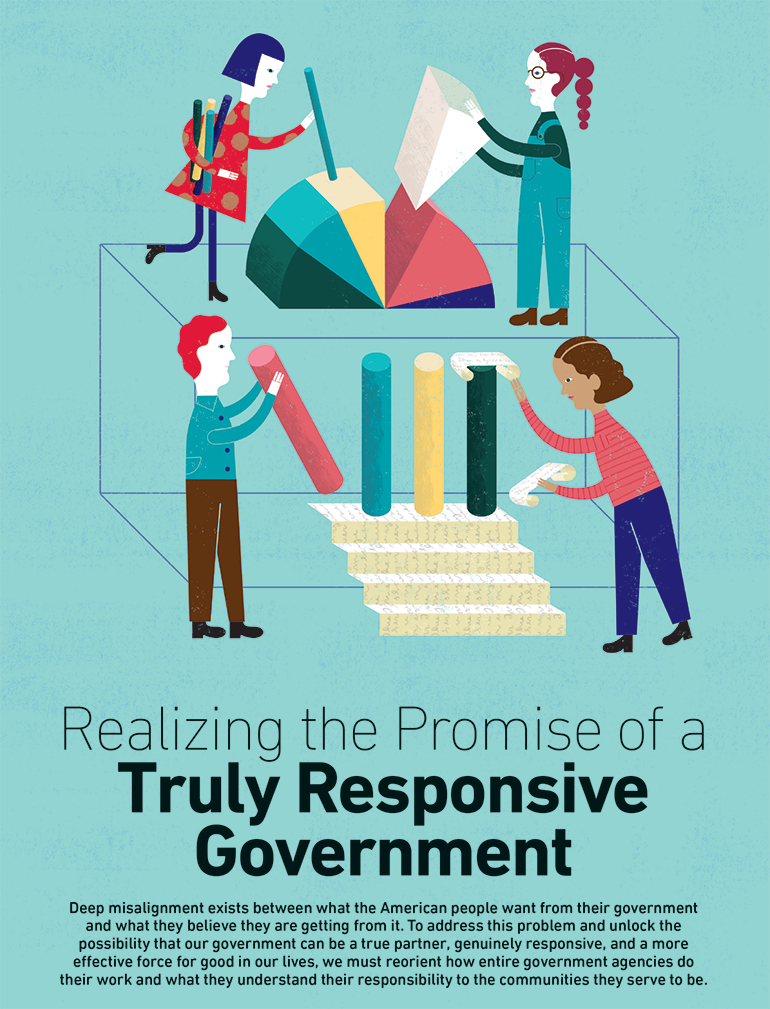
Deep misalignment exists between what the American people want from their government and what they believe they are getting from it. To address this problem and unlock the possibility that our government can be a true partner, truly responsive, and a more effective force for good in our lives, we must shift how entire government agencies do their work, and most importantly, what they understand their responsibility to the communities they serve to be. Sponsored by Third Sector
An early 2022 survey of Candid’s database on Foundation Funding for U.S. Democracy indicated that US foundations dedicated $14.7 billion to democracy-related causes and grantees over the previous decade. In the same period, however, foundations allocated just $478 million, a mere 3 percent of that total, to improving government capacity and performance. Philanthropic funders are skimping on investing in the capacity and performance of our faltering governing institutions, even as they attempt to push through higher-octane inputs to the policymaking process. This is a recipe for failure.
There are notable exceptions, to be sure. Bloomberg Philanthropies has invested heavily in supporting innovation in mayoral offices and administrative capacity at the municipal level. The William and Flora Hewlett Foundation has made a point of building governing capacity in Congress and the executive branch. An especially auspicious development is the newly launched Recoding America Fund, a six-year, $120 million grantmaking initiative that is setting out “to reform the administrative state at the federal and state levels and expand American capacity and competitiveness.” These examples, however, alongside a few other pattern-breakers, are exceptions that prove the rule. Philanthropy presumes that helping to improve the capacity and performance of governing institutions is not its job.
Understandable, if flawed, reasons support this view. Since government resources dwarf those of philanthropy, it is counterintuitive for funders to see a need to invest in government resources. But that thinking overlooks barriers that government executives and legislators face when it comes to investing their scarce time and the taxpayers’ money in building the capacity of the institutions where they serve. In the absence of ideas, advocacy, and material support from outside the government, officials are inclined to neglect or even abuse the health of those institutions. Many elected and appointed executive branch officials often rail against “government bureaucracy,” as if they were not in charge of it. Likewise, lawmakers can find it politically advantageous to campaign against their own legislatures and to cut funding for essential activities within them in penny-wise, pound-foolish ways.
The increasingly polarized nature of philanthropy also reduces funders’ support for institutional innovation and development. A growing number of funders interested in pushing our society and the economy to the right or the left are ambivalent about governing institutions. They support branches of government when “their side” has control and oppose them when the “other side” wins. But that approach, instrumental rather than institutional, is an undemocratic way of funding democracy. Instead of bolstering institutions so that whoever is elected can put them to better use, polarized philanthropy overrides the electorate, hitting the gas or brakes depending on the political preferences of funders.
Where Do We Go from Here?
What would it look like for philanthropy to take governing institutions seriously and invest in their capacity? Here are five steps that farsighted funders should take:
- Strike a better balance between support for inputs to government and the “throughputs” of government—respectively, the capacity and performance of our legislative and executive branches. The balance doesn’t need to be evenly divided, but unless philanthropic support for governing institutions at the federal, state, and local levels increases in substantial ways, funders’ investments in inputs will have diminishing returns. A reasonable initial target would be a threefold increase in the proportion of funding dedicated to legislative and executive branch performance in the democracy field. Tripling this figure would take us to approximately 10 percent of total annual foundation funding for US democracy. From there, we can build!
- Invest steadily and patiently, regardless of what party controls which institutions. Financial investors struggle to time the stock market. So too will philanthropic funders struggle if they try to surge or scale back support for improving governing institutions depending on who controls them. Funders should invest in good ideas and promising nonprofit organizations and networks for the long haul. Institutional development and change in government take time, even decades. The push for civil service reform took a century to come to fruition at all levels of government. We can’t presume that the complex tasks we face will be wrapped up within the confines of one or two electoral cycles.
- Underwrite ideas, research, and development alongside reform work and operational activities. The task of institutional reform and government development has become much more complex. It requires grappling with the persistent thickening of the institutional and policy environment within and between levels of government. These processes are taking place amid accelerating technological change and the social and economic dislocations that come with it. Overcoming the daunting challenges we face will require fresh thinking, experimentation, and new approaches that chart a way forward. Philanthropy is uniquely positioned to support discovery and innovation in the research and policy realms and to underwrite the requisite links between them. For our governing institutions to flourish in the 21st century, funders will need to help.
- Recognize that the revitalization of our governing institutions will depend on talented members of rising generations of Americans serving in them. We need younger, more diverse, and tech-savvy public servants. The civil service reform movement of the previous century at once attracted and cleared the way for talented young people to dedicate themselves to public service. We need to restore its luster for those at the start of their careers and for other Americans who can bring mission-critical expertise to government, even if just on a time-limited basis, later in their professional lives. Reforming long-outdated laws, regulations, and organizational culture that make it hard to recruit, retain, and develop public servants will surely help. So will talent pipelines and professional development programs that inspire and guide people to enter public service and help them learn, grow, and contribute as they pursue it.
- Build infrastructure and networks in the government reform field, linking and supporting grantees who demonstrate a knack for collaboration. Earlier generations of institutional reformers solved coordination problems, for example, by establishing the National Civil Service Reform League. Currently, we are not in a position to establish one national entity, nor would we want to, given the diversity in perspectives and work that characterizes the field. That gives funders even more reason to support entities that provide shared infrastructure and public goods that other organizations, leaders, and researchers can use. Funders can help link different groups so that the whole amounts to much more than the sum of the parts. They should also identify individuals who are inclined to collaborate in constructive ways and fund them so they can continue their work.
No doubt funders can take other helpful steps. We need profound changes and much more ample philanthropy to help bring them about. The stakes are high, and the payoff would be enormous. Generations of Americans who pushed to reform government, from inside and outside, rose to the occasion in the first part of the 20th century. As a result, we have enjoyed decades of more effective government. To live up to their legacy, it is time to join forces in a new government reform league for the 21st century.
Read more stories by Daniel Stid.