


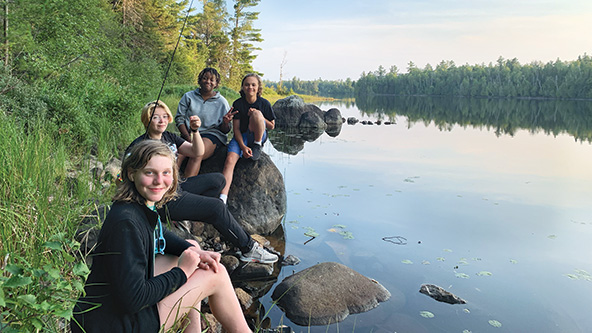
 LGBTQ+ youth sit in the Boundary Waters Canoe Area, in Minnesota’s Superior National Forest, in August 2022. (Photo courtesy of QUEERSPACE Collective)
LGBTQ+ Americans are experiencing an onslaught of legislative attacks. In the first quarter of 2023 alone, nearly 400 anti-LGBTQ+ bills have been proposed in state legislatures across America, many targeting trans youth: 18 states have banned trans athletes from participating on school sports teams, and 7 have outlawed gender-affirming health care.
Statistics measuring the safety and well-being of LGBTQ+ youth reflect this grim reality. The Trevor Project’s 2022 National Survey on LGBTQ Youth Mental Health reported that nearly half of all LGBTQ+ youth “seriously considered” taking their own life. And according to the National Alliance on Mental Illness, LGBTQ+ youth “have a 120 percent higher risk of experiencing homelessness—often the result of family rejection or discrimination based on gender identity or sexual orientation.”
QUEERSPACE Collective seeks to reverse these statistics by providing a strong support network and community for LGBTQ+ youth. Launched in April 2021 by Nicki Hangsleben, a community activist with a background in international development, the Minneapolis-based nonprofit helps young people cultivate their self-worth and develop a sense of belonging. The organization covers the Twin Cities metro area and, in March, expanded northwest to the city of St. Cloud. Currently, it does not have a physical location but operates its programming in social spaces like parks and private venues.
The collective’s mission is realized through its LGBTQ+ youth mentorship program—the first in Minnesota and one of fewer than 10 mentorship programs for queer youth in the nation.
Hangsleben’s early life inspired the program. “My mom dated women when I was a kid, and I was surrounded by a lot of queer folks growing up,” she explains. “So when I came out, I already had this huge network of support, which made [coming out] so much easier.”
The mentorship model includes one-to-one mentoring and group hangouts. Mentors are recruited primarily through word of mouth and community events. They must be at least 25 years old, and QUEERSPACE provides them with education and training as well as support and resources to build community among themselves.
Each mentor meets with their mentee two to three times per month, often in the mentee’s community, to help them nurture a sense of safety and belonging in their own social setting. Meetings can include a range of activities, from playing video games to visiting museums, and tend to revolve around building self-esteem, developing healthy relationships, and working through academic goals.
“[Our] research has found that LGBTQ+ youth who lived in an accepting community, had access to LGBTQ+-affirming spaces, and/or felt high social support from family and friends reported significantly lower rates of attempting suicide in the past year,” says Myeshia Price, director of research science for The Trevor Project.
QUEERSPACE began with 6 mentor-mentee relationships and now counts 34. It has recruited and trained more than 50 mentors and supported more than 50 youth.
At the outset, Hangsleben did not anticipate the extent of the mental-health support the youth would need or that they would be overwhelmingly—more than 85 percent—trans and gender-nonconforming. Both factors demanded the collective to readjust its approach to mentorship. “We’ve been doing more training with our mentors on suicide prevention techniques, and how to advocate for LGBTQ+ youth in schools and in their communities,” Hangsleben says.
The collective is funded by foundation grants, corporate contributions, and individual donations. Minneapolis-based Flip Phone Events, which organizes drag brunches across the country, has held several fundraisers for QUEERSPACE and raised nearly $100,000 for the nonprofit in 2022.
Last year, QUEERSPACE launched an LGBTQ+ cultural-competency training and consulting program for youth-serving organizations seeking to provide safer and more inclusive spaces. It worked with the YMCA to help train summer-camp counselors last summer; in April, it began working with Best Buy to make their Teen Tech Centers more LGBTQ+ inclusive. The program has introduced a new revenue stream, which may allow the nonprofit to subsidize trainings for nonprofits that might not be able to afford them in the future.
In January, QUEERSPACE doubled in size from four to eight employees. Yet Hangsleben is cautious about growing too quickly because she wants to avoid staff burnout and ensure sustainability.
That said, Hangsleben dreams of expanding the nonprofit’s reach beyond Minnesota. She also believes the state’s political climate—Minnesota recently became a “refuge state” for trans individuals seeking gender-affirming care—will bolster the nonprofit’s efforts to secure a permanent physical space.
Read more stories by Noor Noman.