


 George Johnson, a mechanical engineering professor at UC Berkeley, trains math and science teachers for CalTeach. (Photo by Richard Schultz)
At North Laurel High School in southern Kentucky, teacher Bridgette Napier has created a hall of fame at the entrance to her math classroom. This spring, she “inducted” 14 seniors who earned passing scores on the Advanced Placement calculus exam. Although Napier has been encouraging students to take higher level math courses throughout her 15-year teaching career, few attempted the rigorous AP tests in the past. What’s changed? Since 2008, North Laurel High, which typically sends less than half its graduates on to college, has become part of a comprehensive program that offers everything from professional development and mentoring for AP teachers to cash incentives for students. “I’ve become a better teacher,” Napier says, “and our students realize you don’t have to come from somewhere else to be successful.”
Preparing students from all kinds of communities to thrive in the fields known collectively as STEM (science, technology, engineering, and math) has become a national obsession. President Barack Obama, New York Times columnist Thomas Friedman, members of the National Academy of Sciences, and corporate CEOs all offer a similarly urgent message: If we don’t act fast to fill the STEM pipeline with qualified and capable students, we risk a stalled economic engine and a future of missed opportunities.
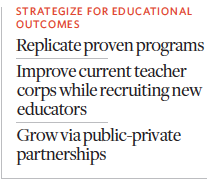
The National Math and Science Initiative (NMSI), launched in 2007 with corporate and philanthropic dollars and an all-star board, aims to avert the STEM crisis through a rapid-response approach. CEO Tom Luce, former assistant secretary of education, says what sets NMSI apart from other education reform efforts is its focus on replicating proven programs. Instead of waiting for a moon shot to improve math and science education, NMSI is betting on ready-made strategies that can be rolled out immediately. “We’re not a startup. We’re not a garage innovator,” he says. “We go find existing programs that have proven results and figure out how to get them replicated.”
For starters, NMSI has invested $126 million to scale up two signature programs “and show communities that success is possible quickly,” Luce says. He has been working to improve public education since 1983, when A Nation at Risk sounded an alarm about the declining quality of American schooling. “Back then, we had to convince people there was a problem,” Luce says. “Today, we have to convince them there’s a solution.”
Recent years have brought a spate of bad news, with US students faring poorly on international comparisons of achievement in math and science. Interest in STEM subjects is lagging along with achievement. The President’s Council of Advisors on Science and Technology cautions that many of the country’s most proficient students are choosing other professions over science and engineering. Qualified math and science teachers are in short supply, prompting the president to set a goal of recruiting 10,000 new teachers in these fields within five years.
Luce insists there’s no shortage of good strategies to change the picture. He’s seen them rolled out in one pilot program after another—but seldom replicated.
A Texan prone to folksy phrases (“It’s time to stop stewing and start doing”), Luce has built NMSI’s two-pronged approach on programs piloted in the Lone Star State. The larger effort is the Advanced Placement Training and Incentive Program. APTIP, developed in Dallas, focuses on improving the ability of current teachers to teach AP courses, touted as a gateway to college success. The second program, UTeach, was developed at the University of Texas at Austin and builds the preservice teacher ranks with candidates who have strong foundations in math and science.
EXPANDING AP OPPORTUNITIES
Once the domain of only the most talented and privileged, AP courses are now standard fare for college-bound students. Yet minority, inner-city, and rural students have long been underrepresented in AP. For many, prior educational experiences don’t prepare them for the pace and rigor of AP. Even if they are ready, there aren’t enough qualified teachers to go around.
APTIP offers professional development and incentives to bring AP courses in math, science, and English to more students, especially to minority and low-income teens. The program goes beyond access and aims to increase the pass rate on AP exams. Research cited by NMSI shows a correlation between students who pass AP tests in high school and those who go on to earn college degrees. Now offered at 229 high schools in six states selected for the first round of competitive, five-year funding, APTIP is already producing measurable results. Luce cites a 97 percent increase in the number of students taking and passing the national test. The average annual cost of $120,000 per site makes the program a bargain, he adds, when it comes to changing the culture of a school to emphasize academic achievement.
Teachers say they appreciate the peer-led, practical approach to professional development. Anthony Palombella, a high school science teacher with a doctorate in molecular and cellular biology, entered teaching with a mastery of his content area. Attending the summer institutes with his colleagues “adds more tools to my tool belt as a teacher,” he says.
Having a range of teaching strategies available—from technology-assisted labs to hands-on activities using duct tape and Velcro—helps diverse learners understand challenging concepts. At Cosby High School in Midlothian, Va., where Palombella teaches, enrollment in AP biology has swelled from 20 students per year to more than 100, and similar gains are occurring in AP math, English, and other science courses. “Students who might not have thought of themselves as AP material are taking these classes,” he says.
Teachers also learn pre-AP strategies to introduce as early as middle school. That gets students ready for tougher high school classes, says Trevor Packer, vice president of College Board, which administers the AP program. He credits APTIP for “helping overcome the two greatest barriers to student participation and success [in AP]”: improving access to qualified teachers and student readiness to succeed.
UTeach, currently offered on 22 college campuses and enrolling nearly 4,000 undergraduates, focuses on another critical piece of the STEM puzzle: recruiting and retaining the next wave of STEM teachers. Participants in the four-year program fulfill requirements for a math or science major, while also taking education courses that prepare them to teach high school. Graduates are not only entering the teaching profession with deep understanding of math and science, but they’re also sticking around. Some 92 percent of UTeach graduates immediately start teaching math and science. Five years later, 82 percent are still in the classroom, compared with a national retention rate of about 50 percent.
University of Texas at Austin education professor Anthony Petrosino played a key role in developing the UTeach curriculum. New teachers’ knowledge of math and science is a hallmark of the program, he says, along with “faculty who are active researchers.” It’s no accident that UTeach courses incorporate research about learning science. And coursework reinforces best practices in assessment, equity, and technology integration.
The most popular aspect of UTeach may be the fieldwork. Undergraduates are assigned to master teachers’ classrooms “early and often,” Petrosino says. That gives them real-world context for what they are learning, plus a chance to find out fast whether they’re cut out for teaching. Andreea Popa, graduate of UTeach-University of North Texas, arrived at her first teaching job in the Dallas area “so well prepared,” she says. Classroom management issues that plague many first-year teachers haven’t been a worry in her algebra classes. She can concentrate on convincing a new generation to love math as much as she does.
QUESTIONING GOALS AND REWARDS
Despite support for NMSI from corporate, philanthropic, and government sectors, not everyone is convinced that a national expansion of rigorous AP courses is the best solution to the STEM crisis. Alfie Kohn, author of Punished by Rewards, says AP courses “typically offer an accelerated version of the worst sort of traditional teaching: lecture driven, textbook based, and test focused. People confuse harder with better.”
Luce has heard that argument, but counters that AP offers the best available combination of curriculum and assessment. “Right now, it’s the highest standard we have. If there’s a better program in the future, we’ll consider it,” he says. “Meanwhile, we’re giving opportunities to kids who have never been given the opportunity to stretch themselves.”
The offer of cash incentives—$100 to students who pass AP tests plus a per pupil bonus for their teachers—also has rankled critics. Robert Schaeffer, public education director of FairTest, calls such rewards “bribes for the kids, bounties for the teacher.” Tying teacher bonuses to student achievement “is further incentive to teach to the test,” he says. Pay for performance “is not positive and may have negative consequences long term.”
Kohn points to a research base of 75 studies showing that external rewards can get in the way of internal motivation to learn. “What rewards can never do is help kids to become more effective or enthusiastic learners,” he says.
Healthy critique is important as these programs expand. An iterative design process has improved UTeach over the years, Petrosino says, and he hopes replication allows for ongoing fine-tuning. “It’s easy to fall into PR mode,” he admits. “We need to keep reflecting, refining, responding to research, and addressing new challenges.”
From Luce’s vantage point, the biggest challenge is securing public and private resources to fund expansion so that NMSI lives up to its name and achieves national impact. There’s no time to waste, he adds. “We need to move the needle in all 50 states.”
Suzie Boss is a journalist from Portland, Ore., who writes about social change and education. She contributes to Edutopia and is co-author of Reinventing Project-Based Learning.
Read more stories by Suzie Boss.