


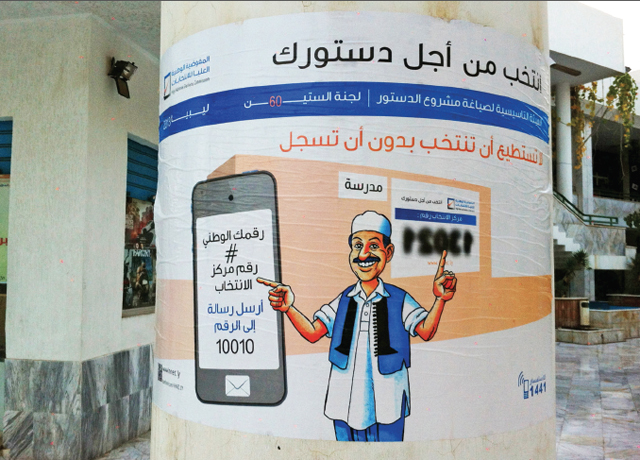
 Sign of Change:
A poster inTripoli, Libya,
advertises a system of
voter registration that
uses text messaging. (Photo by Josh Levinger, courtesy of Caktus Group)
Sign of Change:
A poster inTripoli, Libya,
advertises a system of
voter registration that
uses text messaging. (Photo by Josh Levinger, courtesy of Caktus Group)
In late 2013, soon after Vinod Kurup joined Caktus Group, an open source software firm based in Durham, N.C., he became the lead developer for a new app. The client was the government of Libya, and the purpose of the app would be to support voter registration for the 2014 national elections in that country. Bomb threats and protests in Libya made in-person registration risky. “I realized right away that this wasn’t your standard tech project,” says Kurup.
As a result of that project, Libya became the first country in the world where citizens can register to vote via SMS text messaging. By the end of 2014, 1.5 million people—nearly half of all eligible voters in Libya—had taken advantage of the Caktus-designed app during two national elections. “This never would have happened in a country like the United States, where we have established systems in place [for registering voters],” says Tobias McNulty, cofounder and CEO of Caktus. “Libya was perfect for it. They didn’t have an infrastructure. They were looking for something that could be built and deployed fast.”
Libyans are heavy users of cell phones. According to World Bank data, there are 165 subscriptions for every 100 people. Mobile penetration is high even among nomadic segments of the Libyan population, says Hao Nguyen, strategy director for Caktus. Internet connectivity rates, meanwhile, are quite low: Only about one in six Libyan households has Web access. Not surprisingly, then, the motivation to leapfrog Web-based tools and go straight to a mobile platform was high.
Simplicity was an essential criterion for designing the app. “With SMS, there’s only one way to use it: Enter characters on your phone,” Kurup says. To register to vote, citizens merely need to text in their 12-digit national identification number, along with a 5-digit code that identifies their local polling place. Once that information enters the government’s data system, however, the level of complexity increases. “The system has to make sure that the ID code has been entered correctly and that the person is eligible to vote [according to the nation’s Civil Registry]. For each possible error, we had to create a response message,” Kurup explains. Working closely with advisors from the United Nations and with Libyan election officials, developers planned for various use cases: What happens, for example, if multiple family members share a single mobile phone? A complicated flow chart shows all of the communications that might take place between a citizen and the system.
Developing the app quickly was a high priority, and it became even more critical when the Libyan High National Elections Commission (HNEC) moved the election for seats in the national assembly forward by two months—from August 2014 to June 2014—in an effort to reduce political turmoil. Fadia Hadi, who was then head of data management for HNEC, credits Kurup and his colleagues with working “hand in hand with the commission, as though we were one team.”
For technologists who work on apps for international development, the project demonstrates the value of open source tools—including, in particular, a platform called Rapid SMS. Created by the UNICEF Innovation Unit, Rapid SMS has enabled developers to build mobile apps for tasks that range from disease tracking to conducting citizen surveys. “The fact that Rapid SMS was our [foundation] saved us months of time, compared with starting from scratch,” Vinod says.
In the 2014 elections, voter turnout fell short of expectations. Even so, experts from the Carter Center who observed the elections praised SMS voter registration for its speed and efficiency. “This system should be used again in future elections,” the center’s report concluded.
“Our hope,” says McNulty, “is that other countries can use this [app] as a building block for their own voter registration software.” McNulty was in Libya during the June election. He saw political ads plastered everywhere, along with colorful signs posted by HNEC that told citizens how to register via mobile phone. “It was humbling to see the hope of citizens in this fledgling democracy,” he says.
Read more stories by Suzie Boss.