


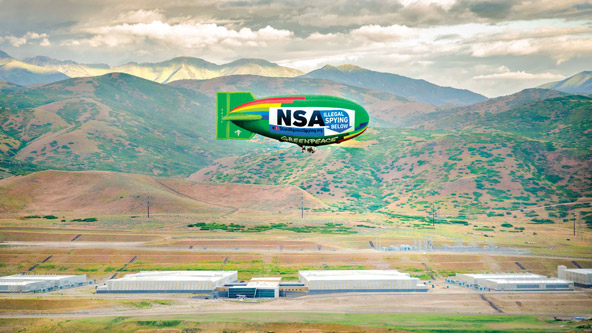
 On June 27, 2014, EFF joined Greenpeace and the Tenth Amendment Center to fly a protest airship over the NSA’s data center in Bluffdale, Utah. (Photo courtesy of Greenpeace)
On March 1, 1990, the US Secret Service executed a search warrant on Steve Jackson Games, a game and publishing company in Austin, Texas, and took its computers and floppy disks. The government alleged that an employee had stolen proprietary information from Bell South, a telecommunications company (now part of AT&T), and posted it on Steve Jackson Games’ bulletin board system. The government also claimed that GURPS Cyberpunk, the employee’s forthcoming game book for cyberpunk role-playing, encouraged computer crimes.
The news sparked immediate outrage among users of online bulletin boards, the era’s equivalent of social media. Calls to action spread. Impassioned parties began to build coalitions and fundraise. Then, on July 10, 1990, at the National Press Club in Washington, D.C., software developer Mitch Kapor and Grateful Dead lyricist John Perry Barlow announced the creation of the Electronic Frontier Foundation (EFF) to protect people’s rights on the Internet, or “electronic frontier.” It would go on to achieve major legal victories that shape how each of us uses the Internet, our mobile phones, and the software that now drives our workplaces and provides access to music, video, news, work, and drivers. It would usher in an ecosystem of nonprofits, activist efforts, and digital rights organizations. And it would become an anchor institution of what we now know as digital civil society.
EFF launched with big names and a fair amount of bravado. It had important early successes, including the countersuit it brought against the US government on behalf of Steve Jackson Games and a Supreme Court decision that declared software code protectable free speech. EFF’s history tracks an important trajectory from an electronic frontier to an age of digital dependence. Its framing of people’s rights in cyberspace shaped how the masses got online and what they experienced when they arrived.
Today, we digital dependents use tools that EFF’s work has shaped. I first found EFF in the mid-1990s, after blogging for several years. I did much of my posting in cafés, surrounded by other people’s sticker-festooned laptops. Over time, I kept noticing one sticker in particular, “Protect Bloggers’ Rights: EFF.” “What’s EFF?” I wondered. Soon enough I realized that, yes, I was interested in my right to publish without government surveillance. Perhaps you’ve attended a “tech safety” workshop, where you learned to photograph protestors so you capture only the backs of people’s heads. Maybe you’ve even convinced your board of directors to choose an encrypted messaging app for their communications (if so, good for you for seeing the intersection between information security and good governance). Each of these domains—from online publishing to encryption to digital and physical security—is shaped by a long run of legal activism. The core issues at stake run from intellectual property (IP) to constitutional rights to expression, association, and privacy. EFF sits at the center of this history.
Born to Litigate
EFF wasn’t the first nonprofit dedicated to digital activities; other software and computing-specific groups had been founded at least a decade earlier. Nor was it the first nonprofit to look at the legal implications of the Internet—the American Civil Liberties Union (ACLU) had launched a project on digital technology in the late 1980s. But EFF was the first US nonprofit to focus specifically on the intersection of digital systems with everyday people’s daily activities and civil liberties.
In 1990, government-led stings on computer hobbyists and game players directly affected only a small number of people. Most of the people online then were academics, phone company employees, defense contractors, game players, or computer hobbyists, with a few journalists and musicians thrown in. They were excited to master command-line interfaces, waited patiently while their modems connected, scrolled through and typed out conversations, and then logged off whenever another member of their household needed to make a phone call.
While the digital world has changed dramatically, the issues that brought EFF into being have proved persistent. The Secret Service’s Operation SunDevil raids, including at Steve Jackson Games, centered on claims of stolen information and perceived threats to national security. It would take three years and a countersuit for the game company to get its property back, having had to explain along the way that the role-playing fantasies detailed in its publications were part of a fictional game universe and not a coordinated threat to the nation. At stake in 1990 were the publishing of ideas, the nature of property, and the appropriate reach of government—three rights protected in the First and Fourth Amendments to the US Constitution.
Kapor, the founder of Lotus software, and Barlow, a Wyoming rancher, essayist, and poet, met via discussions about the government’s actions on The WELL, a West Coast-based bulletin board. In June 1990, Barlow posted “Crime and Puzzlement” to The WELL. The essay became an EFF founding document and sealed Barlow’s reputation as the bard of digital rights. He evoked “old West” outlawry to tell the story of Operation SunDevil and quoted German theologian and Nazi resister Martin Niemöller (“Then they came for me, and by that time there was no one left to speak up”) to exhort others to act. He announced that he and Kapor (with funds from John Gilmore of Sun Microsystems and a matching gift from Apple cofounder Steve Wozniak) were launching EFF to “raise and disburse funds for education, lobbying, and litigation in areas relating to digital speech and the extension of the Constitution into cyberspace.”
Barlow’s list of activities and comments on the role of the Constitution is telling. The organization spent its first decade trying out different mixes of educating, lobbying, and litigating. It fought against government surveillance and for free expression; it pushed the courts to adapt IP law to digital spaces and to recognize the changing nature of personal association in a networked world. Barlow knew well that other rights frameworks besides the US Constitution existed and that digital networks would be global and not just American. Only six years later, he would write “A Declaration of the Independence of Cyberspace,” in which he argued for an Internet beyond the bounds of any “terrestrial” government. Even as he called for a new global community, Barlow’s imagery and world-view were firmly rooted in a sense of American exceptionalism.
In keeping with the promises of “Crime and Puzzlement,” EFF paid for Steve Jackson Games to countersue the government for the return of its property. Kapor and Barlow sought to bring public attention to the issues. Barlow continued discussing the issue in posts on The WELL (one of which was reprinted in the March 1990 issue of Harper’s magazine). Kapor published articles in Scientific American and gave interviews to national newspapers. In their first year, they hired Mike Godwin, who had been an outspoken critic of the FBI raids as a University of Texas law student, as EFF’s first staff counsel. They retained litigators and hit the road to make presentations to hacker conferences and corporate associations. They won over some but alienated others—especially technology executives who viewed them as “hacker defenders,” as both The New York Times and The Wall Street Journal described the EFF. The founders framed their actions in the language of rights and freedoms—of speech, press, and voluntary association. And they brought their legal, technological, and activism expertise to bear.
From Fighting the Law to Writing It
It wasn’t long, however, before EFF decided to try its hand at writing laws, not just fighting them. The early 1990s was a busy time for Internet regulations. Kapor, in particular, wanted EFF to have a place at the table. He funded EFF to convene a Communications Policy Forum in 1991 as a way of testing the waters. He also made a grant to Computer Professionals for Social Responsibility (CPSR) to hold a policy roundtable. By 1992, Kapor, Barlow, and Jerry Berman, an EFF board member whose day job was at the ACLU’s Project on Privacy and Technology, were working hard to convince the board that EFF should move to Washington, D.C., and get directly involved in policymaking.
The board didn’t agree, and several meetings turned contentious over the proposal. EFF sympathizers also resisted it. Contributors to The WELL and subscribers to EFF’s newsletter, the EFFector, denounced the idea. Eventually, Godwin convinced the board that they needed to meet with those opposed to the proposed move. He organized a two-day retreat in Atlanta for the board and 11 activists from around the country. The activists, including supporters from Austin who had helped pay for the legal defense of Steve Jackson Games, issued several demands. They wanted better communication with grassroots groups, formal chapters, and a commitment to litigation—not policymaking. Berman and the EFF board refused them all, insisting that adding policymaking would not require them to drop litigation. Berman argued that fighting to protect the electronic frontier required a presence inside the beltway, as legislation and regulation of telecommunications, security, privacy, property, and speech were increasingly part of the federal agenda. EFF promised to improve its communications with other associations and these activists, and it picked up the tab for the meeting. But it didn’t back down on its commitment to policymaking.
There were also signs of an emerging field. The 1991 CPSR D.C. policy roundtable attracted US senators and Navy brass, company executives from startups such as Prodigy Services (an early Internet service provider), and John Quarterman, author of The Matrix. A month later, Jim Warren, pioneer promoter of home computing, organized the first Computers, Freedom, and Privacy (CFP) Conference near the San Francisco airport. More than 400 people gathered, including law enforcement and those they’d recently been chasing, academics and hobbyists, journalists and librarians. Both John Gilmore, a founding member of EFF’s board, and Harvey Silverglate, one of the lawyers EFF had hired for the Steve Jackson Games countersuit, made presentations. The CFP conference went on to run annually for 25 years. CPSR was the original host, but by 1998, tensions between CPSR’s mainstream computer scientist membership and what CFP’s founders referred to as “hardcore libertarians” became too much for CPSR. It handed off hosting duties to others, including EFF.
In 1992, EFF moved to Washington, where Berman became executive director and led EFF’s policy efforts. One of his first hires was a lawyer named Shari Steele, who would eventually lead EFF. The federal policy agenda centered on proposals from President Bill Clinton and Senator Patrick Leahy to empower law enforcement to wiretap digital telephone systems. Both CPSR and the ACLU opposed these proposals. CPSR’s nascent legal team cut its teeth fighting the Clipper chip proposal—Clinton’s bill, supported by the National Security Agency, that would add encryption devices to voice and data communications with a back door for law enforcement. In opposition, CPSR served up what may have been the Internet’s first online petition.
However, unlike the ACLU and CPSR, the EFF didn’t stand against the Clipper chip. Kapor, Barlow, and Berman tried to make the bill less bad. Even Barlow would eventually fail to find the words to convince the public that this was a good idea. The WELL roiled with outrage. Rogier van Bakel, a writer for Wired magazine, whose publisher sat on the EFF board, wrote:
The Electronic Frontier Foundation went to Washington to “reverse-engineer government, hack politics down to its component parts, and fix it.” Then it helped pass the FBI’s loathsome “let’s-just-wiretap-everyone” Digital Telephony Bill. And discovered it was Washington that had reverse-engineered the EFF, driving it into dissension, debt, disgrace—and right out of town.
Berman remained convinced that staying in Washington and working with companies and policymakers was the best way forward. When the EFF board voted to get out of policymaking, Berman chose to stay behind. He launched the Center for Democracy & Technology (CDT) to continue working on policy issues, taking several of EFF’s corporate funders and some of its staff with him.
The Lost Decade
EFF’s failure to fight the Clipper chip bill lost the trust of its own community. Every principle the organization seemed to stand for was compromised: private communications, a personal right to encryption, and freedom from government overreach. It had alienated its members and lost its executive director and would soon pack up its D.C. office and head west to San Francisco.
When EFF landed in California, it was more than $200,000 in debt and had lost half its staff. John Gilmore donated office space and core operational funding, a role he would play for many years to come. Mitch Kapor summed it up: “We went to D.C. to play policymakers, and we got played.” Such a failure might have been the death of EFF. Survival wouldn’t be assured for almost another decade.
Personalities, organizational strengths, and political orientation drove the schism between CDT and EFF, between policy engagement and litigation, between East and West. CDT would go on to model a liberal, pragmatic approach—work with the companies, work with the government, and look for the compromise. EFF, by contrast, would eventually return to its roots as a resister of government overreach. Getting there wasn’t easy; the organization spent the next few years figuring out what the right strategy was and how to pay for it.
One clue lay in EFF’s courtroom success. Even as it was failing to influence policy in D.C., it was still winning important legal cases. In 1993, Steve Jackson Games got its computers back. In 1995, EFF’s hired legal team of Cindy Cohn and Lee Tien convinced the Supreme Court that software code was worthy of First Amendment protections. This type of high-impact litigation and the team of Cohn and Tien held the key to EFF’s future.
Between 1994 and 2001, EFF cycled through five executive directors and almost as many strategies. The organization was now geographically close to the tech industry, but it still had to figure out how closely to work with companies. Through the dot-com decade, EFF tried partnering directly with industry and incubating efforts at self-regulation. Whether to work with tech companies, which ones, and how would become a recurring question for EFF in the decades to come.
In 1995, Daniel Bernstein, a math PhD at the University of California, Berkeley, tried to publish an algorithm for encryption, an act that the US government viewed as equivalent to selling arms. Cohn, who later became EFF’s legal director and then executive director, led EFF’s victory in Bernstein v. US Department of Justice, which established the principle of software code as speech. EFF also helped fight the Clinton administration’s attempt to mandate decency in communications, which the Supreme Court struck down in Reno v. ACLU. EFF continued to build public support regarding privacy, surveillance, and free speech on the Internet. Almost every issue of the EFF newsletter included long lists of congressional phone and fax numbers that its 21,000 subscribers were encouraged to use.
EFF had made its relationship with the government clear, but what about the burgeoning tech industry? Almost half of US adults got online in the second half of the 1990s, and they needed their rights protected. However, tech companies shared the goal of getting people to trust a website with their credit card. They preferred to do so by setting industry standards and avoiding regulation. In 1996, EFF’s then-executive director Lori Fena signed on to colaunch eTRUST, a Good Housekeeping seal for corporate privacy policies and practices. This was about as “in bed” with the companies as an independent nonprofit could get.
As eTRUST grew from voluntary standards to an industry association, EFF’s board and several staff grew increasingly uncomfortable with such corporate relationships. The litigation team knew that companies could easily violate personal liberties. As companies cropped up to offer every imaginable online service, the tech industry was itself organizing to shape policy. Shari Steele, who at the time was still working from the D.C. office on EFF’s legal team, remembers, “Fighting to protect personal privacy on one hand while incubating an industry association to mitigate privacy regulation on the other was untenable.”
The landscape of nonprofits focused on Internet issues had grown dramatically since EFF’s founding. CPSR was going strong and had spun out its own legal effort into the Electronic Privacy Information Center (EPIC). CDT was making strides in D.C. The ACLU was expanding its focus on technology and had already partnered with the EFF on cases, including a suit against the government’s proposed Communications Decency Act (Reno v. ACLU). Brewster Kahle, a tech entrepreneur and librarian in spirit, had launched the Internet Archive, a digital library whose mission is “universal access to all knowledge.” In December 1997, EFF became a founding member of the Internet Free Expression Alliance, a network of seven nonprofits that quickly grew to include 30 human rights, journalism, and publishing groups.
In 1998, Fena changed the association’s name to TRUSTe and spun it out of EFF, once again leaving the organization without an executive director. The saga of TRUSTe exemplified EFF’s split personality—divided between market liberalism and civil libertarianism. If it stood for personal liberty, what should it do when the violators were companies, not just governments? Should it help corporations do the right thing or seek to hold them responsible? Whatever choice EFF made was bound to please some and infuriate others.
Finding a Sustainable Mission
Negotiating relationships with governments and companies and getting EFF back on its feet eventually fell to Shari Steele. Steele describes herself as a “First Amendment junkie.” Mitch Kapor and Cindy Cohn refer to her as the “turnaround artist” who “saved EFF.” Steele had stayed in D.C. when the EFF team moved west. She credits her remote location and the chance to focus solely on the legal work for the fact that she stayed on throughout “the lost years” of the 1990s. “My real love was litigation and activism,” Steele says. “I even left EFF for six months, rather than go through some of the organizational stuff.” By July 2000, however, Steele was back at EFF. “I had to learn how to run the organization. I had to figure out how to raise the money. We’d been depending on a few dedicated board members for years.”
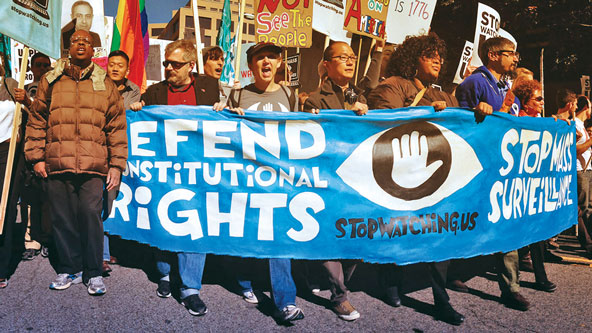 EFF has worked with more than 100 public advocacy organizations in the Stop Watching Us campaign to protest government surveillance. (Photo courtesy of EFF)
This was no easy task. For years, John Gilmore had directed his annual donations to cover budget shortfalls. In addition to raising money, Steele needed creative perks to keep her staff onboard, especially in San Francisco, where high-paying private-sector positions for tech-smart lawyers abound. Some of the benefits Steele “made up” included providing staff with assistance for rent and student loans. Her pivotal contribution was realizing that she could approach fundraising like activism. EFF members are passionate about digital rights. Steele tried a number of different tactics to diversify the organization’s revenue. Selling T-shirts, stickers, and swag worked on a small level. Finding ways to convince foundations to support EFF was a different challenge. For several years in the early 2000s, Steele’s goal was “asking Gilmore as late in the year as possible” to make his annual donation.
In 2003, Steele finally cracked the world of foundation philanthropy. That year, the MacArthur Foundation awarded EFF a three-year, $600,000 grant to represent the public interest in digital rights management and IP. “They had to tell me to issue a press release,” she remembers. “The MacArthur grant was key. They really helped us figure out how to leverage their money.” Ironically, a decade after its attempt to make policy almost wiped out EFF, it was back at the table with rulemakers. This time, EFF stuck to the role of mobilizer, advocate, and educator—roles Steele and her team knew well. MacArthur’s funding also marked an important point in the history of digital civil society, as it recognized the importance to civil society of IP law.
This work requires bringing together two different legal fields: constitutional law and IP expertise. EFF’s work to establish this legal frontier was informed by and allowed it to attract experts such as professor Pamela Samuelson from the University of California, Berkeley. Samuelson, a MacArthur Fellowship winner who holds a joint appointment in the School of Information and the School of Law, joined the board of EFF in 2000 and continues as board vice chair today. This connection not only benefits EFF’s legal work but also facilitates professional training relationships that have been crucial to the organization and the broader field of technology law.
Under Steele’s leadership and with Samuelson on the board, EFF won several important IP legal victories. These included cases that protected the right to file sharing and podcasting technologies, as well as individuals’ right to the fair use of digital content. One of the most well-known such cases involved a viral video in which a mom recorded her toddler dancing to Prince’s “Let’s Go Crazy.” The video was an immediate hit, and the mom was slapped with a lawsuit from the copyright-holding company, Universal. EFF argued it was a case of fair use by the mom. Had the case been decided the other way, the Internet of the past two decades would have been less of a space for personal creativity and more like just another screen on which to watch material from big recording, television, and movie corporations.
In most instances, IP cases pit one company against another, like Viacom versus YouTube. In the late 1990s, tech companies were still viewed as underdogs, fighting copyright-holding (and hoarding) behemoths for the right to share. In IP cases, EFF falls on the side of sharing, a position that hasn’t shifted, although its tech allies are now giants. This split between industries applies to copyright cases, but industries don’t divide so neatly on EFF’s other issues. In particular, regarding questions of personal privacy and surveillance, the role of technology companies has grown only more complicated since the days of TRUSTe. While EFF was born to litigate against government violations of privacy, the organization now has to address corporate surveillance and negotiate its relationships with the tech industry.
More Than a Law Firm
Impact litigation remains at the heart of EFF’s work. Twenty years after the groundbreaking Bernstein case, Cindy Cohn and Lee Tien are still at EFF. Cohn is now executive director, and Tien is lead counsel and holder of the Adams Chair for Internet Rights. Their First Amendment victories directly affect the nonprofit sector and associational rights, as in cases such as First Unitarian Church of Los Angeles v. NSA. In this 2013 case, EFF successfully argued that the NSA’s mass collection of telephone records was unconstitutional because it gave the government detailed and complete communications records on nonprofits’ members.
In addition to litigation, EFF builds technology and supports activism. Its board has always included crack technologists who could both explain and predict future concerns about digital systems. Back in the 1990s, EFF assembled a team of experts to prove that the government’s standards for encryption were too lenient. In a matter of weeks, the team broke the proposed standard, proving it useless and short-circuiting the government’s arguments. Steele decided that EFF should bring similar technological expertise on staff.
EFF started out building technology for itself and then expanded to serving others. Like every organization, EFF runs on software, relying on a stack of programs for payroll, outreach, communications, and program management. Having coders on staff allowed EFF to use what Steele remembers as “even pretty kludgy” open-source software.
Steele realized that EFF could use this expertise to benefit others: “Our coders could work on the open-source systems, such as CiviCRM, and then put the code out into the world so other nonprofits could benefit from these tools.” It soon became apparent that these coders could do more than simply maintain others’ open-source code—they could build things that would help people use the kinds of technology that EFF lawyers were fighting for. Not only did this work contribute to EFF’s mission, but it gave the organization another way to connect with people who might become donors. Tired of being tracked around the Web? Install Privacy Badger, an EFF-built software plug-in that stops websites from following you. Think all website transactions should be encrypted by default? So did EFF. In addition to fighting the issues in court, EFF worked with the Tor Project to build and promote HTTPS Everywhere, a free and open-source browser extension that encrypts the data you generate whenever you use the Web.
Activism is the third leg of EFF’s strategic tripod, as it has been since the group’s founding. As early as June 1991, in just the sixth edition of the EFFector newsletter, the group was urging its readers to contact their US senators about a proposed ban on encryption. The newsletter spelled out whom to call, how to reach them, and what to say. By 1993, “What You Can Do” had become a regular column in the EFFector. It included legislative updates, information on how to reach elected officials, and how to join (or start) public protests.
EFF’s activism has moved beyond newsletter calls to action. EFF helped coordinate the widespread Internet blackout of 2012. On January 18, some of the biggest Internet properties (e.g., Google, Reddit, Wikipedia, Mozilla) and as many as 100,000 smaller websites went dark to oppose legislation (the Stop Online Piracy Act and Protect IP Act, or SOPA and PIPA) that would have censored content from around the world. Working with Fight for the Future, a digital rights organization founded in 2011, EFF’s technologists did the underlying analysis to explain the software code that the bills proposed. The activism team helped organize street protests to extend the online blackout. EFF forwarded more than one million messages to Congress on that January day, and that outpouring helped stop SOPA and PIPA.
EFF’s activism extends to helping people better understand how tech companies also challenge people’s rights to privacy. Since 2011, it’s published an annual ranking of tech companies called “Who’s Got Your Back Online.” EFF staff rank platform providers, app stores, and telecom companies on how well they protect personal data from government requests and communicate to users about these issues. Other nonprofits have launched ranking systems for tech and human rights (e.g., New America’s annual Ranking Digital Rights Corporate Accountability Index), and Mozilla now produces an annual “creepy tech” holiday gift guide. In turn, pro-democracy organizations Freedom House and Civicus have begun incorporating measures of digital practices (by both governments and companies) into their research on democracy indicators.
 NSA whistleblower Edward Snowden gives an interview in December 2013
after gaining asylum in Russia. A red EFF sticker is affixed to his laptop. (Photo by Barton Gellman/Getty Images)
NSA whistleblower Edward Snowden gives an interview in December 2013
after gaining asylum in Russia. A red EFF sticker is affixed to his laptop. (Photo by Barton Gellman/Getty Images)
EFF has contributed to the field of digital rights in several ways. First, by framing the core intersections of expression, association, privacy, and personal ownership (IP), EFF has effectively demarcated the bounds of digital civil society. Second, EFF has incubated new organizations. Two examples are the Verified Voting Foundation and the Freedom of the Press Foundation (FPF). Two computer science pioneers, David Dill and Barbara Simons, launched Verified Voting in 2003 to apply computer science expertise to public purchasing of secure voting technologies. In 2012, EFF counseled journalist Glenn Greenwald and whistleblowers Ed Snowden and Daniel Ellsberg to launch FPF, which sought to circumvent “payment censorship” by payment processors such as Visa, PayPal, and Amazon after they cut off service to WikiLeaks.
EFF’s influence extends to academia as well. Once rather rare, privacy and technology clinics have become mainstay offerings at American law schools. The Samuelson Law, Technology & Public Policy Clinics at UC Berkeley, the University of Colorado, Fordham University, and American University, named for Pamela Samuelson, are lynchpins of these efforts. Scratch the surface of many graduate training clinics on law and privacy, as well as many of today’s digital rights nonprofits, and you’re more likely than not to find personnel connections to EFF.
Surveillance Conflicts
Since its founding, EFF has focused on government agencies as a major threat to personal liberties. The attacks of September 11, 2001, followed quickly by passage of the USA PATRIOT Act, sparked a new national conversation about surveillance and data collection, and EFF became a leader in the fight to protect individual freedoms online. A dozen years later, the first photos released of Ed Snowden after his 2013 revelation of NSA surveillance showed his laptop proudly bearing an EFF sticker. Cindy Cohn remembers sitting with Shari Steele as the story broke and having “a near heart attack” when they saw the photo. Snowden’s revelations were partially informed by EFF’s six years of litigation efforts against NSA surveillance.
But contemporary critics of EFF now fault this focus, pointing to corporate surveillance as an equal threat. In early 2018, news broke that British political consulting firm Cambridge Analytica had harvested a massive amount of Facebook personal data without user consent and used it for political purposes. Critics wondered about “The Watchdogs That Didn’t Bark”—the catchy headline for a Slate essay by April Glaser, who had once worked at EFF. Glaser blamed the organization’s slow response to Facebook’s practices on EFF’s need for Silicon Valley financial support. A few months later, another critic, Yasha Levine, went further. In a piece for The Baffler magazine, he reminded people that EFF had not only supported Apple in refusing the FBI’s demands that the company crack the iPhone software in 2016 but also urged people to hold “pro-Apple” rallies. This wasn’t just a case of financial ties—Levine called EFF “a corporate front.”
Levine targeted EFF, but his point redounds to a tough challenge for all of digital civil society. Two forces threaten individual liberties: corporate practices and government policies. The notion of corporate capture typically focuses on financial ties, but tech companies have other, more insidious means of exerting influence on nonprofits—the pervasive reach of their products.
EFF does take corporate donations: Companies contributed just less than 5 percent of its $17 million budget in 2017. By contrast, other civil liberties groups have taken a stand to avoid the perception of funding conflicts. For example, the ACLU doesn’t take government funds. Consumer Reports, which reviews products, enforces a strict conflict-of-interest policy on board and staff and screens donations from corporate manufacturers to ensure mission alignment. For EFF, the range of issues it works on can make for strange bedfellows. Some companies are allies on one and foes on another.
The history of institutional philanthropy is filled with questions about the ethics of accepting “dirty money” to support good work. Are corporate donations more suspect than contributions by individuals whose wealth comes from their corporate ties? These conflicts with tech-funded philanthropy will only increase as software continues to expand its reach into all areas of work.
After two decades, the triangle of characters shaping digital civil society—corporations, governments, and nonprofits—is now set, even if some players keep shifting roles. By the time Steele retired in 2015, public opinion of companies like Facebook, Twitter, and Google as protectors of individual liberties was on the wane. Communities that both industry and government have long marginalized were among the first to point out tech companies’ failings. Black Lives Matter protestors made it known that Twitter, Facebook, and the broadcast news were covering the unrest in Ferguson, Missouri, over the police shooting of Michael Brown from very different angles—some focused on the protestors, some on the police, and others ignored the news altogether. Scholars began releasing studies showing how the companies moderated content even while claiming platform neutrality. The words “algorithm,” “discrimination,” and “manipulation” found their way as a group into common parlance and were met by regular public apologies from Facebook CEO Mark Zuckerberg.
Barlow’s original “rights” framing highlighted mutual interests among civil libertarians, human rights advocates, journalists, librarians, civil rights activists, and independent publishers and secured their support for EFF’s goals. But while digital rights and civil rights align easily in the abstract, bringing together people who work on these issues has required confronting multiple structural divides. Struggles for racial and economic equity call for more government action, not less. These struggles emphasize collective justice more than individual liberty. In contrast, most digital rights organizations are led by white, financially secure individuals with political power. Alliances across these communities are an ever-shifting work in progress.
Digitally Captured World
The digital agenda that EFF laid out in 1991 is striking in its consistency. The work divides along the lines of privacy, free speech, security, and creativity. What have changed dramatically since EFF was founded are the number and diversity of civil society organizations working on the same or allied issues. Some of these, like Consumer Reports or Public Knowledge, a nonprofit dedicated to affordable Internet access, overlap with EFF on specific issues, such as access to broadband. Other organizations have integrated digital rights into their work, most visibly in organizations such as the Center for Media Justice and ColorOfChange, that work at the intersection of civil rights and social justice—areas where surveillance risks, lack of privacy, and exposure can be life-threatening.
Perhaps more surprising than the alliances that have been built are the ones that don’t yet exist. All nonprofits and foundations depend on commercial software and hardware to do their work. Ensuring that their digital tools advance, rather than compromise, those missions seems logical. Yet few of these organizations have implemented digital governance practices that go beyond basic legal compliance, for several reasons. First, software and hardware that cost nothing financially are very attractive to organizations with no money. Second, technology companies have been relentless in promoting themselves as forces for good—giving away their products, underwriting conferences and professional associations, occasionally even loaning out their engineers as a type of philanthropy. Third, public and philanthropic funders require nonprofits to collect ever more data, often demanding that these organizations collect and report increasingly detailed (and identifiable) information on the people they serve. Rarely does financial support for responsible data management accompany these requirements. Finally, some platforms explicitly target nonprofits by integrating payment processing and donation functionality into messaging applications and group software. The short-term appeal of these offerings (free!) is simply too enticing for nonprofits better schooled in keeping costs down than in keeping data safe. All of these practices contribute to our current condition, in which even financially independent nonprofits are effectively “digitally captured.”
Everyone with a cell phone camera and every organization with a networked printer has a stake in issues of copyright, communications privacy, and digital surveillance. The right to control how and with whom we meet and speak, who watches and tracks what we do, and how we can use digital technologies in ways that advance our social objectives should be core concerns of every mission-driven organization. But after decades of work and in a time of intense concern about democracy in a digital age, the nonprofit sector continues to see these policy issues as niche. This disinterest speaks not only to the limits of the digital rights movement but also to the countervailing success of digital industry marketing, the tyranny of convenience, and what is now called surveillance capitalism. The good news for those just starting to think about aligning their technology with their mission is that plenty of expertise is available. In the very midst of civil society sit a number of nonprofits like EFF that have been fighting for decades for ways to use digital tools safely and ethically.
In 2020, the Electronic Frontier Foundation will celebrate its 30th birthday, the age at which hippies proverbially stop trusting anyone. For an organization that a Grateful Dead lyricist cofounded, such an accomplishment is a bit of poetic justice. But EFF deserves credit for far more than longevity. Its legal victories shape how we experience today’s Internet. In protecting free speech, association, personal ownership, and privacy, EFF patrols the boundaries of digital civil society. That its founders saw the need for this work in 1990 was prescient. That civil society and democracy today depend on these freedoms is incontestable.
Read more stories by Lucy Bernholz.