


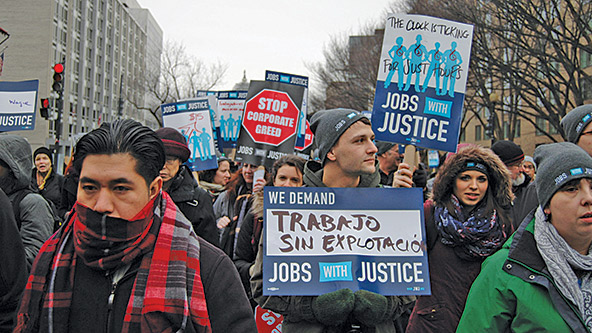
 Retail and restaurant workers participate in a 2016 Jobs With Justice march in Washington, DC. (Photo courtesy of Jobs With Justice)
Working Americans have less bargaining power today than they did in the 20th century. Between 1953 and 2012, collective bargaining in the private sector dropped from 25.7 percent to 6.6 percent. Today, the United States ranks 20th for collective-bargaining coverage and union density among 21 Organisation for Economic Co-operation and Development (OECD) countries.
Since 1987, Jobs With Justice (JWJ) has negotiated for political and economic advances for US workers, from wage increases to contract changes. Operating through its national network of local coalitions, the union rights organization wields collective bargaining as its primary tool for providing disenfranchised groups with a national platform.
“Collective bargaining really is the key force to combat inequality,” says JWJ Executive Director Erica Smiley. “It gives [workers] a channel to collectively renegotiate their wages, their rents, their fees—you name it.”
JWJ also uses collective bargaining to combat racial injustice. “There are some pretty explicit racial or racialized exclusions that still exist, not just for migrant workers, but for Black workers in the United States,” Smiley says. “We talk about collective bargaining and contract negotiations as a site of struggle, because a lot of what we’re trying to do is to win gains that aren’t just about ‘pay us more’ but are also to make sure that there’s a prayer space for Muslim employees at the worksite, or to make sure that there’s language accessibility for people where English isn’t their first language.”
In addition, JWJ serves as a community resource, even for workers who are not union members. For example, when Rima Lawson, a journeyman carpenter in Denver, Colorado, lost her job due to layoffs, JWJ provided professional support even though she wasn’t part of a union. Through their Equity and Possibilities in Construction (EPIC) program, Lawson says, she was able to “meet other women from different trades,” who, because of this connection, realized they “shared the same issues on the job” and were able to “talk about those issues.” For workers like Lawson, JWJ provides an invaluable safety net and support community. “I think it’s very important that there’s somebody there to represent you and others as a group, rather than trying to represent yourself,” Lawson observes.
JWJ’s role as both an activist organization and a support community for workers has remained effective despite union coverage continuing to dwindle. A significant reason for the organization’s longevity has been its use of collaboration as a tactic to move workers’ issues onto the national stage.
'Not Just Jobs'
JWJ “came out of pain in 1986,” says Larry Cohen, JWJ founder and former president of the Communications Workers of America (CWA). That year, a group of customer service representatives at the telecommunications provider MCI Communications, who were based at a call center in Southfield, Michigan, joined the CWA to protest unreachable sales quotas and revolving-door employment.
MCI retaliated by shutting down the call center. Seeking legal recourse, Cohen and US Representative John Conyers met with the US House of Representatives Education and Labor Committee Chair Gus Hawkins. But Hawkins, Cohen recalls, dismissed their concern, saying that he was only interested in “unemployment in his district.” Cohen’s response to this rejection—“We don’t just need jobs, we need jobs with justice”—inspired the organization’s name.
As attacks on bargaining rights increased across the United States, the CWA and other unions formed what became JWJ.
“The premise of Jobs With Justice is three things, and the pledge card being [its] hallmark: the right to organize—meaning mostly the right of workers to organize into a union—secure jobs, and a decent standard of living,” Cohen says.
At the first official JWJ event in Miami, in July 1987, more than 11,000 people gathered and recited the “Jobs With Justice Pledge.” The vow commits members to participate at least five times a year to support other organizers.
In its early years, both unions and individuals funded JWJ. “Until probably 10 years ago, it was all C4 [non-tax-deductible donations], as we call it; it was all union direct donations, treasury money,” Cohen says, adding that “the large unions that were the base of the coalition often gave $100,000 a year.”
Beginning in 2013, however, social justice foundations began to play a larger role in JWJ’s overall funding. This foundation support offset the decline of both union power and contributions. Between 2013 and 2016, JWJ received nearly $10 million from foundations—nearly twice the amount that it received from unions, according to the US Chamber of Commerce.
Currently, JWJ’s funding comes from foundations, unions, individuals, and other organizations. The Surdna Foundation, a charitable organization that advocates for social justice reform across the United States, has given JWJ more than $1 million in grants since 2013. The ongoing funding relationship is largely due to JWJ’s extensive network. “We continue to support JWJ because of their unique ability to work across various stakeholders in the labor movement, [including] unions, worker centers, policy groups, [and] academia,” says Mekaelia Davis, program director of inclusive economies at Surdna.
“JWJ maintains an ability to nimbly connect with and support workers on the ground, while simultaneously building and participating in multipartner coalitions that are addressing big, hairy, complex issues,” Davis says. This ability has become increasingly important, Davis adds, because “the nature of worker organizing has transformed over the last few years as employers and large corporations have shifted employment structures, [such as] higher rates of contracted employees [and] increased use of technology.”
The Ford Foundation has also been a major funder of JWJ because they value it as a “network hub” that “clearly understands the importance of power dynamics and how that’s impacting workers,” says José García, a program officer on the Ford Foundation’s Future of Work(ers) team.
One of the core motivations for the Ford Foundation’s support—more than $4 million since 2013—is JWJ’s strategic approach to implementing cultural and political change. “They understand the issue of power as a toolbox,” García explains. “Clearly, we have to organize, but we also have to know about policy and research, and we have to think about cultural narrative change.”
Surviving an Anti-Union Climate
One of JWJ’s consistent challenges has been maintaining effective campaigns against the growing tide of anti-union sentiment.
“In the United States, there’s been a multidecade approach to undermine democracy both in the workplace by eroding union rights, but also in other arenas like in the questions of student fee[s],” Smiley says. “Those same people have tried to roll back ballot initiatives” and to restrict “the ability of the majority to vote on an issue.”
With the tide against the unions, large companies have little incentive to come to the bargaining table. “The prevailing school of thought among large companies and international corporations in this moment is very much that unions are a problem,” Smiley observes.
To counterbalance the decline of union power, JWJ has scaled by building stronger partnerships, and by reframing workers’ rights through the lens of social justice.
One such partner is United for Respect, a nonprofit organization that advocates for retail workers. “JWJ has been a key partner for us in building a vibrant bottom-up labor movement,” says Andrea Dehlendorf, codirector of United for Respect. JWJ has done this by assisting United for Respect with “mobilizing community support for Walmart associates, who were organizing from within to transform working conditions of the country’s largest retailer,” Dehlendorf explains.
The partnership has continued for multiple years, not just with Walmart workers but with other causes as well. Recently, JWJ and United for Respect have focused on addressing poor working conditions at multinational companies like Amazon. The two have worked together to launch Athena, a coalition of local and national organizations that seeks to organize workers to protest Amazon gaming the political system for tax breaks, providing unsafe working conditions, and mining personal data for profit.
JWJ also has pivoted toward supporting migrant workers. They “have no real recourse for when wages are stolen from them and are often in abusive situations, both physically and mentally, where they have no recourse against those employers,” Smiley says. And any recourse they do attempt could lead to a threat of deportation.
JWJ’s answer to the plight of migrant workers and racial minorities has been to fight against such divide-and-conquer tactics with collective bargaining. This means encouraging workers to treat “contract negotiations as a site of struggle,” Smiley says. JWJ provides strategic guidance on how to organize and promote local campaigns on social media, as well as providing workers with access to extensive national coalition contacts so they have the groundswell support to demand a place at the negotiating table with their employers.
In the COVID-19 world, JWJ’s efforts have focused on supporting workers affected by the virus. As of May 2020, the organization has raised more than $200,000 for its worker solidarity fund, which provides direct cash relief to those unable to work due to the pandemic. It also has organized a rent strike to pressure landlords to forgive unpaid rent. As the United States slowly reopens its economy, collective bargaining will be high on the agenda as workers have to negotiate where social distancing starts and stops.
Pragmatically speaking, JWJ’s work will be concluded only when injustice has been eradicated—which means the struggle will continue indefinitely, as rights can be taken away as quickly as they are won. But Smiley maintains a level of optimism, because, as she says, “everything is negotiable.”
Read more stories by Tim Keary.