


 At the Consumer Electronics Show in Las Vegas, a group of Girl Scouts demonstrates the Digital Cookie program, along with other technology-based GSUSA initiatives. (Photograph courtesy of Girl Scouts of the USA)
Mallika Jain, a 15-year-old girl who lives in San Jose, Calif., is on her way to raising $25,000 to pay for bathroom facilities, water purification systems, a computer lab, sports grounds, and libraries for two schools in poor communities in India. This effort to develop and display her fundraising prowess is part of a project for her Girl Scout troop. Jain, who has been an active Girl Scout since the age of 5, talks passionately about the way that scouting has helped her become a confident social change leader. “One of the main things I’ve gained from Girl Scouts is the ability to look beyond myself, my friends, my family, and my community—to think about the global perspective and to look at a problem and say, ‘I’m going to make a difference,’” she says. “And I get so much out of this project, knowing that I was able to raise the money myself.”
Being a Girl Scout has long been about more than camping under the stars and selling cookies door-to-door. But Jain’s story demonstrates just how much the Girl Scout movement has changed in recent years. Founded in the early 20th century, the movement has reinvented itself for an era of girls’ empowerment. Its purpose is to prepare members to become not just capable women but also effective leaders.
Girl Scouts of the USA (GSUSA), a national network that serves as an umbrella group for regional and local Girl Scout organizations—including troops like the one to which Jain belongs—has been at the forefront of this development. Yet adapting to this new era has not been easy or automatic. As a membership association with more than a century of tradition behind it, GSUSA faces a challenge that is common to other organizations of its kind: How can it remain relevant in a changing world while remaining true to its heritage? How can it be responsive to a changing population while meeting the needs and expectations of its current members?
In 2004, GSUSA embarked on a project of transformation, and for more than a decade its leaders have sought to revamp its strategy and its operations on multiple fronts. Kathy Cloninger, who was CEO from 2003 to 2011, recalls the circumstances that led her and other GSUSA leaders to undertake that transformation: “In terms of having a clear focus, we were not unified. And that was translating into the beginning of a membership decline.”
Today the GSUSA network encompasses 2.7 million members across the United States—a number that includes 1.9 million girls, along with 800,000 adult volunteers who act as troop leaders or who otherwise help run scouting activities. But back in 2004, GSUSA had 3.8 million members. That year, after increasing in each of the preceding three years, total membership in the network fell by almost 77,000, and that shift became a trend that persisted in later years.
To stem its membership decline and to achieve what Cloninger calls “a clear focus,” GSUSA has moved to revamp everything from how it uses technology to how it manages people to how it designs programs. It has pushed, for example, to offer more activities that engage girls in STEM (science, technology, engineering, and math) topics. Equally important, GSUSA leaders have taken bold steps to alter the federated structure of their network.
With change comes controversy. Between 2004 and 2010, GSUSA undertook an ambitious consolidation effort that effectively eliminated nearly two-thirds of the network’s regional councils. Although that effort was generally successful, it generated hard feelings and vocal opposition. “It was a process of merging, in some cases, five councils—with five different cultures, five different leaders, and five different boards—into one,” says Nhadine Leung, chief governance officer of GSUSA. “It was a very difficult [process].” One group of Girl Scout members even set up a Facebook page titled “GSUSA, Are You Listening?” The page attracted passionate comments on a wide range of programmatic and structural changes that GSUSA had initiated. High on members’ list of grievances was the closure of selected Girl Scout campsites. (That move was partly a by-product of consolidation.) In a survey conducted by the group in 2013, more than half of respondents said that campsite closures should stop or that GSUSA should help councils find other ways to handle the campsite issue.
GSUSA leaders are doing their best to show that they are listening, even as they continue the work of updating their organization both internally and externally. Their goal is to build a network that will be robust enough to support a second century of fostering girls’ personal and educational development. Anna Maria Chávez, who became CEO in 2011, sees this work as part of a natural evolution. “It’s about understanding that we are in different times,” she says. “If Juliette Gordon Low, our founder, were here now, she’d say that change is necessary, because the girls of today are different from the girls of 20 or 30 years ago.”
A Movement of Leaders
The Girl Scout movement has come a long way since 1912, when Juliette Gordon Low founded it. At that time, women in the United States (and in many other countries) lacked the right to vote. But Low had a lofty vision for what girls could accomplish. “Girl Scouting and Girl Guiding can be the magic thread which links the youth of the world together,” she said. The movement began when Low gathered 18 girls in her hometown of Savannah, Ga., and invited them to join a new outdoor and educational program for young people. Since then, Girl Scouts organizations have taken root in more than 90 countries.
Millions of alumnae now form the “magic thread” that Low envisioned. Among those alumnae are 15 of the 20 women in the US Senate and more than half the 88 women in the US House of Representatives. Other former Girl Scouts include the singers Taylor Swift and Mariah Carey, the tennis players Venus and Serena Williams, and media personalities such as Katie Couric and Barbara Walters.
GSUSA leaders note that being a Girl Scout has a measurably positive impact on members later in life. “We know that girls who are Girl Scouts make more money, get more education, vote more often, and are more likely to be leaders,” says Leung. In one poll of US women, more than four out of five successful professional women who had been Girl Scouts said that their involvement in the movement had contributed to their success.1 In a 2012 study, meanwhile, the Girl Scout Research Institute compared the life outcomes of Girl Scouts alumnae with non-alumnae. The results were notable: 63 percent of alumnae described themselves as “competent and capable,” compared with 55 percent of non-alumnae, and 41 percent of alumnae said that they had engaged in volunteer activities, compared with 34 percent of non-alumnae. In addition, alumnae reported having an average before-tax household income of $51,700, whereas the comparable income figure for non-alumnae was $42,200.2
At the core of the Girl Scout experience are activities that aim to promote members’ overall development—from field trips to cultural exchanges, from environmental stewardship programs to digital technology projects. In addition, members participate in the celebrated Girl Scout Cookie Program. Each year during cookie season, they sell about 200 million boxes of Samoas, Thin Mints, and other varieties, and total sales come to nearly $800 million. But the cookie program does more than raise revenue to support scouting activities. It also promotes leadership development by requiring girls to set their own sales goals and to create a business strategy to reach those goals.
A Federated Structure
What allowed the Girl Scout movement in the United States to grow during the 20th century was its federated structure. There is a national GSUSA organization, based in New York City, and it employs about 300 people. That entity oversees the national Girl Scout brand and provides some program support to local groups. But regional Girl Scout councils, which are separate legal entities, take responsibility for frontline administration and program implementation within its geographic areas.
The federated model has certain advantages. It gives affiliated organizations the freedom to adjust their operations to meet local needs, and it retains the benefits that come with having a recognizable national brand. “Federations, at their best, share their experience on what does and doesn’t work with their affiliates and replicate successful programs across the country,” wrote Maisie O’Flanagan and Lynn K. Tariento in a 2004 article on federated nonprofit organizations. But in some cases, O’Flanagan and Tariento note, federated structures can “suffer from uneven performance among local organizations, costly administrative duplication, and cumbersome national offices that deliver insufficient value.”3
In the case of GSUSA, those drawbacks were reinforced by another problem that commonly afflicts federated organizations. “There’s a good deal of autonomy in the local councils, and they can each go their own way unless they commit to rallying around the brand and the business model,” says Willie Pietersen, professor of the practice of management at Columbia Business School. Pietersen started working with GSUSA as a strategic advisor in 2004.
By then, in fact, the federated structure that had helped GSUSA build a nationwide movement was coming under an increasing amount of pressure. GSUSA leaders felt this pressure most acutely at the level of strategy and vision. “The biggest challenge was one of focus and clarity about purpose,” Cloninger recalls. “No one was able—in a unified voice—to say what Girl Scouting does for girls, what our purpose is, and what the mission is.”
GSUSA leaders were not alone in exploring questions of purpose and mission. In a recent report, consultants from the Bridgespan Group observe that several large network-based organizations with long histories—such as the Y-USA, 4-H, the Salvation Army, and Save the Children—have begun to recognize the need for institutional change. Over the past decade, these organizations have sought ways to adapt the goals set by their founders to the realities of the 21st century.4 “We were starting to hear from some [leaders] questions about what success for their networks actually meant,” says Kelly Campbell, a co-author of the report.
For GSUSA, the challenge of defining success overlapped with another challenge: the fragmented and highly diverse nature of its network. Councils varied considerably in their scale and in the types of markets that they served. Some councils served only white girls in rural areas, whereas others served black girls in urban areas. Some councils operated with multimillion-dollar budgets, whereas others had budgets of less than $500,000. Smaller councils often lacked the resources to manage their operations efficiently and found it hard to raise money or to attract talented executives. Larger councils, meanwhile, often suffered from redundant capacity or an excess of bureaucracy. “The size and number of councils had been talked about in the hallways and around the water cooler for decades, but no one wanted to deal with [that issue] because it was too complicated,” says Cloninger.
Fragmentation led to a wide range of problems: programming inconsistencies, operational inefficiency, competition for resources, and a general lack of cross-network coordination. Of particular concern to Cloninger and her colleagues was their inability to present the Girl Scout movement to the public in a coherent way. “We had five councils sharing the media market in the Chicago area,” Cloninger says. “So if they were trying to do a story and if they weren’t coordinated, the same newspapers and radio stations would hear from five independent nonprofits.” These problems prevented the movement from making the most of its strengths, including its vast alumni base. To continue serving the purpose that Low had established in 1912, therefore, GSUSA would need to initiate a fundamental redesign of its federated structure.
A Changing Environment
When Cloninger joined GSUSA, she quickly came to see that the organization needed to confront external as well as internal challenges. The social, cultural, and technological environment in which the Girl Scout movement recruited new members was shifting in profound ways. That shift had potentially big consequences for the programs and services that GSUSA provides to girls.
The demographic profile of the United States was changing rapidly and significantly. The nation’s foreign-born population, for example, quadrupled over the course of four decades, rising from 9.6 million in 1970 to 38.1 million in 2007. “The population was shifting in a wonderful way toward diversity,” says Cloninger. “But there were lots of families that had not been part of Girl Scouts. We needed to answer the question about purpose [in a way] that was relevant” to those families.
Whether the Girl Scout experience was relevant to girls in general was also a point of concern. “The brand had become uncool,” says Pietersen. “You can’t live by quality alone. You have to have a brand that’s appealing, particularly for young people.” And by the early 2000s, Pietersen adds, young people “had alternatives that were much cooler” than standard Girl Scout programming. Most notably, an increasing number of entertainment offerings—movies, television, video games, and so on—were drawing girls’ attention away from traditional scouting fare.
 Traditional activities such as archery (above) are still part of the Girl Scout experience. But other activities—such as testing a water robot (below)—now play a big role as well. (Photographs courtesy of Girl Scouts of the USA)
Even core Girl Scout activities such as camping were losing their appeal. “Traditionally, the camps were very spartan,” says Krista Kokjohn-Poehler, who served as chief girl experience officer at GSUSA from 2013 to 2015. Cleaning latrines “was part of the experience,” she notes. “And who wants to do that today? Girls today want a zip line and a climbing wall.” When it came to physical activity, girls now had access to a wide array of options. Starting in the 1970s, sports that had long been the preserve of men—including basketball and soccer—became open to participation by girls.
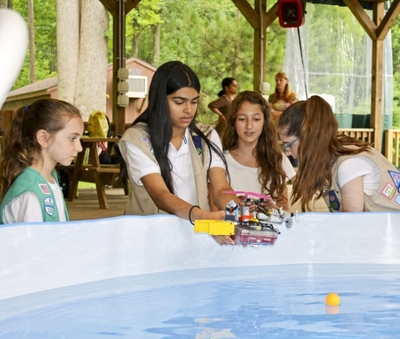
In addition, GSUSA faced the prospect that various forms and uses of digital technology—from mobile devices to social media—might become more compelling activities for young people than making crafts and selling cookies. Internet use was rising sharply. In 2003, for the first time, more than half of all US households reported that they had access to the Internet. By 2011, nearly 72 percent of households would fall into that category. And as access to digital technology increased, so did girls’ expectation that using such technology would be part of their educational and recreational experience. “The way of the future is technology,” says Jain. “Nowadays, we all have cellphones and we’re constantly on technology.”
A Strategy for Relevance
Adapting to changes in society was not a new experience for GSUSA. In the 1980s, for example, the organization had introduced a program designed for kindergarten-age girls. Previously, girls had needed to be in first grade to join the Girl Scout movement. But the largescale entry of women into the US labor force had resulted in a greater need for activities that would occupy young children while their parents were at work. GSUSA responded to that need by launching a program called Daisy Scouts. The influential management expert Peter Drucker cited that initiative as an example of how “a clearly defined mission will foster innovative ideas and help others understand why they need to be implemented—however much they fly in the face of tradition.”5
In the early 2000s, however, falling membership numbers raised new doubts about the relevance of the Girl Scout movement. So GSUSA embarked on a period of self-reflection that involved assessing the organization’s role in providing leadership development for girls. “We had always been a leadership organization but had never stepped into owning who we were,” says Cloninger. As part of this effort, GSUSA leaders enlisted Pietersen to provide guidance. “We liked his model of reinventing strategy,” Cloninger explains. “It was focused on bigger, bolder infrastructure change—on the transformation that needed to happen, versus just saying, ‘We need more members.’”
Cloninger and her colleagues created a strategy group that consisted of 26 executives from the GSUSA network and charged the group with exploring how the organization could ensure that scouting remained a compelling experience for girls. “There wasn’t a girl leadership model that existed in the US, and we couldn’t find any models worldwide, so deciding what we mean by ‘girl-centered leadership’ was critical,” says Cloninger.
The strategy group developed a framework called the Girl Scout Leadership Experience (GSLE) and identified 15 outcomes that contribute to that experience. Those outcomes include “develop[ing] healthy relationships,” “seek[ing] challenges in the world,” being “resourceful problem solvers,” and being able to “identify community needs.” In addition, the group organized the 15 outcomes around a set of three “leadership keys”: Discover, Connect, and Take Action. The GSLE framework gave GSUSA volunteers and staff members, along with outside experts, a system for evaluating the impact of Girl Scouts programming on girls’ development. Members of the strategy group, says Pietersen, “consulted with sociologists and psychologists to understand the motives of girls at different ages and designed a leadership development system that was fit for girls at every stage.”
A crucial next step was to develop a mission statement for GSUSA that would highlight the core themes of the GSLE framework. Previous versions of the organization’s mission statement had focused on themes such as womanhood, citizenship, and patriotism. In 2004, after gathering input from all parts of the network, the strategy group adopted a new statement: “Girl Scouting builds girls of courage, confidence, and character, who make the world a better place.”
During this period, GSUSA leaders had to pursue multiple aspects of organizational transformation simultaneously. But according to Cloninger, the work of defining the organization’s mission and connecting that mission to the Girl Scout experience was pivotally important. “You can talk about yourself in all kinds of sexy ways,” she says. “But if you don’t have a program once girls come in the door, your brand is not authentic.”
A Plan for Consolidation
To help manage the transformation process, GSUSA leaders collaborated with Pietersen to create a set of six “gap teams.” The purpose of these teams, as their name suggests, was to close the gap between the Girl Scout movement of 2004 and the movement that its leaders now wanted to build. The teams drew members from all parts of the country and from the ranks of GSUSA volunteers, staff members, council CEOs, and board members. Each team focused on one of six topics: brand, culture, funding, organizational structure and governance, programming, and volunteerism.
The gap team that arguably had the most ambitious mandate was the one devoted to organizational structure and governance. GSUSA leaders had concluded that the biggest barrier to transforming their movement was the sprawling, fragmented nature of their organization. “When the strategy process kicked in, we realized [that our] corporate structure was behemoth,” says Cloninger. With that premise in mind, members of the governance team set out to examine options for overhauling GSUSA at a structural level.
Team members considered adopting a parent-subsidiary structure. They considered converting GSUSA into a single national entity that would have local chapters. They considered shifting to a shared services model. Ultimately, though, GSUSA leaders decided to maintain a federated structure. But at the same time, they decided to realign that structure by drastically reducing the number of councils and by changing the geographic boundaries between councils. They based that decision partly on research that showed a correlation between previous efforts to reduce the number of councils and increases in membership.
Expanding the geographic area covered by each council would offer another benefit: It would enable GSUSA to respond more effectively to demographic change. “We couldn’t make a region more diverse than it was,” says Cloninger. “But you naturally draw in more diversity when you’re not serving single counties.”
The process of restructuring the GSUSA network was complex. The first step was to design an “ideal council”—a template that GSUSA could use to guide decisions on the number, size, and location of councils. The organization hired a team of demographers to support that effort. (Leaders and members at the council level could submit restructuring suggestions as well.) Using data on factors such as population distribution and the size of local media markets, the demographers worked with GSUSA to establish a basic formula: The ideal council would cover an area with at least 100,000 girls; at that size, it could aim to draw in 8,000 to 10,000 members. It would also have an annual budget of about $2.5 million. “We needed to be able to hire top executive talent in the nonprofit sector,” Cloninger explains.
By March 2006, the demographers had completed work on redrawing council boundaries, and GSUSA leaders had developed a plan for merging councils. That month, Cloninger and her team gathered the CEOs and board chairs from every council—about 700 people in all—for a special meeting to discuss the merger plan. “We talked about how [our existing] structure was never going to allow us to be the best nonprofit we could be,” Cloninger says. She and other GSUSA leaders made their case for the plan and presented maps that showed the new configuration of councils. Then Cloninger waited nervously for the response from council leaders. “Slowly someone started to clap,” she wrote in her book Tough Cookies. “Then the room erupted in a standing ovation.”6
In response to comments by council executives, the GSUSA team made adjustments to the initial merger plan. But the merger process that began in 2006 largely followed the maps that Cloninger and her colleagues presented at that meeting. By 2010, GSUSA would reduce the number of regional Girl Scout councils from 315 to 112.
The merger process did not unfold without controversy. “It was a voluntary set of mergers—but that doesn’t mean there weren’t leaders who resisted,” says Leung. “When you have two-thirds fewer positions, it can be very disruptive.” Many executives lost their jobs as a result of council mergers. Battles erupted over whether to close and sell campsites. Members and leaders protested the loss of local autonomy. In the most extreme episode, the Girl Scouts of Manitou Council, located in Wisconsin, filed suit against GSUSA in 2008 to prevent changes to its jurisdiction. That council eventually won its case on appeal.
On the whole, Cloninger argues, there was relatively little resistance to the merger initiative. “Of course, there was trauma, and people asked, ‘How could you do this?’” she recalls. “But even though people realized how painful it was going to be, there was a common [understanding] that it was the right thing to do.”
Indeed, for some council leaders, the merger process was remarkably smooth. “It was a pretty seamless transition for us,” says Mary Vitek, CEO of the Girl Scouts of San Jacinto Council (GSSJC), which merged with a smaller council, the Girl Scouts of South Texas Council (GSSTC), in 2006. GSSJC kept its name and increased its coverage area from 21 counties to 26 counties. As it happens, GSSTC had no CEO at the time, so managing the transition at an executive level was especially seamless. In addition, Vitek notes, “there was some sharing already going on” between the two councils.
In working with councils everywhere, GSUSA tried to make the process as inclusive as possible. Each newly formed region created a working group to examine its merger plan in detail and to adjust the plan as necessary. In addition, leaders in each region could choose their own time frame for completing a merger, and they could handle difficult human resources issues in their own way as well. “We had a very high-touch approach to dealing with the impact on the human side,” says Cloninger. “That’s why we had only one lawsuit.”
A Focus on Customers
Once the merger process was complete, GSUSA faced a new set of challenges. Chief among them was the need to form a new kind of relationship between the regional councils and the central GSUSA office in New York City. Those councils, after all, had frontline responsibility for engaging with volunteers and delivering services to girls. They were, in effect, GSUSA’s primary “customers.”
In 2012, Chávez brought in Leung to lead an initiative called Customer Focus Forward. For this initiative, GSUSA undertook an internal assessment that revealed weaknesses in the way that the national office interacted with local affiliates. The national organization had a top-down approach that prevented ideas from originating at a grassroots level, and leaders at both levels recognized the value of shifting to a more collaborative approach. “The work that had to be done was [about] rethinking the role of the center,” says Amy Kates, managing partner at organization design firm Kates Kesler, who worked with GSUSA from 2012 to 2013. “We needed to have a way to develop and implement products, services, and initiatives in which everyone has a role.”
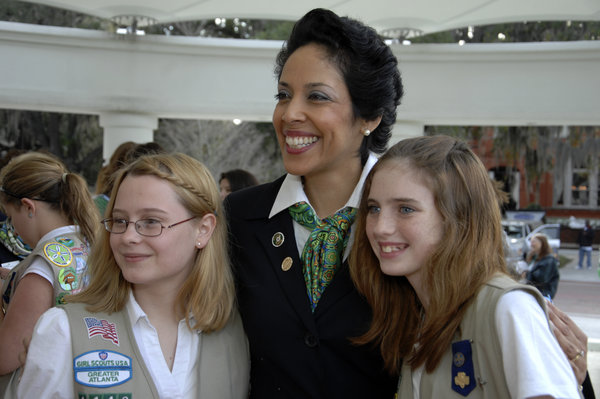 Two Girl Scouts join Anna Maria Chávez, CEO of GSUSA, at an event held in Savannah, Ga., to mark the Girl Scout Centennial in 2012. (Photograph courtesy of Girl Scouts of the USA)
As part of that assessment, GSUSA conducted a survey of people at the council level. The survey incorporated the net promoter score (NPS) method, a tool widely used in the business world to assess customer loyalty. An NPS survey asks respondents how likely they are to recommend a company, product, or service to a friend or colleague, and the final score can range from positive 100 to negative 100. For GSUSA, the score on its 2012 survey of internal customers was negative 47. “That was a real wake-up call,” says Leung. “It’s not that we hadn’t done amazing things and created incredible programs for girls. But at that moment, [the national organization] wasn’t meeting the needs of its partners.”
In a separate poll, GSUSA posed questions to council leaders about their relationship with the GSUSA central office. Asked where they turned when they faced a problem, 54 percent of leaders said that they turned to an outside party (rather than to the central office). “That was a clarion call to me that we needed to reconfigure our products and services to ensure that our 112 councils were getting the services they needed,” says Chávez.
Responding to that call has involved developing a new culture of collaboration between the national office and the councils, and it has led to changes in how GSUSA leaders make decisions. Working with Kates, GSUSA introduced a process that enables leaders to gather and consider ideas from all parts of its network. “Being customer-focused,” Leung explains, means “that rather than deciding what is ‘best’ in a maternal way, we identify what the challenges are and co-design the solutions.”
An Investment in Technology
In March 2013, GSUSA tested its new, more collaborative approach by gathering all council CEOs for a high-profile event in Phoenix. The purpose of the event was to identify the organization’s biggest challenges, to assess their root causes, and to decide how to tackle them. And the root cause of many challenges, according to the assembled leaders, was the lack of a unified technology platform across the GSUSA network. Each council had a fully autonomous website—an arrangement that undermined operational efficiency, branding, and other strategic goals. “We needed to do a lot of work when it came to catching up with technology,” says Leung.
For Chávez, upgrading GSUSA’s technology infrastructure has been an especially high priority. When she became CEO, the organization hosted more than ten IT platforms and supported more than 100 email systems. “We were spending close to $70 million on technology across [our network]—without a national IT or digital strategy,” she says. Her first executive appointment was a chief technology officer, and under her leadership GSUSA rolled out a national technology strategy and started building a shared Web platform.
The use of technology for external communication is another area where “catching up” was necessary. “It was a pretty haphazard approach when I got there,” says Lillian Ruiz, a social media strategist who joined GSUSA in 2009 as a marketing assistant. “The digital marketing team was in charge of maintaining websites, but that was about it.” Along with a colleague, Ruiz developed a social media strategy. She started responding to negative comments about GSUSA that appeared on social media channels, and she began posting positive content about the organization as well. The two-person team also created a best-practices guide for councils and trained council members on how to engage with people via social media. “We started to see positive turnaround,” says Ruiz (who is now director of audience development at Inside Hook, an online men’s lifestyle guide).
By 2012, GSUSA was able to use social media to promote various events associated with its 100th anniversary. Through Twitter and other channels, Ruiz and her colleagues shared images and video clips with people who could not attend those events. “At the time, it was pretty cutting edge,” Ruiz says.
Technology has enabled GSUSA to streamline its management of volunteers. Traditionally, procedures for signing up troop leaders and other volunteers differed from council to council, and it often took two months or more for a would-be volunteer to be placed with a troop. Much of that process involved time-consuming face-to-face meetings and training sessions. Because the process was so cumbersome, it had led to a shortage of volunteers. “We knew we were never going to serve more girls without more volunteers,” says Vitek. GSUSA, she adds, needed to create a “robust onboarding system” that would allow the organization to integrate volunteers at a faster pace.
Under Cloninger, GSUSA created Single Entry Registration, a Web-based program that makes it easier for volunteers to qualify for service. And in 2014 the organization began to invest in a movement-wide IT platform that includes a resource called the Volunteer Toolkit, which provides training materials and enables volunteers to plan troop activities online. In developing that platform, GSUSA also worked with the software company Salesforce to build an improved volunteer onboarding process. “Someone signs up and is automatically processed through background checks, and no one on staff has to get on the phone,” Leung explains.
A New Kind of Experience
Along with enabling GSUSA to achieve internal efficiencies and to spread its message externally, digital technology has underpinned its efforts to make the Girl Scout experience relevant in the 21st century. “Girls are digital natives,” says Chávez. “So we have to change a hundred-year-old program, keep what’s great and what we love about our legacy, but also update it to meet today’s girls’ needs.”
One important initiative in this respect was the introduction in 2014 of the Digital Cookie platform. Through the platform, girls can create their own Web pages, where they can conduct cookie sales and then track customer orders. During the 2015 cookie season, almost 90 percent of councils used the new platform. In 2015, GSUSA also launched Digital Cookie 2.0, an enhanced version of the platform that benefits from sponsorship by the computer company Dell and the credit card provider Visa. This version includes a wider range of interactive features, such as quizzes and games. GSUSA added those features not only to make the platform more compelling for girls but also to help girls learn skills such as planning, budgeting, and business ethics.
 During a media event in 2014, Girl Scouts show how the Digital Cookie platform helps them plan and manage cookie sales. (Photograph courtesy of Girl Scouts of the USA)
Technology, GSUSA leaders recognize, will need to become a central part of how girls, volunteers, and parents engage with the Girl Scout movement. Kokjohn-Poehler notes that competing forms of activity have fostered that expectation. “Say [that a girl is] in soccer. You’d expect as a parent to get your schedule, interact with coaches, and share pictures online,” she says. “Going into the digital space represents a big challenge[for GSUSA].”
GSUSA has also updated the Girl Scout experience in ways that go beyond the use of technology. The system of scouting badges, for example, has been a defining aspect of that experience for decades. (Girls earn a badge for completing a specific activity or achievement, and they can then sew the badge on their Girl Scout uniform.) In 2011, GSUSA introduced a new set of Journey awards that supplements the badge system. There are three journeys, and each of them promotes leadership within a broad area of activity. “It’s Your World, Change It!” encourages girls to pursue social change. “It’s Your Planet, Love It!” offers opportunities to practice environmental stewardship. And “It’s Your Story, Tell It!” lets girls engage in various forms of self-expression. In recent years, meanwhile, GSUSA added new badge options that reflect skills such as financial literacy and business acumen.
A Big Opportunity
Now, more than a decade after launching their transformation effort, GSUSA leaders have reason to believe that they have strengthened the GSUSA network. Its total membership continues to decline, but the rate of decline has started to slow. (Membership fell by about 5 percent in 2015, compared with a drop of roughly 6 percent in 2014.) What’s more, the retention rate for members has risen in recent years. At a systemic level, meanwhile, GSUSA has succeeded in realigning its federated structure, in modernizing its technology, and in revitalizing its programs. In doing so, the organization has laid groundwork for its next big challenge: diversifying its sources of revenue.
GSUSA derives its revenue primarily from cookie sales, membership dues, and philanthropic contributions. (Sales of Girl Scouts merchandise account for a small share of revenue as well.) In 2015, cookie sales brought in nearly $800 million, membership dues totaled $38.2 million, and donations generated $128.4 million. Revenue from cookie sales stays with regional councils and local troops, membership revenue goes to GSUSA, and philanthropic revenue is spread across the entire network.
This funding mix had long served the organization well, but GSUSA leaders are now eager to increase the amount of revenue that comes from philanthropic sources. “Girl Scouts is pretty unique in the nonprofit landscape because we have been largely self-funded. Membership and the cookie program—those have been our major sources of revenue,” says Leung. “But if we want to reach more girls more effectively, that’s not enough.”
GSUSA executives see an opportunity to position their organization as a leader in the field of women’s and girls’ empowerment. “Currently, of all the billons of philanthropic dollars given in the United States, only 7 percent goes to women’s and girl’s causes,” Chávez says. The GSUSA network, she argues, is an ideal vehicle for donors that want to boost their giving in that area: “We are the only organization that is with a girl every week, every month, for 12 years.” Chávez also cites the value of the Girl Scouts alumnae network, which includes about 59 million women.
“We have not leveraged the investment that corporations and other philanthropic donors could be making in this work,” says Leung. “That’s our biggest opportunity.” Over the past few years, GSUSA leaders have taken notable steps to pursue this opportunity. In 2012, for instance, they launched ToGetHerThere, a $1 billion campaign that the organization calls “the largest, boldest advocacy and fundraising cause dedicated to girls’ leadership in [US] history.” GSUSA pledged that 90 percent of the money raised for the campaign would go directly to programs that “help fill critical talent gaps in finance, science, technology, environmental, and global leadership arenas.”7
Previously, GSUSA lacked the technology infrastructure needed to support a large-scale fundraising campaign. But recent capacity-building efforts have improved the organization’s ability to tap into its large member and alumnae networks for this purpose. GSUSA leaders suggest another way in which the organization’s enhanced IT capabilities can bolster its fundraising efforts: The digital platforms that GSUSA is building will enable the organization to collect and analyze large amounts of data on its members’ activities and achievements. The organization can use those data to demonstrate to funders the social return on their investment in GSUSA initiatives. “In the future, we will be able to track girls over longer periods of time,” says Chávez. “Then we can show national donors the impact that our movement has on girls in local communities.”
In seeking philanthropic support for initiatives like ToGetHerThere, Leung notes, GSUSA will rely heavily on its leaders’ ability to achieve cohesion across their network. “The number-one barrier to our being able to raise money was the fact that we weren’t aligned,” she says. “Because if you can’t speak with one voice, you can’t tell your story.”
This article has been modified since its initial publication.
Read more stories by Sarah Murray.