


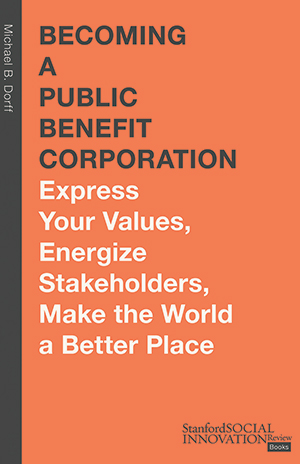
Becoming a Public Benefit Corporation: Express Your Values, Energize Stakeholders, Make the World a Better Place
Michael B. Dorff
272 pages, Stanford University Press, 2023
As a scholar in the social enterprise field, I should place my cards on the table: The benefit corporation is frustrating. Like the Roman deity Janus, it has two faces. The first face is encouraging, in that the benefit corporation—at least on paper—rejects shareholder wealth maximization. It enables market participants to focus more intentionally on the social consequences of corporate activity. The second face, however, is more sinister, in large part because the statutory architecture establishing benefit corporations suffers from accountability defects, including weak reporting requirements and government oversight. These flaws provide escape hatches that self-interested corporate insiders can exploit to purpose wash—make surface-level commitments to nonfinancial objectives but only as a marketing ploy—at the public’s expense.
My scholarship, a central theme of which is corporate accountability, emphasizes this second face. As such, it is fair to call me a benefit-corporation critic. Indeed, in Becoming a Benefit Corporation: Express Your Values, Energize Stakeholders, Make the World a Better Place, Southwestern Law School professor Michael B. Dorff rightly identifies me as one.
Before even cracking the book open, I was quite apprehensive. Over the years, I have read countless articles that elide discussion of the accountability defects and that try to paint the benefit corporation as an organizational form that can clean capitalism. These works read more like academic activism or propaganda than like objective scholarship. Would Dorff’s book be the same?
The answer, thankfully, is no.
While Dorff admits he is “inspired” by the social-entrepreneurship movement, he has no illusions about the benefit corporation. In Dorff’s words, the organizational form is a supportive “reinforcement tool” for those who genuinely care about creating social value; yet, at the same time, it is not an effective “enforcement tool” for “forcing companies that lack sincere goals to prioritize purpose.” Being honest with readers about the benefit corporation’s duality gives the book a credibility that distinguishes it from many previous studies.
Becoming a Public Benefit Corporation is a triumph. Although I remain a benefit corporation critic, Dorff’s book has made me less of one.
Dorff organizes the book in a way that deserves praise. In different states featuring a benefit corporation statute, the organizational form looks and operates a little differently. Instead of attempting to capture every jurisdictional variance—which may well have thwarted the book’s coherence—Dorff spotlights the two predominant organizational models: the nonprofit B Lab’s Model Act and Delaware’s benefit-corporation statute, a primary difference between which is how “public benefit” is legally defined. B Lab’s ambition was to lobby state legislatures to adopt the Model Act and in so doing harmonize social-enterprise law across the country. B Lab was largely successful, so it is sensible that Dorff cites the Model Act as representative of states’ benefit-corporation statutes to give a “good grounding in the core concepts.” Dorff’s reference to the Delaware statute is likewise prudent. One reason Dorff gives for the inclusion is that the Delaware statute is “different from the Model Act in some significant ways”—for example, with respect to how “public benefit” is legally defined. The differences in the Delaware statute matter for fully grasping the benefit corporation’s nature. Through this twin lens of the Model Act and the Delaware statute, the book lucidly explores the benefit corporation.
The promise of benefit corporations is that they must legally pursue some public benefit purpose alongside profit. Rather than owing obligations with a purely shareholder focus (as in the traditional corporation), corporate leaders in a benefit corporation are legally required to reconcile how purpose and profit are simultaneously pursued—what Dorff calls the “balancing duty.” When the balancing duty is taken seriously, benefit corporations have the capacity to “produce quality goods and services while taking care of” stakeholders like consumers and employees.
However, the pitfalls are manifold. As Dorff observes, there are “few restrictions” on how benefit corporations “define their public purposes.” Directors and officers also have “enormous discretion” under the balancing duty. That is, the law is silent on how corporate leaders should achieve an equilibrium between purpose and profit. With the discretion in the balancing duty, directors and officers might consider “all the costs and benefits” of how a decision affects nonfinancial objectives, “not just the impact of the decision on the company’s profitability.” But a vaguely articulated purposeful commitment coupled with broad discretion under the balancing duty ultimately makes it difficult for shareholders to gauge whether corporate leaders are behaving with integrity. With shareholders’ view obscured, self-interested directors and officers can then, Dorff argues, “pay themselves high salaries, enter into contracts between the corporation and friends and relatives, or simply slack off.”
The benefit report—a reporting requirement that Dorff characterizes as a “purpose enforcement mechanism”—is designed to lessen shareholders’ burden in measuring “how successful the company was in creating” public benefit. Dorff states, however, that directors and officers also have wide legal “latitude” to “shape their benefit reports.” A benefit report could be comprehensive, or it could amount to a “marketing brochure.” Self-interested corporate leaders need not worry about government oversight of their benefit reports. Dorff notes that most states do not “insist on a measure of quality for these reports,” and most do not issue penalties to benefit corporations that “neglect to produce them.”
Unable to rely on state support, shareholders’ recourse is to sue when directors’ and officers’ actions are suspect. Litigating, Dorff points out, can shape corporate leaders’ “behavior and push them to take social concerns” seriously. Notwithstanding, he cites several drawbacks to such “benefit enforcement proceedings.” For example, the legal standard governing most of directors’ and officers’ decisions is whether they are “informed, disinterested, and in good faith.” That legal standard is easily satisfiable where the purposeful commitment is ambiguous and the balancing duty grants wide discretion. Provided corporate leaders package their decisions to comply with the legal standard, they can obfuscate self-serving behavior and avoid liability.
Purpose washing is able to arise because this opportunism occurs behind the corporate veil, a point that Dorff could have made clearer. Socially conscious consumers paying a high premium for what they believe are ethically produced goods, for instance, depend on a benefit corporation’s marketing claims. Such consumers are vulnerable to directors and officers leveraging that positive public perception to misappropriate the corporation’s assets.
Dorff concedes that directors’ and officers’ ability to purpose wash under the current statutory architecture paints a “dispiriting” portrait. However, he proposes new strategies for better defining purposeful commitments and stipulating how to balance purpose and profit. Theoretically, these strategies could reduce corporate leaders’ ability to purpose wash.
Notably, Dorff does not advocate for a “mandatory scheme” in which state legislatures would amend their laws to impose such a requirement. Instead, he favors voluntary contractual implementation. But he provides no explanation for this preference. It could be that Dorff prefers a contractual approach because of the low likelihood that state legislatures will amend their benefit-corporation statutes. Since the first statute was passed by Maryland in 2010, state legislatures have done essentially nothing to increase the benefit corporation’s public trustworthiness. Therefore, continuing regulatory inaction may explain Dorff’s stance.
That said, Dorff’s contributions of “minimum thresholds,” “trade-off ratios,” and “maximizing subject to constraints” are sound strategies. It is plausible that contractually implementing one, or a combination, of these strategies through a bylaw or charter provision and then publicly disclosing a plan could make a benefit corporation’s purposeful claims more transparent and believable—in particular, when the plan is more detailed. The lax legal requirements for defining purpose and the balancing duty—which are both nebulous—would be supplemented with a plan that externally communicates what “purpose” entails and how directors and officers are expected to blend the pursuit of purpose and profit. As Dorff notes, the “more specific and detailed the goals and the more accurate and verifiable the measures, the greater will be the constraint” on corporate leaders’ ability to purpose wash.
Significantly, though, Dorff does not claim that the strategies are the only methods that could prevent purpose washing. The strategies are merely illustrations to “spur” benefit corporations’ “creativity to come up with others.” Even so, readers familiar with benefit-corporation literature will not have come across such contractual strategies before. In that respect, they add something new and worth further interrogation to the scholarly record.
However, whether Dorff’s proposed contractual innovations will have any value in practice is another matter. I am cynical. My cynicism stems from the European social enterprise law that I spend most of my time writing about. In Europe, social enterprises are subject to heavy-handed regulation, which gives the public more assurance that these businesses are following through on their social commitments. Consequently, my usual mantra is the more regulation, the better. But if state intervention to increase public trustworthiness is not assured, perhaps the fate of the benefit-corporation movement does rest with entrepreneurs and investors acting through contracts. While contractual self-regulation does not sit well with me, the book does show that altruistic entrepreneurs and investors do exist, such as “profit-plus investors.”
This review would not be complete without revealing my one quibble. The book details empirical findings raising concerns that shareholders, specifically venture capital funds, “are interested in purpose washing.” Yet Dorff does not examine the theoretical implications and offer possible solutions like those he offers on directors and officers. Even in a perfect world, where all directors and officers took purposeful commitments seriously, it would not impede financially motivated shareholders from using their control rights to renege on those commitments. That Dorff neglects the self-interested shareholder escape hatch makes the book feel somewhat unfinished.
Nevertheless, Becoming a Public Benefit Corporation is a triumph and will be of interest to anyone who wishes to take a clear-eyed look at the benefit corporation’s pros and cons. Although I will likely always be a benefit corporation critic, Dorff’s book has made me less of one.