


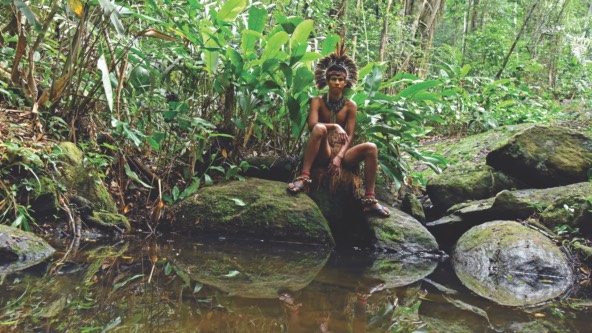
 Siricuá Pataxó, an Indigenous guide from the Pé do Monte village, sits by a sacred pool in Brazil’s Monte Pascoal National and Historic Park. (Photo by Nico Ferri, courtesy of WWF)
In the summer of 2016, 20 leaders and staff of the World Wide Fund for Nature (also known as the World Wildlife Fund or WWF) gathered at Impact Hub Zürich’s Viadukt. Housed in the restored arches of a historic railway, the space’s exposed stone walls host entrepreneurs and creatives from tech and gastronomy to arts and social ventures. On this occasion, WWF’s innovators met to discuss how to rethink its practices for restoring the Earth’s climate, forests, and oceans.
The room buzzed with both concern and possibility. Environmental pressures were mounting. The planet’s climate was reaching or crossing tipping points that would lead to runaway warming. Biodiversity was disappearing. Incremental efforts were falling short.
Despite its impressive tradition of conservation leadership, the WWF assembly shared a growing concern that its strategies no longer sufficed. The scale and complexity of challenges like deforestation and climate-driven ecosystem collapse demanded more than traditional science-based methods alone. To meet the scale and urgency of global problems, WWF would need a fundamentally new way of thinking and working.
By the end of the meeting, the group had launched a movement to bring WWF’s new slogan, “Together Possible,” to life. The organization’s staff, volunteers, and supporters have long referred to each other as “Pandas.” This critical meeting marked the birth of the “Pandapreneurs,” as they called themselves: a community of internal innovators committed to fostering collaboration across the network. WWF would invest in building an internal innovation capability—one that embraced experimentation, welcomed collaboration with actors whose primary focus was outside conservation, and demonstrated a readiness to rethink established practices in service of its mission. In the wake of the ideas brainstormed during the gathering, they would launch a series of bold experiments to spark cultural change, including virtual clinics to enable peer-to-peer sharing across offices and even “Failure Nights” at internal events to normalize learning from failure.
“The gathering in Zürich felt like no other workshop I had attended at WWF before,” recalls Tiffany Limsico, head of talent management at WWF International. “There was a longing for change, and it also felt like that change could come from anyone—whether you were the CEO or a much more junior person in the organization.”
To translate this vision into organizational momentum, WWF needed to pull together a broader coalition of partners and formulate a clearer road map. Two years later at a follow-up gathering in Amsterdam, around 40 participants from across WWF’s global offices deliberated about what change might look like in practice. They discussed the need for internal support structures, seed-funding mechanisms, and cross-office learning platforms that could enable teams around the world to explore new ways of working.
“The meeting was a first of its kind,” says Oana Mondoc, community development and innovation lead at WWF Romania. “People from all over the WWF network, who were itching for change, came together to imagine the path forward and tie strong ties between us. Innovation was fairly new as a concept, but all of us had the mindset.”
But embedding innovation across a decentralized, global network of 84 offices and 9,000 staff would be no easy task. Founded in 1961 and headquartered in Switzerland, WWF is one of the world’s largest environmental organizations. Active in over 100 countries, it works to protect biodiversity, restore ecosystems, promote sustainable resource use, and support local communities in stewarding nature, while also addressing broader systemic issues such as greening the financial system, transforming supply chains, and engaging in advocacy. This vast and distributed reach, while essential to tailoring conservation efforts to local contexts, made alignment and change management particularly complex.
In what follows, we tell the story of how WWF embedded innovation across its vast organizational network. It is a story of mindset shift and institutional renewal: how a large, science-based NGO with a long legacy sought to move beyond predictability and familiarity to embrace adaptive, agile approaches to respond more creatively and collaboratively to complex conservation challenges. It explores what it takes to foster innovation in a large, decentralized, mission-driven organization—and the accompanying cultural, strategic, and operational challenges.
Developing the Innovation Approach
What could innovation mean for a long-standing, globally distributed NGO like WWF? The 2016 Zürich meeting had clarified that innovation could not be a one-off effort or confined to siloed projects. For WWF, innovation would need to be embedded into how the organization thought, operated, and collaborated at every level. It had to be purposeful, mission-aligned, and designated to improve outcomes for people and the planet.
The challenge was as much cultural as operational. WWF’s decentralized structure spans the globe, with national and regional offices, regional coordination units, and the international secretariat all operating semi-independently, with distinct priorities, processes, and decision-making structures.
This decentralization also extends to funding. While many WWF offices in the Global North raise their own income through a combination of public donations, government and corporate partnerships, philanthropic grants, and legacy giving, several offices in the Global South primarily rely on internal funding redistribution from other WWF offices. A portion of this income may be allocated to shared global initiatives, but each office retains significant autonomy over how it allocates resources. In 2024, the WWF network (which includes WWF International, national organizations, and country offices) reported €1.08 billion ($1.27 billion) in donated income, with total available gross income, including investment returns, reaching €1.15 billion ($1.35 billion).
This financial structure enables local responsiveness but also makes alignment around shared goals more complex. Without a traditional, top-down hierarchy, the core team driving the innovation effort had to engage each office on its own terms. Success would require every office to find its own connection to the broader idea; otherwise it would not stick.
In this context, working differently meant giving teams permission to question old routines, rethink how they engaged partners and communities, and explore new ways of delivering impact. To support this shift, WWF began sharing a simple internal working definition to guide its innovation efforts across the network: “The implementation of a novel idea to make something substantially better for people and the planet.”
Cultural resistance emerged when teams struggled to understand the relevance of innovation in conservation work without a clearly articulated, shared vision and goals. They expressed reluctance to move away from well-established ways of working and familiar approaches to solving conservation problems. WWF also faced structural hurdles. “Its funding model tends to favor low-risk initiatives with clear impact metrics and cost recovery, leaving little incentive for experimentation,” says Alistair Monument, WWF’s conservation impact director for Asia Pacific. Internal systems and approval processes remained geared toward linear planning—leaving little room for iterative, agile, or adaptive approaches. What’s more, middle managers were often unfamiliar with innovation and hesitant to champion change.
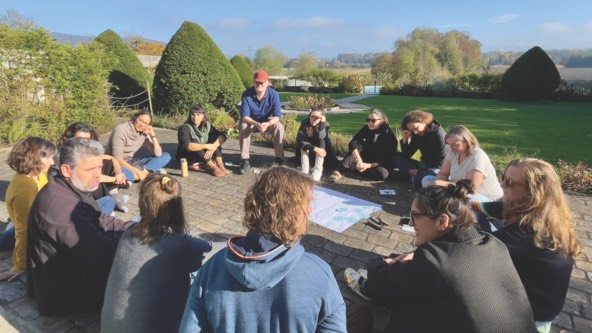 The Global Innovation Team facilitates a workshop in Montmirail, Switzerland, in October 2024. (Photo by Anne Merkle, courtesy of WWF)
It took a global disruption to make the need for innovation undeniable. The COVID-19 pandemic ushered in lockdowns and travel restrictions that disrupted conservation efforts around the world, forcing the organization to reimagine how it implemented projects, collaborated across regions, and engaged with communities. With fieldwork paused and existing plans suddenly unachievable, many staff found themselves with unexpected time and a pressing need to find new pathways forward.
In response, WWF Switzerland established a new role focused on innovation culture meant to support the entire WWF network and appointed Anne Kathrin Merkle—who had led WWF’s partnership with Impact Hub to promote environmental stewardship and sustainability across the latter’s global network—to the position. What began as an individual role gradually evolved into a Global Innovation Team, as WWF Switzerland and other offices—including WWF International, WWF Netherlands, and WWF Australia—recognized the value of the effort and contributed funding to support it. The team’s starting mandate was to embed innovation capabilities and culture throughout WWF’s network.
The creation of the new team reflected a critical step toward turning bold ambition into organizational change, but driving transformation across such a vast network demanded a unifying vision. WWF convened a global working group, bringing together 25 Pandas from across the network—from Chile to Laos—each representing diverse geographies, cultures, and conservation challenges. They were joined by experienced innovation practitioners from other leading international NGOs in the field, including August Ritter, managing director of global portfolio management and the Agility Lab at The Nature Conservancy; Christian Graham, colead of the experiments team at Friends of the Earth; and Julie Michel, senior director of innovation and collaboration at Amnesty International USA. Michel’s participation reflected WWF’s recognition that environmental challenges are also social and that building an innovation culture is not field-specific.
Over a series of collaborative sessions, the group landed on a fundamental insight: Innovation could not be outsourced or siloed. It had to include everyone, especially leadership at the highest levels. Accordingly, they cocreated what would become WWF’s Innovation Approach: an organization-wide framework designed to embed innovation as a core driver of the organization’s mission across countries, job functions, and leadership levels.
“Becoming an innovative organization can’t be delegated,” says Dermot O’Gorman, CEO of WWF Australia, who participated in these sessions. “Creating the culture for testing and validating starts with the CEO and board. Building collective CEO leadership skills in innovation is one of the most important things a global organization can do.”
In the months following the launch of WWF’s Innovation Approach, Merkle found herself returning to the persistent question: How do you turn a powerful vision into everyday practice across an organization as complex as WWF? She invited every part of WWF—from country offices to global practices, regional teams to operational units—to contribute to and benefit from a more innovative way of working. To bring this vision to life, 55 workshops were held in offices across the network, enabling teams to make concrete commitments on their offices’ next steps toward a more innovative culture.
From this experience, Merkle and the Global Innovation Team recognized they needed a clearer path from inspiration to implementation. In 2022, they began shaping what would become WWF’s first innovation theory of change.
“We needed something that could live between strategy and behavior—a way to help teams see their role in driving change and how that connects to WWF’s larger mission,” Merkle says.
At its core, WWF’s innovation theory of change reflects the belief that innovation is not a separate workstream but a way of working. It is not confined to labs or pilots, but embedded into how conservation is imagined, designed, and delivered. To bring this mindset to life, the Global Innovation Team articulated three strategic pillars—learn, apply, and spread—that have shaped its efforts since 2022. Let us consider them in turn.
Learn: Developing an Innovation Culture
WWF’s organizational transformation was founded on a commitment to cultivating an internal learning culture across the network. Given WWF’s decentralized structure, this meant working with individual offices to codefine locally relevant innovation priorities and approaches.
This cultural shift began with the Global A-Team for Innovation, a cross-office volunteer network of 24 staff who committed 10 percent of their time to championing innovation in their regions. A-Team members brought local knowledge and the extra capacity needed to embed new ways of working. As WWF’s Global Innovation Team grew, the role of the Global A-Team evolved. In 2022, WWF transitioned to a more localized model through the Innovation Champions network, with local A-Teams carrying the work forward. By 2024, 25 WWF offices had created their own local A-Teams, often anchored by innovation leads embedded within strategy or conservation teams—keeping the spirit of peer-driven innovation alive and growing.
Building on this momentum, WWF also invested heavily in strengthening innovation capabilities across the network. A major milestone was the rollout of large-scale skill-building programs—such as tailored courses introducing core innovation theory and practice, off-the-shelf office trainings, and thematic workshops—which collectively reached over 2,600 staff across functions and geographies by 2024. These programs were part of a broader effort that included more than 190 workshops, sprints, and community events held annually. Together, these sessions introduced practical innovation tools and practices like cocreation, human-centered design, and systems thinking across the organization. These approaches emphasize designing with stakeholders rather than for them, understanding problems from the user’s perspective, and recognizing the interconnected nature of conservation challenges.
This cultural and capability shift also paved the way for innovation in how offices organize and operate. For example, starting in 2022, WWF Brazil adopted a decentralized structure known internally as “Pandocracy,” inspired by holacracy principles that favor nonhierarchical, rather than top-down, decision-making. This shift empowered teams to self-organize, define clear roles, and share decision-making authority. This change was as much about culture as governance: It removed bottlenecks, accelerated collaboration, and created space for innovation to flourish across the organization.
Building connective tissue across the network also required accessible and multilingual knowledge systems. The Global Innovation Team created a centralized internal website—available in English, Spanish, and French—that served as a go-to hub for innovation tools, templates, case studies, and guidance. In 2024 alone, it registered more than 3,700 users across the network. Supplementing this was a bimonthly newsletter that reached over a third of the global workforce, regularly spotlighting stories, resources, and learning opportunities.
To amplify peer learning, WWF made storytelling a core practice. The team moved from just 12 documented innovation stories in 2022 to over 200 by the end of 2023. One such story featured the endangered Indus River dolphin in Pakistan, where acoustic deterrents (known as pingers) were used to reduce dolphin entanglement in fishing nets and strandings in irrigation canals. The approach showed promising results, with dolphins avoiding danger zones with zero mortality and local fish catches improving, boosting income for local communities. These stories, documented with vivid photography, validated experimentation, surfaced local ingenuity, and gave staff across the network tangible reference points for what innovation looks like in practice.
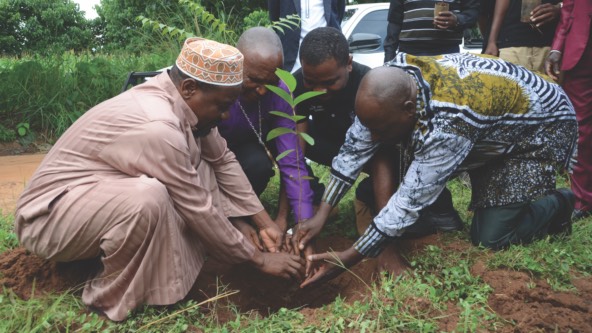 In Tanzania, WWF mobilized interfaith coalitions—including Catholic, Anglican, Pentecostal, Evangelical Lutheran Church of Tanzania, and Muslim communities—to lead reforestation efforts. (Photo by Allen Mazoko, courtesy of WWF)
Yet sharing knowledge at scale proved more complex than simply making resources available. Uptake of tools and content varied widely across the network. Offices, ranging from 3 to 1,350 people, differed in innovation maturity, language preferences, digital infrastructure, and appetite for new ways of working. While some teams quickly embraced peer learning, others remained unaware of available resources or unsure how to apply them in their contexts. Despite a centralized platform and regular communication, building a culture of shared learning at scale demanded regional adaptation, translation, and ongoing engagement.
So, WWF invested in experiential learning and peer-to-peer engagement, based on the Global Innovation Team’s understanding of the organization’s diverse needs. To support this, the Global Innovation Team launched the Innovation Festival—a online convening held twice a year to foster cross-office exchange through workshops, showcases, and dialogue. Informal formats—such as innovation cafés, community calls, and office-to-office coaching—enabled organic collaborations to flourish. These decentralized mechanisms helped build a distributed learning network, one where innovation was no longer championed only by early adopters but gradually became mainstream.
Some offices quickly embraced the new ways of working, embedding innovation deeply into their strategies and operations. Others moved more cautiously, seeing innovation as an optional add-on rather than a strategic necessity. Perhaps most critically, WWF worked to build a culture of mindful failure—one that reframed failure as a source of learning. Internal storytelling campaigns, leadership modeling, and space for reflection encouraged teams to share setbacks openly and apply insights to future iterations. This shift encouraged staff to put aside fears and test bold ideas with confidence.
By 2024, over half of WWF’s offices had reached what the organization considers its internal innovation tipping point, which it defined as having at least 25 percent of staff equipped to apply innovation methods. These cultural roots enabled WWF to move from isolated experimentation to a shared mindset of creative problem-solving, positioning the organization to adapt with agility in the face of increasingly complex challenges.
Apply: Applying Innovation for Conservation Impact
While building capacity and cultivating a supportive culture laid the groundwork, the real test of WWF’s innovation initiative would take place in the field, where the organization’s mission came to life. Could innovation truly help deliver better outcomes for nature and people?
Take WWF Brazil, for example. After several years of investing in new ways of working, WWF Brazil achieved a breakthrough with the Parks Design project, a fresh approach to a long-standing goal of making conservation more inclusive, sustainable, and impactful for local communities. Drawing on the design-thinking methods the team had learned, WWF Brazil brought together Indigenous leaders, park rangers, local business owners, and community members to cocreate sustainable tourism models in 13 protected areas across Southern Bahia and around the Tapajós River. These models aimed to enhance the visitor experience while generating income for local communities and promoting environmental stewardship. Tourists can now access clear information about the protected areas, discover authentic experiences hosted by local communities, and, in some cases, even book experiences in advance and plan their visits accordingly.
The project did more than produce ideas; it built trust, honored lived expertise, and generated new solutions that responded to local realities. By 2024, the initiative had benefited 1,739 people, mobilized over $1 million in funding, strengthened 142 local organizations, and piloted a visitor-monitoring tool now being scaled across all 360 Brazilian protected areas that permit tourism.
WWF’s Brazil experience exemplifies the broader embedding of innovation across the network. At the heart of this effort is Panda Labs—originally initiated in WWF Australia and launched across the WWF network in 2022—as the organization’s support mechanism for integrating innovation into programmatic work. Panda Labs were designed to tackle complex environmental challenges through human-centered design, experimentation, and cross-sector collaboration. Each lab brings together local WWF teams, external partners, and community stakeholders to codevelop and test innovative solutions to conservation problems, often leveraging new technologies or business models.
Within its first year, Panda Labs supported more than 50 projects across the network, helping local WWF teams apply design thinking, test assumptions, and cocreate solutions with stakeholders. In Cambodia, for instance, Panda Labs guided WWF staff through a participatory design process aimed at reviving a struggling wild honey social enterprise. The local forest-dependent communities had lost interest in the venture, which promoted local conservation. Through cocreation workshops with residents and research with local honey collectors, the WWF team identified roadblocks—such as unclear ownership structures and inaccessible production facilities. They collectively decided to relocate facilities and introduce transparent financial practices. As a result, community engagement rose from 14 percent to 95 percent, signaling renewed local ownership. The social enterprise is now poised to scale across other protected areas.
In other regions, support focused on sharpening experimental approaches. In Zimbabwe, for example, Panda Labs provided targeted coaching to help the team define and test key assumptions around the use of black soldier fly larvae as sustainable feed, guiding them through the design and evaluation of a prototype farm. In Mozambique, it helped validate an experimental role-play method aimed at strengthening civil society organizations’ ability to influence ocean policy. Notably, teams who worked with Panda Labs reported a 20 percent greater ability to innovate, as measured by WWF’s internal survey.
As a complement to this support mechanism, WWF’s Network Executive Team—a collective decision-making body representing multiple offices across the network—established the Innovation Fund in 2019. The fund provided both seed funding and design coaching to conservation projects that crossed disciplinary and geographic boundaries. In the last two funding cycles—each lasting two years and led by the Global Innovation Team—the fund backed 27 initiatives tackling complex, high-stakes issues.
In Hong Kong, for example, the WWF office developed an AI-powered cargo-screening tool to detect mis-declared or undeclared wildlife products in shipping documentation—a major gap in current port enforcement systems. The tool, built in partnerships with technology providers and enforcement networks, uses rules from the Convention on International Trade in Endangered Species of Wild Fauna and Flora (CITES) and adaptive algorithms to flag suspicious shipments and generate data for long-term insights into trafficking trends.
In Tanzania, WWF mobilized interfaith coalitions—Catholic, Anglican, Pentecostal, Evangelical Lutheran Church of Tanzania, and Muslim communities—to lead reforestation efforts in the Ruvuma Transboundary Landscape. These communities have already planted more than 110,000 trees across 213 hectares, enhancing biodiversity and ecosystem connectivity while uniting diverse groups in a shared commitment to restoration.
While such initiatives helped spark bold ideas, securing sustained support for innovation-driven projects remained a challenge. Traditional funding models and budgeting cycles often prioritized short-term, proven outcomes, making it difficult to secure support for higher-risk, innovation-driven initiatives. Recognizing this gap, Merkle and her team realized that success depended on engaging fundraisers early and equipping them to advocate for innovative projects. They piloted more flexible funding mechanisms and designed trainings for fundraisers to help them navigate the distinct narratives and risks associated with innovation.
What distinguished the “apply” pillar, however, was its commitment to learning by doing. WWF’s form of innovation evolved through contextualized, collaborative problem-solving. Conservation teams were encouraged to embrace uncertainty, test early hypotheses, and adapt their strategies based on iterative feedback and data—whether working with Indigenous communities in the Amazon or shipping companies in the South China Sea. For instance, in the case of disrupting wildlife trafficking in maritime supply chains, the team based in WWF Hong Kong began with the hypothesis that technology could be leveraged to detect illegal wildlife shipments in container cargo. They partnered with stakeholders across the shipping industry and codeveloped a screening tool that used a constantly updated rules library to identify trafficking patterns. Through ongoing testing, feedback, and real-world data, the team refined the rules and improved the tool’s accuracy. This iterative process led to the adoption of the system by major ocean carriers, enabling them to flag high-risk bookings. As a result, 7.3 million screenings have been conducted to date, identifying over 25,000 suspicious shipments.
Moreover, the Global Innovation Team ensured that even projects that did not receive funding still benefited from coaching, networking, and shared learning opportunities. This approach helped shift perceptions of innovation from a competitive resource allocation process to a community of practice, where learning, support, and iteration were valued outcomes.
By 2024, innovation had transformed from an aspirational concept into core conservation practice applied across WWF’s network. The Global Innovation Team supported 88 innovation projects with targeted coaching, funding, or training—up from applying innovation methods just three times a year to staff now reporting an average of 18 applications annually, actively generating insights roughly every three weeks.
Spread: Embedding Innovative Practices Within WWF
If learning was about building capabilities, and applying was about putting them to use in the field, the third pillar, “spread,” was about scale. It focused on weaving innovation into WWF’s organizational fabric.
A pivotal moment came in 2023 when WWF Netherlands decided to place innovation at the heart of its 2025-30 strategic-planning process. Instead of relying on traditional forecasting models, the office partnered with the Global Innovation Team to codesign a yearlong process using foresight—a strategic approach to exploring possible futures and emerging trends—alongside design thinking and participatory planning methods.
“We need exponential impact in these challenging times,” says Jelle de Jong, executive director of WWF Netherlands. “It requires innovation to get to transformative approaches. This should be at the core, not at the fringes of our work.”
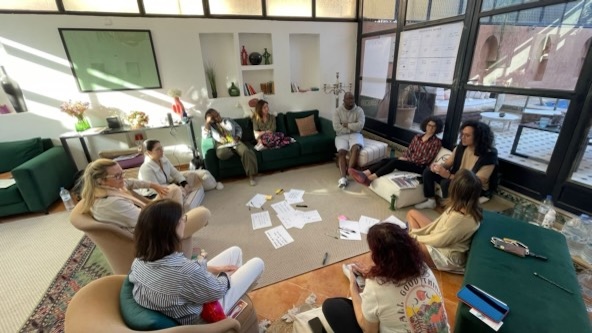 The Global Innovation Team meets in Marrakesh, Morocco, in April 2024 to cocreate its next strategies. (Photo by Anne Merkle, courtesy of WWF)
Building on WWF Netherlands’ example, the Global Innovation Team launched four-sessions series to help integrate innovation into strategy across the network. Twenty-nine offices participated, all eager to learn how to move from static planning to dynamic experimentation. By 2024, 72 offices (or about 80 percent) had embedded innovation into their strategic frameworks, redefining not just what they aimed to achieve, but how they would get there.
This movement expanded into core business functions, signaling a deeper shift in WWF’s understanding of innovation. In certain offices, human resources teams began actively embedding innovation into their practices—seeking concrete behaviors that reflect an innovation mindset when assessing candidates, introducing new staff to innovation teams and tools during onboarding, and incorporating innovation into organizational development plans through dedicated training and coaching programs. Operations teams reimagined internal workflows, testing more iterative, user-centered approaches.
But perhaps the most transformative frontier was fundraising. Recognizing that resource mobilization is both a barrier and a lever for innovation, the Global Innovation Team partnered with fundraising teams to build innovation capacity from the inside out. More than 100 fundraisers participated in workshops dedicated to innovation; a global “fundraising innovation map” was launched, spotlighting 75 replicable examples from across the network. In one standout case, a sustainable fashion collaboration led to an innovative merchandise campaign that attracted 3,000 new annual donors—proving that innovation could generate both impact and income. By positioning fundraisers as cocreators of innovation, WWF began unlocking new avenues for support.
Still, embedding innovation into core functions often meant confronting rigid internal processes. Many of WWF’s systems—designed historically for stability, accountability, and compliance—were not built for agility. Teams pushing new ideas often found themselves up against slow approval chains, unclear mandates, or siloed responsibilities. Even with leadership support, these structural frictions made experimentation difficult, especially across teams or functions that didn’t usually collaborate.
To begin breaking down those barriers, the Global Innovation Team worked with internal stewards of WWF’s project-design standards to explore how and when to integrate innovation methods into conservation planning. This collaboration led to updated guidance, embedded tools, and revised language that helped teams assess when innovation was needed and when tried-and-true methods were still the best fit.
As momentum grew, WWF turned to offices in regions where innovation uptake had previously lagged. In 2022, the Global Innovation Team hired regional Innovation Enablers in Africa and Asia-Pacific (APAC). These fixed-term positions served to build trust by conducting listening tours, translate innovation tools for local practices, and tailor support to each office.
As part of this effort, WWF began tracking innovation maturity—a measure of how well-equipped an office was to apply innovation in its work. The network assessed maturity levels (beginner, intermediate, advanced) through a combination of staff and leadership self-assessments via the Innovation Survey and external validation by the Global Innovation Team. The assessment considered factors such as awareness of innovation concepts, confidence in applying innovation methods, the number of concrete innovation examples, and the depth of engagement with the Global Innovation Team.
The goal of measuring innovation maturity wasn’t to benchmark performance, but to identify each office’s starting point and ensure that support was responsive and inclusive. By aiming to bring all offices to at least an intermediate level—where basic innovation skills and mindsets are in place—WWF could build a stronger, more distributed foundation for experimentation, learning, and impact.
Between 2022 and 2023, innovation maturity rose by 21 percent in Africa and 37 percent in APAC—“evidence that with the right support, systemic change could take root even in complex, resource-constrained environments,” says Kali Gibson, innovation strategy and impact measurement lead for the Global Innovation Team.
By 2024, innovation practices were shaping how WWF teams worked, made decisions, and tackled complex challenges. Nevertheless, when staff were asked to rate how innovative they felt the organization was, the average came out 6.4 out of 10. It was a sign of real progress, but also a reminder that many teams were still navigating barriers, from rigid processes to limited resources.
“It showed us that the shift is happening, but also how much care and consistency it takes to make innovation feel real across such a diverse network,” Merkle says. “We have always said that this isn’t about flashy ideas; it’s about helping people work differently, with more creativity and courage.”
Spread: Fostering Knowledge Sharing and Partnerships Outside WWF
Spreading innovation within WWF was only part of the goal. WWF also sought to spark a broader culture of innovation across the nonprofit sector. This meant building the relationships, networks, and knowledge infrastructure that allow innovation to circulate, evolve, and scale.
This effort began in 2021, when Merkle—who had been stewarding WWF’s innovation efforts from the start—found herself frustrated by the lack of spaces to connect with peers wrestling with similar questions in other international NGOs. Innovation was gaining traction, but there were few resources, no dedicated community, and little visibility into how others were approaching the same kinds of transformation. So, she reached out to a handful of peers outside WWF and began hosting informal calls.
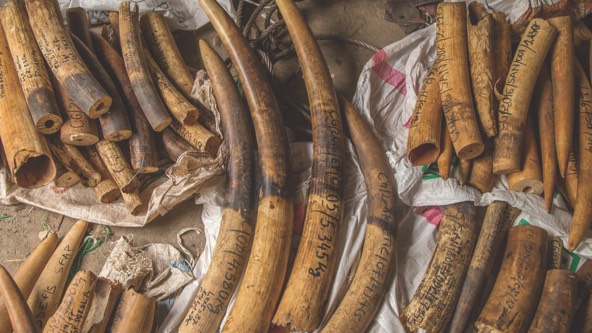 WWF Hong Kong worked with stakeholders across the shipping industry to codevelop a screening tool to identify illegal wildlife shipments, such as this confiscated ivory. (Photo by Daniel Nelson, courtesy of WWF)
What started with four organizations grew quickly into the Innovation for Impact Network—a trusted space where innovation leads from more than 30 international NGOs and UN agencies meet every two weeks to exchange experiences, test ideas, and maintain solidarity. Together, they cocreated learning agendas, tackled frontier topics like AI and equity-centered design, and opened up a level of dialogue that many had been missing.
“The network has been a game changer, shaping how I lead innovation strategies and accelerating my own growth,” says Emma-Lee Knape, head of innovation at World Food Programme East Africa, the United Nations agency responsible for delivering food assistance and addressing hunger worldwide. “I’m deeply grateful to the WWF team for launching and cultivating such a powerful platform for collective learning and impact.”
The relationships that the network spawned led to many exchanges. For example, the international Catholic humanitarian federation Caritas Internationalis—one of the world’s largest networks dedicated to emergency relief and social service—drew directly from WWF’s core innovation capacity-building program to design its own, adapting WWF’s formats, exercises, and delivery model to fit its relief efforts worldwide.
“What excited us most is how seamlessly the content translates to the social sector, equipping our teams with concrete skills to drive meaningful impact,” says Florian Pomper, head of innovation at Caritas Vienna.
The team drew capacity from across 25 WWF offices to codesign the Innovation Approach and shape the team’s first offerings. From the outset, innovation was grounded in diverse local contexts and designed for a decentralized system.
Meanwhile, WWF actively learned from peers as well. In a working group on scaling with six other international NGOs, WWF adapted international humanitarian NGO CARE’s approach to identifying scale readiness, borrowing language and frameworks that had proven effective in development contexts. Similarly, The Nature Conservancy shared its tool for developing a project-scale vision, which WWF teams are now using for their own scale planning. These exchanges exemplify the spirit of collective intelligence: not simply exporting solutions, but coevolving them through open dialogue, shared challenges, and mutual support. WWF has a core mission to build a future where people live in harmony with nature—a goal that can be achieved only through a global movement. WWF embraced this openness not to showcase its own progress, but because it understands that true impact comes when the entire sector advances together. As Merkle puts it, “WWF only wins when we all do.”
WWF has also partnered with universities to ground its innovation efforts in research and inquiry. Collaborations with institutions like the University of Geneva and the Technical University of Munich (TUM) helped bridge theory and practice, enriching academic work while producing actionable insights for the field.
“From codeveloping research on AI to sharing their applied experience with students, WWF’s Innovation Team helped generate unique scientific knowledge with real-world environmental impact,” says Professor Orestis Papakyriakopoulos of TUM.
By 2024, the Global Innovation Team’s commitment to collective learning had become a defining feature of its Innovation Approach. When the Innovation Team opened its strategy process to input from peers, 17 international NGOs—including National Geographic Society, Oxfam, Aga Khan Foundation, CARE, Caritas Europe, Save the Children, The Nature Conservancy, Friends of the Earth, and Conservation International—showed up to help shape the next chapter. It was a small but powerful indicator of how far the organization had come in embedding innovation as a collaborative force across the social sector.
Lessons From WWF
By 2025, WWF had come a long way from its first conversations in Zürich about innovation. What started as scattered pilots led by a few passionate individuals eventually became a global movement across the social sector. The journey was marked by experiments, missteps, and recalibrations, propelled forward by a shared commitment to doing things differently in service of the planet. WWF learned four specific lessons along the way.
“By thinking beyond our institutional boundaries, we support teams in identifying potential doers and payers who are better positioned to scale what works. Seeing the state of the climate and biodiversity crisis, strategic scaling support is nonnegotiable.”
1. Innovation champions are essential for local ownership. | WWF’s cultivation of innovation was fueled not by mandates, but by committed individuals who sparked change within their own offices. From Cambodia to Colombia, individuals across levels and functions stepped up—not because they were told to, but because they saw the potential for greater impact. The Global Innovation Team’s portfolio of learning programs, peer communities, and coaching opportunities gave these changemakers the tools, structure, and confidence they needed to lead transformation from within.
In the early days, the so-called Global Innovation Team had one member. While the lack of staff posed obvious challenges, it also proved to be a creative advantage: Instead of building everything centrally, the team drew capacity from across 25 WWF offices to codesign the Innovation Approach and shape the team’s first offerings. From the outset, innovation was grounded in diverse local contexts and designed for a decentralized system.
Five years later, that foundation had scaled. The Global Innovation Team had grown to 10 members—financed by various WWF offices that believed in the necessity of this organizational shift—spread across the globe, and more than 40 offices had appointed innovation champions. This close-knit network of around 40 innovation champions sparked a much broader wave of engagement across the organization: In 2024 alone, over 2,600 Pandas participated in innovation-related trainings, workshops, or learning journeys, and 88 conservation projects received direct support from the Global Innovation Team. Most strikingly, 61 percent of WWF offices had reached the innovation tipping point.
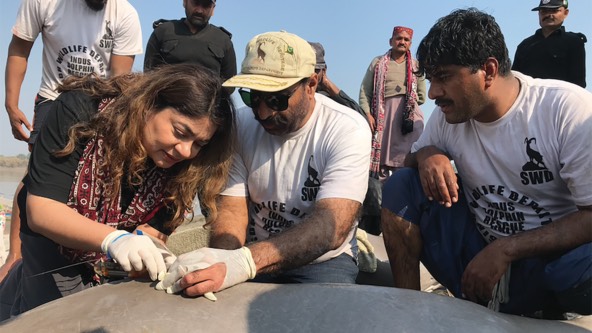 Dr. Uzma Khan (left), Asia coordinator for WWF’s River Dolphin River Initiative, tags an Indus river dolphin in Pakistan for satellite tracking. (Photo by Janan Sidhu, courtesy of WWF)
2. Accessibility is critical for widespread culture change. | In a decentralized organization like WWF, offices vary greatly in resources, context, and readiness to innovate. From the outset, Merkle recognized that making innovation accessible across this diversity would be critical. This meant tailoring support to a wide range of roles and functions, including leaders, fundraisers, project designers, and field staff.
To achieve this, the team took a multifaceted approach. It had training materials and the internal innovation website translated into French and Spanish, it added live translation to its workshops, and it upskilled local staff to help facilitate sessions in ways suited to the local context. When participation lagged in parts of Africa and Asia, WWF piloted regional Innovation Enablers in those regions. The impact was immediate: Offices reported higher engagement, and maturity levels rose significantly—36 offices increased their scores between 2022 and 2024 alone.
3. Evidence builds credibility and sharpens decision-making. | The Global Innovation Team turned to data to make innovation culture more visible and actionable. By embedding data into its planning, adaptation, and resourcing decisions, WWF not only strengthened the credibility of its innovation efforts—it turned culture change into something measurable, actionable, and aligned with real-time needs across the network.
Over three years, it collected more than 3,300 responses through an annual, network-wide survey completed by staff across nearly all functions and 96 percent of WWF offices. Respondents assessed innovation capacity at the individual, team, and organizational levels, while also providing feedback on communication efforts, program effectiveness, and tools relevance.
These insights became central to decision-making. The team used the data to track progress over time, identify regional or functional gaps, and tailor support accordingly. It offered targeted coaching to lower-capacity offices, prioritized translation where uptake lagged, and designed new offers in response to emerging needs. The data also helped shape the team’s strategic direction, clarify internal priorities, and make the case for continued investment in innovation.
4. A mission-aligned definition of innovation fosters internal buy-in. | One of the biggest challenges the Global Innovation Team faced was moving innovation from the margins to the core of WWF’s work. Early on, staff often misunderstood innovation as something separate from conservation, only relevant to tech-savvy teams.
In response, the team developed a clear, mission-aligned definition of innovation as a mindset and set of practices essential to achieving WWF’s global goals. The team articulated why innovation matters, how it changes the way WWF operates, and what pathways can help teams apply it in practice. Crucially, they linked innovation to impact—framing it as a tool to help close the gap between WWF’s ambition and the scale of environmental challenges. This clarity helped shift perceptions and increase internal buy-in, particularly when paired with practical support for embedding innovation in strategy processes, redesigning conservation approaches, and building leadership confidence.
Innovation Everywhere
After years of experimentation and culture building, the Global Innovation Team is now focused on ensuring that its innovation practices consistently deliver value across diverse geographies and contexts. Many offices now seek support not in generating ideas, but in scaling what already works. Others require tailored guidance that accounts for language, local capacity, political realities, and operational constraints. As WWF matures in its innovation practice, three shifts will shape the path ahead.
First, it is focusing less on ideating new solutions and more on scaling proven solutions. To meet this demand, the Global Innovation Team is launching a WWF Scaling Lab to help teams articulate scale plans, remove barriers, and develop pathways for broader adoption. Crucially, this work extends beyond WWF. By engaging external partners and funders, the team aims to position WWF innovation for replication and sustainability across the conservation landscape.
“Too often, the scale of our conservation solutions is limited by the resources and capacity within our own organizations—rather than being guided by the size of the problem itself or the possible size of the solution,” says Kate Gardner, WWF’s innovation to scale lead. “By thinking beyond our institutional boundaries, we support teams in identifying potential doers and payers who are better positioned to scale what works. Seeing the state of the climate and biodiversity crisis, strategic scaling support is nonnegotiable.”
Second, WWF is shifting from establishing a network-wide culture to contextualizing innovation culture to regional and local offices. Broad offerings like large-scale trainings and shared resources have led the groundwork, but the most transformative results often come from highly contextual, one-on-one support. The Global Innovation Team will expand regional and language-specific assistance that reflects the economic, cultural, and political realities of different offices and their stages of innovation readiness. With 83 percent of surveyed staff expressing a desire to further develop their innovation skills, the appetite to learn is growing, not fading.
Third, WWF is turning from exploring AI uses to adopting AI responsibly. The Global Innovation Team spent the past 18 months helping the network build AI literacy, codevelop use cases, and convene peer exchanges. A growing community of 35 WWF offices now forms the AI Community of Practice, with support from the Global Technology & Digital Services team. Together, they are mapping AI-driven conservation projects, developing strategies, and exploring how to assess the trade-offs between AI’s environmental costs and its potential impact gains.
WWF is now past the midpoint of its Decade of Action for Nature—its commitment to halt and reverse biodiversity and habitat loss and halve the impact of human production and consumption on nature by 2030. It recognizes that it cannot hope to make progress on these goals alone. By sharing its innovation journey openly, WWF’s Global Innovation Team hopes to inspire and equip others across the nonprofit sector to embrace innovation as a shared imperative and grow and scale the solutions that the planet needs.
Read more stories by Lisa F. Canova & Katherine Tatarinov.