

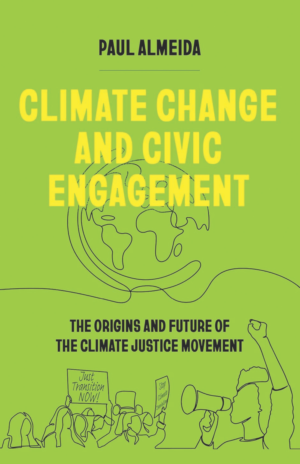
Climate Change and Civic Engagement: The Origins and Future of the Climate Justice Movement
Paul Almeida
262 pages, University of California Press, 2026
When the United Nations COP 95 ratified the Paris Agreement on climate change, it ignited a tiny spark of hope: Nearly the whole world had collectively committed to cutting their greenhouse-gas emissions in an attempt to stave off the most catastrophic impacts of climate change. It felt like, perhaps, the world’s leaders might finally be taking seriously humanity’s continued survival on this planet.
In the decade since the Agreement became legally binding, that spark hasn’t just sputtered out. It’s been strapped into the world’s largest gas-guzzling vehicle, hurtling 150 miles per hour toward a concrete wall (while politicians debate whether and when we should possibly consider tapping the brakes). Instead of putting the world on a trajectory to cut greenhouse-gas emissions in half by 2030, as the Paris Agreement requires, global emissions have continued to rise. (Even in the US, where emissions had declined fairly steadily since 2007, the explosion of AI data centers has started them ticking upward again.) Meanwhile, more of us are experiencing the impacts of climate change directly, through increasingly extreme floods, hurricanes, wildfires, heatwaves, and food prices. Anyone feeling sticker shock at the cost of olive oil since 2023 can blame the effects of a heatwave and drought that year in the Mediterranean, which decimated olive oil supplies. There are too many other examples like this to list; everything, increasingly, is an example.
Given this reality, in which elite-driven, summit-oriented top-down progress has stalled, sociologist Paul Almeida argues that the only way forward is expanded civic engagement, offering a vision of change that starts from an inclusive, bottom-up, and worker-based sense of movement building. He recalls, as a graduate student, being told by the head of an environmental and economic-justice organization that “if we want to eliminate the production of hazardous chemicals, the workers themselves must be involved in the problem,” an insight into the kind of “broad-based network of youths, students, community-based organizations, [and] labor organizations” that he now realizes, decades later, have always been the way forward.
In his new book, he not only highlights how mass civic engagement has shaped the climate-change movement so far—and gleans lessons from those actions—but shows that moving forward will require the climate movement to build even more on broad collective struggle. Put bluntly, we are far past the point of asking when our politicians and business leaders will hit the brakes (and waiting for them to do so), as the evidence mounts that they may—or will—never do it. Ordinary people must collectively pull the emergency brake ourselves.
Three Pathways
Almeida outlines three potential ways in which we can address climate change, though of course the three are not created equal. He starts with climate denialism, which doesn’t just mean pretending that climate change isn’t real: It can also mean accepting the reality of human-caused climate change, but arguing that a warming climate is not, in fact, a problem. Examples abound, from the misleadingly simplistic claim that more CO2 will increase plant growth to the Trump administration calling climate-change threats “a scam” as a pretext to gut offshore wind and other renewable-energy projects (while doubling down on fossil-fuel extraction). But if denialism is a problem, he argues, it is probably not the problem: Research from the Yale Program on Climate Change Communication has shown that for years, most Americans have believed that global warming is happening, is human-caused, and is a real concern. Almeida therefore limits his attention on denialism to the ways it structures and impacts the other two pathways: decarbonization and just transition.
The US climate movement springs out of an environmental movement long focused on conservation and the preservation of landscapes, but not necessarily (and only belatedly) the well-being of working people. Even today, a white, male, and elite legacy continues to shape institutional organizations, and by extension the climate movement.
Decarbonization means working to reduce greenhouse-gas emissions but doing so within the existing market-basedeconomic system. This includes programs like cap and trade—setting limits on how much CO2 a region or industry is allowed to emit and turning these emission allowances into tradable commodities—as well as everything from swapping electric vehicles for gas cars to the suite of as-yet-unproven technologies like carbon capture and sequestration (which attempt to remove carbon dioxide from the atmosphere and store it). Almeida doesn’t argue that decarbonization is bad, as such, but simply that decarbonization, alone, will only perpetuate existing inequities (and is most congruent with “mobilization from above” or the kind of “institutional” environmental movement that has stalled). That might be because it doubles down on existing (and inequitable) societal structures—the focus on electric vehicles, for example, only reinforces the limitations of car culture. It can also reinforce those inequities more directly. As he discusses in the book’s penultimate chapter, the recently approved Darden solar-array and battery-storage-capacity plant—the world’s largest—in western Fresno County, California, illustrates the ways that building renewable-energy technologies in communities that have already suffered from decades of environmental injustice both exacerbates the broader problem and inevitably depresses bottom-up solidarity.
For this reason, Almeida’s emphasis is on the just-transition pathway, which borrows from and builds on the decarbonization pathway, but in a much more holistic and transformative way. “[W]orking-class and lower-income communities face multiple challenges in addition to climate change,” he writes, which need to be addressed simultaneously, as a matter of simple coalition-building: “The intersectional nature of those exposed to climate hazards calls for multi-group and multisectoral coalitions.” In this context, California, as a whole, represents not only the leading edge of ecological modernization, “a leader in the battle against global warming,” but an illustration of what must yet be done: “assuring the representation of the most vulnerable communities and workers in the transition … away from decarbonization-only strategies.”
Time Is Running Out
Almeida takes the reader through a history of the climate movement, both globally and within the US, linking modern, global youth movements such as the school walkouts of Fridays For Future to predecessors like the US-based Chicano movements of the late 1960s and ’70s, as well as the school walkouts that helped facilitate the end of apartheid in South Africa. In his view, civic engagement around climate change springs from a long line of actions fighting for other human rights. He also rightly notes that while noninstitutional actors were often left out of high-profile climate negotiations (and during COP 30 in 2025, 1 in every 25 participants was a fossil-fuel lobbyist), they have always found ways to exert pressure, even on events where industry otherwise dominates.
His work is strongest in detailing the challenges facing climate mobilizations in the US, where the movement is subtitled “one step forward, two steps back” (especially accurate in this present moment, in which the US has started a war that by one estimate released as many CO2 emissions in the first two weeks as the country of Iceland does in a year). The US climate movement springs out of an environmental movement that long focused on conservation and the preservation of landscapes, but not necessarily (and only belatedly) the well-being of working people. Even today, a white, male, and elite legacy continues to shape institutional environmental organizations, and by extension the climate movement, even as Black people and Hispanic people—who are more likely to be impacted by climate change—are also comparatively more likely to be concerned about it. This limitation on the prospects and efficacy of civil engagement needs to be corrected if there is to be any hope of halting the worst effects. “Our best hope for a civic engagement revolution,” Almeida writes, “[a]s global warming continues to pick up pace,” is “to invest public funds into the locations that will generate rapid results in climate solutions that are equitable and not reproduce existing structures of stratification and subordination.” That strategy will probably mean building something different in western Fresno County than massive-scale ecological modernization.
Climate Change and Civic Engagement clearly articulates the need for increased civic engagement and ramping up the ways that civic engagement has enacted change, but it stops short of going into the details. Almeida cites the potential role for universities—especially those embedded in climate justice communities, like the author’s own institution, UC Merced (a few hours’ drive by electric car from the Darden solar facility)—and argues for the importance of strengthening the relationship between the labor movement and the climate movement, citing groups like BlueGreen Alliance. Whether that will be enough remains to be seen. The concrete wall, after all, is coming ever closer.