


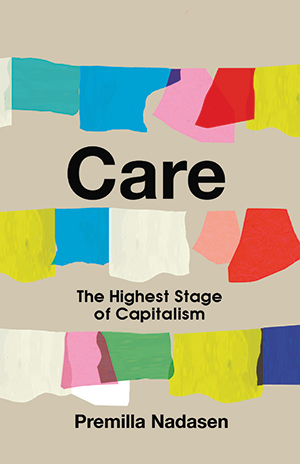
Care: The Highest Stage of Capitalism
Premilla Nadasen
288 pages, Haymarket Books, 2023
Private equity has become a multi-trillion-dollar industry, in no small part due to its foray into the care sector. Since 2021, private equity firms have spent more than $200 billion on purchasing health-care companies. Their investments in nursing homes have grown twentyfold in the last two decades. Some people view private equity’s interest in the care sector as hopeful. For them, private equity can help improve health-care outcomes alongside cutting costs and enhancing efficiency. The evidence for this is not promising. One study shows that private equity ownership consistently increases health-care costs for payers, producing mixed or adverse effects on the quality of health care. Critics see private equity’s interest in the care sector as naked profiteering. In a biting article in The Atlantic, Rogé Karma argues that the results of private equity’s interest in the nursing sector “have not been pretty,” pointing to cases of thousands of premature deaths in nursing homes, over-prescription of opioids, and cutbacks on staffing.
Private equity’s interest in the care sector spotlights how care has become a significant source of profit. And in Care: The Highest Stage of Capitalism, Barnard College historian Premilla Nadasen examines how care has become the “site for economic extraction.” Care is a sweeping history of the labor of social reproduction since the antebellum United States. For Nadasen, the nation’s foundation in the systemic enslavement of Africans is the crucial link between profit extraction and social reproduction that defines US capitalism. Nadasen also unpacks how capitalizing on care has occurred alongside a cultural trend where discussions of care—such as diluted notions of self-care as feminism—though omnipresent, fail to recognize care as labor that should be compensated. Nadasen exposes how care continues to be placed on a cultural pedestal but worries that it “is treated as unlike other kinds of work—as even more important—because it requires an emotional investment and is critical for human well-being.”
The confluence of these two seemingly disparate trends—of care as a source of profit and care as a morally elevated calling—is where Nadasen begins her analysis of capitalism’s impact on care in the United States, given the “context of the history of slavery, racism, imperialism, and colonialism.” In illuminating how “capitalism is remaking itself by turning to forms of accumulation that are rooted in the very crises it has created,” Nadasen charts two historical trends: how discussions of care have centered the concerns of privileged white women to the exclusion of the poor, marginalized, and vulnerable; and how care has become a locus of capitalist profit. On the first, Nadasen notes “how the very definition of the care crisis is rooted in the experience of white, middle-class families.” At the intersection of these two trends is domestic work, and the employer-domestic worker relationship in particular, which Nadasen believes offers insights for how to transform care into something that can be recognized and valued as labor.
Nadasen examines care work as a singularly gendered form of labor—which is not actually recognized as labor at all. She introduces the phrase “the emotionally invested worker” to demonstrate how the emotional investment expected of care workers obscures that they are workers at all: Cleaning a home, taking care of children, helping a physically dependent individual bathe, all require labor. Nadasen points out that under this framing, domestic workers become worthy of labor rights because of being emotionally invested workers whose labor benefits those with privilege, power, and affluence.
With Care, Nadasen has laid the groundwork for what a care system that is not animated by profit could look like.
For Nadasen, how the labor of care is framed is important because who society believes needs care and who is expected to provide it shapes national interests and policy decisions. She contends that by promoting upper- and middle-class care needs, the care discourse erases poor, marginalized, and vulnerable people. For example, at the height of the COVID-19 pandemic, the media framed care around issues of “balancing” work and life, outsourcing childcare during lockdowns, and stalled promotions. According to Nadasen, these concerns do not represent the scope of care needs across society. But when care is framed this way, policy solutions are devised to respond to them, from flexible hours and working from home to parental leave, which ignore the reality of poor workers who can barely afford their basic needs.
Care discourse legitimizes how economic profit is reaped from caring, Nadasen argues, because it glosses over its capitalist underpinnings. Economic extraction from care work forms the book’s second thread, in which Nadasen examines specifically how care under capitalism disadvantages both care providers and recipients. Care has historically been a source of profit derived from women’s labor, conditioned by “racism … as a form of labor control,” she writes. White people made distinctions about which racial groups were suitable for domestic work, with African Americans regarded as the “ideal domestic workers” until the civil rights movement. The revoking of segregation laws in the 1950s and 1960s opened a variety of work possibilities for African Americans, who then left domestic work to pursue these alternatives. Subsequently, employers turned to immigrants to fulfill their domestic work needs.
The story Nadasen tells of those who receive care is just as troubling. She argues that the “financialization of social reproduction” has turned America’s most vulnerable people into the most profitable products for the care industry. The government collaborates with for-profit enterprises, transforming what ought to be care provision into a patronizing welfare system that does not trust the poor to make decisions about how to spend money or take care of children. From Nadasen’s perspective, this results in excessive regulation of the distribution of meager resources, such as food stamps and childcare credit. In a more innocuous thread, this disdain of the poor is, ultimately, transformed into profiting off vulnerability and poverty.
Nadasen highlights the example of Maximus, a large, privately run, for-profit health- and human-service contractor. Many US state governments outsource social-services administration to Maximus. One of the tasks that Maximus does for state governments is to identify children who need to be brought under state care. Nadasen argues that while the rhetoric used by Maximus is of protecting children, what Maximus does is far from it. She argues that for-profit enterprises like Maximus deliberate over (typically, poor and racially marginalized) children’s health and educational records to determine if they should be taken under state protection or if they can remain with their families. “Children are evaluated and ranked using data analytics to determine who among them might be most economically valuable to the state,” she explains. In Nadasen’s explanation, economically valuable children are those who are eligible for most assistance from the state. If a child is separated from their parents, for instance as a result of parental death or overzealous intervention by Child Protective Services (CPS), the monetary assistance to which the child is entitled is placed in the state’s control. This assistance, Nadasen argues, is often not used for the child’s benefit but to maximize the revenue for Maximus and the state with which it has a contract.
Nadasen sharply criticizes the idea that the welfare state has been a just arbiter of social and economic care. Rather, she exposes how the welfare state continues to provide the most resources to the most privileged groups in society while actively denying those resources to poor and racially marginalized groups. In the case of Maximus’ lucrative partnerships with government agencies, Nadasen points out that public dollars are taken from the poor and marginalized and end up “in the hands of stockholders and CEOs,” in a process that impoverishes the former and enriches the latter. “The state has retreated from its purported commitment to achieving equality and, in fact, is moving ahead full force to exacerbate inequality,” Nadasen writes. Care paints a dire picture. In observing that populations are aging and chronic illnesses are becoming more prevalent and debilitating, Nadasen conveys the urgency of developing adequate care infrastructure and governance.
How can we go about achieving care for all? Nadasen responds not with defeatism but with a sketch for a care system informed by radical care. For Nadasen, radical care seeks to change the world, through individuals’ relationships to each other and to economic and social systems by being motivated by care and concern rather than by economic extraction. The principles of radical care, as she points out, are principles that have also guided activist organizations like the Black Panthers and the Young Lords. For Nadasen, radical care is “nonhierarchical, anticapitalist, and collective.”
To provide an example of what the theory of radical care could look like in practice, she cites the Black Panthers’ 1969 Free Breakfast Program as exemplifying the power of radical care. The program provided schoolchildren in an Oakland neighborhood with breakfast—alongside brief history lessons and lessons in Black Power—for free. Nadasen credits the program with addressing an important economic need in a community overlooked by the government’s social safety net while also raising awareness about the “commodified relationship that mediates their basic needs.”
While Nadasen believes radical care can transform society by severing the link between care and capitalism, she is also mindful that some care needs—specifically medical needs—cannot be met through community-led efforts. Here Nadasen acknowledges, but does not thoroughly explain, the need for developing welfare-state infrastructure and government programs that protect the poor rather than penalizing them for their poverty. Nevertheless, with Care Nadasen has laid the groundwork for what a care system—what she calls a “truly caring society”—that is not animated by profit could look like.