


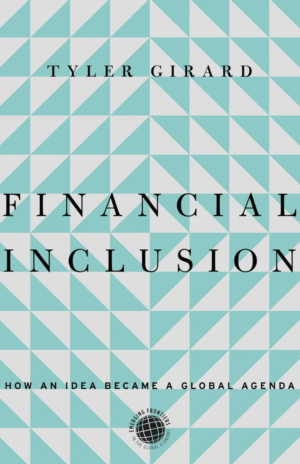
Financial Inclusion: How an Idea Became a Global Agenda
Tyler Girard
284 pages, Stanford University Press, 2026
Microfinance is often cited as an example of what social entrepreneurship is and can accomplish: new market entrants with a wide range of organizational structures attracting social, government, and for-profit capital, providing innovative in-demand services (often using new technology) to previously excluded bottom-of-the-pyramid customers. Since 2011, according to the World Bank’s Global Findex Database 2025, financial-account ownership has more than doubled (just as one example).
How did that success happen? It’s a particularly relevant question given how fraught the current global development environment is. Official aid budgets are falling. The Gates Foundation, long one of the most reliable funders of global efforts in financial inclusion, is wrapping up its work. The Trump administration’s hostility to investment in community-development programs, at least insofar as they are not directed at white American men, is clear. And while digital finance has made huge strides nearly everywhere, digital-financial fraud has kept pace. It should probably be setting off more alarm bells that Anthropic’s frontier model can reportedly hack most digital systems, were it to be released. What will happen when AI-enabled Russian or North Korean hackers come for mobile money systems in developing countries?
Two recent books look at the success of the modern financial-inclusion movement from very different angles. That’s more than appropriate, given how contested the financial-inclusion space has always been: Just in the last 40 years, the nomenclature has shifted from “microcredit” to “microfinance” to “financial access” to “financial inclusion” to “financial health.” Tyler Girard’s Financial Inclusion: How an Idea Became a Global Agenda is a work of academic sociology, which starts from the premise that “financial inclusion as an idea, as well as the construction and maintenance of its ambiguity, have been inadequately theorized.” Mara Kardas-Nelson’s We Are Not Able to Live in the Sky: The Seductive Promise of Microfinance takes a journalistic approach. The contrast between the two is instructive for social innovation and entrepreneurship well beyond financial inclusion.
Sociologist Kieran Healy once made a light-hearted riff on an XKCD comic, categorizing the “12 Types of Sociology Papers.” Among them is “This Thing Became Widely Adopted for Stupid and/or Evil Reasons.” That is the attitude of a good deal, but not all, of academic sociology about financial services for the poor: By their very nature, financial services must be tools of neoliberal/capitalist oppression, and the success and expansion of financial inclusion can be explained only by powerful nefarious actors deceiving or co-opting others. Girard does routinely note the presence and work of grassroots, local, or indigenous actors that have been involved in modern financial-inclusion efforts, but his account is framed by the idea that powerful central actors must have been the dominant forces. “Given the lack of consensus on the meaning of financial inclusion,” he writes, “one might reasonably expect there to have been a pronounced conflict to resolve competing visions, or for an international organization … to impose a singular interpretation.” One might only reasonably expect that if one’s conceptual framework puts existing powerful actors at the center.
How much this perspective affects Girard’s telling can be seen in the fact that the book only mentions Muhammad Yunus, John Hatch, and Sam Daley-Harris once (all in a passing discussion of the 1997 Microcredit Summit Campaign), and entirely omits Jeff Ashe, Alex Counts, Mary Ellen Iskenderian, Beth Rhyne, and Cliff Rosenthal. His work does include confidential interviews, but there are no anonymous insights or quotations that are remotely controversial enough to justify confidentiality. If you’ve ever met any of these leaders, you know they are not shy about sharing their perspectives (perhaps one of the reasons they were effective?), so I can only guess that they are not sources.
Kardas-Nelson, on the other hand, provides a terrific history of the modern financial-inclusion—née microfinance—movement focused on the social innovators who created it literally from the ground up. Despite having engaged with many of these pioneers, I learned a great deal from reading those chapters focused on the people who were less concerned with “resolv[ing] competing visions” and more with reaching more excluded people. She alternates these chapters with the story of predatory financial services in Sierra Leone (in some ways embodying another of Healy’s types of sociology papers, “Five Years of Brutal, Intensive Ethnographic Work Suggests It Sucks To Have No Money”).
This is where the authors’ mostly unspoken views of the world align, rather than diverge, and where I disagree with both. If Girard is amazed that a global agenda emerges without the powerful taking charge, Kardas-Nelson holds the financial-inclusion movement responsible for predatory actors in Sierra Leone, because those predators found space in the gaps of financial-services regulatory frameworks that the movement encouraged. The movement, in other words, is guilty of proffering a “seductive promise,” because powerful actors in the financial-inclusion movement did not stop the predators.
There is still much work to be done, or redone, to ensure that everyone who wants to use financial services can use high-quality, safe, and low-cost tools. Maintaining progress will probably require even more participatory ambiguity than has already been deployed.
In this sense, if Kardas-Nelson were a sociologist, she might borrow Girard’s words to accuse him of using “the [financial inclusion] agenda’s ideational and material dimensions [to] conceal the extractive logics at its core.” But Girard’s useful focus is on the “participatory ambiguity” in the development and application of financial-inclusion efforts. He draws attention to the fact that the financial-inclusion agenda was not ultimately created or driven by a unified set of powerful actors, but by a diverse coalition made up mostly of the relatively powerless social innovators. These were the people and organizations who were sensitive to the needs and realities of local, national, regional, and ultimately global contexts simultaneously, and therefore were able to co-opt the powerful.
This idea is important. It is possible to drive concrete action and real-world change—and there is no disputing that the financial-inclusion agenda has led to massive real-world change—without central control. Girard rightly highlights that the movement did not need widespread agreement on terms, measures, or goals; he underplays, however, that it was precisely that ambiguity that allowed the innovators (in financial inclusion and in other domains) to keep working and making progress even while they debated, revised, and evolved what they were moving toward. The success of the movement has been more rooted in grassroots actors persuading the powerful to get out of the way than getting them on board with a highly detailed set of definitions, metrics, and steps.
There has always been clear demand for the financial tools to turn flows into stocks and stocks into flows, to manage volatility and risk, to aid family and community. Financial-services social entrepreneurs were going to meet that need until and unless banking regulators and anti-terrorist-financing “police” stopped them. Entities like the Alliance for Financial Inclusion have therefore been tools to fend off the powerful as much as or more than to enlist them in the work.
The current global political landscape is roiled by demands for ideological purity and unwavering solidarity by activist groups of every stripe. For this kind of activist, there can be no incremental progress, no compromise, only total victory: Any agenda with, for example, “extractive logics at its core” must be revealed and repudiated. In contrast, as Girard explicitly and Kardas-Nelson implicitly document, financial inclusion advanced through the combined but not coordinated efforts of governments, regulators, banking-industry associations, telcos, fintechs, microfinance institutions, non-bank financial institutions, and grassroots activists. Hundreds of millions of poor households, rural households, women, minorities, and more gained access to and used financial tools that they decided were valuable to them.
Kardas-Nelson’s attention to the victims of predatory financial services that have taken advantage of advancing financial inclusion is valuable and necessary. But it also points to the limits of looking only at the modern version of microfinance and financial inclusion. Predatory financial services are not an outcome of modern financial inclusion. The inclusion agenda has existed since the invention of money and financial services, because of the predators. The grassroots innovators of the 1970s, ’80s, ’90s, and 2000s were preceded by Maggie Lena Walker, Edward Filene, Hermann Schulze, Benjamin Franklin, and Jonathan Swift, all of whom created financial services for the poor as an alternative to predatory and exclusionary financial systems that already existed.
As Kardas-Nelson’s heartbreaking stories of predation hiding under the veil of inclusion illustrate, there is still much work to be done, or, potentially in the near future, redone, to ensure that everyone who wants to use financial services can use high-quality, safe, and low-cost tools (ambiguous terms, I know). Maintaining and extending progress will probably require even more participatory ambiguity than has already been deployed. Indeed, ambiguity can be powerful and can even coexist with clarity: We also need data and metrics, summits and statements of principles, and to bring together bankers, both barefoot and bespoke. All hands are going to be needed on deck.