


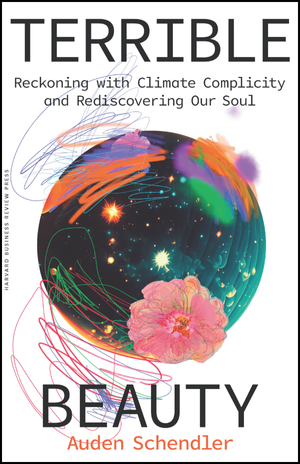
Terrible Beauty: Reckoning with Climate Complicity and Rediscovering Our Soul
Auden Schendler
272 pages, Harvard Business Review Press, 2024
If you work in corporate sustainability, you are probably used to being called naive or misguided for believing that businesses can be persuaded to help solve the world’s biggest problems. But Auden Schendler goes much further. At one point in his new book, Terrible Beauty: Reckoning with Climate Complicity and Rediscovering Our Soul, he writes that corporate sustainability is “borderline evil.” Why? Because the sustainable business movement has, for decades, been complicit in allowing the fossil-fuel industry to maintain its position of economic and political dominance. According to Schendler, the “technocratic fantasy” of businesses and markets solving the climate crisis—without the need for more serious government regulation—has distracted from the real work of challenging the structural power of the fossil-fuel industry and its backers.
Schendler offers a couple of analogies to drive his message home about the feebleness of traditional corporate sustainability practices. First, he says that they are “akin to responding to racism in America by asking people to just be nicer, instead of passing the Voting Rights Act.” And shortly thereafter, “the climate equivalent of asking for prayer in response to school shootings.” In short, proponents of sustainable business may be well-intentioned, but they have been useful idiots for the fossil-fuel industry.
At this point you may be surprised to learn that Schendler is a fully paid-up member of the corporate sustainability club. He is currently the senior vice president of sustainability at Aspen One, a private company owned by the Crown family. (As of September 2024, the Crowns sit at No. 30 on the Forbes list of America’s richest families.) Schendler has worked for one of their companies (before Aspen One he headed up sustainability for its subsidiary, Aspen Skiing Company) since the late 1990s. Before that, he worked for the Rocky Mountain Institute, a think tank that has been a pillar of the sustainable business community for more than 40 years.
No doubt those who feel threatened by Schendler’s evisceration of corporate sustainability will use his résumé to imply that he is a hypocrite. To my mind, though, his insider status strengthens rather than undermines his credibility. In fact, his apostasy has been brewing for a long time: Schendler first went public in 2007 with his concerns about the win-win narrative that underpins most corporate sustainability efforts—the tale that companies’ pursuits of sustainability and profit maximization are compatible. He has had time to plumb the depths of disillusionment, test out different approaches, and emerge with a rare clarity about how to harness the power of business as a genuine force for good.
At its heart, Terrible Beauty is a call to arms for Schendler’s fellow corporate sustainability professionals. Its central message is that political activism is the way to make genuine progress on climate issues and that corporations are powerful political actors that can support or impede climate action. Schendler’s advice to those working in corporate sustainability is not to quit your job—that really would be hypocritical—but to focus on getting your company to use its political influence for good. To do this, companies need to stop obsessing about “operational greening” and instead divert resources toward efforts to engage with policy makers.
Schendler is not the only person to argue that companies should use their political influence to tackle the climate crisis, but he pushes the case further than most. As he acknowledges, there are already companies that advocate in favor of climate policies. (Walmart, Salesforce, and Constellation Energy get honorable mentions.) But even these leaders are, in Schendler’s words, “missing the policy forest for the operational trees.” Take Salesforce as an example: The company “overwhelmingly emphasizes addressing its own footprint in its public materials and almost footnotes the critical power-wielding and lobbying it does.”
Sustainability professionals working inside companies need help from outside if they are to succeed in elevating policy engagement to the top of their priority list. As Schendler acknowledges, “there is enormous pressure [on corporate sustainability teams] to set goals, file reports, create ‘science-based targets,’ measure, marginally tweak emissions, and show progress, even if that progress is fake. There is almost no pressure to engage in systemic change, wield power, influence politics, or participate in movements.”
Corporate sustainability strategies respond to expectations set by external groups. Companies spend time and money on activities that will improve the score they get from ESG ratings agencies, or how they perform against various disclosure frameworks. They prioritize things that will garner a positive response from opinion-leading NGOs, journalists, and academics. These self-appointed arbiters of what good looks like have a lot to answer for. They are the ones that keep companies focused on target setting and operational greening, while providing little incentive to tackle what Schendler refers to as the “hard, unpleasant, and nasty work of political activism that might truly drive down global emissions.”
Terrible Beauty offers valuable ideas for corporate sustainability professionals to reinvent their profession.
Let’s suppose, though, that the status quo can be upended and that a company’s political footprint, rather than its carbon footprint, becomes the ultimate yardstick of sustainability performance. What, then, does good look like? On this, Terrible Beauty offers several valuable insights.
First is the recognition that most corporate political influence is indirect: It is channeled via trade associations that lobby on their members’ behalf. I get the impression that if Schendler could persuade most Fortune 500 companies to do one thing, it would be to quit the US Chamber of Commerce, which has a track record of staunch opposition to climate policies. Ironically, this may be that rarest of things: a genuine win-win for the bottom line and the planet. If corporate America decided to stop paying membership dues to trade associations that block meaningful climate action, they could save money and improve the chances of science-based policies being enacted.
It is also striking that the examples of successful political activism in Terrible Beauty are more local than global. It makes no mention of the UN Framework Convention on Climate Change and its annual Conference of Parties (COP). Instead, we get the story of how Schendler instigated a campaign to get clean-energy champions elected to the board of the local electric utility in Western Colorado. The guerrilla-style campaign, fought over many years, resulted in the utility in question—Holy Cross Energy—appointing a climate scientist as CEO and pivoting away from coal and gas toward renewables. In 2008, just 6 percent of Holy Cross’ power supply came from renewables; by the end of 2024, Schendler reports, that number will be 90 percent. The implicit message to companies that think climate advocacy is about showing up at COP every year is that they are expending effort in the wrong arena. The political processes that matter and where corporate support for more aggressive climate policies can make a real difference are mostly local or national.
Schendler is not overly prescriptive about which specific policies companies should push for, but he does give several examples of good and bad policy. As instances of good policy, he cites banning natural gas in new buildings and banning the extension of gas lines into new neighborhoods. He is a fan of California’s zero-emissions vehicle standard (which Colorado emulated during a period when he was serving on the state’s Air Quality Control Commission) and of the tax incentives for clean energy included in the Inflation Reduction Act.
Conversely, he is critical of the US Securities and Exchange Commission’s decision to adopt rules requiring companies to disclose extensive climate-related information. “The law will take years to comply with and occupy time that could be spent on real change; it is a law that could have been written by the fossil-fuel industry,” he explains. Much of the same criticism could be leveled at the European Union’s complex web of rules requiring companies and financial institutions to provide detailed disclosures about their sustainability-related risks and impacts. Using precious political bandwidth to pass rules requiring companies to compile detailed reports eats into the political bandwidth available for other, potentially more impactful, policy measures (not to mention companies’ bandwidth to do anything other than reporting).
What differentiates the good from the bad, for Schendler, is the underlying theory of change. Enhanced disclosure requirements work on the assumption that unsustainable business practices are a problem of information. If investors and other stakeholders have access to more and better information about the sustainability profiles of companies, they are supposed to reward good companies and punish bad ones. Unfortunately, there is no evidence that they will do so to any meaningful extent. In reality, transitioning to a sustainable economy is a problem of incentives, not information. The climate policy ideas that are worth supporting—eliminating fossil-fuel subsidies, putting a meaningful price on emissions, implementing stricter environmental standards for new buildings, introducing phase-out dates for climate-wrecking technologies—are the ones that alter the incentives driving business and investment decisions.
Terrible Beauty offers valuable ideas and insights for corporate sustainability professionals ready to respond to the call to reinvent their profession. It’s also a deeply personal book that seeks to offer moral and spiritual succor to those of us who feel compelled to participate in the struggle to save civilization, despite knowing that things will only get worse in our lifetimes. “We need to treat the climate slog,” Schendler writes, “more like making coffee in the morning than deploying for war. A joyful habit. The right way to live.” To his credit, Schendler seems to practice what he preaches: There is a palpable sense of enjoyment—of reveling in the camaraderie, the challenge, the chance to make mischief—threaded through all the stories in this book. Together they make it a primer for any would-be changemaker.