


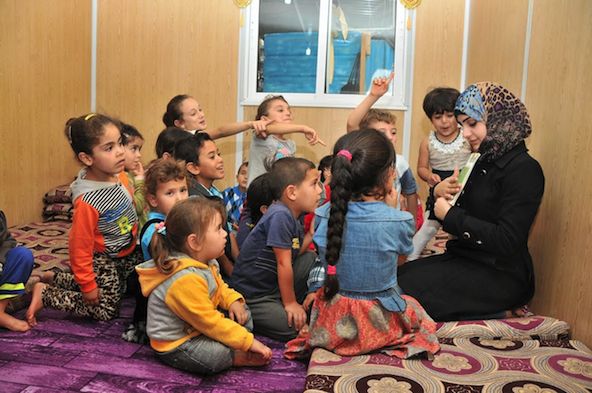
 Asma Al-Rashed, a Syrian refugee and We Love Reading ambassador, reads aloud to children at the Za’atari refugee
camp near Mafraq, Jordan. (Photograph by Abdulrahim Al-Arjan, courtesy of We Love Reading)
Asma Al-Rashed, a Syrian refugee and We Love Reading ambassador, reads aloud to children at the Za’atari refugee
camp near Mafraq, Jordan. (Photograph by Abdulrahim Al-Arjan, courtesy of We Love Reading)
Rana Dajani, a molecular biologist at Jordan’s Hashemite University, returned home from a Fulbright fellowship in the United States struck by the lack of readers and public libraries in her home country.
So, on a Saturday morning in February 2006, the mother of four carried a bag of children’s books across the road to her local mosque in Amman, Jordan. She donned a traditional folklore dress and a silly hat, and spent an hour reading stories to two dozen children gathered at her feet.
During Friday prayers the following week, her imam advertised her story time to the congregation. Fifty children showed up for the second event. With a small grant from the mosque, as well as some personal savings, Dajani bought a collection of books for her first library. She acted out the stories in costume and with puppets, and read three books before offering to lend each child a book to take home. Some of them had never had a children’s book in their home.
“The way the kids look at you, the way you feel their eyes sparkle as they’re listening to the story, it makes you forget everything, and you just say, ‘Oh my God, this is worth it,’” Dajani says.
Thus began We Love Reading (WLR), a global program that guides women volunteers through the process of forming and hosting weekly read-aloud circles for children in their neighborhood’s public spaces.
After a two-day training, each WLR volunteer takes home a bag full of 25 books and a puppet. The WLR team curates each seed library with stories appropriate and compelling to little readers, and ensures that the stories avoid religious and political bias. The organization holds volunteers responsible for recruiting an audience and fundraising for more books.
By January 2017, WLR had trained approximately 2,000 women, built 1,500 libraries, and told stories to 40,000 children—60 percent of whom were girls—in 30 countries across the Middle East and Africa. The organization has partnered with Unicef to train WLR volunteers in Syrian refugee camps and with Jordan’s Ministry of Education to improve reading in classrooms. WLR has been awarded grants from the Clinton Global Initiative, the Qatar Foundation’s World Innovation Summit in Education (WISE), and the Stars Foundation’s Impact Awards. WLR also won an award from the UK Department for International Development through an IDEO.org Amplify challenge focused on refugee education helped Dajani develop an online training program and mobile app to help scale the organization.
Dajani’s beautifully simple and replicable idea can be adapted to almost any context, says Rob Gradoville, portfolio manager for IDEO.org’s Amplify innovation challenges. “The magic is in the details that Dajani and her team provide to each volunteer, training them so they can host reading circles in a way that has been scientifically proven to engender empathy and improve learning outcomes in children,” Gradoville says.
Volunteer Dedication
The benefits of reading are undeniable. Reading expands children’s imagination, improves their vocabulary, and enables them to be more expressive and less violent. A study organized by the University of Chicago psychology department found that WLR nearly doubled children’s generosity and also increased the amount of empathic concern that a WLR child felt for another child. Further research by economists at the University of Melbourne has shown that children will eventually read for pleasure if adults read aloud to them.
But not everyone receives these benefits. The illiteracy rate in the Arab world is around 35.6 percent, nearly double the global rate of 18 percent, according to the Arab League Educational, Cultural and Scientific Organization. Public surveys also suggest that a shockingly low percentage of Arab households read for pleasure, compared with their counterparts in the United States and Western Europe, Al Arabiya has reported.
WLR seeks to address this inequality. Parents of kids who attend WLR programs report that their kids do better in school, ask for stories rather than toys, feel more confident, and are safer when they spend less time in the streets of unsafe neighborhoods. This satisfaction, in turn, instills a sense of ownership in communities, Dajani says.
In Aqaba, Jordan, a volunteer who started a new reading circle in her local mosque soon found the space too small. So, a local contractor donated his time to build a new room; neighbors came with paint cans, wood, and nails; and together they created a library. “Now if we had built a library, nobody would have used it or taken care of it, but because they did it, and it was the buy-in from the community, it’s still running,” Dajani says.
The cute, eager audience also inspires the dedication of WLR trainees. Many volunteers report back to WLR Program Manager Alaa Zaghoul that they believe in the power of reading to improve their communities. Hashemite University researchers found an 84 percent increase in leadership skills among WLR volunteers. “It’s a kind of leadership formation or starting point for creating community leaders,” says Anke Schwittay, an anthropologist at the University of Sussex who studied winners of the Amplify challenge.
Still, Dajani and her team are acutely aware of the need to help volunteers stay motivated, Gradoville says. During IDEO .org’s design work with WLR, they helped prototype an SMS-based system for WLR staff and the volunteers around the world to stay connected. “This allows Dajani’s team to collect information about the volunteers’ progress and highlights, and also provides volunteers with a window into the global movement that they are contributing to,” Gradoville says.
Unlike many international organizations working in the same refugee camps, WLR does not pay trainees for participating in their activity. Instead, WLR gives only the two-day training and books. But Dajani says you can visit these same volunteers a year later, and they’re still reading to kids. When Gradoville visited a Zaatari refugee camp in Jordan with his team in 2015, one reading volunteer said of the program, “It shows that I’m not simply an idle refugee waiting for help and feeling sorry for myself.”
“It is a simple yet powerful way for refugees to take a stand, support their children’s education and growth, and continue fighting for a better life despite the many challenges they face,” Gradoville says.
WLR’s success with volunteers may offer an important lesson for those working in international development. Dajani believes that if you compensate someone for doing something, they will do it for the money. “We plant that feeling of responsibility so they do it without being paid, because they want to do it for their own sake, for their own people,” she says.
Nevertheless, the organization still needs funds to support itself and grow. Dajani credits some of the organization’s success to its focus. From the outset, she has expanded WLR carefully and cautiously. She spent little time looking for funds; instead, donors—including Unicef and USAID—came courting her. “Slowly, we were able to get a very good reputation that we have a program that works,” she says. This tactic slowed progress, but now WLR is recognized as the best community-based program for reading for children under the age of 10.
Scaling Around the Globe
Dajani’s work has already reached far beyond her home country. In Turkey, the Mother Child Education Foundation adopted the WLR model to educate illiterate mothers. Indigenous people in Mexico have applied the program as a way to preserve the oral heritage and pride of their local communities and to improve school enrollment. In developed countries, WLR encourages literacy among immigrant communities and refugee communities.
But scaling WLR’s model at a pace beyond the capacity of Dajani proved a core challenge for the IDEO.org team. When it began working with WLR, the organization relied on Dajani to host training sessions in every new location. This approach enabled her to inspire volunteers through her own story, but it prevented WLR from meeting demand for the program, says Amplify Design Lead Rafael Smith. “Together we developed and tested prototypes that used videos and mobile technology, to take the place of Rana and allow for trainings to be facilitated by any NGO staff member on the ground.”
They also realized that WLR had to evolve from a program run by one organization to a regional movement that any NGO working with refugees across the Arab world could implement. Part of this was helping WLR find a sustainable way to expand their program to reach the many children they want to serve, while maintaining quality.
Based on insights that emerged through conversations with people living in the Zaatari refugee camp, the IDEO.org team designed a service model, a suite of training tools, a partnership strategy, and a brand for WLR to launch in refugee contexts. The campaign and training materials feature illustrations that are inspired by traditional Arabic script and are commonly found in Arabic-language children’s books. They also created a series of Arabic-language training videos that bring Dajani’s founding story to life and share the values of reading aloud to children.
Dajani’s ultimate goal is to set up a story hour in every community around the globe. She believes reading can provide children with not only knowledge, but also passion, empathy, and respect for the world, Gradoville says. “She is a dreamer with a scientific mind, and she has set her sights on this visionary goal of a world where all children learn to love reading at an early age.”
Schwittay is skeptical of global plans similar to Dajani’s because countries vary in their reading cultures. And yet, she points out, Dajani already operates in many different countries. “Her organization has found a way to adjust to those different contexts,” says Schwittay. “Rana managed to do it in Jordan, on her own account. There wasn’t a culture of reading for pleasure there, and she managed to start instilling that.”
Read more stories by Corey Binns.