


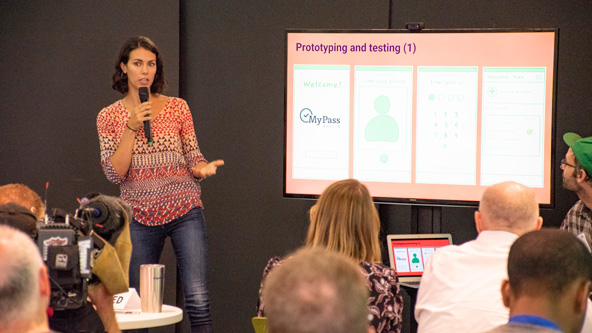
 MyPass Austin's early stages of development culminated with a hackathon, where teams of
developers and volunteers worked with the city’s office of innovation to test whether blockchain technology was the most effective means of creating “digital passports” for people experiencing homelessness. (Photo courtesy of the Austin Innovation Office)
MyPass Austin's early stages of development culminated with a hackathon, where teams of
developers and volunteers worked with the city’s office of innovation to test whether blockchain technology was the most effective means of creating “digital passports” for people experiencing homelessness. (Photo courtesy of the Austin Innovation Office)
Cities across the United States are searching for ways to help people facing housing insecurity. Austin, Texas—where more than 2,000 people experience homelessness on a given day—has taken initial steps toward piloting a program to create digital identities that retain an individual’s personal identification materials through blockchain, the incorruptible digital ledger that can record just about anything.
In February 2018, the city of Austin—working in partnership with leaders from the Dell Medical School at the University of Texas at Austin and a group of advisors who were either currently experiencing or had formerly experienced homelessness—was awarded a $100,000 grant from Bloomberg Philanthropies to explore how to use blockchain to provide homeless residents with ready access to personal information, including medical and court records, using a unique, secure identifier. Inspired, in part, by how blockchain technology has assisted identification among refugees, the initiative aims to reduce the daunting number of logistical hoops—and, in turn, the amount of time—the homeless face in gathering their documents from various agencies, helping them access critical services more quickly.
“One thing that would help shorten the time people are homeless all over the country is if we could solve the identification crisis,” says Ann Howard of Ending Community Homelessness Coalition in Austin. “Not so much because we need a new data system, but because we need the people experiencing homelessness to have the ability to retain their ID even if they lose everything.”
For a person experiencing homelessness, physically losing or misplacing critical paper documents—such as photo identification and medical records—can make the difference between being able to access services and being turned away. Through the MyPass Austin program, agencies would have the ability to upload an individual’s records to the blockchain, which would be readily accessible to city and social service agencies and—most important—the individuals themselves.
“There’s a tremendous runaround to getting and keeping documentation,” says Kerry O’Conner, Austin’s chief innovation officer. “Right now, it’s in everyone else’s databases and is oriented toward the system. If the people themselves are the data integrator, that empowers them while allowing for more time to focus on the need.”
MyPass began with a number of focus groups to ensure that homeless populations would be responsive to, and trust, the blockchain system; that service providers would be able to easily access the data; and that individuals’ information would be secure. These early stages of development culminated with a weekend-long proof-of-concept
hackathon, where teams of developers and volunteers worked with the city’s office of innovation to test whether blockchain technology was the most effective means of creating these “digital passports.”
“The big question from the hackathon was, ‘Is blockchain necessary or not to what we’re trying to achieve?’” O’Conner says. “One team even explicitly tried to disprove that blockchain was necessary.” Ultimately, the teams proved that blockchain, which provides both security and streamlined information retention, was a critical component of the platform. A New York City-based startup, Blockchain for Change, has also worked on using the technology to create digital identities for the housing-insecure, by providing free cell phones with a preloaded app, Fummi, to more than 200,000 individuals.
MyPass still faces the challenge of helping service providers seamlessly provide records for inclusion in the system.
“It’s one thing for the technology to exist, but you have to get all of these other system [providers] to use it” or it won’t be helpful, Howard says. But she sees great potential from its contribution to service delivery. Giving the client “power over their own identity and being able to access a service or sign a lease by saying, ‘You can see all my documents through the blockchain’—that’s exciting,” she says.
But Sam Lew of the Coalition on Homelessness San Francisco is concerned about the potential of individuals’ information to fall into the wrong hands—even with the secure technology.
“My initial concern would be around the tracking and data-mining of people who are experiencing homelessness,” Lew says. “How could this be used to further criminalize homeless people by having all this information about them in the cloud?”
Still, the MyPass team see reducing risk and fraud as blockchain’s main benefit. O’Conner says that city agencies are excited about the prospect of MyPass, and the program is currently seeking additional funding.
“This is something that could be easily replicable in other cities,” she says. “It’s all about taking a really user-centered design approach as we work on how we help individuals access their benefits with less friction.”
Howard agrees: “Blockchain would give more autonomy to the individual, and I’d love to think that we could lead the world by solving some of these issues.”
This article appeared in the Summer 2019 issue of the magazine with the headline: “Fail-Safe Keeping of Personal Records.”
Read more stories by Sarah Baird.