

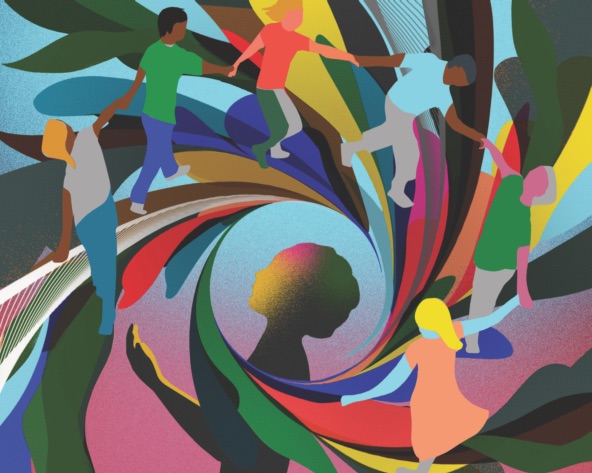
 (Illustration by Brian Stauffer)
This article is based on a recent written dialogue between the two authors about the New Education Initiative (NEI), the largest NGO in China, which operates in more than 11,000 schools nationwide. Yongxin Zhu, a Yidan Prize laureate, founded NEI. Kai-ming Cheng is an emeritus professor at The University of Hong Kong and emeritus advisor to the Yidan Prize. The dialogue was conducted in Chinese and comprised more than 80,000 characters.
With a population of more than 1.4 billion people, China has a vast education system: more than 136,300 primary schools, 52,100 junior secondary schools, 15,800 senior secondary schools, and more than 3,000 institutes of higher education. The system has nearly universal attendance at the basic education level and is supported by sophisticated governance. It also has a strong culture in which parents value education highly, teachers work exceptionally hard, and students achieve strong results in international comparisons.
Yet what has held the national system together is examinations, especially public examinations. It is perhaps no exaggeration to say that China is the home of standardized testing. Public examinations were formalized about 1,600 years ago as a mechanism for selecting people for the civil service. At the heart of this system is a paradigm of equal competition that has spread to other countries and become a foundation of civil service systems. Because civil examinations have tested mostly reading and writing, they are often mistakenly regarded as an “education” system. The system has instead created a culture that respects hard work and honors competition while placing less emphasis on innate ability. It has also resulted in a preoccupation with symbolic achievement at the expense of authentic learning.
Although Chinese students perform exceptionally well in international comparisons, the culture has come under heavy public criticism. There is simply no substitute for the examination system, yet its negative effects—including intense pressure, depression, and anxiety among students—are felt across the country. Critics argue that students are too often placed in structured, passive modes of learning. They have few opportunities to think deeply, explore the meaning of what they are learning, or indeed, consider the meaning of life.
Breakthroughs in Education
That said, many schools are seeking to transform their learning environments so that students can enjoy a more relaxed and meaningful life. Both authors of this article have visited many schools, and Zhu, in particular, visits nearly 100 schools each year. As an academic, he set out to explore the schools in search of breakthroughs. He reads extensively, beginning at around 5 each morning, a habit that has helped him summarize and theorize what he observes on the ground.
Through this work, he has come to believe that breakthroughs in education must begin with students. Above all, education should support students’ well-being, rather than teaching them to equate success with high scores and satisfaction with prizes.
Students need a rich and comprehensive life in which they can grow, and different students will follow different paths in their development. This vision runs counter to the educational paradigm that emerged at the height of the industrial era, in which every student was expected to learn the same things, follow the same processes, and undergo the same assessments.
Over the course of his observations, Zhu found that some schools were doing better than others, despite facing the same examination pressures. The students lived healthy, energetic lives because they enjoyed a harmonious school environment. He observed this phenomenon at the grassroots level, on the front lines where educational innovation takes place.
There is no shortage of theories in education, most of them originating in the West. It is easy to fit what we observe in schools into existing theories, or to build on those theories to propose incremental improvements and, eventually, a new theory that can readily lead to academic recognition. Zhu’s work is distinctive in its purpose: He observes schools not simply to develop theory, but also to find ways to improve schools more broadly.
After years of observation, Zhu has concluded that the real wisdom of education lies on the front lines of schools. He is particularly adept at recognizing the strengths of individual schools, but more importantly, distilling what he has observed into insights that can have meaning for all schools.
This approach to school is especially important at a time when circumstances are changing so rapidly that schools cannot afford to wait for theories to emerge. Young people face a world of unexpected changes and challenges, and they need to develop the agency to shape their own futures. Schools operate in local environments and under diverse conditions, but they want to understand how their work fits into the larger picture.
The NEI Motto
The NEI not only provides a broad framework to guide schools; it also respects diversity. Its motto, “Providing an Enlightening and Fulfilling Education Life,” requires some explanation.
The original Chinese motto draws on three concepts: “happiness” (幸福), “comprehensiveness” (完), and “education life” (教育生活). These were Cheng’s initial translations. But an in-depth conversation with Zhu revealed deeper meanings behind each term.
First, “happiness” is best understood as students’ well-being. “Happiness” is not a goal in itself. Students must undertake hard work and difficult tasks. Those experiences are essential to their growth. Schools, in turn, must create the conditions for students’ well-being and help them find meaning in their lives. In this sense, happiness is understood broadly, with a long-term view of students’ development.
“Comprehensiveness,” too, is only a partial interpretation of the original term. Chinese schools already provide students with a wide range of activities, and extracurricular activities are often abundant. For Zhu, however, comprehensiveness generally means something more fundamental: students should understand success as something larger than examination scores, and meaning as something beyond winning prizes or gaining admission to prestigious universities. They should have the opportunity to pursue the goal of “becoming a better self.” Zhu emphasizes that this goal will look different for different people. Comprehensiveness is about fulfillment in the broadest sense.
Cheng grappled with how to translate “education life.” He considered “school life” and “learning life,” but found neither satisfactory. His conversations with Zhu made clear that the term refers to a holistic approach to education and the ecology in which students are embedded. It encompasses schools and families, but also the media and society at large. For this reason, “education life” may be worth retaining as the translation, since it captures a distinctive and emerging way of thinking about education.
On reflection, the motto might be rendered as, “Let students enjoy well-being and a fulfilling education life.” It is far from a perfect interpretation but it comes close to capturing the spirit of the original.
Why Schools Join NEI
In conversations with school principals who participate in NEI, one explanation for joining was:
I had my own ideas, and I put some of them into practice. But it was only when I read and heard Dr. Zhu that I became enlightened. It was an “aha” moment. I realized that what I was doing had significant meaning. For the first time, I felt that my work was being seen and recognized, and I was eager to join a community where I could find peer schools doing similar things.
NEI advocates 10 actions:
- Constructing a campus with the fragrance of reading
- Writing together, teachers and students
- Listening beyond the windows, with attention to society
- Learning to speak eloquently
- Shaping ideal classes
- Building a digital community
- Fostering good habits and virtues
- Creating a positive classroom atmosphere
- Developing an excellent curriculum
- Nurturing the next generation through school-family cooperation
Together, these actions encompass everything to which a school might need to pay attention. But they are by no means intended as a manual or a prescribed set of steps. Each year, NEI’s leadership chooses a topic for in-depth study, while individual schools decide where to place their own emphasis.
How NEI Scales
There is no financial benefit to schools for joining NEI, nor are there directives they are required to follow. What connects them is a shared philosophy of education and way of learning that places human development and flourishing at the center. NEI is an NGO that is loose in structure but demanding in its vision of education. It is a community that honors diversity while aspiring to excellence. This combination has allowed it to prosper.
Over the past 25 years, NEI has grown from one school into a network of more than 11,000 schools, reaching over 10 million teachers and students, many of them in rural areas of China. As teachers experienced how NEI’s approach helped them grow and supported children’s development, they shared those experiences with colleagues. The resulting flywheel effect drew more schools to join the initiative, while a rapidly growing online community helped spread its ideas across regions.
In this way, NEI expands from school to school and county to county through existing administrative structures and a community of educators. In 2024, the Chinese Ministry of Education named NEI a key project for promoting teaching nationwide, recognizing grassroots innovation at the national level.
And this may only be the beginning. A relatively small number of innovative schools are already demonstrating what is possible.
New Developments
Zhu was awarded the Yidan Prize for Education Development in 2022. He donated the entire $30 million Hong Kong dollar ($3.8 million) prize to Suzhou University, his alma mater, and established the New Era Teacher Foundation. Building on NEI’s work, the New Era Teacher Foundation launched a teachers’ learning community called the Class of Enlightened Teachers, which brings together some 40 participants each year. It is not a conventional training course. Instead, it introduces selected teachers to a wide range of fields through professional reading, writing, and exchange.
The New Era Teacher Foundation has also created an annual international activity that brings around 40 educators to China to exchange ideas and discuss the frontiers of education. Other programs focus on local teacher development and strengthening rural schools.
NEI is an unusual example of an NGO: It encourages, recognizes, and shares school-level innovation while operating within a broader education system and culture that are still evolving. At the heart of NEI is a simple but powerful question: What kind of person do we want to help each child become?
This question asks us to put the whole person—not the demands of the system—at the center of education. It means nurturing a love of learning and addressing school aversion. It means protecting learners’ mental health and developing their agency. It means seeing education not merely as a means to an end, but as a way of life.
Read more stories by Kai-ming Cheng & Yongxin Zhu.