


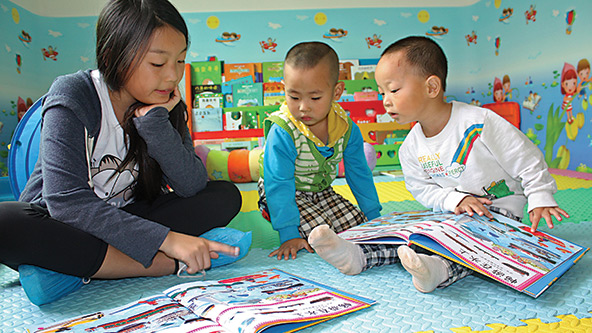
 A Stanford REAP intern reads with two local toddlers at a parenting center REAP constructed in Southern Shaanxi Province. (Photo courtesy of Stanford REAP)
Scott Rozelle took his first trip to the People’s Republic of China in 1984 when, as a PhD student at Cornell University studying development economics, he helped teach a course at Nanjing Agricultural University (NAU). In the late 1980s, as part of his dissertation research, he launched one of the first in-country field studies by a foreigner since China had opened up to researchers from abroad. He was studying the economics of hybrid rice adoption to see how village leaders would respond to the introduction of new rice strains and how the product would impact rural livelihoods.
To this day, Rozelle remains closely tied to that same corner of the world. He leads Stanford University’s Rural Education Action Program (REAP), a research collaboration between Stanford and dozens of university partners in China. For 15 years, REAP has focused on finding innovative, scalable solutions to health and education problems in rural China. REAP’s work includes programs to improve nutrition, promote better teaching, boost health and cognitive outcomes for infants, and leverage computers to enhance learning in classrooms. The common denominator in all these efforts is simple: Find out what works, and scale it.
REAP belongs to a branch of development economics that emphasizes rigorous evaluations of social programs using primary data and statistics. Their idea was to measure the effectiveness of a program in the same way that one would for a medicine: Choose a large enough sample of people, randomly divide it into halves, provide an intervention for one half and not the other, and then observe the two groups over time. Using this approach, whatever changes that occur between the two groups can be attributed to the intervention. In this way, researchers can quantify the impact of a program and determine who was benefiting or not and why—all in order to better inform the selection and implementation of development policies.
But REAP is more than a research collaborative. In addition to determining what works for development, the group pushes for large-scale change and adoption of proven programs. This advocacy takes many forms, from writing policy briefs to China’s highest leaders, to piloting proven solutions with local officials, NGOs, social enterprises, and philanthropists to showcase how successful programs can be scaled. In this way, the group is a unique blend of knowing and doing.
Beginning in 2006 with a small grant, one full-time staff person, and a cramped, windowless office in Stanford’s Encina Hall, REAP now has 20 full-time staff in the United States and China and dozens of affiliated faculty around the world. REAP has published hundreds of papers in the academic press, trained thousands of students in the United States and China, and touched the lives of millions of children, all while informing development best practice around the world. REAP’s rise to prominence tracks China’s own economic development and testifies to the extraordinary gains possible when researchers from the United States and China work together.
Better Schools, Higher Quality Health
Rozelle’s lifelong interest in China began when his father, a fourth-generation Californian who had been stationed in Shanghai during World War II, encouraged him to sign up for a Mandarin language class at his junior high school in Bellflower, a suburb of southeast Los Angeles County. The course was part of a new, Cold War-era government program to increase skills in strategic languages such as Russian and Chinese that were rarely taught in US grade schools.
Since Rozelle’s fateful childhood decision to study China’s most popular dialect, his trajectory has become integrally linked to the country. In the course of his earliest work with China’s farmers when he was still a student writing his dissertation, Rozelle found an impoverished, predominantly agricultural countryside. The region was slowly emerging from more than three decades of ruinous political upheaval and collectivist experimentation under Chairman Mao Zedong. Farmers still relied chiefly on manual labor to produce crops, and very few of the country’s hundreds of thousands of rural villages were even served by a road.
Upon completing his PhD in 1990, Rozelle took up a post as assistant professor at Stanford’s Food Research Institute (FRI). After FRI closed in 1996, Rozelle became an associate professor with tenure at the nearby University of California, Davis, where he continued his work on rural China. While Rozelle was at Davis, his research program grew rapidly, and based on these accomplishments, he was ultimately promoted to full professor in 2000. Rozelle returned to Stanford in 2006, becoming the Helen C. Farnsworth Professor in International Agricultural Policy at the Freeman Spogli Institute for International Studies. Throughout his time at Stanford and UC Davis, Rozelle continued to focus on development and poverty alleviation in rural China, building a wide network of collaborators in China and gaining abundant experience doing fieldwork in rural areas. Indeed, by the mid-2000s, Rozelle had become one of the top figures in the academic world who were studying China’s rural economy and farming sector.
Meanwhile, market reforms of China’s economy initiated under Chairman Deng Xiaoping were by the 1990s steadily transforming livelihoods in rural areas in important ways. Rozelle studied improvements in farming and food production as well as the growing shift of rural labor into the off-farm sector. By the early 2000s, as the country emerged out of grinding poverty into a more prosperous middle-income country, Rozelle realized that continued economic development in rural China was no longer strictly about choices of rice strains.
“I was seeing that even if farmers had all the inputs to make their small farms as productive as possible—seeds and tools and whatnot—their lives and incomes could improve, but only marginally,” Rozelle says. “These are all tiny family farms. Factory and construction jobs were certainly around, but what’s the future in hauling bricks up scaffolding? Plus, what is going to happen to those jobs when the highways are all built and the building of condominiums slows down? That’s where we are now. That stuff is all mostly built.”
As China was opening up, other pathways to prosperity were emerging. How could farmers tap this potential? The problem crystallized in Rozelle’s mind in 2004 when he analyzed results from a survey of 20,000 farmers.
“We asked them what they needed to improve their livelihoods,” Rozelle recalls. “And they didn’t ask for new irrigation ditches or better plows. They asked for better schools and higher quality health. They wanted the one thing that could get them off the farm and into the better opportunities of the future: a good education.”
This finding marked a shift in Rozelle’s thinking. He began to study the complex challenges of human capital formation in rural China. And what he found was sobering. Two-thirds of China’s population—one of every nine people on Earth—live in the country’s interior. Nearly three-quarters of school-age children in China are rural—and fewer than one-third of them were finishing high school. Rozelle and his colleagues’ research revealed that rural young people of all ages were underperforming their urban peers by almost any educational metric imaginable. In these agrarian areas, so often obscured by the dynamism and growth of China’s cities, was a growing crisis. By dint of its sheer size, rural China, should it falter, had the potential to derail not only the country’s economic growth but the world’s as well.
Fortunately, China has a strong national government that can, if it decides to, mobilize major resources to get things done. It also has a deep wellspring of ambitious and talented researchers—many of whom were either students or close colleagues of Rozelle. With the right knowledge about what programs were effective, China’s researchers and policy makers could enact big changes and help millions of people. Rozelle saw the opportunity to launch something new and impactful that could address the real problems faced by China’s rural populations.
“China is the ultimate laboratory for an economist to study development,” Rozelle says. “It’s developing so fast that you see it before your eyes. And there’s a wherewithal there, so you can measure things that you can’t measure anywhere else, and with the evidence in hand, big change is possible.”
Adapting Experimental Economics to China
In 2003, three development economists with ties to MIT, Abhijit Banerjee, Esther Duflo, and Sendhil Mullainathan, launched the Poverty Action Lab. Now called the Abdul Latif Jameel Poverty Action Lab (J-PAL), the venture pioneered the use of lab methodologies to solve development problems. Banerjee and Duflo would go on to win the Nobel Memorial Prize in Economic Sciences for their innovative approach.
Inspired by their work, Rozelle parlayed his long-standing connections and collaborations in China to form a new research group at Stanford that would seek to deploy these approaches to address development problems in rural China. He named the new initiative the Rural Education Action Program.
Adapting J-PAL’s approach to rural China presented a challenge. J-PAL’s model involves researchers at leading universities in the United States and Europe working together with local NGOs and survey companies in developing countries to evaluate promising interventions. This model could not work in China because the country had very few comparable local organizations that would be allowed into a rural school or clinic. As a consequence, J-PAL created extensive programs that spanned nearly every corner of the developing world, from South Asia to Latin America and sub-Saharan Africa, except China. Paul Glewwe, an applied economist at the University of Minnesota, is a J-PAL affiliate and has worked on several projects in China with Rozelle. He summarized the difference between J-PAL and REAP nicely: “Rozelle and his colleagues tweaked the way J-PAL did things elsewhere in the world in order to bring the fruits of this new approach for development to vulnerable, rural communities in China.”
The key to unlock this opportunity was local universities. “University professors in China often have really strong ties to their former students, many of whom now work for the government,” Rozelle says. “We learned that we could leverage those ties to get things done. The professor wants to do good research, the official wants to make a difference, there’s trust because they know each other, and then all of the sudden we have access to schools and clinics to do our work.”
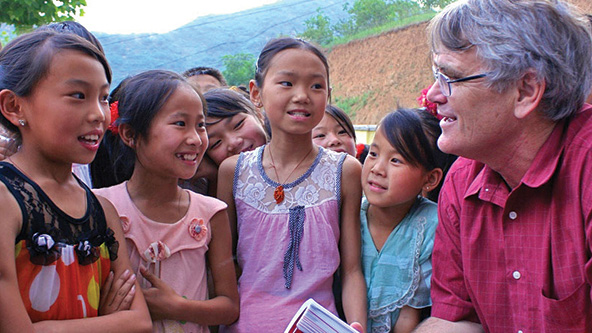 Scott Rozelle (right), the founder of Stanford REAP, speaks with a group of children during a 2014 school visit in Henan Province. (Photo courtesy of Stanford REAP)
On the basis of this alliance as well as a seed grant from the Ford Foundation, REAP—at the time just Rozelle and a research assistant—launched its first evaluations in 2006, investigating nutrition among rural primary school children. Today, REAP has partnerships with professors and their students in more than 30 universities across China. Built on such collaborations, since 2006, REAP has completed more than 70 evaluations on a wide variety of interventions.
Doing the Fieldwork
As development economists by training, Rozelle and his REAP colleagues know how to run evaluations and measure impacts, but they do not necessarily have topical expertise on the interventions themselves, including what outcomes are important. Nutrition programs need nutritionists, mental health programs need mental health physicians, and computer-assisted learning programs need faculty fluent in educational technology. For these pursuits, REAP must recruit other faculty to participate in the evaluation design and help determine the outcomes of interest. Fortunately, Stanford is fertile ground for experts, and many of REAP’s programs leverage Stanford faculty. But REAP frequently goes further afield, too.
“I remember meeting Scott Rozelle at a conference in about 2010,” says Nathan Congdon, a research ophthalmologist at Queen’s University Belfast. “I’d seen a talk he gave about his program, and I asked him if his team could evaluate the impact of giving glasses to nearsighted children. We sat down for coffee and have been working together ever since, publishing one-of-a-kind stuff on vision and how it is important for schooling.”
In addition to the right topical expertise, evaluations need support staff—another area where partner universities have proven essential. A sample for a study includes dozens or even hundreds of schools or villages. Partner faculty in China have their own graduate and undergraduate students who are eager to participate in international projects. Partner faculty recruit teams of enumerators, REAP trains them in survey administration, and they fan out across the countryside surveying sample areas or implementing an intervention. Over time, particularly skilled and committed students and junior faculty emerge to become key field staff for multiple studies.
“I joined my first REAP project as a young faculty member,” says Yanyan Li, who served as a fieldwork manager during those first years on the faculty of Henan University. “I had never seen or heard of an impact evaluation before. My senior colleague was working on a project with Professor Rozelle, and they needed field staff to conduct a survey. Although I was born in an urban area, I was interested in helping and seeing what international research was all about. Opportunities like that were very rare at my school. I was totally inspired by the rigor and methodologies, and also the dedication to do something good with the research outcomes.”
Another upside to getting involved is the chance to publish in an international journal.
“So many of our faculty and students have no idea how to do research that would qualify for an international journal; taking a role in a REAP study is a great way to learn how to do that,” says Guirong Li, a professor of education at Henan University and an important REAP collaborator.
Such collaboration in fieldwork and publishing has underpinned the growth of REAP’s network of university partners, which now covers nearly all of China’s central and western provinces, as well as China’s most prestigious universities in Beijing and Shanghai. Since 2005, REAP and its affiliated scholars accounted for more than half of all impact evaluation studies on education in China as well as a large share of in-the-field randomized controlled trials (RCTs) in health and nutrition.
Papers and Policy
While REAP researchers regularly publish papers in journals and the academic press, the group’s primary goal is to bring about lasting and well-targeted policy change to benefit rural communities far beyond the scope of their study sites. As an academic, Rozelle knows the futility of the unread paper.
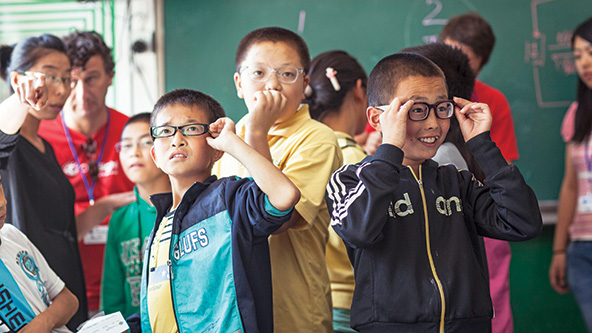 Children diagnosed with myopia try on glasses after receiving a classroom screening through a REAP vision care intervention. (Photo courtesy of Stanford REAP)
“The joke I tell my students is that I put a $100 bill in my printed dissertation volume when I graduated, and when I came back years later to find the volume in the library, the bill was still there—that’s how many people had read my work,” Rozelle quips. “From the outset at REAP we’ve really wanted to make sure our work reaches people. It’s applied research, with an emphasis on the applied.”
Every time REAP finishes a set of evaluations, colleagues in China write a policy brief explaining the nature of the problem and the findings of the research and offering concrete policy recommendations. This brief then goes to the State Council, the highest decision-making body of China’s government. Since REAP launched, the group’s collaborators and affiliates have submitted more than 30 policy briefs to China’s national government. More than 20 of them have been signed by government leaders at the level of premier and vice premier. Once signed, the briefs become part of policy formulation and execution in the relevant ministry, usually (given REAP’s areas of focus) the Ministry of Education or Ministry of Health. REAP also draws on relationships with regional and local partners to effect change at the provincial or county level. The demonstrated success of these local efforts often marks the first steps of a larger policy rollout.
This combination of scientifically robust, solution-driven research and REAP’s active engagement with national, regional, and local partners has led to significant, measurable impact for China’s rural interior.
An early example of REAP’s policy advocacy success centered around school-based nutrition. One of REAP’s first surveys in 2006 revealed that the rates of iron deficiency anemia among rural schoolchildren in China were alarmingly high—around 30 percent. Follow-up surveys over the next few years, eventually encompassing 60,000 primary school students in seven provinces in rural western and central China, confirmed that the debilitating condition was indeed very common. No one knew this condition was still a problem in China, but REAP was able to provide a solution through its research: simple nutritional interventions like multivitamins and iron-rich foods at lunch.
China’s government noted this finding but took an interest only after a crucial connection was established: Students who were brought out of anemia through nutritional interventions also performed much better in school and on standardized tests. Following REAP’s submission of this finding to China’s top leadership, as well as countless meetings with local and provincial education officials, the central government launched a 10-year, $20 billion school nutrition program that continues to deliver daily free lunches to more than 25 million poor students. It is likely the largest school feeding program in the world.
“We really spent a lot of time and energy on that issue in the early days because the research was so clear,” says REAP collaborator Renfu Luo, then a researcher at the Chinese Academy of Agricultural Sciences in Beijing and now a professor at Peking University. “Seeing the policy rollout was huge affirmation—someone was listening!”
Research and Mentorship
REAP projects have a predictable life cycle. Each research project includes months of careful research design, logistical preparation, interviews with local stakeholders, and development of research materials, including piloting all survey forms in real-world settings. REAP then spends hours training teams of volunteers (mostly undergraduates in China’s universities) to undertake the study under the direction of graduate student leaders. REAP chooses a region, obtains a list of all counties in that region, and randomly selects households within those counties; then dozens of student enumerators pile into small vans and drive through mountainous areas, across rivers, and on bad roads, until they reach every family on the list. Because poverty lingers in the places that are hardest to reach, it’s only through this kind of work that it is possible to develop a true understanding of what is happening in rural China today.
At the heart of REAP’s success are long-term and mutually beneficial collaborations between a core team of researchers based at Stanford and several other universities in the United States, Europe, and China. But REAP is also a platform that allows for new connections and dedicated partnerships between field researchers in nearly every province of China, the United States, and Europe.
This collaboration benefits all sides: The world’s best social scientists get the opportunity to bring their theoretical innovations out of the abstract world of academia and test them in the real world alongside experienced field researchers. At the same time, this platform gives young faculty within China the opportunity to work with experts and learn the skills that will help them succeed. Research funds, data, and authorship are all shared between partners.
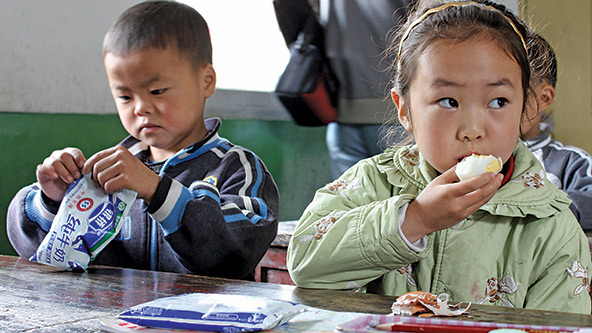 Children eat hard-boiled eggs at school from a pre-packed nutritional meal given through a REAP intervention. (Photo courtesy of Stanford REAP)
Young faculty on REAP’s team are given the opportunity for valuable mentorship. Nearly every research fellow in each of REAP’s China-side partners has been a visiting scholar at Stanford or another US university partner, where they receive guidance in writing papers, the chance to take classes, and mentoring from senior researchers. This partnership has helped the young researchers at REAP to be some of the most widely published scholars in their fields anywhere in the world.
“Since participating in REAP projects, I have recognized the importance and meaning of such research for China’s rural development, and dedicated my life and career to it,” says REAP collaborator Chengfang Liu, who first participated as a master’s student and later went to the United States and finished her PhD at UC Davis. She returned to continue research at the Chinese Academy of Sciences in Beijing and is now a professor in agriculture economics at Peking University.
Young Chinese scholars increasingly participate at conferences hosted by the Agricultural and Applied Economics Association (AAEA), the leading academic association for the field. AAEA members from China have increased more than fourfold, from 11 to 50, over the past 10 years. The number of US-based scholars from China has also almost doubled during the decade. Rozelle has been actively involved and made the group highly visible in the profession.
REAP has cultivated younger students as volunteers. The organization has worked with universities in China to send tens of thousands of students into the field to participate in cutting-edge social science research and to learn how to collect high-quality data. Students who return for multiple projects get the opportunity to lead small teams of other students and develop leadership skills that will serve them well wherever their careers lead.
Seller of Eyeglasses
REAP’s scaling successes do not always take the form of big policy change. Another avenue for innovation was revealed when the group spun off a social enterprise. In 2011, REAP launched a series of studies to document the widespread occurrence of uncorrected myopia that plagued rural schools in China. Earlier research by J-PAL affiliate Paul Glewwe and Albert Park, professor at Hong Kong University of Science and Technology and former PhD student of Rozelle’s, had found high rates of myopia in one small area of northwestern China. REAP partnered with Chinese and American ophthalmologists to better document the issue and explore its implications. They found that from grade three to grade nine, nearly one-third of rural students have poor enough vision to hamper their learning. Unfortunately, a vast majority of these myopic students do not have glasses. Many of them do not even know that they are nearsighted.
In a series of large-scale RCTs, REAP found that when you give nearsighted children glasses, their learning improves immediately and dramatically, and their anxiety around schoolwork falls. In a classroom where all of the students can focus better on learning, even the learning of the nonmyopic students improves.
The seemingly simple solution of screening students’ vision and providing glasses was in fact quite complex, owing to a multitude of factors including limited access to clinicians, cultural norms, parental misconceptions, lack of interagency cooperation, and cost. While China’s leaders have since publicly recognized myopia to be a major problem, there has not yet been a large policy rollout to address it.
In the meantime, though, REAP did not sit on its hands. Over the course of running trials on vision correction, REAP’s team of local collaborators had become adept at arranging for vision care in rural schools. With funding from OneSight, an international vision care nonprofit, the team launched Smart Focus, a new social enterprise that is beginning to fill critical gaps in rural vision care services. It trains teachers to screen children for vision problems in the classroom, fits them for glasses where needed, and charges only what their families can afford to pay.
The enterprise has screened millions of children over the nearly 10 years of its existence and has dispensed more than 200,000 pairs of glasses. Uncorrected myopia is still one of rural China’s biggest challenges, but the issue has received much more attention since REAP began its trials. In 2018, General Secretary Xi Jinping declared myopia to be a national challenge, and since then a high-level government task force has assembled to recommend solutions.
A New Focus on Infants
But not all of REAP’s educational efforts have found equal success. While these early victories stand out, REAP tried other interventions to improve schooling outcomes for struggling rural grade school students—including several forms of teacher training and new teacher pay incentive structures—that were not effective at all. Other interventions helped students somewhat but did not come close to closing the gap with urban peers. REAP also evaluated two of China’s biggest educational programs—the nationwide teacher professional development program and vocational education program—both of which cost billions and are aimed at boosting opportunity for rural children. Neither program was found to have improved learning outcomes for young people.
Why were these ideas and programs failing? A clue came when Reynaldo Martorell, a nutrition expert at Emory University, learned about REAP’s work on anemia. He told the group that improving nutrition among grade school students was good, but the best time to intervene is much earlier in life—during infancy. A lot of the developing brain’s circuitry gets hardwired in the first 1,000 days of life. University of Chicago economist and Nobel laureate James Heckman had shown in multiple longitudinal studies that insufficient nutrition and care in infancy means reduced outcomes for the rest of one’s life.
“That was another aha moment,” Rozelle says. “That’s when we started doing cognition tests among infants. Sure enough, there were the delays. Rural babies were way behind. Forty percent of them were cognitively delayed. You could say they were behind before they even started.”
Through a series of trials, REAP learned that China’s rural infants, though their cognition improved with nutritional interventions, were still lagging far behind their urban peers. Continued research revealed that the problem was even more fundamental: A lack of stimulation among rural infants was leading to cognitive delays that no amount of nutrition could compensate for.
“Rural caregivers love their children as much as anyone, and would give anything to ensure their child could have a good future,” says Qi Jiang, field manager for multiple REAP studies on infant cognition. “But often they are away working in distant cities or simply don’t know that they should sing and talk to their babies.”
Since this seminal finding, REAP has been improving the understanding of early childhood development (ECD) and how to improve ECD outcomes across China. REAP was one of the first to show systematic developmental delays among China’s rural babies and toddlers and to identify contributing factors. REAP has designed, evaluated, and refined interventions that effectively reduce cognitive delays by improving the home language environment—the amount of speaking and social interaction to which infants are exposed in the home—and is now working on integrating a readily scalable health and nutrition initiative with a proven parental training program.
The rollout and progression of the experiments and evaluations followed REAP’s traditional rigor and patience. The team started with an in-home training program run by local medical practitioners. They, in turn, were taught to deliver a curriculum that REAP had borrowed from a successful international program and then adapted to rural China in collaboration with its partners (a child psychologist and pediatrician from two universities in western China). After finding positive impacts on several key early childhood development outcomes, REAP created and evaluated an intervention based at a center to try to overcome some of the shortcomings of the in-home program. Based on their experiences and findings, REAP then began to work with different ECD foundations and NGOs. Together, they have designed and evaluated four additional versions of the parental training program in their search for an optimal design that can be upscaled successfully.
REAP’s work in this area has led to significant policy changes across China. Findings from their ECD work, along with research of other colleagues, were presented to China’s State Council, leading to official assignment of responsibility for the 0-3 age group to China’s Ministry of Health, which issued a document in 2019 to promote building up the 0-3 education system nationwide. Previously, China’s youngest children were considered the exclusive purview of their families and, outside of infant vaccines and other basic medical care, not the focus of any government policies and institutions. After revealing the high rates of developmental delay across China, REAP teamed up with the Executive Leadership Training Center of the National Health Commission (NHC) to develop a comprehensive parental training curriculum that provides parents with a set of interactive activities implemented in stages that are designed to stimulate children’s early development.
The NHC has endorsed this curriculum, and the government has formally adopted it as the official ECD curriculum. Moreover, the sites set up by REAP to deliver the curriculum have been recognized by China’s State Council as national pilot program sites, signaling a long-term government plan for investment and upscaling. REAP is also behind the establishment of the 1,000 Day Initiative, an informal association of hundreds of organizations from governmental to NGOs that are dedicated to applying proven approaches and also finding new solutions to China’s rural ECD challenges.
Who Pays?
Depending on how complicated the intervention and study design are, one of REAP’s impact evaluations can cost $100,000 or more, with line items for travel expenses, contractors, student stipends, data collection tools and technologies, materials, supplies, transportation, participation incentives, and researcher and staff salaries, to name a few. Where does the money come from?
In REAP’s earlier days, a majority of the support came from research grants and corporate social responsibility organizations. But over time, the funding sources have changed. One important factor driving this change is the widespread notion among traditional funders that China—as an upper-middle-income country and the world’s second-largest economy—does not need the money as much as many other places in the world. Since the early 2010s, international research grants that focus on development have largely eschewed projects in China, as have federal grantmaking bodies and bilateral aid agencies. Virtually all big international philanthropies have moved away from giving to causes in China. The country has a robust philanthropy sector itself, but domestic players in this space will not typically fund a research program housed at a wealthy US university.
For the last several years, the majority of REAP financial support has come from a growing circle of individual investors, mainly businesspeople from the United States, mainland China, Hong Kong, Taiwan, and Chinese communities in Singapore that are interested in poverty alleviation in China and the experimental approach. REAP’s Stanford affiliation helps open doors, as does the Stanford alumni network, which includes many graduates with personal, family, or business ties in China who are looking to make a positive change for vulnerable communities. Today, working with these individuals is mostly how REAP makes ends meet.
Politics and Pandemics
The past few years have seen a precipitous decline in diplomatic relations between the United States and China that the COVID-19 pandemic only exacerbated. The developments are cause for concern at REAP, an enterprise wholly dependent on collaboration between researchers in both countries.
The group has been successful in avoiding sensitivities in both countries by continuing to focus on the needs of poor rural children—an issue few find controversial. So far, there has been no significant governmental interruption in REAP’s work.
“REAP tries to stick with issues that don’t raise eyebrows in either the United States or China,” Rozelle says.
The benefits of this work are felt in rural China but also around the world, as it contributes to growing bodies of knowledge about what works in development.
“We’ve been following REAP’s work for years,” says Johan Swinnen, director of the International Food Policy Research Institute (IFPRI) in Washington, DC. “You need teams like this to be trialing new concepts, confirming the findings of other groups, and otherwise enriching the debate on development. Their impact does not stop at China’s borders.”
Meanwhile, the complexity of problems is rising, and the tools and inputs needed to address them continue to span boarders. Leaps in analytical precision that have proven instrumental in pushing the boundaries of knowledge, either by breakthroughs or incremental research, depend on large volumes of data and new mixtures of subject matter expertise that, more often than not, require groups in more than one country to work together.
REAP’s work is emblematic of this trend. The dozens of papers that the group produces, as well as all the impacts on the ground, are simply not possible without collaboration.
“Even one project evaluation involves a whole team of experts, from field managers to data analysts,” Rozelle says. “That is why the author lists of academic papers are getting longer, not shorter.”
Without teams working together, everyone loses.
“The upshot is: If you cut that collaboration short, you are pushing into the future the growth of knowledge that helps improve lives,” Rozelle says. “We’re trying to be an example of how international collaboration, in particular between the United States and China, can be a force multiplier to create knowledge and improve lives. We feel that to limit that progress would be tremendously shortsighted.”
Although REAP has so far navigated the turbulent waters successfully, it could not avoid the limits imposed by the pandemic. In February 2020, when the novel coronavirus was proliferating in China, conducting fieldwork essential to REAP’s success seemed impossible for the foreseeable future. Within a few months, though, China managed to emerge from the pandemic in reasonably good shape, while the problem of rising caseloads shifted to the United States and the rest of the world. Prior to the pandemic, most US-based REAP staff traveled to China four to five times per year to oversee fieldwork, attend conferences, teach, seek opportunities, and refresh collaborations. None of this work seemed possible during the pandemic.
But because China returned to “normal” by summer 2020, REAP was able to maintain its momentum. The group’s collaborators were eager to get back to work. Online conferences became the norm for much professional interaction worldwide. On the basis of trust and shared knowhow, REAP and core collaborators were able to keep working, mostly over Zoom and WeChat, China’s ubiquitous communications platform. In the year since summer 2020, REAP has implemented five major projects in the field and published nearly twice its usual volume of annual papers.
As the United States gradually emerges from the pandemic in the second half of 2021, REAP staff will no doubt seek to return to their frequent in-person travels to China. New and expanded partnerships may depend on it. But considering how things looked a year ago, REAP and its collaborators appear to have landed on their feet.
Expanded Horizons
Having emerged from the pandemic with new staff and multiple projects in the field, REAP is healthy. In fact, it is now a flagship initiative in a new, broader center that Rozelle has set up with his colleague (and onetime PhD student) Hongbin Li, now a senior fellow at the Stanford Institute for Economic Policy Research. The new center is called the Stanford Center on China’s Economy and Institutions (SCCEI, pronounced “sky”) and will be Stanford’s home for data-driven analysis on China.
“Scott and I both knew that the attention to empiricism that REAP is known for has application beyond development problems in rural China,” Li says. “It can inform how we understand China as a whole—the place is too important to have misapprehension dominate the conversation.”
By bringing together faculty across campus that do data-heavy work on China, and serving as a platform to facilitate more similar work, SCCEI hopes to magnify the role that data-driven analysis plays in the debate about China.
While leading the new center is a new challenge, Rozelle still keeps a close eye on progress at REAP. “The good news is, we’ve set up an infrastructure to keep REAP going. The group is in good hands.”
Read more stories by Tianli Feng.