


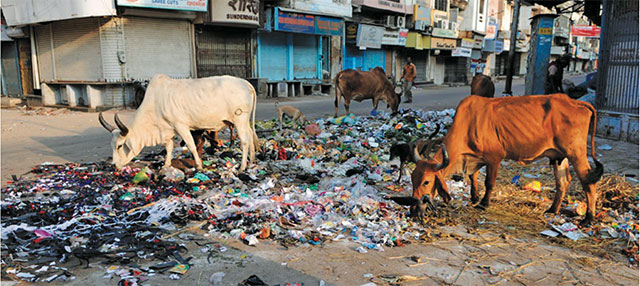
 A street scene in Ahmedabad, India, illustrates the need for ways
to clean up Indian cities. (Photo by Wei Deng)
A street scene in Ahmedabad, India, illustrates the need for ways
to clean up Indian cities. (Photo by Wei Deng)

During childhood trips to India to visit relatives, Dinesh Sonak recalls taking in the sights of “a beautiful, colorful country with roots in spirituality.” Today, mountains of garbage obscure that once-inspiring view. “People think nothing of throwing their trash out of train windows” or dropping litter in the streets of Mumbai or Delhi, says Sonak, who grew up in the Netherlands. (He is half-Indian and half-Dutch.) Waste management systems, he notes, have not kept pace with the needs and habits of more than a billion people: “The country as a whole does not have the infrastructure to extract energy from waste or the culture to inform citizens about their role.”
Sonak sees an opportunity to restore India’s beauty, and to create new economic opportunities, through design thinking. It’s a problem-solving approach more common in Amsterdam where he lives, than on the Indian subcontinent. But Sonak and his colleagues at the Saaf India Foundation, a social enterprise that they formed in 2012, are convinced that Indians are ready for change.
Saaf India was incubated at THNK, also known as the Amsterdam School of Creative Leadership. Sonak, a commercial designer who formerly served as director of partnerships at THNK, helped to develop a curriculum at the school that builds on the work of the Silicon Valley design firm IDEO and the Stanford University Institute of Design (known as the d.school). When Shammy Jacob, a THNK student, suggested tackling India’s solid waste problem, Sonak embraced the idea. (Today, Sonak acts as THNK’s India ambassador.)
To meet the challenge of waste in India, Sonak and Jacob began by focusing on the Indian Railways, a system that carries about 22 million passengers—and their trash—every day. The two men traveled thousands of miles on the rail network in an effort to analyze the problem. “We found that 90 percent of Indians don’t understand the risks of waste,” Sonak says. Other organizations are attempting to solve the waste problem, “but not in a holistic way,” he notes.
Sonak and Jacob are working to develop solutions that are not only design-savvy, but also financially sustainable and socially inclusive. One idea is to create a market for recyclable materials that would engage the legions of ragpickers who ply their trade in India. Other ideas focus on using videos, slogans, and celebrity endorsements to encourage recycling and discourage littering. “How do we integrate ragpickers into the formal economy? How could we bring in a champion cricket player to influence consumer behavior? Solutions have to work for all stakeholders,” Sonak says.
For the current phase of the project, Sonak and team are focusing on large urban train stations. “This allows us to reach practically every Indian, rich or poor, in every corner of the country,” he says. “It’s an ideal scaling platform.” Chhatrapati Shivaji Terminus in Mumbai, for example—a UNESCO World Heritage site (formerly Victoria Terminus)—is one of “the busiest spaces in the city,” Sonak notes. “If we can engage people to clean up the biggest, dirtiest stations, then it should be easy to replicate [that work] in thousands of stations across the country.”
In late 2013, Sonak and his colleagues demonstrated a prototype of its approach during an exhibition for railway executives in New Delhi. “We rebuilt a train coach,” Sonak explains. “A theater group played the roles of ticket inspector, tea vendor, housekeeper, and so on.” Actors modeled practices such as using bags to separate wet and dry waste, and the “ticket inspector” showed how he could use his on-board authority to educate passengers about recycling. About 500 people attended the exhibition, and afterward they made suggestions to improve the prototype.
Railway veterans have been quick to endorse the project. V. K. Raina, a retired general manager of Indian Railways, says the Saaf India team “brings a different skill set and attitude to this problem. They’re using media, design, communication—all things that are not yet common in railway management.”
For Sonak and his colleagues, the next challenge is to recruit financial backers. Raina suggests that the Saaf India team “is one hit away” from achieving its ambitious goals: “They have to convince corporations that this is doable. Once they score a hit, then companies will be lining up to help them.” And not a moment too soon, he adds: “This is something that we desperately need in this country.”
Read more stories by Suzie Boss.