


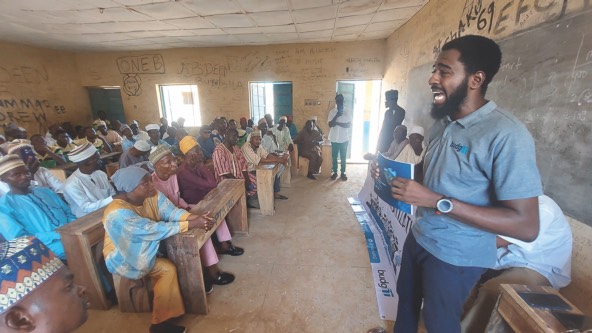
 A Tracka staffer joins a town hall meeting of the Gauraka community in the Tafa Local Government Area of Niger State to report on local budgetary allocations. (Photo courtesy of Tracka)
Nigeria has long been engulfed in corruption since its founding in 1960, when Great Britain orchestrated the joining of two nations—the Northern Nigeria and Southern Nigeria protectorates—to be placed under its colonial rule. The citizens of both nations had no power in the union process or the formation of the new country’s governance system.
Corruption continued into the 1960s with the misuse of public funds and election rigging. Nigeria’s oil boom in the 1970s generated significant wealth, which was notoriously looted by government officials—more than $200 billion was lost to government mismanagement and theft, according to estimates. The transition from military to democratic rule in the 2000s did little to lessen government corruption because it did not include the creation of oversight and regulatory bodies. According to a 2021 Gallup poll, 93 percent of Nigerians believe corruption is widespread throughout government.
In September 2011, entrepreneur Oluseun Onigbinde and product manager Joseph Agunbiade cofounded The BudgIT Foundation, which aims to spur civic engagement by translating dense government documents into digestible pieces of information. The next year they launched Budget Cut, an app that creates greater fiscal transparency by boiling down Nigeria’s federal budget into accessible language for citizens. In 2014, the Omidyar Network granted BudgIT $400,000, which the organization used to create Tracka, a nonprofit similarly dedicated to government transparency and accountability.
Tracka informs citizens about government funding allocated to projects in their communities by summarizing Nigeria’s annual budget in simple terms and outlining the name and amount dedicated to each project. In line with BudgIT’s mission to empower Nigeria’s citizens, Tracka also trains people on how to report on projects in their communities, communicate with their elected representatives, and demand the completion of government projects.
“We want a Nigeria where everyone is aware of their civic duties, they take action, they know what to do, they know where to go, and they hold their elected leaders accountable for the purpose of community development and development at large,” says Ayomide Ladipo, who headed Tracka until January 2025.
Educate to Activate
Tracka operates in 32 of 36 Nigerian states to further two objectives: educate citizens about the Nigerian budget and its allocations and, through this education, activate them to ensure that the government delivers on the services promised to them. Its organizational structure spans the different regions and states in Nigeria, with regional coordinators managing specific geopolitical zones, state officers overseeing the activities of each state, and program officers assisting with administration and communications.
Nigeria’s annual budget runs to roughly 300 pages. The Tracka team distills budget data into visual media for the broadest public accessibility. “We simplify the Nigerian budget into print and digital infographics that can be handy to the community,” explains Moses Motoni, a regional coordinator of Tracka.
With simplified budget materials in hand, Tracka’s state officers travel to their respective states’ local governments—for example, Lagos has 20 local governments that are visited by its one officer—where they share information about the budget and apportioned community projects in public meetings with residents. The sessions are intended to reduce the knowledge gap between government and its citizens and to facilitate meaningful discussions about local development. To further encourage transparency, regional coordinators and state officers educate the community about how government functions, the roles of elected officials, and the significance of public funds.
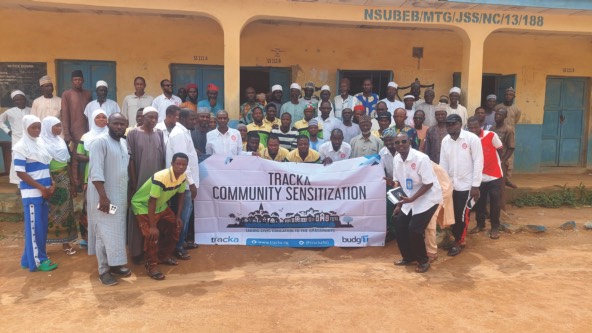 Members of the Gauraka community in the Tafa Local Government Area of Niger State take a group photo. (Photo courtesy of Tracka)
State officers are then responsible for tracking each step of a project’s development, from fund disbursement to quality assessment. The Tracka team shares this information with citizens so that they, too, can keep track of each project, effectively functioning like project managers who, when necessary, follow up with their government representatives to ensure a project’s completion. In Nigeria, statistics show that in most cases projects are either not executed, poorly implemented, or abandoned. In these situations, the state officers also contact government representatives to demand both the status of these community projects and their completion.
The Tracka team explains the accountability process for citizens so that they learn how to communicate with elected officials. The process begins with each state officer conducting a community-needs assessment and then providing the summary of this information to residents so that they are armed with the language they need to petition their representatives.
Thus far, the Tracka team has met three kinds of citizens in the course of their work. “There are ones that are very eager and happy to partner with us,” Ladipo says. Tracka calls these people its community champions, who assist in documenting the progress of government projects and communicating with government representatives. “But we also have the ones that are very distrusting and have no hope that anything can be changed, so they stay on the sidelines,” she adds.
Former head of Tracka Ilevbaoje Imoukhuede, who is credited with scaling the nonprofit between 2014 and 2017, recalls the extent of the government corruption he witnessed while in his role. For example, in 2016, the team discovered that a federal budget provision of 710 million naira ($443,750) for 71 motorized boreholes—narrow holes drilled deep into the ground to access water—for 70 community wards in Kebbi State was never fulfilled. Instead, only one borehole had been drilled—inside the premises of their representative, Kebbi State Senator Bala Ibn Na’allah, to provide him tap water for his personal use. The team learned about this development from community leaders who had written Na’allah requesting an update on the project.
“Following this discovery,” Imoukhuede explains, “Tracka formally demanded accountability from the government. After sustained pressure and follow-ups, the state government intervened, and by late 2017, a public water tap was installed outside the senator’s home, finally granting the community access to the borehole water.”
Ladipo encountered a more nuanced instance of corruption. “One story that brings me both a sense of pride and sadness is about a community in Katsina State,” she says. This community had been struggling with banditry for about seven years, and it also lacked a functional health-care facility. As a result, many children died from malaria because their parents couldn’t risk traveling to another community for treatment due to the threat of ambushes.
When Tracka visited this community in 2020, they were shocked to find that the facility was in ruins—its roof had been blown off, and the entire structure was damaged. “We interviewed community members, listened to their struggles, and then took action,” Ladipo says. “We advocated for them by meeting with elected leaders and writing letters to push for change.”
In 2022, their efforts paid off: The state government renovated the facility, turning it into a fully functional and accessible primary health-care center. “This story stands out to me because it highlights the complexity of Nigeria’s challenges,” Ladipo says. “While the problem of health-care access was addressed, the other major issue—security—remains unresolved. It’s a reminder that change doesn’t happen all at once, but small victories matter. If restoring this facility saves even one or two lives, then the effort was worth it.”
Tracka’s funding comes from donor organizations, including the Gates Foundation, the Ford Foundation, the Marketo Foundation, Luminate Group, and the USC Foundation. The funding covers the team’s salaries, travel expenses, and general operating costs.
Government Partnerships
Tracka’s work to ensure that civil servants do their jobs has evoked resistance from government officials because, Motoni says, “they think we’re performing a witch hunt and fishing for mistakes.”
But some government officials do appreciate their work. Ladipo notes that the Tracka team has meetings with state senators who have expressed their commitment to transparency. “The senators also asked for Tracka’s support in working with NGOs to carry out projects in their constituencies,” she says, specifically asking Tracka to help hold contractors accountable for completing their work.
Tracka remains committed to its goal of creating an ecosystem of active citizens who keep the government transparent and accountable.
Political partisanship is also a challenge. In situations where a community supports a particular political party, citizens are resistant to Tracka’s efforts, perceiving them as attacks on their political leader. Motoni recalls one occasion, after a community meeting, when the community leader told him he was just wasting his time. “They still haven’t executed that project, and nothing has been carried out in the community,” he says.
Additionally, armed conflict and insurgency have made it too dangerous for Tracka to reach certain regions. In these instances, it relies on community champions to educate the citizens and push for government accountability. Tracka believes its community champions are the catalysts for significant, long-term political change. It is currently planning to increase the number of community champions by recruiting and training more volunteer citizens in all states and local governments.
Tracka remains committed to its goal of creating an ecosystem of active citizens who possess the skills and tools to keep the government transparent and accountable. “We want to get Nigerians to realize the power they hold as individuals and as a collective,” Ladipo says. Of Tracka, she adds, “we want to become irrelevant and redundant as an organization, and how we achieve that is when at least 90 percent of the citizens know about governance, are interested in it, and even the ones that are not interested know where to go and who to seek when there’s a problem.”
Read more stories by Edikan Umoh.