


 (Photo by iStock/Eoneren)
Rob Reich has argued that philanthropic foundations have a special role in discovery and experimentation: As society’s “risk capital,” they can afford to enable innovation in ways that companies and governments can’t or won’t. In response to both COVID-19 and to the global call to address racial inequality and exclusion, philanthropy’s unique role will be more important than ever. But are contemporary foundations wired for their purpose?
The weight of the evidence suggests that they are not. Because they often favor “anti-political” practices that unwittingly entrench unequal power relations, foundation officials are only incentivized to recognize certain solutions, to define certain problems as worthy of addressing, and to see only particular entrepreneurs and organizations as worthy of funding. To be transformational, foundations must maximize their own humility, reduce the tendency to plant flags on—and lay claim to—solutions in silos, and shift internal incentives. More practically, they must optimize for hiring diverse, lateral thinkers, writing the first check, and taking unsolicited applications. And across the board, they should bias in favor of lived experience and away from herd behavior.
The Risk Needed to Build a Global Health Reserve Corps for Africa
To understand the challenges of philanthropic foundations, as currently structured, let’s imagine an African entrepreneur who hears Bill Gates’ famous Ted Talk on preparing for the next global health crisis and is inspired to help build a medical reserve corps, deciding that every African country needs their own Anthony Fauci, and a world-class team around them. Our imaginary entrepreneur is aware of the stiff competition for traditional, dollar-in-dollar-out grant funds, so she decides to innovate on the Pay-for-Success model, to unlock affordable loan financing to African public health and the science, technology, engineering, and math (STEM) students to study at leading programs across the world, both online and on campus. Thousands of African students receive offers to these schools but cannot afford to attend, a missed opportunity for students, investors, and countries. It is also a much needed but missed opportunity to diversify college campuses and pipelines from which global workplaces hire.
However, debt investors will simply not lend to these students at scale without better data. While the African continent will soon be home to the fastest-growing number of 18-23-year-olds in the world—who are going to university in increasing rates—their repayment behavior is not yet known. But because debt investors’ priority is to make a return on their investment, they will worry that African students may not be able or willing to make loan repayments. The money will not come from conventional lenders.
Enabling Potential Through Pay-for-Success
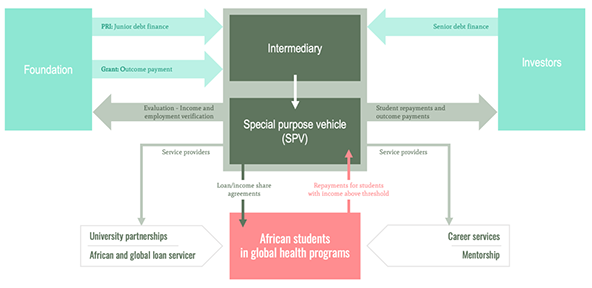
In this scenario, our entrepreneur may decide that foundations are important partners in the short term. She may therefore develop a model through which they can use both their grant and investment capital to remove risk from this market, demonstrate its existence through data, and incentivize additional lending, with positive externalities on both diversity and sustainable development:
In this model, investors are bifurcated. Senior debt is mobilized from private impact investors and banks, conditioned on receiving some downside protection. Our entrepreneur invites foundation mission and program-related investment capital to invest junior debt in a first loss position. She also gets some universities to provide some risk reserve. This de-risking arrangement allows senior debt investors to target their desired return level without passing on the risk premium to the students in the form of a high interest rate.
The outcome payer is also bifurcated. She seeks to raise one part from foundations grants, which can pay for a student’s loan obligations only when, for example, a graduate completes her Hopkins graduate degree and works at the Ministry of Health in Monrovia. (Some US law and business schools already have similar arrangements to incentivize graduates into the public service.) The second part comes from the well-remunerated graduates who choose to work at Novartis or the Gates Foundation, whose loan repayments are income-contingent while targeting a particular rate of return on the debt. These graduates would belong to the upper-middle class of their society.
As in traditional pay-for-success models, the intermediary structures and coordinates the program: partnering with universities that offer target programs, negotiating concessional tuition costs, networking with employers, and critically, managing an SPV for pooled debt. It contracts all service providers needed to run an efficient student financing entity: originators, servicers, and mentors, as well as verify income and employment for the outcome payer, in order to decide the students whose loans convert to grants, and when.
After our entrepreneur pilots a mini-version of the program to demonstrate that the plumbing works, she turns to raising capital in order to lend more and start tracking the data on repayment habits.
She expects foundations to like this approach because it passes three additional tests:
- It has a multiplier effect on grant dollars, the kind of innovative financing that is wired to catalyze, mobilize, and crowd in private and public capital. The number of students educated because of a grant in the form of a contingent outcome payment—that unlocks debt that would be otherwise unavailable—will be 2x to 10x the number that would be educated under traditional philanthropy. (The multiplier depends on how many students stay and work in Pfizer vs how many go into a national health ministry.)
- The model is autonomy-respecting, avoiding the paternalism of telling a Liberian where they must live. It recognizes that in the knowledge economy of a post-pandemic 21st century, problems will have no borders, and so, solutions to our common problems must come from everywhere. Graduates with the lived experience of Monrovia who choose to settle in Zurich or Seattle can still be part of the global health response corps when the next health crisis breaks out because there will be great value in people who understand the dynamics both at global health macro-level and at the country level in Monrovia.
- The model can scale dramatically and can be as useful in South-East Asia and the Caribbean as in Africa. The limit is less how many students can get accepted into the target health and STEM programs, and more how much capital private investors are willing to commit, which, in early days, depends on how much foundations are able to support a genuinely pioneering approach to social change.
Our entrepreneur has done everything she could be asked to do. But she is likely to receive little to no support from foundations. Even plain vanilla pay-for-success programs are relatively new, but the challenge goes beyond a new approach, into broader anti-political practices of many foundations that stand in the way of innovation.
Below are three barriers to innovation that our entrepreneur will encounter, and suggestions on how they might be corrected:
1. Silos and a Lack of Lateral Thinkers
The first meeting our entrepreneur is likely to have is with the education program officer. For an Anthony Fauci in Burundi, Eswatini, and every last country in the world, we need to invest in relevant graduate degrees. But in a typical foundation, the portfolio of international projects tends to focus on primary and secondary education. The very few cases that focus on tertiary education are usually domestic, and the program officer is likely only authorized to commit foundation grants. Thus, even if our entrepreneur gets through the door armed with a warm introduction (more below), she is likely to be tuned out when she talks about grants to be used as contingent outcome payments for students who work in the public sector in low-income countries, or program-related investments to be used as downside protection to train a world-class health workforce. The officer with a great grasp of education and its inequities, will not likely extend to financial innovation or what human capital the health sector might require, and will decide that this is not in his wheelhouse, and point the entrepreneur in the direction of the health team (if there is one).
With few exceptions, foundations do not invest in human capital for health and science. The health team will likely have experience funding the building of innovative gadgets and the planning of meetings about those innovations, but not people who can be shaped to be the future inventors of those gadgets. The few who fund human capital for health might support community health workers, or research on, and hold meetings about the subject of human capital—such as which categories you need or how to measure whether the competencies are met—but they will not provide guarantees to allow investment capital to pay for the master's education of the next world-leading virologist. That is an education issue, but since it would be absurd to send her back to the education team, our entrepreneur will be passed on to the financial inclusion team.
The solution? Foundations need more lateral thinkers. They need diverse people whose real life has exposed them to a multiplicity of disciplines lived experiences. Program officers should be rewarded for identifying collective outcomes that provide ladders to shared prosperity, championing programs that need more than one team, and for uncovering deals that unlock private financing from both inside the foundation and outside it, rather than just for spending down their time-bound budget. A checklist for selecting programs should be to interrogate their biases by weighing heavily the types of programs they would NOT have identified pre-COVID.
2. Herding and Traction
Months later, when our entrepreneur finally gets on the calendar of the financial inclusion team, she will be relieved to find that they are comfortable with the idea of lending. But she will soon discover that financial inclusion only refers to the bottom of the pyramid, for the basket weaver, not for the woman who might one day build a woven basket industry with supply chain to Target and Burberry’s (using her global connections together with her lived experience to create other pathways out of poverty that do not include charity). She will find that financial inclusion teams are comfortable financing organizations that offer micro-credit loans (a ceiling of a few hundred dollars) and those that support small- and medium-sized enterprises, not in unlocking funding for education for Africans, at world-class universities.
As our entrepreneur continues on, she meets the Program Related Investments and Missions Related Investments teams. Her model only requires foundation capital for a few years, until there can be information about the performance of the students so investors will know how to price the risk. And this team, finally, gets it: They know the structures and the vocabulary and have written case studies about how they use their downside protection dollars to incentivize investors into low-income housing. However, they will not have seen a use case of education, for Africans, in tertiary education: They inhabit a world where “world-class education” and “African” do not sit comfortably with their idea of what their capital is for. They struggle with uninterrogated, received wisdom about African brain drain that they might not hold about any other region of the world, wisdom inconsistent with the direction of travel that Africans might want for themselves. They are likely to end her journey with regret that, even if human capital is a cross-cutting enabler, they nonetheless only invest narrowly in areas of existing programmatic grant giving, and since the foundation does not have a grant-giving portfolio for students, their hands are tied.
The few who will entertain her will ask to see traction in the form of a robust loan book, perhaps a couple of million dollars’ worth of lending to this group of students. Never mind the inconvenient data about how many women-led entities raise that level of funding, much less minority women. Or the fact that such a loan book would mean someone else outside the “accountability regimes” of the market or the ballot box—meaning, another philanthropist—would have to have already written that high-risk check; they will still ask. But if every foundation asks the entrepreneur to somehow have already found a million dollars before she knocks on their door, it will only be a matter of time before she exits the Kafkaesque situation and gives up.
The solution? Foundations should clamor to write the first check, and reward staff who uncover deals on which there is no herd. The usual checklist we use to measure traction—how much raised and who from are technocratic and anti-political, reinforce existing structural inequalities, and have no place in justice-supporting philanthropies. Demanding a pilot of significant size only serves to perpetuate the status quo, because the wealth of “friends and family” it takes to make “meaningful” progress possible are not evenly distributed. When we engage in herd behavior, we are saying that entrepreneurs with more grit than privilege and that tend to reside outside existing power structures—which are also racialized—are not valuable sources of innovation. We are making choices about who gets to propose solutions for our problems, and therefore what kinds of problems get made visible and solved.
3. The Need for a 'Warm Introduction'
In many cases, the journey made by our entrepreneur above will not even begin, because she will need to have a warm introduction from a trustee in order even to get through the door. Many foundations do not take unsolicited applications, justifying it as a way of managing their busy inbox. Others see it as a signaling mechanism: If an entrepreneur is good enough, or the problem she’s solving is important enough, she’ll surface.
But we intuitively know that this logic is wrong. It flattens all the structural reasons why the world looks as it does, and while some philanthropists justify herding as beneficial in sharing due diligence, the benefit in saved time is significantly outweighed by the cost in the lack of diversity in the field whose playing ground is historically exclusive, in both investment dollars and in philanthropy. And the inertia of past practice leaves this anti-political gatekeeping tactic intact.
The solution? Foundations should welcome unsolicited applications. They should have the humility to realize that there are worthy problem solvers in networks outside their own. The cost of hiring additional people to scout the field and review the proposals submitted online is worth it in the innovation it will surface. Indeed, the global call to address the exclusion of people of color requires foundations to hire a Chief Gate Opener, a senior official who is different from the majority of the foundation, and whose mandate is to constantly highlight what justice might require for the demographic groups the foundation seeks to serve.
Innovation Matters
By many accounts, foundations are underperforming in the delivery of social pioneering. Foundations should undertake the exercise of following the journey of the entrepreneur and ask themselves: If an opportunity like this knocked on their doors, would they, with their current structures, fund it?
As we work our way through the current crises, few strategies are more valuable than foundations welcoming ideas from outside the box. The guiding principle should be something like this: If a program is completely outside your normal pattern recognition universe, rather messy and hard to pin down in one sector, and if it could, if wildly successful, conceivably lead to diminishing your own importance because it would be taken up by the market or government, then you are on the right track. If, on the other hand, it’s the social equivalent of the next food delivery app presented by a younger version of yourself, your innovation has failed. Stop and reassess.
Read more stories by Lydiah Kemunto Bosire.