


How does going to prison affect one’s chances of finding a job afterward? Much of the sociology literature has focused on the problem of mass incarceration and its connection to racial inequality. But a new study considers the impact of a prison term on a convicted felon’s ability to find work after getting out.
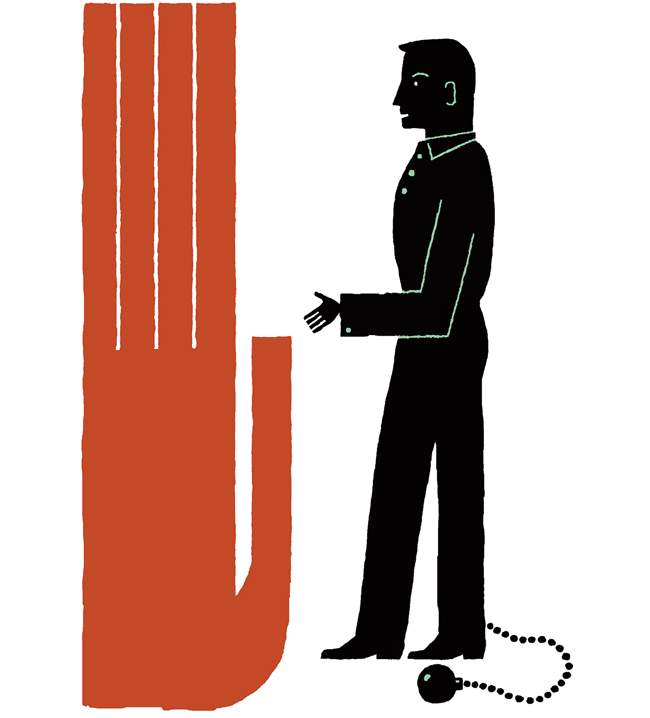
David J. Harding, of the University of California, Berkeley; Jeffrey D. Morenoff and Anh P. Nguyen, of the University of Michigan; and Shawn D. Bushway, of the State University of New York’s University at Albany, have published a new paper that zeroes in on the alleged causal link between incarceration and increased unemployment. They do so by comparing the outcomes of the imprisoned with those of similar people who were convicted of the same crime but sentenced to probation instead.
The researchers found a suitable pool of subjects in Michigan, where those accused of felonies are randomly assigned to judges. Controlling for race and work history, they studied a data set of every person convicted of a felony in the state between 2003 and 2006—a total of some 100,000 individuals—to see how convicts sentenced to prison fared on the job market in comparison with those sentenced to probation.
“The largest and most widespread effects of being sentenced to prison on employment occur through incapacitation, not only from the period of incarceration connected to the initial sentence but also from being returned to prison in the future on a new sentence or parole revocation,” the researchers write. It is precisely by being removed from the labor market that the imprisoned face poorer employment prospects on release.
In particular, the data show that a prison sentence has the most noticeable consequences on those who have a work history before their conviction. (Since a larger percentage of white convicts have a work history than black convicts, this employment pattern is more likely to affect white convicts.) By contrast, those without work experience initially see positive effects after they are released from prison, although those effects dissipate over time.
“Imprisonment is most damaging over the long term for people who had the strongest economic prospects before being convicted of a felony, and it is these individuals who are most at risk of relegation to jobs in the secondary labor market upon release from prison,” the researchers write. The secondary labor market includes jobs with little possibility for upward mobility, such as those with low pay, harsh working conditions, and high turnover.
The paper also calculates the toll that prison time takes on a person’s future job prospects. “During the time that people are in prison, quite a bit of employment is being lost, because you can’t work in the regular labor market while in prison,” Harding says. Depending on one’s race and work history, the dampening of employment prospects ranges from 29 to 41 percent, the study finds.
The research provides support for the idea that alternatives to prison, instead of shorter prison terms, are more likely to change the job outcomes of people with felony convictions, Harding says. Since what’s making it difficult for people to get jobs is their time in prison, further study is needed to determine how to alter the criminal-justice landscape so that they can avoid going to prison in the first place.
Christopher Wildeman, a professor of policy analysis and management at Cornell University, says this study is “one of the most important in the field, since it shows that the lion’s share of the negative effects of imprisonment on labor market outcomes is due not to postrelease dips in earnings but to the incapacitation of earnings that happens during confinement.”
The study is also important because it sparks a data-driven conversation about the results of both criminal convictions and prison time and sheds light on alternatives to conviction, such as drug courts’ diversion programs, says Sarah Lageson, of the Rutgers University-Newark School of Criminal Justice. “You can see the different trajectories that come from what happens in that moment of sentencing,” she says.
David J. Harding, Shawn D. Bushway, Jeffrey D. Morenoff, and Anh P. Nguyen, “Imprisonment and Labor Market Outcomes: Evidence from a Natural Experiment,” American Journal of Sociology, July 2018.
Read more stories by Chana R. Schoenberger.