


 (Illustration by Ben Wiseman)
Power has its perks, and those perks go well beyond the external rewards that powerful people accrue. According to Ana Guinote, program director of experimental psychology at University College London, research shows that the possession of power also brings cognitive and behavioral benefits: People who hold power tend to be more creative, more goaloriented, and better at sticking to a task than people who lack power. “Having power feels better than lacking power, and power holders feel more optimistic, have more elevated selfesteem, and enjoy higher levels of self-confidence than those lower down the social ladder,” says Guinote.
But a different picture emerges when people who are high on a power hierarchy try to work together on boards of directors, executive committees, and other collective bodies. Two scholars from the Haas School of Business at the University of California, Berkeley—Cameron Anderson, associate professor of business, and John Angus Hildreth, a doctoral candidate in organizational behavior—carried out several experiments that explored this scenario. People who hold power, Anderson and Hildreth found, often let their egos get in the way of effective collaboration.
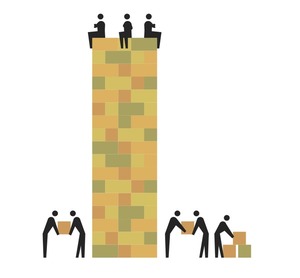
In one experiment, the researchers recruited a set of university students and assigned some of them to positions of power and others to subordinate positions. Participants then engaged in a series of tasks. For the first task, they formed pairs that included one high-power participant and one low-power participant. Each pair had five minutes to build a tower using toothpicks and pieces of Dots candy. For a second task, participants who shared the same power position formed three-person groups and engaged in a creativity exercise that involved inventing a new organization and charting its strategy. With each task, participants were told that the highest-performing group could win a prize worth $100. The researchers found that in the second task, groups that consisted only of high-power people experienced more conflicts, had more difficulty in focusing on the task at hand, and showed less empathy than groups made up of low-power people. Those groups also showed lower levels of creativity, were less likely to share information, and had more difficulty in reaching agreement.
Anderson and Hildreth obtained similar results in experiments that involved groups of actual executives. In one case, 158 managers who were at three different levels of power in a large health-care company worked in small groups along with colleagues at the same power level. Each group conducted a role-playing exercise that required members to collaborate on hiring a chief financial officer for the company. The researchers found that groups of high-power executives had more difficulty in reaching an agreement, were more likely to express conflict over status, and displayed more aggression than groups of executives who were at a low or moderate power level.
Anderson and Hildreth obtained similar results in experiments that involved groups of actual executives. In one case, 158 managers who were at three different levels of power in a large health-care company worked in small groups along with colleagues at the same power level. Each group conducted a role-playing exercise that required members to collaborate on hiring a chief financial officer for the company. The researchers found that groups of high-power executives had more difficulty in reaching an agreement, were more likely to express conflict over status, and displayed more aggression than groups of executives who were at a low or moderate power level.
Although these findings derive from research on business organizations, they are also relevant to the social sector. “It’s quite common for top leaders from nonprofit organizations to get together to come up with solutions to pressing problems,” says Nathanael Fast, assistant professor of management at the University of Southern California Marshall School of Business. In this context, Fast cites research by Robb Willer, professor of sociology at Stanford University. Willer’s work shows that people often gain status-related benefits from taking part in social causes. To the degree that nonprofit leaders become accustomed to enjoying those benefits, therefore, they may have an especially strong urge to compete for status.
Fast offers a couple of (admittedly untested) lessons for leaders who plan to engage in a group project. First, before a group comes together to solve a problem, leaders should encourage group members to do some initial creative work on their own. Second, leaders should identify ways to reduce the status competition that often emerges during group work. “By repeatedly highlighting a superordinate goal, one might be able to increase one’s own—and maybe others’—psychological [capacity] for creativity and effective decision-making,” Fast says. The most important step, he explains, is to shift attention away from “who gets credit for the work.”
John Angus D. Hildreth and Cameron Anderson, “Failure at the Top: How Power Undermines Collaborative Performance,” Journal of Personality and Social Psychology, 110, 2016.
Read more stories by Corey Binns.