

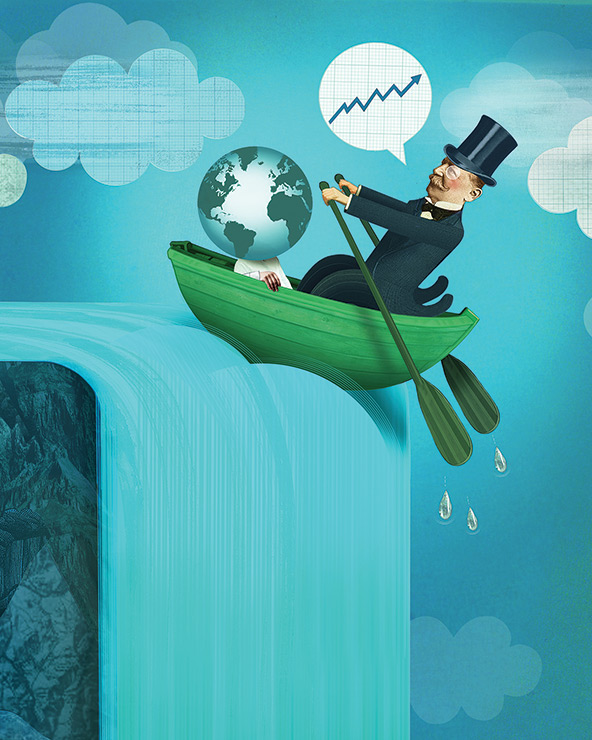
 (Illustration by Carolyn Ridsdale)
Sustainability is the biggest challenge we face. The planet has suffered significant ecological damage and is nearing the point of no return for sustaining life.1 Corporations have helped bring us to the brink. Can they help pull us back?
Firms have voluntarily taken up the existential challenge of sustainability and devoted their massive resources, global reach, and unique capabilities. More than 90 percent of the largest global corporations now avow their environmental responsibility.2 Today, corporate sustainability programs are commonplace, often deeply embedded in corporate structure and culture, and managed by professional senior staff.
So why are we still on the brink and heading over it? Corporations are not solely responsible for keeping the planet on sustainable footing. Governments, after all, exist for a reason. However, corporations have made significant commitments to address our grandest sustainability challenges, and their contributions thus far have proven inadequate. For example, corporate sustainability programs commonly seek to end excessive greenhouse gas emissions, yet during the past three decades, a period corresponding with explosive growth in corporate sustainability programs, more CO2 has been emitted than in the preceding 250 years.3
The mass of corporate sustainability efforts long under way should have produced marked success by now in reversing or at least slowing the course of environmental degradation. Yet, as even CEOs widely acknowledge, corporations are not doing enough to save the planet.4 Something must change. That something is the business case paradigm for corporate sustainability. The rise of this approach has spurred massive growth in corporate sustainability programs. However, the business case biases such programs in ways that severely limit their effectiveness. We must acknowledge and correct this slant before it is too late to sustain the world.
A Record of Failure
Though sustainability is the primary challenge facing the world, overcoming this challenge is not a core focus of most businesses. To the contrary, corporations have blighted the environment in the pursuit of their primary business activities. Corporations are not solely responsible for our unsustainable plight, but their contributions are significant. For example, data from the Climate Accountability Institute show that from 1965 to 2018, the 20 largest oil, gas, and coal companies were responsible for 35 percent of all global fossil fuel-related emissions.
Profit is a powerful motivator that can drive firms to harm people and the planet. But it can also motivate companies to do things that improve our collective welfare and sustainability. Enter the business case for corporate sustainability. Corporations have come to view sustainability as similar to any other business investment. They adopt such initiatives when they can establish a “business case” that portends profit. This approach has naturally led, via the profit motive, to a tremendous growth in corporate sustainability programs. Most of the world’s largest corporations now invest significant resources in a wide range of sustainability programs.
Today, the business case paradigm for corporate sustainability dominates. This trend is evident, for example, in the myriad glossy reports about corporate sustainability that public firms release annually, in which they portray their substantial investments in such programs as “win-wins” for the company and the planet. Government regulators have also supported the business case, encouraging corporations to expand their investments in sustainability. Voluntary self-regulation of corporate behavior is cheaper and easier to implement and enforce, thus proving attractive to governments eager to offload the heavy burden of formal regulation. Corporate sustainability programs have thus thrived as self-regulation has partially supplanted formal government regulation.
Meanwhile, the environment continues to degrade, as tropical deforestation expands massively, oceans become clogged with plastic residuals, soils grow toxic, and countless species die off. Firms’ contributions to many of these growing problems have increased, not declined. For example, emissions from the “carbon major” firms—the companies that have the largest carbon footprints in the world—have increased, even at companies like BP and Shell with widely publicized ambitions to reduce emissions to net zero by 2050. A shocking 98 percent of firms do not achieve their own sustainability goals, according to a 2016 survey by Bain & Company. Overall, corporate sustainability, even as it expands, is proving largely ineffective at offsetting environmental degradation.
Easy Tech-Driven Consumerism
What gives? How can corporate sustainability programs be on the rise while the most substantive aspects of sustainability are on the decline? The profit motive that drives firms to invest in sustainability programs biases the resulting investments in ways that mitigate substantive outcomes. As a result, although the dominant business case paradigm involves greater investment in corporate sustainability, no corresponding rise in positive environmental impact is occurring. Instead, the business case pushes firms to pursue a narrow range of easy wins driven largely by technological innovation, leading to perverse outcomes and rising consumption levels. Let us examine some of its typical features.
Easy wins | In framing sustainability not as an obligation or cost but as an investment, the business case reinforces profit maximization as the prime objective of firms. The pursuit of profit motivates companies to search for greening opportunities, ushering in innovations that would have otherwise gone unrealized. But the realized greening opportunities tend to fall into a narrow range. Under the “win-win” framework of the business case, the environment benefits only if firms are first able to craft a suitably desirable financial gain for themselves.5 Where they perceive ample financial incentive to take on environmental issues and even to pioneer innovative solutions, corporations will pursue green initiatives that enable them to outcompete their rivals.6 But such opportunities materialize only where there is a “market for virtue” that rewards corporations for delivering green products and services to customers.7 As a result, firms address a relatively modest subset of environmental issues—mostly those that increase appeal to high-end consumers. Improvements in the functionality and design of green goods take priority over substantive environmental benefit.
But for many important environmental issues, building a business case is difficult—and in some cases impossible. Most consumers do not recognize direct benefits from buying a product that is, for example, better for biodiversity, so the market for biodiversity-friendly products remains minimal, serving only the small segment of environmentally conscious consumers.8 Major environmental issues, such as ocean pollution, habitat loss, and species extinction, may be devoid of a clear business case and have no viable path toward one, even in the face of rising consumer awareness. Thus, the business case tends to provoke too little corporate action toward resolving many of the most critical environmental issues.
Techno-centric solutions | To make a business case, those who champion a particular sustainability initiative must not only demonstrate adequate market demand but also show how the firm can meet this demand cost-effectively. Fortunately, technological advances abound, and these can help entrepreneurial firms to create environmental opportunities while lowering operating costs, minimizing waste, and reducing input requirements. Whether promoting remote-sensing technology as the solution to illegal logging or switching to hydrogen fuel cell electric vehicles for decarbonizing transportation systems, firms rely heavily on technological breakthroughs to demonstrate their sustainability bona fides.9
Unfortunately, technological innovations are often riddled with unintended consequences that can give rise to new types of environmental problems. For example, while electric vehicles reduce transportation-related carbon footprints, they exacerbate soil toxicity through battery production that involves such “dirty” minerals as cobalt, which also exact severe environmental costs in mining. Similarly, transitioning to renewables from traditional sources of energy requires installation of switchgears in transmission grids. This shift is associated with leakage of sulfur hexafluoride, a gas with much higher global-warming potential than CO2. Another perverse consequence is that windmill blades, built to withstand hurricane-force winds, are hard to recycle and are quickly piling up in landfills.
Even the intended consequences of technology can be harmful to the environment. Existing alongside the many examples of helpful breakthroughs in environmental technology, such as solar panels and electric vehicles, are technologies that increase environmental harm. For example, technological breakthroughs in pulp-and-paper production have allowed firms to profitably harvest vast tracks of boreal forests that were not previously economical to exploit and so remained safely intact.
Moreover, though often seen as quick solutions, technological breakthroughs take time. There can be a major lag between a technological breakthrough and its deployment and mass commercialization. This lag varies across industries and regions, but a 2018 Energy Policy study found that for the energy sector, its typical range is 20 to 70 years. This time frame belies the urgency with which environmental problems must be addressed.
Consumerist at the core | The business case is built on consumer demand for sustainable goods. It cannot pay to be green unless enough people are willing to pay enough to purchase green goods. Fortunately, consumer willingness to pay for green goods is increasing, especially if the products have improved functionality and design. As firms use advancing technology to produce green goods capable of meeting such preferences, green consumerism rises, generating more opportunities for firms to profit from further greening.
Rising green consumerism strengthens business cases, but it is a problematic solution for environmental sustainability. We cannot consume our way to sustainability. The 1992 Rio Earth Summit, which brought corporate sustainability to prominence, identified unsustainable levels of consumption as a fundamental threat to sustainability, yet green consumerism is based on increasing consumption. Even if that consumption is more efficient, rising levels of it do not decrease environmental harm. The positive effects of technological innovations on the environment, specifically in the context of energy efficiency, are often offset by increased consumption. For example, as jet airliners have become more fuel efficient and the price of air travel has decreased, the amount of air travel has increased massively. Proponents of the business case seldom account for the harm associated with this rebound effect, known in environmental economics as the Jevons paradox.
More people are entering the middle class every year in the most populous regions of the world. Within a five-year period (2007 to 2012), the environmental footprint of Chinese households increased by 19 percent, three-fourths of which was due to growing consumption by the urban middle class and rich.10 Globally, within the next decade, middle-class spending is estimated to grow from about $37 trillion in 2017 to $64 trillion by 2030, mostly because of increased consumption in emerging economies, according to a 2020 forecast by the European Commission. The adverse environmental impact of excessive consumption will rise with affluence. Rising green consumerism will not offset this damage, even as it bolsters business cases.
Turning Hype Into Hope
In biasing corporations toward sustainability investments that are predictably profitable, technologically innovative, and consumerist, the business case falls short and has even exacerbated environmental problems. Corporations must redirect the flurry of activity that the business case has motivated to achieve more substantive outcomes. They must account for factors that jeopardize easy wins, do the hard work of collaborating, instead of seeking piecemeal technological solutions, and prioritize sufficiency over growth. Each of these important steps will require government to play a more active role.
Accurately account for environmental impact | Before corporations can better deploy their sustainability programs, they must first be more aware of the programs’ effects on the environment. Firms are good at assessing financial outcomes but bad at accounting for the environmental and social impacts of their actions. Markets have been complicit, often rewarding seemingly good intentions alone by allowing firms to gain financial benefits from their sustainability efforts without clearly demonstrating substantive environmental impact. Thus, in making the business case, firms have had little incentive to bear the risk of closely accounting for their environmental impact. Doing so would only complicate easy wins.
To make a discernible impact, firms must do the hard and risky work of providing clear target measures for their sustainability initiatives and credibly reporting how they are performing relative to those measures. Most established measures assess a firm’s environmental performance in relation either to its own past performance or to that of its industry peers. Such metrics thus take historical environmental performance as the baseline. This anchoring effect perversely rewards poor past performance by allowing firms with historically weak records to appear to make significant environmental progress, given their marginal gains relative to a weak baseline. Moreover, these improvements contribute little to solving the problem at issue. Marginal improvements in emission reductions, for example, can seem impressive, but when firms continue to generate a disproportionate share of greenhouse gas emissions in absolute terms, they exacerbate the problems they claim to be solving.
Companies must set and implement appropriate environmental benchmarks by integrating environmental science into corporate decision-making, not by defaulting to a firm’s historical baseline. Firm-level targets should be connected to systems-level targets through reverse engineering. The Science Based Targets initiative (SBTi)—a partnership of CDP, the United Nations Global Compact, the World Resources Institute, and the World Wide Fund for Nature urging the private sector to fight climate change—is a concrete step in this direction. It specifically demands that companies adopt the Paris Agreement’s target of a no more than 1.5 degrees Celsius global temperature increase to avoid catastrophic tipping points in Earth’s climate system. Thus far, the SBTi has focused on CO2 emissions at the expense of other greenhouse gases and, more notably, has omitted other planetary parameters.11 Still, it is a legitimate starting point for broader conversations about benchmarking corporate sustainability outcomes, because it questions the appropriate anchors for firm-level targets.
When firms do assess environmental outcomes, most of their metrics focus on the firm level. However, emissions are often hidden in supply chains and usage at the consumer end. Corporate supply chains are frequently globally dispersed and operate in such an opaque environment that simply tracing suppliers can be an insurmountable challenge in many industries. The Greenhouse Gas Protocol, an effort by the World Resources Institute and the World Business Council for Sustainable Development to establish a global framework for greenhouse gas emissions, guides firms in assessing and managing all emissions related to their business. The GHG Protocol divides these into three scopes: company-level emissions (scope 1), emissions from purchased electricity (scope 2), and value chain-level emissions (scope 3). Assessments of the third can be complex; many firms that have made net-zero commitments and seem to be concerned with sustainability simply ignore scope 3 emissions.
Government has an essential role to play in moving firms toward accounting for impact. Few firms will assess and report scope 3 emissions in the absence of a binding legal framework. In the United States, the Environmental Protection Agency does not mandate scope 3 emission disclosures, but some US states (e.g., California) and foreign national governments (e.g., the United Kingdom and Germany) have mandated supply-chain disclosure requirements. Such legislation primarily seeks other goals, such as abolishing abusive human treatment, human trafficking, and other human rights violations within supply chains. However, by requiring corporations to identify suppliers, these regulations pave the way for mandatory reporting of scope 3 emissions.
Governments can set common reporting standards for evaluating corporate sustainability programs and their impacts, and thereby enable market participants to be more consistent in rewarding good and punishing bad corporate behaviors. The International Financial Reporting Standards have enhanced market exchange by ensuring that financial statements are consistent, transparent, and comparable around the world. The implementation of an international environmental reporting standard based on science-based targets could do the same.
Collaborate to find solutions | Technological breakthroughs at profit-seeking firms have produced myriad greener goods. But it is foolish to keep our collective fingers crossed in hopes that some firm somewhere will uncover the innovative solution to our major sustainability challenges, such as climate change and the destruction of ecological diversity. Business-case logic guides firms to internalize innovation to retain any revenues. Yet firms cannot solve “super wicked” sustainability problems, as a 2012 paper in Policy Sciences calls them, by acting alone and owning the whole problem, no matter how innovative they may be. Instead, they must collaborate.
Broad collaborations that reach across sectors and stakeholder groups are better at facilitating innovative solutions to complex problems. They give voice to groups underrepresented in conventional corporate sustainability interventions. For example, climatology scientists collaborated with the Inuit to use Qaujimajatuqangit (Inuit traditional knowledge) to explain changes in sea ice conditions, and the Alawa and other Indigenous peoples of northern Australia helped biologists to understand that falcons intentionally carry burning sticks to spread fires in order to increase feeding opportunities. Of course, to be useful in resolving sustainability problems, the insights resulting from such broad collaborations must then be implemented effectively. Here, the biases of the business case become especially problematic.
In sustainability collaborations, firms typically hold veto power in implementing solutions, and they exercise this power for initiatives that fail to meet their business case criteria. This tendency can derail the most substantive and transformative changes, since these are unlikely to be easy wins. Through broad collaboration, firms may recognize that sustainability initiatives that fail to meet their internal bar can produce positive effects beyond the firm’s narrow interests that nevertheless make these initiatives worth implementing. Going beyond easy wins and embracing the challenge of accounting for stakeholders’ concerns and for multiple forms of value creation are critical steps toward cocreating viable solutions.
Firms must develop a heightened dexterity that enables them to assess the degree to which a sustainability initiative can generate not only economic value for the firm but also ecological value for the environment and social value for society. They must commit to discussions that are open and honest about tensions between economic growth at all costs and degradation of the planet. As the world becomes more complex, accountability for anything beyond financial performance can no longer be solely the province of nonprofit or hybrid organizations; firms must also be fully cognizant, collaborative, and responsible partners in solving our toughest sustainability challenges, even absent a traditional business case. Regulatory frameworks will also need to play a primary role in setting priorities and holding all parties accountable, to set the stage for the robust joint efforts necessary to handle our greatest challenges.
Design for degrowth | Growing consumer demand for an expanding supply of greener goods is good. Growing aggregate consumption of limited resources is not. The economic, environmental, and social tolls of a global pandemic, unprecedented worldwide forest fires, heat waves, hurricanes, and a seemingly unending string of other massive disasters have laid bare the unsustainable levels of human consumption. We must bring our consumption-production systems in line with what our planet can bear.
Establishing sustainable consumption-production systems at this late stage will not be easy. Rather than churning out more and more goods, even if they are green, we must instead determine the level of consumption that is sufficient for our optimal well-being12 and design accordingly for degrowth. Moving beyond overconsumption begins with understanding what consumers actually need for a full and happy life and how these needs can be met with much smaller environmental impacts.13
Prioritizing sufficiency over profitability represents a drastic shift from business case thinking and from established practice. This approach completely alters, for example, the classic “4 Ps”—product, price, promotion, and place—that underpin marketing orthodoxy. Under a sufficiency framework, rather than focusing on sales volume, firms would design and manufacture products to be more durable and repairable, as well as tradable in secondhand markets. Pricing includes the full costs of production, distribution, and disposal or recycling. Promotion becomes a tricky balancing act of messaging to promote a given product without promoting its overconsumption. Place decisions, which deal with where to sell products, look beyond traditional sales channels to consider novel experiential settings, such as online stores or product-sharing arrangements.14
Designing for degrowth is a much more complicated proposition than continuing to pursue growth in consumption. Degrowth itself is a difficult concept, referring not just to declines in rates of consumption but also to measures such as GDP growth rates and employee work time. It finds affinity with radical ideologies that favor moving away from capitalism.15 As environmental policy scholar Thomas Princen argues in his 2005 book The Logic of Sufficiency, it may require transformation of the consumption system itself: “Today, with the imperative to translate the self-evident limits of a single planet into the limits of everyday life, the organizing principle might be sufficiency. Such a translation is unlikely, arguably impossible, under the logic of a consumer economy where specialization, large-scale operation, and consumer demand prevail.” However we conceptualize it, degrowth will require political change to occur alongside the development of any degrowth-oriented business models.
Degrowth need not be so radical as to require the overthrow of government to implement it. Rather, as with the prior steps, it requires government to take an active role. For example, if properly designed, take-back laws that make producers responsible for their own waste can motivate firms to design reusable and recyclable products. Tax-break policies for repair can motivate consumers to repair goods and companies to design more repairable products. More such policies are needed to support a collective effort toward sufficiency and degrowth.
Avoiding the Abyss
Overdevelopment has put our planet on unsustainable footing. We face a precarious stage, and we must take drastic steps. In 2015, global leaders, under the auspices of the United Nations, enthusiastically committed to achieve 17 Sustainable Development Goals (SDGs) by 2030. This pledge was the latest in a long line of UN-initiated sustainability efforts, from Rio’s Agenda 21 in 1992 to the Millennium Development Goals in 2000 to the “green economy” of Rio+20 in 2012. Yet again, we assess major public commitments to sustainability many years after they were made, and we find that they fall short. Progress toward most SDGs has been inadequate, especially for those related to climate change and biodiversity conservation.16 UN Secretary-General António Guterres concluded in a 2019 SDG progress report that “an honest and frank reflection on our current direction of travel is necessary.” Greta Thunberg said it more directly and colorfully at Davos in 2019: “Our house is on fire, and it is time to act decisively.”
Corporations are powerful actors. They can make a significant difference in bringing about, or preventing, sustainability. Spurred by our dire straits, corporations have made many grand commitments to sustainability over several decades. Spurred by the business case that currently dominates corporate approaches to sustainability, these commitments have, unfortunately, materialized largely as empty promises that have failed to bring about sustainability and sometimes done more harm than good.
To be fair, corporate sustainability has not been a total failure. Despite falling short, corporate sustainability programs have brought greater societal attention to these critical issues. And, from the perspective of many firms, corporate sustainability has proven very useful. Government regulation can be a blunt instrument that imposes costs on firms and can be difficult for regulators to enforce. Firms are eager to avoid it. Though regulations have curtailed many environmentally destructive industrial practices, corporations have successfully lobbied governments for self-regulation as a substitute for formal regulation. Unfortunately, the flood of corporate sustainability programs has proven more successful at easing environmental regulation than at offsetting environmental degradation.
Better environmental regulation, not greater freedom from it, is required to move corporations to make their critical contributions to cocreating sustainability. Government should step up, not step aside. Prioritizing environmental problems requires corporations to view their actions within interdependent ecosystems. They must develop a more holistic understanding of the production, distribution, and consumption of their products and services so that they can take broader and deeper sustainability actions. These steps would include, according to business scholars Sanjay Sharma and Irene Henriques, “redesign of products and processes to reduce environmental and social impacts, product stewardship, protection of habitats, operation within a region’s environmental carrying capacity, protection of the interests of future generations, as well as the equitable balancing of the interests of all segments of society.” 17
Without effective regulation to untangle corporations from the profit-prioritizing straitjacket of the business case, they tend to target only a narrow range of consumer-facing environmental issues. Even those causes that are amenable to a business case regularly fail to provoke corporate action. The same business case logic that drives corporations to invest in the environment drives them to avoid making economically disadvantageous trade-offs. If, for example, a firm can choose between a project with a large financial return and a small environmental benefit, and one with a small financial return but a large environmental benefit, the business case prioritizes the project with the largest financial return. Both projects are win-win scenarios, but by following a business case rationale, firms typically put economic objectives above environmental objectives.18 Thus, the business case distracts corporate sustainability from the enormity of environmental crises that require more significant actions on a wide range of environmental issues.
The ultimate problem with continued dominance of the business case paradigm is not just that it biases firms to invest in a limited range of activities that fail to adequately address serious sustainability issues. This whirlwind of bounded activity also crowds out more meaningful action, at a time when time is of the essence. Firms fail to use their full range of resources in collaborative ways, and, given the excuse that intervention would blunt voluminous voluntary corporate actions, governments fail to formally intervene in ways critical to success. Thus, the massive growth of corporate sustainability programs under the business case is not benign. It is a cancer. The longer it metastasizes and continues to crowd out healthier interventions, the greater the risk that it will kill our prospects of pulling back from environmental disaster.
Read more stories by Michael L. Barnett, Benjamin Cashore, Irene Henriques, Bryan W. Husted, Rajat Panwar & Jonatan Pinkse.